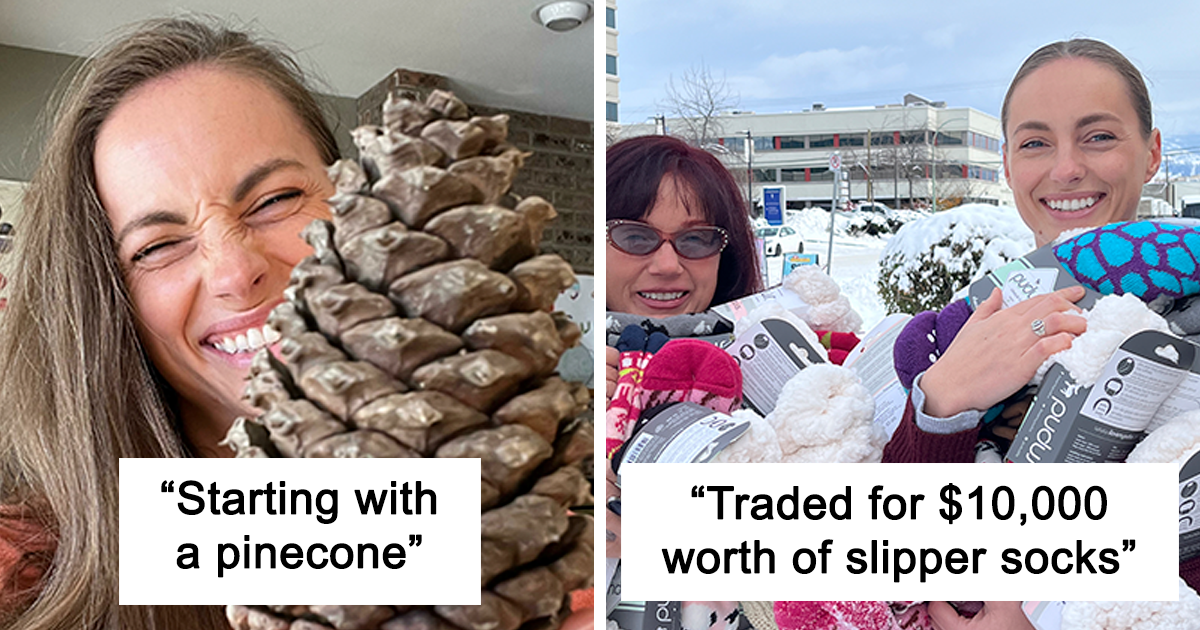
I Challenged Myself To See How Far I Could Get In Trading When Starting With A Pinecone, And Here’s How It Went

Most people look at a pinecone and see yard debris. A squirrel sees groceries. A craft enthusiast sees a future wreath. I saw the opening move in a trade-up challenge that might become something much bigger.
The rules were simple: start with an object that had almost no market value, trade it for something more useful or desirable, and continue swapping upward without buying the next item. No secret investor, no suitcase of cash, and no suspicious uncle who happened to own a yacht. Just creativity, persistence, community participation, and one surprisingly photogenic pinecone.
Eight trades later, the experiment ended with approximately $10,000 worth of warm slipper socks for people experiencing homelessness. Along the way, I discovered that successful bartering is rarely about squeezing every dollar from an object. It is about understanding what people value, telling a compelling story, and giving others a reason to join it.
Why Begin a Trading Challenge With a Pinecone?
The challenge was inspired by the famous “one red paperclip” project, in which Canadian blogger Kyle MacDonald completed a series of trades that eventually led to a house. His adventure turned the childhood game “bigger and better” into a real-world lesson about negotiation, persistence, and the wildly different ways people define value.
I did not have a red paperclip nearby. I did have a pinecone that had come home from my child’s school. It was sturdy, symmetrical, faintly forest-scented, and worth approximately one pinecone. That made it perfect. Because I had almost nothing to lose, I could focus on the experiment: Would people trade for usefulness, curiosity, generosity, publicity, or simply the fun of joining a strange local story?
The Goal Quickly Became a Community Donation
As the challenge gained attention, I connected with a local outreach worker in Kelowna, British Columbia. Winter was approaching, and warm socks were among the practical items needed by people living without stable housing. The project suddenly had a destination. I was no longer asking people to help me collect better stuff; I was inviting them into a chain that could end with something useful.
Trade One: Pinecone to 3D-Printed Dragon
The first trade is usually the hardest because the starting item is intentionally unimpressive. My offer was essentially, “Would you exchange something for this free piece of tree?” Somehow, the answer was yes. The pinecone became a 3D-printed dragonan ideal first upgrade because it was colorful, portable, handmade, and appealing to children, collectors, fantasy fans, and anyone whose desk needed more mythical authority.
Trade Two: Dragon to Fresh Okanagan Fruit
The dragon was exchanged for a basket of handpicked Okanagan fruit. This trade replaced a decorative object with something broadly useful and distinctly local. The basket carried freshness, regional identity, and gift appeal. It also introduced urgency. Fruit has a limited shelf life, so I could not wait three months for the perfect offer while the peaches quietly became a science project.
Trade Three: Fruit to Premium Cleaning Products
The fruit basket became a bundle of high-end cleaning products. It was not as dramatic as a dragon, but practical household supplies have reliable demand. The exchange taught me that useful value can outperform flashy value. Bundling mattered, too: a coordinated set felt more complete and attractive than one lonely spray bottle standing around like it had been separated from its family.
Trade Four: Cleaning Products to Nonalcoholic Drinks
The cleaning supplies were traded for a variety pack of nonalcoholic beverages. By then, the project had something more powerful than a single item: momentum. Participants were no longer judging only what sat in front of them. They were also responding to the trade history, the community goal, and the chance to become part of the next chapter.
Trade Five: Drinks to a Wakeboard and Life Jacket
The beverages became a wakeboard and life jacket, the first substantial leap into higher-value recreational equipment. Geography helped. In a lake-centered region, water-sports gear has an obvious audience. The life jacket also made the offer more complete. Instead of receiving only the fun item, the next trader received equipment that could be used more safely and immediately.
Trade Six: Wakeboard to a $1,000 Jewelry Shopping Spree
The wakeboard package was exchanged for a $1,000 shopping spree at a jewelry store. This was the moment the pinecone developed a résumé. The trade made sense because businesses can value more than the object itself. Community goodwill, social-media exposure, customer attention, and participation in a positive story can all be part of the exchange. The store was not merely buying a wakeboard; it was joining a visible local project.
Trade Seven: Jewelry Credit to a Mountain Getaway
The jewelry credit became a three-night bed-and-breakfast stay with ski passes for Big White Ski Resort. This moved the chain from a product into an experience. Experiences are powerful barter items because their emotional value varies enormously. A jewelry credit may be ideal for one person, while a winter escape may be far more desirable to another. The best trade was not always the item with the largest price tag, but the one offering the most promising next moves.
Trade Eight: The Getaway to $10,000 in Warm Socks
For the final exchange, I shared the project’s purpose: helping local people stay warmer during winter. Pudus traded approximately $10,000 worth of slipper socks for the bed-and-breakfast stay and ski passes. An outreach worker then helped distribute the socks during snowy conditions.
The pinecone did not become a mansion, sports car, or yacht with alarming maintenance costs. It became something immediately useful. The final sequence sounded almost absurdpinecone, dragon, fruit, cleaning products, drinks, wakeboard, jewelry credit, getaway, socksbut every step matched one person’s assets with another person’s priorities.
Why the Pinecone Trading Challenge Worked
Value Was Personal, Not Fixed
Each participant valued something different. Some wanted the item. Some liked the cause. Others appreciated the visibility or simply wanted to join an entertaining experiment. A successful barter does not require two items to have identical retail prices. It requires both people to prefer what they are receiving over what they are giving up.
The Story Became an Asset
After several trades, the chain itself gained value. Photographs, updates, and a transparent record gave future traders confidence that the project was real. Participants were not merely acquiring an object; they were adding their name or business to a story people wanted to follow and share.
The Purpose Encouraged Generosity
A charitable goal changed the tone from “How much can I get?” to “What can we create together?” That did not eliminate negotiation, but it expanded what each side could gain. Businesses could contribute goods or experiences, receive positive community attention, and help produce a practical donation.
Rejection Became Part of the Process
Not every message led to a trade. Some people were uninterested, unavailable, or understandably suspicious of pinecone-based economics. Each rejection simply narrowed the search. With every successful swap, I had a stronger item, clearer proof, and more confidence approaching the next person.
How to Start Your Own Trade-Up Challenge
Begin with something legal, safe, portable, and easy to photograph. State your rules clearly, including whether money, shipping, sponsorships, or trades with friends are allowed. Keep messages, dates, estimated values, and photographs so the project remains credible.
Choose items for tradeability, not just estimated price. A rare collectible may be valuable but difficult to match with the right person. Gift certificates, useful bundles, popular equipment, and local experiences often attract a wider range of offers. When meeting strangers, use safe public locations, inspect items, protect personal information, and watch for online marketplace scams.
U.S. participants should also remember that barter transactions can have tax consequences, especially when connected to business activity. Keep records and consult appropriate tax guidance rather than assuming that “no cash changed hands” means “nothing happened.”
Finally, give the challenge a meaningful destination. “Bigger and better” is entertaining. “Bigger and better for a reason” gives people a stronger reason to participate.
500 More Words of Personal Experience: What the Challenge Actually Felt Like
The public version of a trade-up challenge looks wonderfully smooth. Item A becomes item B, a cheerful photograph appears, and the next offer arrives as though the universe operates a customer-service desk for whimsical projects. The lived experience was messier.
There were pauses when nothing happened. I would post an item, refresh my messages, and discover that the internet had collectively chosen to care about something else. During those quiet stretches, doubt appeared with impressive punctuality. Maybe the previous swap had been the peak. Maybe I had reached the natural economic ceiling of cleaning products. Maybe I was about to become the permanent owner of twelve beverages in flavors I could not pronounce.
I learned to improve the pitch without overselling the item. Honesty mattered. I described what was available, explained where it came from, and shared the community goal. I did not pretend each offer was a guaranteed financial bargain. Instead, I emphasized the experience: join the chain, receive something you value, and help move the challenge toward a useful donation.
The most surprising part was how often people responded to enthusiasm. Energy is not a substitute for value, but it helps others imagine the next step. When I treated the challenge like a shared puzzle rather than a transaction I had to win, conversations became more creative. Someone who did not want the current item might know a friend, neighbor, or local business that did.
I also became aware of the invisible labor behind every exchange. Each trade required photographs, messages, scheduling, transportation, follow-ups, and judgment. A more expensive item was not automatically better if it was enormous, fragile, difficult to verify, or located six hours away. A free grand piano sounds impressive until you remember that grand pianos are furniture with the transportation demands of royalty.
The wakeboard felt like a turning point because the project suddenly held an item with obvious recreational appeal. The jewelry shopping spree felt almost unreal. Yet even then, progress depended on finding one person whose priorities matched the current offer. Estimated value helped, but fit mattered more.
The final trade changed the emotional weight of the entire experiment. Until then, every object was temporary. I could not become attached because each item had to leave. The socks were different. They represented completion, usefulness, and the combined goodwill of everyone who had participated.
Seeing the donation move through an outreach worker made the project feel less like a social-media stunt and more like a small community system. One person contributed creativity. Another offered produce. Businesses supplied goods, experiences, and attention. The outreach worker provided local knowledge and distribution. The outcome depended on relationships, not magic.
I finished with greater respect for negotiation and a broader definition of it. Negotiation was not aggressive haggling under fluorescent lights. It was listening, matching needs, explaining possibilities, accepting rejection, and making it easy for someone to say yes for reasons that mattered to them.
The pinecone never became valuable in the normal sense. Its contribution was making the first question possible. Once the question was asked, people supplied the value. Ambitious projects do not always begin with impressive resources. Sometimes they begin with an ordinary object, a useful purpose, and enough nerve to ask, “Would you trade me something for this?”