This Single Dad Adopted A Baby Girl With Down Syndrome Who Was Rejected By 20 Families

Some families begin with a carefully color-coded plan. Others begin with a telephone call, a newborn waiting in a hospital, and a mto changeincluding his relationship with uninterrupted sleep.
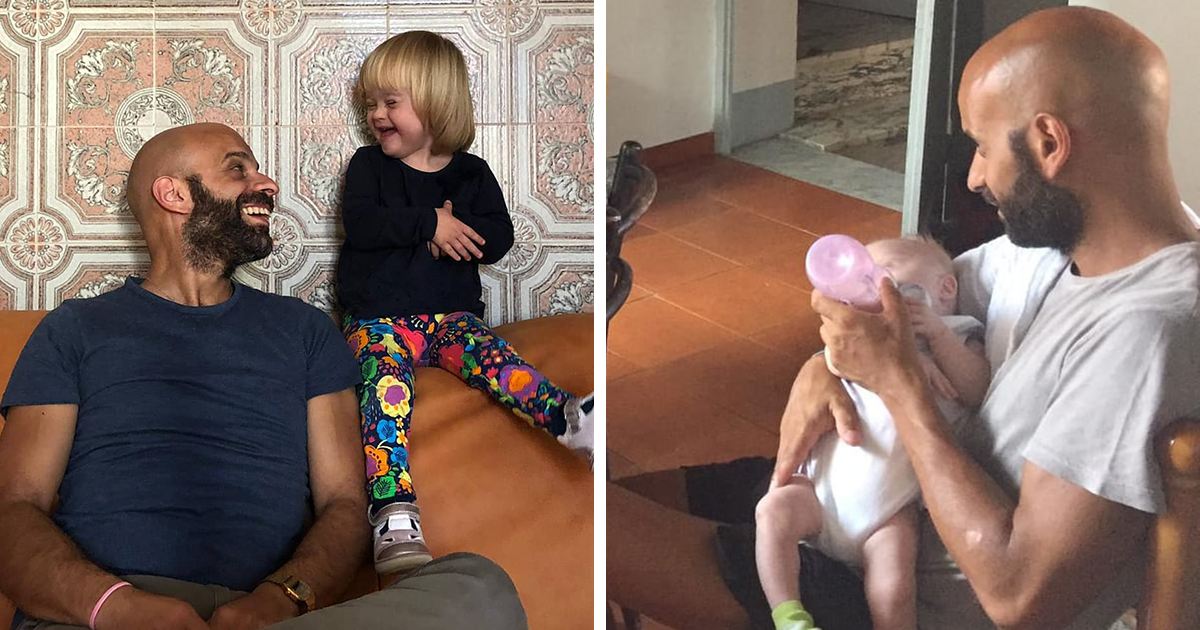
In 2017, Italian social worker and disability advocate Luca Trapanese became the father of Alba, a baby girl born with Down syndrome. Public accounts report that approximately 20 prospective families had declined to adopt her before Luca was considered. While Italian adoption rules made placement with a single applicant unusually difficult, Luca’s experience supporting people with disabilities helped demonstrate that he was prepared for the responsibility. story quickly traveled far beyond Naples because it challenged two stubborn assumptions at once: that a single man could not provide a complete family and that a child with Down syndrome would be defined primarily by medical challenges. Luca and Alba showed something far simpler. A family is created through daily care, commitment, patience, and a heroic tolerance for toys that make noise without an obvious off switch.
The Phone Call That Changed Two Lives
Luca had wanted to become a father for years. He had also been realistic about the obstacles facing a single applicant in Italy. According to interviews and profiles about the adoption, he indicated that he was willing to care for a child with significant medical, developmental, or behavioral needs.
Then he learned about Alba.
She was still a newborn and needed a permanent home. Her Down syndrome diagnosis had made prospective parents hesitant, but it did not frighten Luca. He understood that parenting a child with a disability could require medical appointments, therapy, advocacy, financial planning, and flexibility. He also understood that a diagnosis is not a personality.
When he met Alba, he did not see a chromosome chart wearing a tiny hat. He saw his daughter.
That distinction matters. Public discussions about disability often begin with lists of possible complications and end before anyone mentions laughter, stubbornness, friendships, favorite songs, embarrassing dance moves, or the intense toddler belief that bedtime is an unconstitutional government policy.
Why Luca Was More Prepared Than the Headlines Suggest
Years of Experience Came Before the Adoption
The story is sometimes presented as though Luca simply woke up one morning, felt unusually brave, and adopted a child with Down syndrome before lunch. The reality was more grounded.
He had volunteered and worked with people with disabilities since his teenage years. He later helped establish services supporting individuals with disabilities and their families. This background did not make parenting effortlessnothing doesbut it gave him practical knowledge about developmental differences, community support, therapy, caregiving, and the importance of treating disabled people with dignity. ation is one of the most important parts of any special-needs adoption. Love is essential, but love benefits from a pediatrician, a reliable support network, health insurance, emergency contacts, and somebody who can babysit without panicking when handed a page of instructions.
He Did Not View Alba as a Charity Project
Luca’s decision was not simply an act of rescue. That framing may sound inspiring, but it can unintentionally reduce an adopted child to a symbol of someone else’s goodness.
Alba was not adopted so that Luca could become an internet hero. She was adopted because she needed a parent and he wanted to become one. He accepted the ordinary and extraordinary responsibilities of fatherhood: comforting her, protecting her, learning what made her laugh, attending appointments, celebrating milestones, losing socks, buying more socks, and eventually discovering that the socks were inside a toy kitchen.
What “Rejected by 20 Families” Really Means
The number in the headline is painful because it reveals how strongly fear can influence adoption decisions. Prospective parents may worry about medical costs, developmental delays, long-term caregiving, limited community resources, or whether they are emotionally prepared.
Those concerns should not automatically be dismissed as cruelty. Adoption professionals need honest assessments, not performances of instant confidence. A family that recognizes it cannot meet a child’s needs may be making a responsible decision. The deeper problem appears when decisions are driven by outdated stereotypes rather than accurate information.
It is also important not to describe Alba’s birth family carelessly. Choosing an adoption plan may involve circumstances the public does not know. Relinquishment should not automatically be interpreted as an absence of love. Ethical storytelling leaves room for privacy, complexity, grief, and decisions made under intense pressure.
In the United States, organizations dedicated to Down syndrome adoption report that approved families are actively interested in adopting children with the condition. Research involving prospective adoptive parents has also found applicants who felt prepared to raise children with Down syndrome and, in some cases, waited years for a placement. er words, Alba’s experience should not be interpreted as proof that nobody wants children with Down syndrome. It shows how greatly outcomes can depend on local laws, available information, professional networks, and whether the right family can be found at the right moment.
Understanding Down Syndrome Beyond the Diagnosis
Down syndrome, also called trisomy 21, is a genetic condition caused by an extra copy or portion of chromosome 21. It can affect physical development, learning, and health, but its effects vary considerably from person to person. Intellectual disability is commonly mild to moderate, and no checklist can predict an individual child’s complete future. hildren have congenital heart defects, hearing or vision differences, low muscle tone, thyroid conditions, sleep apnea, or other health concerns. Regular medical screening helps identify issues early. The American Academy of Pediatrics publishes age-based health supervision guidance covering medical care from infancy through adolescence. intervention services may include speech therapy, occupational therapy, physical therapy, and family-centered developmental support. These services are not attempts to make a child “normal.” They are tools that help each child communicate, move, learn, and participate as fully as possible.
Medical care and social inclusion have transformed expected outcomes. Many people with Down syndrome now attend neighborhood schools, play sports, hold jobs, build relationships, advocate for themselves, and live well into adulthood. Average life expectancy has increased dramatically and is now commonly described as approximately 60 years, although individual health outcomes vary. st useful question is therefore not, “What can people with Down syndrome never do?” It is, “What support will this particular person need to pursue a meaningful life?”
Special-Needs Adoption Requires More Than Inspiration
Luca and Alba’s story is uplifting, but it should not be used as a glossy commercial suggesting that determination solves every difficulty. Families adopting children with medical or developmental needs should enter the process with open hearts and open spreadsheets.
Medical Planning
Prospective parents should learn which specialists may be needed, what local hospitals can provide, how frequently screenings occur, and which expenses may not be fully covered. A primary-care pediatrician who understands Down syndrome guidelines can coordinate cardiology, audiology, ophthalmology, sleep, thyroid, developmental, and other services when appropriate.
Developmental Support
Early intervention can help families understand how their child learns. In the United States, eligible children younger than age three may receive support through state-administered early-intervention programs, followed by school-based services and an Individualized Education Program when appropriate. cial and Post-Adoption Resources
Some adopted children qualify for medical coverage, subsidies, therapy funding, respite services, or other forms of assistance. Eligibility varies by jurisdiction, so families should clarify available benefits before finalization rather than discovering afterward that bureaucracy has once again hidden the important form underneath fourteen less important forms. l Support Network
A support network is not a social-media comment section filled with heart emojis. It is the person who drives to a medical appointment, brings dinner after a difficult week, learns the child’s communication style, provides dependable respite care, or listens without turning every frustration into an inspirational speech.
Single parents especially need practical backup. Luca may be the only parent in his household, but successful single parenting is rarely a solo performance. Friends, relatives, clinicians, teachers, other parents, and community organizations can become part of a wider circle of care.
How Luca and Alba Challenged Two Different Stereotypes
The adoption disrupted conventional ideas about both disability and fatherhood.
Single fathers are often treated as though they are temporary substitutes waiting for a mother to arrive with snacks and superior knowledge of laundry settings. Luca’s story demonstrates that nurturing, patience, organization, and emotional availability do not belong to one gender or one family structure.
At the same time, Alba’s life pushes back against the belief that disability automatically produces tragedy. Down syndrome can bring genuine medical and developmental challenges. Acknowledging joy does not require denying those realities. Likewise, acknowledging challenges does not require imagining that a child’s life is destined to be unhappy.
Advocacy organizations emphasize that Down syndrome is only one aspect of a person’s identity. People with Down syndrome have different talents, needs, opinions, temperaments, and ambitions. Some are outgoing. Some are quiet. Some love sports. Some would rather negotiate international peace than participate in gym class. That last category includes plenty of people without disabilities too.
What Viral Retellings Often Get Wrong
Stories like Luca and Alba’s are frequently compressed into a familiar formula: unwanted child, heroic parent, perfect ending. The formula is emotionally powerful, but real family life is more interesting than that.
Alba should not be defined forever as the baby whom others declined to adopt. Luca should not have to perform sainthood every time he packs a lunch or attends a school meeting. Their relationship deserves to be understood as a family, not merely as a viral before-and-after photograph.
Responsible storytelling also avoids describing people with Down syndrome as permanently cheerful angels. Positive stereotypes are still stereotypes. People with Down syndrome experience the full range of human emotions and personalities. They can be joyful, bored, ambitious, annoyed, affectionate, anxious, funny, independent, or furious because someone served peas.
The strongest lesson is not that one unusually generous man saved one unusually vulnerable baby. It is that accurate information, inclusive laws, qualified support, and open-minded families can create opportunities that prejudice would otherwise close.
A Love Story Built Through Ordinary Days
The adoption became international news because the circumstances were unusual. The relationship became meaningful through ordinary repetition.
Parenthood is built through bottles, baths, medical checkups, bedtime routines, first steps, school decisions, minor disasters, major celebrations, and thousands of conversations nobody else hears. It is choosing the child again each morning, including mornings when the child has placed breakfast somewhere breakfast was never designed to go.
Luca’s preparation allowed him to recognize possibility where others saw uncertainty. Alba, meanwhile, became much more than the subject of a dramatic headline. She became a daughter with her own preferences, strengths, challenges, and future.
Their family does not prove that raising a child with Down syndrome is simple. It proves that difficulty and happiness can exist in the same homeand frequently do. That is not a special-needs lesson. That is family life.
Experiences and Practical Lessons for Families on a Similar Journey
Families considering special-needs adoption often describe the beginning as a mixture of excitement, paperwork, education, and nerves. The most useful approach is to replace vague fear with specific questions. Instead of wondering whether everything will be overwhelming, ask which appointments are likely during the first year, which therapies are available locally, who can provide respite care, and how work schedules will accommodate medical needs.
Learn About the Child, Not Only the Condition
A diagnosis provides useful medical information, but it cannot tell parents which song will stop a crying spell, whether the child will love animals, or why one particular spoon is apparently acceptable while every other spoon is an insult.
Experienced caregivers often find that confidence grows through observation. They learn how the child communicates discomfort, what helps with transitions, when stimulation becomes overwhelming, and which activities encourage engagement. This knowledge is acquired through daily life, not downloaded instantly during an adoption seminar.
Create a Care Binder Before It Is Needed
A practical family may keep medical reports, insurance information, therapy notes, medication lists, emergency contacts, adoption documents, and developmental records in one secure location. Digital copies can also be useful. The goal is not to turn childhood into a corporate filing system. It is to avoid searching three kitchen drawers for a cardiology report five minutes before an appointment.
Expect Progress to Follow an Individual Timeline
Developmental milestones are useful guides, but children with Down syndrome may reach them at different ages. Comparing one child constantly with siblings, classmates, or carefully edited social-media videos can create unnecessary anxiety.
Progress may appear in small steps: stronger head control, a new sign, clearer speech, greater independence during meals, or the first successful attempt to put on a jacket. Celebrating these moments does not mean lowering expectations. It means noticing the work required to achieve them.
Protect the Child’s Privacy
Families may receive public attention or feel motivated to raise awareness. Sharing can build community, but children cannot fully understand the permanent consequences of an online identity created during infancy.
Parents can advocate without publishing every medical crisis, behavioral struggle, or vulnerable photograph. A useful rule is to ask whether the child might feel respected when encountering the post years later. Awareness should never require surrendering dignity.
Let Other People Help Properly
Friends and relatives may want to help but have no idea what to do. Specific requests work better than general offers. Ask someone to prepare a meal, attend a training session, watch siblings, make phone calls, or provide transportation.
Supporters should also learn to interact directly with the child rather than speaking only to the parent. Inclusion starts with ordinary habits: greeting the child, allowing time for a response, offering meaningful choices, and assuming competence without ignoring legitimate support needs.
Prepare for Joy Without Demanding Constant Inspiration
A child with Down syndrome does not exist to teach everyone else about gratitude. Families are allowed to have boring Tuesdays, stressful appointments, bad moods, unfinished laundry, and cereal for dinner. They are also allowed to experience pride, humor, connection, and delight without presenting those moments as miracles.
Luca and Alba’s story resonates because it began with an uncommon adoption. Its lasting value comes from a common truth: children flourish when adults combine affection with preparation, expectations with patience, and protection with opportunities to grow.
Twenty families may have looked at Alba’s diagnosis and imagined only uncertainty. Luca looked at the child in front of him and imagined a life together. The years that followed were not created by one dramatic decision alone. They were created through thousands of smaller decisionsthe ordinary, demanding, beautiful work of being a dad.
Editorial note: This article is based on publicly reported details about Luca Trapanese and Alba and on medical, developmental, inclusion, and adoption guidance from ABC News, Good Morning America, the Centers for Disease Control and Prevention, the National Institutes of Health, the American Academy of Pediatrics, HealthyChildren.org, the National Down Syndrome Society, the Global Down Syndrome Foundation, the National Council for Adoption, the National Down Syndrome Adoption Network, Special Olympics, Child Welfare Information Gateway, and peer-reviewed medical research. e>