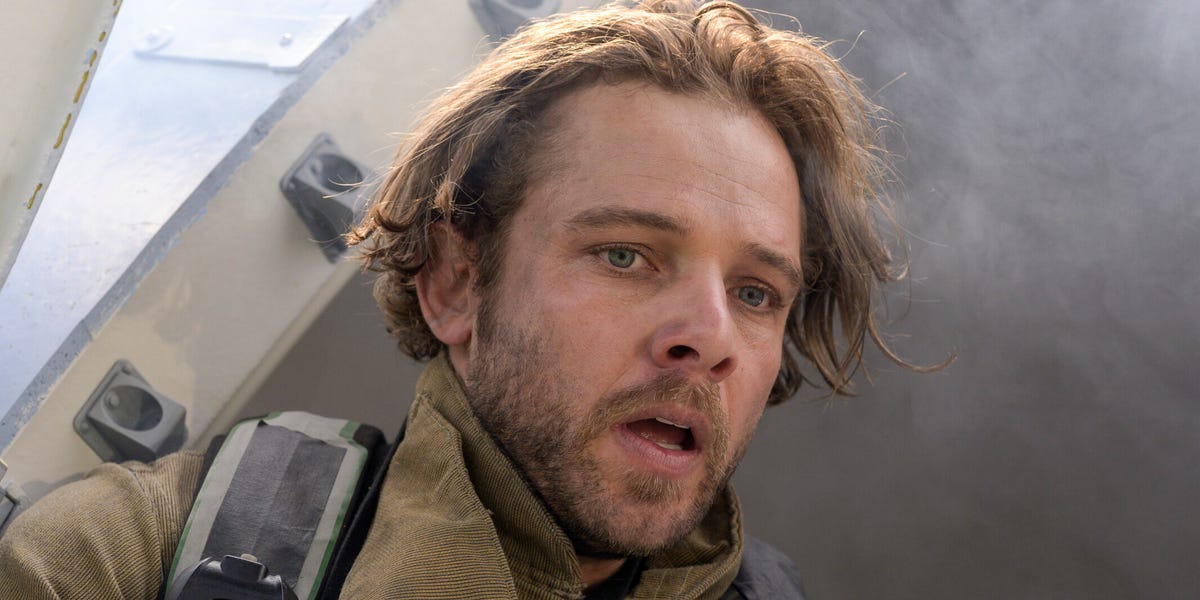

Max Thieriot spends much of Fire Country running toward burning buildings, navigating emotional disasters and carrying enough family baggage to fill an entire fire engine. Yet when he was asked which cast member he would not trust with a fire extinguisher, the actor did not need an emergency-response briefing before answering.
His choice was Kevin Alejandro, the actor who plays Manny Perez.
Before anyone alerts human resources, calls Station 42 or removes Alejandro from the office safety committee, Thieriot’s accusation was entirely playful. The joke revealed something fans do not always get to see beneath the CBS drama’s smoke, heartbreak and high-stakes rescues: the cast apparently has a mischievous streak when the cameras stop rolling.
Why Max Thieriot Says Kevin Alejandro Can’t Be Trusted
During an April 2025 appearance connected to Good Housekeeping’s lighthearted Sheet Happens video series, Thieriot folded laundry while answering questions about his Fire Country co-stars. One question asked which cast member he would hesitate to trust with a fire extinguisher.
Thieriot quickly identified Alejandro, explaining that his co-star is playful, enjoys practical jokes and is sometimes willing to push a joke farther than expected. In Thieriot’s imagination, Alejandro would not simply keep the extinguisher nearby in case of an emergency. He might pull the pin and empty the entire thing on a castmate just because the opportunity was too funny to resist.
“Kevin Alejandro, because Kevin is silly,” Thieriot said while describing his choice.
The comment was not criticism of Alejandro’s judgment or professionalism. It was affectionate teasing between colleagues who have worked together since the beginning of the series. Thieriot even admitted that he might do the same thing to Alejandro, meaning neither actor should probably be left alone near emergency equipment during lunch.
That final admission changed the joke from a one-sided warning into a glimpse of their friendship. Thieriot was not accusing Alejandro of being the only prankster on set. He was essentially confessing that the two men could become equally dangerous once a harmless joke presented itself.
Kevin Alejandro Is the Perfect Target for the Joke
He Brings Warmth and Humor to a Serious Character
On Fire Country, Alejandro portrays Manuel “Manny” Perez, an experienced firefighter and leader whose personal life is almost as complicated as the emergencies surrounding him. Manny has served as a mentor, captain, father and source of emotional support, although his own mistakes have repeatedly tested his resilience.
The character carries substantial dramatic weight. Manny’s relationship with his daughter Gabriela has included arguments, separation, sacrifice and reconciliation. His professional journey has also involved setbacks that forced him to confront pride, responsibility and the consequences of his decisions.
Because Manny often operates as one of the show’s grounded adult figures, hearing that Alejandro is a boundary-pushing joker creates an entertaining contrast. Manny might carefully review safety procedures. Alejandro, according to Thieriot’s joke, might review the same procedures and wonder which paragraph specifically prohibits surprising a co-star with a cloud of fire-extinguisher powder.
Alejandro Also Works Behind the Camera
Alejandro’s contributions to the franchise extend beyond acting. He has directed multiple episodes of Fire Country, including installments featuring complicated action sequences and emotionally demanding performances. Directing a network drama requires preparation, communication and the ability to coordinate a large production team under significant time pressure.
That professional responsibility makes Thieriot’s remark even funnier. Alejandro clearly can be trusted with actors, cameras, visual effects, stunt planning and expensive television production schedules. Apparently, the one object that creates uncertainty is a portable fire extinguisher.
His directing experience also suggests that the playful energy exists alongside a serious commitment to the show. The strongest sets often contain both qualities: intense concentration when a scene is being created and enough humor between takes to keep demanding work from becoming emotionally exhausting.
What the Joke Reveals About the ‘Fire Country’ Cast
Television viewers usually encounter the cast of Fire Country during emergencies. Characters shout instructions over sirens, carry injured people through dangerous terrain and make life-changing decisions while flames move closer. Behind-the-scenes conversations offer a very different picture.
Thieriot’s answer suggests that the actors have developed the kind of familiarity that allows them to tease one another without the humor feeling forced. They have spent years filming in protective equipment, working through long production days and performing scenes that demand considerable physical and emotional energy.
Shared humor can become a release valve in that environment. A joke between colleagues does not erase the difficulty of the work, but it can make a complicated day feel manageable. It also helps explain why the relationships on screen often feel lived-in. Actors who are comfortable together can communicate through small expressions, pauses and reactions that would be difficult to manufacture mechanically.
Thieriot and Alejandro’s off-screen rapport complements the history between Bode Leone and Manny Perez. Their characters have experienced conflict, disappointment and mutual respect. Manny has frequently recognized Bode’s potential while also challenging his impulsive behavior. Bode, meanwhile, has not always accepted Manny’s guidance quietly. “Quietly,” in Bode’s case, is often a limited-edition feature.
That combination of tension and affection gives their scenes energy. Viewers can believe the characters are frustrated with one another while still understanding that a deeper bond exists underneath the disagreement.
Max Thieriot’s Expanding Role in the ‘Fire Country’ Universe
Thieriot is not simply the leading actor who plays Bode. He co-created Fire Country with Tony Phelan and Joan Rater, serves as an executive producer and has directed episodes of the series. The drama was inspired partly by his upbringing in Northern California, where wildfire risk, emergency crews and small-town connections are familiar parts of community life.
The fictional town of Edgewater reflects that background. It is a place where professional emergencies and personal histories constantly overlap. A firefighter responding to a call may know the property owner, the victim, the suspect and three people who dated the victim in high school. Privacy in Edgewater is less a right than an ambitious theory.
Thieriot’s responsibilities require him to balance performance with broader creative decisions about tone, character development and the direction of the franchise. The success of the original drama also led to Sheriff Country, an expansion starring Morena Baccarin as Mickey Fox.
As of August 2026, CBS has scheduled Fire Country Season 5 to premiere on October 9, 2026. The series remains part of the network’s Friday-night lineup alongside Sheriff Country and Boston Blue. Alejandro is among the established cast members expected to continue in the fifth season.
The franchise’s growth makes casual moments such as Thieriot’s extinguisher joke especially appealing. His official titles may include star, co-creator, director and executive producer, but around the cast he can still behave like the co-worker who knows exactly who should not receive unsupervised access to the break-room supplies.
Why Fans Respond to This Kind of Behind-the-Scenes Banter
Celebrity interviews frequently produce carefully polished answers. Actors praise every colleague, describe every episode as “the biggest one yet” and promise a finale that will change everything viewers thought they knew. Sometimes those statements are sincere. Sometimes everyone involved has simply attended the same media-training class.
Thieriot’s answer felt more spontaneous because it included a specific person and a vivid scenario. Fans could immediately picture Alejandro grinning while Thieriot disappeared inside a cloud of white extinguisher residue. The story created an image without manufacturing a controversy.
It also offered a safe form of gossip. Nobody was accused of starting arguments, arriving late or behaving badly. The supposed offense was being too willing to turn safety equipment into a practical-joke accessory. The comment generated curiosity without damaging anyone’s reputation.
This distinction matters because headlines containing phrases such as “can’t be trusted” can sound dramatically more serious than the original conversation. In context, the remark was a compliment to Alejandro’s playful personality and evidence of mutual affection between the actors.
Fans also enjoy seeing how performers differ from their characters. Manny is frequently burdened by responsibility, family conflict and professional consequences. Discovering that Alejandro brings levity to the production reminds viewers that the intense fictional world is created by real people who laugh between takes.
The Important Difference Between a Prop Joke and Real Fire Safety
The imaginary extinguisher incident is funny precisely because it remained imaginary. On a working television set, fire extinguishers and other emergency devices are essential safety equipment, not oversized comedy props.
Productions featuring fire effects require trained professionals, carefully controlled environments and strict coordination among stunt teams, performers, camera crews and safety personnel. Even when flames are enhanced digitally, actors may still work around heat, smoke effects, heavy clothing, tools and physically demanding locations.
Thieriot’s joke should therefore be understood as exaggerated cast banter rather than a description of unsafe conduct. Nothing in the exchange suggests that Alejandro actually misused emergency equipment. The humor came from Thieriot believing his co-star might be mischievous enough to consider it.
In real life, discharging an extinguisher unnecessarily can reduce its availability during an emergency, create respiratory or visibility problems and require expensive cleanup. The safest practical joke involving a fire extinguisher is the one that never gets past the storytelling stage.
Extended Experience: What This Cast Moment Says About Trust at Work
The experience of watching a close-knit ensemble is different from simply following a collection of individual performances. Audiences notice when actors seem genuinely comfortable together. Conversations flow more naturally, arguments feel personal and moments of silence carry meaning because the performers appear to understand how their colleagues will react.
Thieriot’s joke offers a small but useful example of how that comfort can develop. Trust in a creative workplace does not always look serious. Sometimes it appears as gentle teasing, an exaggerated warning or a story that makes everyone involved laugh. The important element is that the humor rests on an established relationship rather than humiliation.
Most people have encountered a colleague who makes a stressful workplace easier. That person knows when the team needs a laugh, recognizes when a joke has gone far enough and can transform a frustrating delay into a memorable story. Alejandro appears to fill some version of that role on the Fire Country set, at least according to Thieriot’s description.
However, playful workplaces still need boundaries. Trust grows when everyone understands the difference between joking about emptying a fire extinguisher and actually doing it. The funniest teams are not necessarily the ones with no rules. They are the ones whose members understand one another well enough to be spontaneous without becoming careless or cruel.
That balance is especially important on a production built around dangerous-looking emergencies. Cast and crew members depend on one another to hit precise marks, follow technical instructions and respond correctly when conditions change. A relaxed atmosphere between takes can help people communicate, but discipline must return the moment filming begins.
For viewers, behind-the-scenes humor also changes the emotional experience of the series. Knowing that the cast laughs together can make the show’s darker scenes easier to absorb. Audiences can become deeply invested in Bode’s redemption, Manny’s struggles and the losses experienced by Station 42 while remembering that the performers themselves are supported by a collaborative environment.
The exchange also demonstrates why specific humor is more memorable than generic praise. Thieriot could have said Alejandro was “fun to work with,” and the statement would have disappeared into the enormous warehouse where ordinary celebrity quotes are stored. Instead, he created a miniature scene: Alejandro, an extinguisher and a castmate who suddenly regrets turning his back.
There is also something relatable about Thieriot admitting he might retaliate. Workplace friendships often include a playful system of mutual accountability. One person starts the joke, the other person responds and both understand that the story will eventually be retold in front of everyone. No official score is kept, although each participant privately believes he is winning.
From an audience perspective, this kind of exchange strengthens interest in the ensemble rather than distracting from the show. Fans are not only watching fictional firefighters. They are following a group of performers whose off-screen chemistry helps support the drama. The joke becomes another layer of the viewing experiencea reminder that intense television is often created through a combination of preparation, trust and well-timed silliness.
For any team, creative or otherwise, the broader lesson is simple: people perform better when they feel respected, connected and able to enjoy one another’s company. Humor cannot replace professionalism, but professionalism does not require everyone to behave like they are attending a three-hour meeting about printer maintenance.
Thieriot’s comment worked because it communicated both affection and familiarity. He knew exactly which co-star could make the imagined scenario believable, and he was comfortable admitting that he might be equally guilty. That mutual teasing says more about their relationship than a polished compliment ever could.
Final Thoughts
Max Thieriot’s claim that Kevin Alejandro cannot be trusted was not a warning about behind-the-scenes conflict. It was a playful tribute to Alejandro’s energetic sense of humor and the comfortable friendship that has developed among the Fire Country cast.
The story also highlights why fans remain interested in the people creating the drama. On screen, Thieriot and Alejandro handle wildfires, damaged relationships and life-or-death decisions. Off screen, their greatest immediate danger may be giving one another access to an extinguisher and five unsupervised minutes.
As Fire Country continues expanding its world, that mixture of emotional storytelling and authentic ensemble chemistry remains one of its strongest assets. The fires may be fictional, but the friendship behind the joke appears refreshingly real.
SEO Information