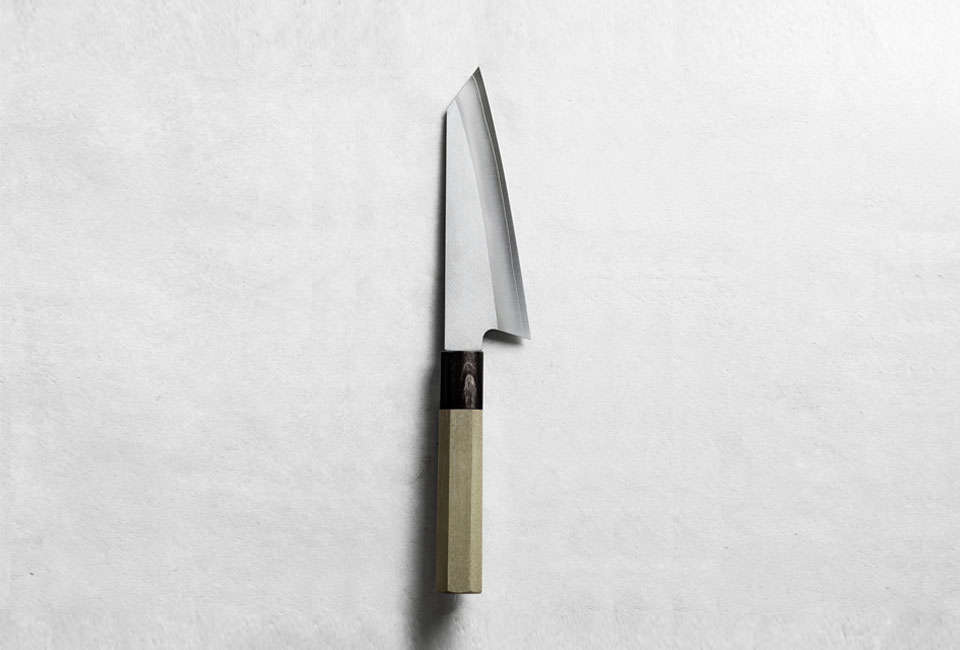

The Banshu Hamono Misuzu Santoku Knife is the sort of kitchen tool that makes a quiet entrance and then gradually takes over the entire cutting board. It does not arrive covered in flashy branding, neon packaging, or promises that it can slice a tomato by merely thinking about it. Instead, it offers a compact Japanese blade, traditional materials, thoughtful construction, and a design rooted in one of Japan’s historic metalworking regions.
With its 15-centimeter blade, stainless warikomi construction, octagonal magnolia handle, and buffalo-horn collar, the Misuzu Santoku combines everyday practicality with the character of a handmade object. It is designed for vegetables, meat, fish, herbs, and most of the daily preparation work that does not involve bones, frozen food, or reenacting a lumberjack competition.
What Is the Banshu Hamono Misuzu Santoku Knife?
The Banshu Hamono Misuzu Santoku is a compact, multipurpose Japanese kitchen knife associated with Misuzu Hamono and the broader blade-making traditions of Hyogo Prefecture. The word santoku is commonly interpreted as “three virtues” or “three uses,” referring either to meat, fish, and vegetables or to slicing, dicing, and chopping.
That description fits this knife particularly well. Its blade is long enough for onions, chicken breasts, carrots, fish fillets, and bunches of herbs, yet short enough to feel controlled on a modest cutting board. At approximately 5.9 inches, it is noticeably more compact than the 6.5- to 7-inch santoku knives commonly sold in the United States.
Core Specifications
- Knife type: Multipurpose santoku
- Blade length: Approximately 15 centimeters or 5.9 inches
- Blade construction: Stainless warikomi laminated construction
- Handle: Octagonal magnolia wood
- Collar: Buffalo horn
- Primary uses: Vegetables, boneless meat, fish, herbs, and general food preparation
- Origin: Hyogo Prefecture, Japan
Some retailers have sold newer Misuzu knives made with named steels such as VG-10, but that does not mean every Misuzu Santoku uses the same material. The Banshu-branded 15-centimeter model has traditionally been described by its warikomi construction rather than a specific modern alloy. Buyers should therefore confirm the exact steel, dimensions, and finish of the production run being offered.
The Story Behind Banshu Hamono and Misuzu
Banshu is an older name associated with the Harima area of present-day Hyogo Prefecture. The region includes communities with long histories of producing scissors, sickles, woodworking tools, small knives, and other edged implements. Miki City, northwest of Kobe, is especially famous for metalworking and is often described as one of Japan’s oldest blacksmithing centers.
Regional blacksmithing expanded as Miki was rebuilt after the siege of Miki Castle in the late 16th century. Carpenters and blacksmiths came to support reconstruction, and locally made tools eventually developed a reputation beyond the area. Other parts of the Banshu region established their own traditions, including the production of household knives and Japanese grip scissors.
Misuzu Hamono was established in 1946 by Shinji Suzuki. The company is credited by regional craft organizations with pioneering stainless steel warikomi kitchen knives in Japan. That development was important because traditional high-carbon cutting steel could deliver excellent sharpness but required more protection from moisture and corrosion.
Misuzu’s approach placed a hard cutting core between more corrosion-resistant outer layers. The result offered much of the cutting performance cooks wanted while making the knife friendlier for everyday household use. In other words, it aimed to preserve the exciting part of carbon steel while reducing its habit of becoming emotionally distressed near a wet sink.
The company has continued through multiple generations, preserving traditional Japanese handle construction and a strong emphasis on sharpening. Its knives are intended to be maintained, repaired, resharpened, and kept in service rather than treated as disposable kitchen accessories.
Understanding the Stainless Warikomi Blade
A Hard Core Protected by Softer Outer Layers
Warikomi describes a laminated construction in which a harder steel core forms the cutting edge while softer steel surrounds or sandwiches it. A useful comparison is a pencil: the hard core does the important work, while the surrounding material supports and protects it.
In the Misuzu Santoku, the harder central steel provides the fine cutting edge. The stainless outer layers improve corrosion resistance and add support to the blade. Only the core reaches the actual edge, so sharpening gradually reveals fresh cutting steel without requiring the entire blade to be made from the same hard material.
This construction provides several practical advantages:
- A keen edge suitable for precise kitchen work
- Better resistance to staining than a fully reactive carbon-steel blade
- More flexibility and toughness around the harder central core
- Easier long-term maintenance than many traditional all-carbon knives
However, “stainless” should not be interpreted as “invincible.” The exposed cutting core may still discolor if left wet or covered in acidic food residue. Tomatoes, citrus, onions, and vinegar are delicious, but they are not known for respecting polished steel.
A Compact Blade With a Practical Profile
The 15-centimeter blade is one of the knife’s defining features. It favors control, agility, and everyday convenience over maximum reach. The profile is suited to push cutting, straight chopping, short slicing strokes, and gentle forward-and-down motions.
Compared with a curved Western chef’s knife, a santoku usually has a flatter section along the edge. That shape allows more of the blade to contact the board during a downward cut. It works particularly well for onions, carrots, cabbage, mushrooms, zucchini, garlic, and herbs.
The compact length also helps cooks who have smaller hands, limited counter space, or little enthusiasm for waving an eight-inch blade around before breakfast. It feels manageable without becoming so small that it loses its usefulness as a primary kitchen knife.
Magnolia Wood and Buffalo Horn Handle
The traditional Japanese handle is another major part of the Misuzu Santoku’s appeal. Magnolia wood is light, comfortable, and commonly used for Japanese knife handles. Its low weight helps keep the knife nimble and allows the user to feel the movement of the blade rather than the mass of a heavy handle.
The octagonal shape provides clear indexing, meaning the hand can sense the knife’s orientation without needing to stare at the handle. It also supports several grip styles and can generally be used comfortably by either right- or left-handed cooks, although the edge geometry of a specific knife should still be checked.
A buffalo-horn collar reinforces the front of the handle where the blade enters the wood. Besides adding durability, it creates a refined transition between the natural handle and the steel. Because horn is a natural material, color and pattern may vary slightly from one knife to another.
The Japanese-style tang is inserted directly into the handle rather than secured between two heavy scales with several metal rivets. This keeps the knife light. It also means the wooden handle can be replaced if years of washing, gripping, and enthusiastic dinner preparation eventually wear it down.
How the Misuzu Santoku Performs
Vegetables
Vegetable preparation is where the compact santoku format shines. The relatively tall blade provides knuckle clearance and creates a useful surface for guiding ingredients with the supporting hand. It can dice onions, slice mushrooms, mince garlic, julienne carrots, and turn a bell pepper into neat strips without feeling clumsy.
The flatter edge encourages push cuts rather than exaggerated rocking. Users accustomed to a German chef’s knife may need a short adjustment period. Once the movement becomes natural, the blade can produce efficient, consistent cuts with less wrist motion.
Boneless Meat and Poultry
The Misuzu Santoku is suitable for trimming and portioning boneless meat. It can remove silver skin, slice chicken breast, cube pork, and cut cooked meat into serving portions. Its compact blade gives the cook good control around smaller pieces and joints.
It is not a cleaver. The hard core and fine edge should not be driven through bones, frozen steaks, hard shells, or joints requiring force. For those jobs, use a butcher knife, poultry shears, or a heavier blade designed for impact.
Fish
The knife can portion boneless fish fillets, trim skin, cut seafood, and prepare smaller whole fish after the heavy bone work has been completed. It does not replace a dedicated deba for breaking through fish bones or a long yanagiba for drawing extremely clean sashimi slices.
For ordinary home cooking, however, it offers enough precision for salmon portions, tuna cubes, shrimp preparation, and delicate garnishes. Its modest length feels especially comfortable when working with smaller fillets.
Herbs and Fine Work
Fresh herbs respond well to a sharp santoku because the edge cuts rather than crushes. Basil stays greener, chives retain cleaner edges, and parsley is less likely to become a damp green carpet. The tip can also handle small detail work such as trimming strawberries, scoring vegetables, and removing blemishes from produce.
Misuzu Santoku vs. a Western Chef’s Knife
A Western chef’s knife typically has a longer blade, more curvature, a heavier handle, and a profile designed for rocking cuts. The Misuzu Santoku is shorter, lighter, and better suited to push cutting or controlled chopping.
The Western chef’s knife has an advantage when slicing large roasts, cutting oversized melons, or working through a mountain of cabbage. Its curved belly can also be more comfortable for cooks who constantly rock the blade while mincing herbs.
The Misuzu Santoku wins when agility matters. It occupies less space, changes direction quickly, and feels less intimidating. Its lighter handle can reduce fatigue during repetitive preparation, while the compact tip offers more control for small ingredients.
Neither style is universally superior. One behaves like a full-size sedan built for long trips; the other feels like a compact car that can park anywhere. The right choice depends on the cook, the cutting board, and whether dinner involves one shallot or a pumpkin the size of a footstool.
Who Should Buy the Banshu Hamono Misuzu Santoku?
It Is a Strong Choice For:
- Home cooks who prefer compact, lightweight knives
- People interested in traditional Japanese craftsmanship
- Cooks who prepare vegetables, fish, and boneless meat regularly
- Users with smaller cutting boards or limited counter space
- Collectors who value natural handles and regional manufacturing
- Anyone willing to hand-wash and maintain a quality blade
It May Not Be Ideal For:
- People who put every kitchen tool in the dishwasher
- Cooks who frequently chop bones or frozen food
- Users who strongly prefer heavy, full-tang Western handles
- Anyone who wants a long blade for large roasts and oversized produce
- Buyers unwilling to learn basic sharpening or use a professional service
The Misuzu Santoku is not meant to be abused and forgotten in a drawer. It rewards owners who appreciate a responsive cutting tool and are prepared to give it a few seconds of care after each use.
Care and Maintenance
Wash It by Hand
Clean the knife soon after use with warm water, mild dish soap, and a soft sponge. Never place it in a dishwasher. Heat, aggressive detergent, prolonged moisture, and collisions with other utensils can damage the edge, discolor the blade, and dry out the wooden handle.
Dry It Immediately
Wipe the blade and handle thoroughly with a clean towel. Do not leave the knife soaking in a sink or resting under wet ingredients. Even a corrosion-resistant blade can develop spots when moisture and acidic residue are allowed to hold a committee meeting on the steel.
Use a Knife-Friendly Board
Wood and quality plastic cutting boards are generally kinder to the edge than glass, stone, ceramic, or metal surfaces. A hard countertop may look elegant, but using it as a cutting board is an efficient way to turn a sharp knife into an expensive butter spreader.
Avoid Twisting and Prying
Cut straight through food and lift the knife cleanly. Do not twist the edge inside dense vegetables, pry open packaging, separate frozen items, or use the tip as a screwdriver. Hard Japanese edges are optimized for cutting performance, not household improvisation.
Sharpen With a Whetstone or Professional Service
When the knife begins sliding over tomato skin or tearing paper instead of slicing it, the edge needs attention. A medium and fine whetstone combination can restore sharpness while preserving the blade’s geometry. Beginners should first identify the knife’s bevel and original sharpening angle.
Pull-through sharpeners remove metal quickly and may impose an unsuitable angle. A professional sharpener experienced with Japanese knives is a safer choice for owners who do not want to practice on a water stone.
Store the Blade Safely
Use a wooden knife rack, magnetic strip, blade guard, or dedicated knife drawer insert. Do not drop the Misuzu into a crowded utensil drawer where it can strike metal tools, damage its edge, and surprise an unsuspecting hand searching for a teaspoon.
Buying Considerations and Specification Variations
Misuzu Hamono produces several blade shapes, handle finishes, steels, and collaborations. Retailers sometimes use the terms santoku, bunka, Misuzu-style knife, and multipurpose knife differently. Product photographs can also make a 15-centimeter blade look nearly identical to a longer version.
Before ordering, confirm the following details:
- Actual cutting-edge length
- Core steel and outer cladding material
- Double-bevel or asymmetrical edge geometry
- Handle material and collar material
- Overall weight and balance
- Included box, wrapping, or blade cover
- Return policy and sharpening support
The traditional presentation may include locally woven fabric and a lightweight kiri wood box. Packaging can vary, especially with older stock, export versions, or retailer-exclusive editions. The knife itself should remain the priority, but attractive packaging certainly helps when giving it as a gift. Few people object to receiving a handmade Japanese knife in a wooden boxunless they were expecting socks, in which case the day has improved dramatically.
Experience Notes: A Week With a Compact Misuzu Santoku
The following experience-based scenario synthesizes the knife’s documented characteristics with common santoku cooking tasks. It illustrates what ownership is likely to feel like without claiming a personal laboratory test of every production version.
First Impressions
The first surprise is the size. A 15-centimeter blade looks modest next to a standard eight-inch chef’s knife, but it does not feel like a miniature tool. The blade still has enough height for comfortable knuckle clearance, while the octagonal handle keeps the whole knife feeling precise and deliberate.
The second surprise is the lack of handle weight. Cooks accustomed to triple-riveted Western knives may initially think something is missing. Nothing is missing; the balance has simply moved. Instead of a heavy handle anchoring the hand, the user feels the blade responding directly to small movements of the fingers and wrist.
Preparing a Vegetable-Heavy Dinner
Onions reveal the advantage of the compact profile immediately. The tip is easy to position for horizontal and vertical cuts, and the flatter edge finishes the dice without leaving several pieces connected at the bottom. Carrots respond best to a controlled forward push rather than a dramatic rocking motion.
Mushrooms, scallions, zucchini, and peppers move quickly beneath the blade. The tall face can scoop ingredients into a bowl, although the edge itself should never be dragged sideways across the board. Use the spine or lift the knife. Scraping with the cutting edge is a tiny act of vandalism performed against your own sharpening work.
Dense sweet potatoes require more judgment. The knife can cut them when sharp, but the short blade provides less leverage than a full-size chef’s knife. If the blade becomes wedged, the correct response is to withdraw it carefullynot twist the handle as though opening a stubborn jar.
Working With Chicken and Fish
For boneless chicken breast, the Misuzu feels quick and controllable. It can trim fat, butterfly smaller pieces, and create uniform strips without the tip wandering. Around chicken thighs, the blade can separate meat from accessible joints, but poultry shears remain the smarter choice for cutting through bone.
With a salmon fillet, the compact blade is useful for portioning and trimming. It does not provide the long, uninterrupted draw of a slicing knife, yet it offers excellent control for home-size portions. Cutting tuna or firm white fish into cubes is straightforward, especially when the edge has been maintained properly.
The Adjustment Period
The main learning curve involves cutting motion. A cook who has spent years rocking a curved German knife may initially lift the Misuzu too high or force it through an exaggerated arc. The blade becomes more natural when used with short forward slices, push cuts, and gentle chopping.
After several meals, the compact length begins to feel less like a limitation and more like freedom. The knife can be picked up for a single clove of garlic without seeming excessive, yet it remains capable of preparing an entire dinner. It occupies little board space and feels especially convenient in apartment kitchens.
Cleaning and Daily Ownership
Care takes less than a minute. Wash the blade immediately, wipe the handle, dry everything thoroughly, and store it safely. This routine soon becomes automatic. The knife asks for more attention than a dishwasher-safe utility blade, but the reward is a sharper, more personal tool.
The natural handle may gradually develop subtle signs of use. That is part of the appeal rather than a defect. A well-maintained Misuzu Santoku should look like a working kitchen knife, not a museum exhibit that panics whenever somebody chops cilantro nearby.
Long-Term Impression
The strongest argument for the Misuzu is not that it performs one impossible trick. Its appeal comes from how many ordinary tasks it handles comfortably. It slices an onion, portions fish, chops herbs, trims meat, and returns to its rack without turning dinner preparation into a technical demonstration.
It is most satisfying for cooks who enjoy responsive tools and appreciate the relationship between use and maintenance. Sharpening, drying, and eventually replacing a handle are not signs that the knife has failed. They are part of owning an object designed to remain useful for years.
Final Verdict
The Banshu Hamono Misuzu Santoku Knife blends regional Japanese craftsmanship with a highly practical household design. Its compact 15-centimeter blade is agile, approachable, and well suited to vegetables, fish, herbs, and boneless meat. Stainless warikomi construction combines a hard cutting core with more corrosion-resistant outer layers, while the magnolia handle and buffalo-horn collar keep the knife light and visually distinctive.
It will not replace a cleaver, bread knife, carving knife, or heavy-duty butcher tool. It may, however, replace the average cook’s habit of reaching for several mediocre knives when one sharp, comfortable blade would do the work better.
For buyers who value compact dimensions, natural materials, repairable construction, and the heritage of Hyogo metalworking, the Misuzu Santoku is more than an attractive kitchen accessory. It is an everyday tool with a storyand unlike many stories, this one can finely dice an onion.
Note: Materials, packaging, edge geometry, and measurements may vary by retailer or production run. Confirm the exact specifications of the knife currently offered before purchasing or sharpening it.
SEO Data