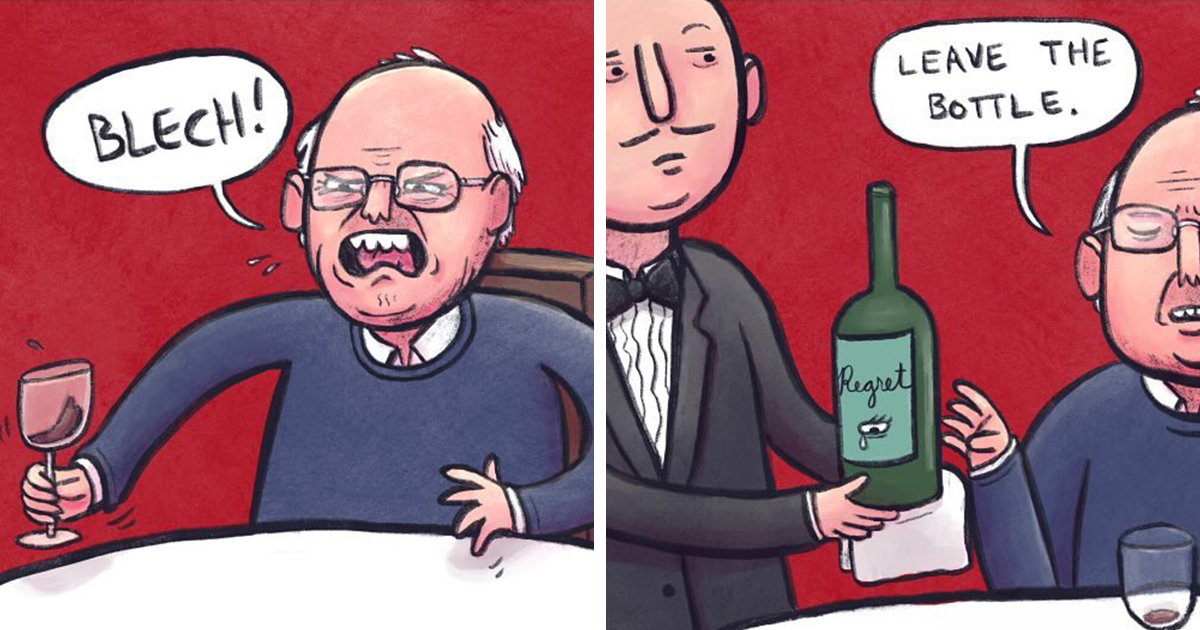

Some comics politely tap you on the shoulder and ask for a laugh. Brad T. Jonas, better known online as bradtjonas, tends to kick the door open, place a sandwich in the middle of a philosophical crisis, and leave before anyone can ask follow-up questions. His comics are strange, quick, dry, and wonderfully unbothered by the normal rules of punchlines. They do not always chase relatable humor. In fact, part of the fun is that they often feel proudly unrelatable, as if everyday life wandered into an absurd courtroom and forgot why it was there.
The title “30 Ridiculous Comics Filled With Unexpected Humor By This Artist” captures exactly why readers keep sharing his work. These are not long-form graphic novels or traditional newspaper strips with predictable setups. They are compact visual jokes built around misdirection, awkward honesty, bizarre logic, and tiny emotional disasters. One moment, you think you understand the scene. The next, the comic has calmly moved the floor three feet to the left.
That is the magic of unexpected humor. It rewards attention, punishes assumption, and reminds us that comedy does not need to shout to be ridiculous. Sometimes it just needs a simple drawing, a deadpan character, and one final panel that makes your brain say, “Excuse me, what?”
Who Is Brad T. Jonas, the Artist Behind bradtjonas?
Brad T. Jonas is an American illustrator and comic creator whose work appears across social platforms under the name bradtjonas. His comics have been described as bizarre, hilarious, and intentionally unrelatable, which is a surprisingly efficient mission statement. Rather than smoothing the rough edges of life into cute, inspirational lessons, Brad leans into oddness. His comics often behave like the weird thought you have at 2:14 a.m. and immediately decide not to tell anyone. Except he draws it, posts it, and somehow makes it funny.
His style is clean enough to read instantly but loose enough to feel alive. The characters often look calm even when the situation around them is deeply unreasonable. That contrast is crucial. A wild idea becomes funnier when everyone in the comic treats it like a normal Tuesday. The humor rarely depends on elaborate backgrounds or complicated visual effects. Instead, the joke usually comes from timing, word choice, facial stillness, and a final twist that reframes the whole scene.
Why These Ridiculous Comics Work So Well
Unexpected humor works because it creates a gap between what readers expect and what actually happens. In comedy theory, this is often connected to incongruity: the pleasure of watching familiar patterns break in a way that feels safe, clever, or playfully wrong. Brad’s comics are a great example of that idea in action. He gives readers enough structure to feel comfortable, then swerves into absurdity before the brain can fasten its seatbelt.
Many of his comics start with a familiar social situation: a conversation, an observation, a moral question, a small everyday frustration. Then the comic quietly replaces the expected punchline with something stranger. The result is not random nonsense. It is controlled nonsense, which is an important distinction. Randomness says, “A refrigerator is now the mayor.” Controlled absurdity says, “Of course the refrigerator became mayor; look at the campaign slogan.”
The Appeal of “Unrelatable” Humor
Most viral comics are built around relatability. They say, “This is you before coffee,” or “This is what introverts do at parties,” and readers nod because the joke is familiar. Brad’s work often takes the opposite route. His comics can feel like they are documenting emotional weather from a planet next door. The situations are odd, but the reactions are recognizable: confusion, anxiety, stubbornness, vanity, overthinking, bad confidence, and the dramatic inner monologue of someone trying to act normal.
That is why “unrelatable” humor can become strangely relatable. The exact scenario may be ridiculous, but the emotional mechanics are real. We may not have argued with a surreal character about a deeply unnecessary problem, but we have all been trapped in conversations where logic left early and took the snacks with it.
30 Reasons Readers Love These Unexpected Comics
1. The Punchlines Refuse to Behave
A predictable punchline is comfortable. Brad’s comics prefer discomfort with a tiny hat on. They often end in a direction that feels both surprising and oddly inevitable.
2. The Humor Is Fast
Online readers scroll quickly, and these comics understand the assignment. The setup is brief, the payoff is sharp, and the joke usually lands before distraction can steal the spotlight.
3. The Characters Stay Calm in Absurd Situations
Deadpan delivery is one of the strongest tools in visual comedy. When a character reacts to nonsense with total seriousness, the absurdity becomes even funnier.
4. The Art Style Serves the Joke
The drawings are not overloaded with detail. That simplicity helps readers focus on the expressions, dialogue, and timing.
5. The Comics Reward a Second Look
Some jokes land immediately. Others reveal an extra layer after a reread. That second-laugh effect is gold for webcomics because it encourages sharing and comments.
6. The Tone Is Weird Without Trying Too Hard
Forced weirdness can feel exhausting. Brad’s comics feel naturally strange, like the artist opened a drawer in reality and found a raccoon wearing reading glasses.
7. The Humor Has a Dry Edge
Instead of big emotional reactions, the jokes often arrive with a blank stare. That dry tone makes the chaos feel sharper.
8. Everyday Life Gets Twisted
One reason the comics work is that they begin near reality. The twist becomes funnier because it starts from something ordinary.
9. The Dialogue Feels Economical
Great comic writing does not waste words. Each line has to move the joke, build tension, or deliver the turn.
10. The Final Panel Often Rewrites the Whole Comic
The best unexpected comics make readers reinterpret what they just saw. That “wait, now I get it” moment is a major part of the charm.
11. The Comics Are Built for Social Media
Short, visual, and punchy comics travel well online. They are easy to read on a phone, easy to share, and perfect for quick entertainment breaks.
12. The Humor Is Not Over-Explained
Nothing kills a joke faster than a paragraph explaining why it should be funny. Brad trusts readers to make the leap.
13. The Absurdity Feels Human
Even when the situation is strange, the emotional core often points back to insecurity, confusion, social pressure, or the weird rituals of daily life.
14. The Comics Have a Distinct Voice
In a crowded webcomic world, voice matters. Brad’s comics are recognizable because the humor has its own rhythm: quiet, odd, and confidently off-center.
15. They Make Small Problems Feel Theatrical
A minor inconvenience can become a full dramatic event. That exaggeration mirrors how our brains sometimes behave when a tiny problem arrives wearing a cape.
16. They Avoid Neat Moral Lessons
Not every comic needs to end with wisdom. Sometimes the point is simply that life is strange and everyone is improvising badly.
17. They Use Silence Well
In comics, a pause can be as powerful as dialogue. A blank expression after a strange line can turn a good joke into a great one.
18. The Humor Feels Internet-Native
These comics understand the language of online absurdity: fast context, strange escalation, and a punchline that can live as a screenshot in a group chat.
19. The Jokes Are Compact but Not Empty
Short comics can still carry personality. Brad’s panels often suggest a bigger world beyond the frame, even when the joke is tiny.
20. The Work Embraces Awkwardness
Awkwardness is comedy fuel. His comics often let awkward moments breathe just long enough to become hilarious.
21. The Characters Often Misunderstand Reality
Misunderstanding is a classic comedy engine. In these comics, characters may misunderstand a phrase, a situation, or the entire concept of being normal.
22. The Humor Can Be Dark Without Becoming Heavy
Some jokes brush against darker ideas, but the tone usually stays playful and surreal rather than grim. That balance keeps the comics readable and fun.
23. They Feel Handmade
There is a human looseness to the work. The lines, expressions, and timing feel personal rather than polished into bland perfection.
24. They Invite Readers Into the Joke
Unexpected humor asks the reader to participate. You have to connect the dots, and that little mental click is satisfying.
25. They Are Memorable
A strange comic sticks in the mind longer than a generic joke. The more specific the absurdity, the more likely readers are to remember it.
26. They Understand Comic Timing
Panel order matters. So does the distance between setup and payoff. Brad’s comics often use structure like a tiny comedy trap.
27. They Make Nonsense Feel Logical
The best absurd comics do not feel careless. They create their own rules and follow them just enough for the joke to land.
28. They Are Perfect for Readers With Odd Taste
Not everyone wants wholesome sunshine every time they open a comic. Some readers want humor that looks at reality and says, “Interesting. What if this got worse, but politely?”
29. They Capture the Mood of Modern Online Comedy
Modern internet humor often blends anxiety, randomness, irony, and sincerity. Brad’s comics sit comfortably in that space.
30. They Are Simply Fun
Analysis is helpful, but sometimes the simplest answer is the best one: the comics are funny. They surprise readers, move quickly, and leave behind the pleasant confusion of a joke that worked.
How Unexpected Humor Helps Webcomics Stand Out
The internet is crowded with comics, memes, cartoons, reaction images, and jokes moving at the speed of thumb-scrolling. To stand out, a webcomic needs more than a cute drawing style. It needs a recognizable comic identity. Brad’s identity comes from his willingness to trust weird ideas. The jokes do not beg to be liked. They simply arrive, do something strange in the living room, and exit through a window.
This kind of humor also benefits from the structure of webcomics. A traditional comic strip has long roots in newspapers and magazines, but webcomics can be looser, faster, and more experimental. They do not have to satisfy every reader. They can find a specific audience that enjoys the artist’s exact flavor of nonsense. That freedom is one reason online comics have become such an important space for independent creators.
What Creators Can Learn From bradtjonas
For artists, writers, and humor creators, Brad’s comics offer a useful lesson: originality often comes from committing to your own rhythm. Trying to make a comic “for everyone” can flatten the joke until it tastes like printer paper. A more interesting approach is to develop a strong point of view, then let the right audience find it.
Another lesson is restraint. Many beginner comics over-explain the joke, crowd the panels, or add too much dialogue. Brad’s work shows how much can happen with a simple setup and a confident turn. The art does not need to scream when the idea is strong. The punchline can whisper, and somehow that makes it more alarming.
Why Readers Keep Coming Back
Readers return to these comics because they offer a reliable form of surprise. That sounds contradictory, but it is true. Fans know they will get something strange, but they do not know exactly what shape the strangeness will take. That repeatable unpredictability is powerful. It turns each new post into a small mystery: What is the normal-looking situation going to become this time?
There is also comfort in absurdity. When real life feels messy, a ridiculous comic can make disorder feel playful for a moment. It does not solve anything, of course. A comic cannot do your laundry, answer your emails, or explain why your phone charger only works at one sacred angle. But it can give your brain a quick vacation from seriousness, and that has value.
Experience-Based Reflection: Reading 30 Ridiculous Comics in One Sitting
Reading a batch of ridiculous comics like these is a specific kind of experience. At first, you think you are just taking a quick humor break. Five minutes, maybe. A tiny scroll. A responsible little visit to the land of jokes. Then suddenly you are 30 comics deep, your coffee is cold, and you are trying to explain to someone nearby why a silent cartoon face just made you laugh harder than a professionally produced sitcom scene.
The funniest part is how quickly your expectations adjust. In the first few comics, the punchlines feel like surprise attacks. You approach each panel with normal logic, and the comic immediately punishes that decision. After a while, you begin reading defensively. You start thinking, “Okay, I know something strange is coming.” But that does not ruin the joke. It actually makes the experience better, because now you are playing along. You are trying to predict the unpredictable, which is basically comedy chess with a raccoon.
One of the best experiences with this kind of humor is sharing it. Ridiculous comics are perfect for sending to a friend with no explanation. In fact, explanation usually makes it worse. You just send the comic and wait. If the friend replies with “what,” you have succeeded. If they reply with “why is this funny,” you have also succeeded. If they send back three more comics in the same style, congratulations, you have started a tiny cultural event.
There is also a nice personal rhythm to reading unexpected comics. They interrupt overthinking. A good absurd punchline forces your brain to stop walking in circles and trip over a banana peel labeled “new perspective.” That may be why so many readers enjoy webcomics during work breaks, late-night scrolling, or quiet moments between tasks. The format is small, but the emotional reset can be real.
From a reader’s point of view, Brad’s comics feel especially satisfying because they do not try too hard to explain themselves. They give you the setup, the turn, and just enough visual expression to complete the joke. The rest happens in your head. That is where the laugh forms: in the tiny gap between recognition and confusion. You recognize the rhythm of a normal comic, then the ending refuses to act normal. Your brain reaches for the expected answer and grabs a rubber chicken instead.
For anyone who creates content, this is a useful reminder. Audiences do not always need bigger, louder, more dramatic material. Sometimes they want a clever little idea with personality. A comic can be memorable because it is honest, weird, simple, or perfectly timed. It can be ridiculous without being careless. It can be short without being shallow. And it can be strange enough to feel fresh in a feed full of recycled jokes.
That is the lasting appeal of 30 Ridiculous Comics Filled With Unexpected Humor By This Artist. The collection is not just a gallery of funny drawings. It is a reminder that humor still has room to surprise us. Even in an online world where everyone has seen every meme format twelve times, a well-built comic can still sneak up from behind the couch and say something deeply unnecessary. And honestly, thank goodness for that.
Conclusion
Brad T. Jonas, known as bradtjonas, has built a comic style that thrives on odd timing, dry delivery, and punchlines that refuse to walk in a straight line. His ridiculous comics work because they understand the power of surprise. They take ordinary moments, bend them into strange shapes, and let readers enjoy the snap. Whether you are a casual comic fan, a creator studying webcomic humor, or someone who simply enjoys jokes that arrive wearing mismatched shoes, these comics offer a refreshing reminder: funny does not have to be predictable.
In a digital world packed with polished content, Brad’s work stands out because it feels distinctive, personal, and confidently weird. The comics are quick enough for social media but clever enough to remember later. That combination is exactly why unexpected humor continues to thrive online. It gives readers a reason to pause, laugh, share, and maybe question reality for a few harmless seconds.