
There are ordinary dog photos, and then there are dog photos that look as though someone opened a portal to a superhero universe and yelled, “Fetch!” The photography project behind “I Tossed Powder On Some Dogs, And The Result Turned Out Amazing (13 Images)” belongs firmly in the second category.
Created by Canadian animal photographer Jess Bell, the series transformed athletic dogs into moving explosions of color. Instead of asking every subject to sit politely, tilt a head, and pretend not to be thinking about snacks, Bell photographed dogs doing what energetic dogs do best: running, jumping, twisting, chasing, and launching themselves through space with absolute commitment.
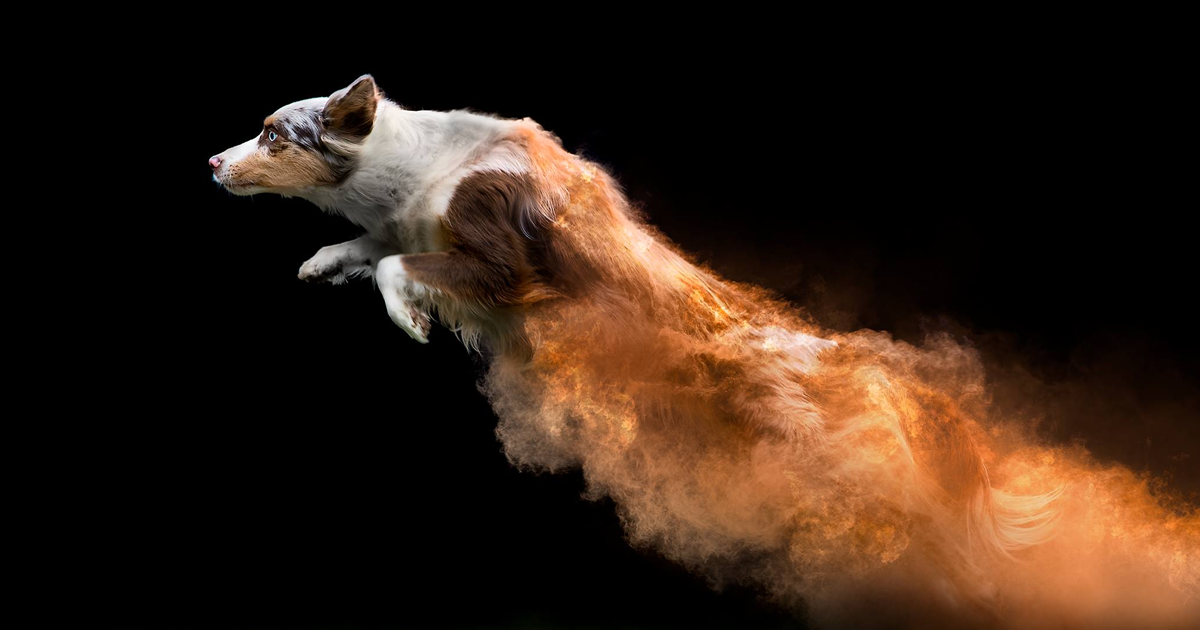
The colored powder added something a conventional action photograph cannot easily show. It made movement visible. Each leap left behind a temporary cloud, streak, or swirling wake, turning a fraction of a second into something that looked almost sculptural. Bell explained that the effects were captured in real time and that the colors were selected with each dog’s appearance and personality in mind. The widely shared 2019 series included Border Collies, Mudis, Australian Shepherds, a Malinois, a Nova Scotia Duck Tolling Retriever, and mixed-breed dogs.
The result is more than a clever visual trick. These colorful dog portraits reveal differences in body shape, movement, energy, and personality. One dog appears to slice through the frame like an arrow. Another seems to float. Another explodes forward with all the subtlety of a furry cannonball. The powder simply makes those differences impossible to miss.
How a Simple Experiment Became Extraordinary Dog Photography
Bell organized the original experimental sessions with talented dog-owning friends and their animals. Her idea was deceptively simple: combine action dog photography with colored powder and see what happened. That sentence makes the process sound almost suspiciously easy. In reality, photographing a fast-moving dog at precisely the right instant requires timing, anticipation, cooperation, technical control, and the acceptance that the dog has not read your creative brief.
The distinctive clouds were not merely decorative backgrounds pasted behind the animals. Contemporary coverage of the project emphasized that the colorful motion was photographed as part of the real action. That matters because real powder behaves unpredictably. It curls around fur, breaks apart in the air, drifts in unexpected directions, and responds differently to every jump. Two attempts can never produce exactly the same pattern.
This unpredictability is a major reason the images feel alive. Perfectly controlled digital effects can sometimes look too perfect. Here, the little irregularities are part of the magic. A cloud may trail behind a dog like smoke from a rocket. A burst may wrap around the body. A thin veil of color may reveal the arc of a turn that would otherwise disappear in a frozen photograph.
Why the Powder Makes Motion So Powerful
It turns invisible movement into something we can see
A still photograph normally gives us one instant and asks our brains to reconstruct everything that happened before and after it. Colored powder provides additional clues. A trail behind the body suggests acceleration. A dense burst near the paws hints at a forceful takeoff. A curved plume can reveal a change in direction.
In that sense, the powder works almost like a visual diagram of energy, except this is the most entertaining physics lesson imaginable because the diagram has ears and may be carrying a tennis ball.
It separates the dog from the background
Dark backgrounds are particularly effective in this style of creative pet photography. Against black or near-black surroundings, both the dog’s outline and the bright airborne pigment become easier to read. Photography guidance for pet portraits also emphasizes the importance of lighting, subject separation, and controlling shutter speed when working with active animals. Fast action demands settings capable of preserving fleeting detail rather than turning an enthusiastic Border Collie into an unidentified blur with a tail.
Color becomes part of the portrait
One of the smartest ideas behind Bell’s project was treating color as part of the subject’s characterization. A photographer can choose a hue that contrasts with the coat or one that harmonizes with it. Purple around black-and-white fur creates a dramatically different mood from orange around a warm brown coat or blue around a darker dog.
That decision moves the images beyond documentation. These are not simply records of what the dogs look like. They are interpretations of how the dogs feel when they move.
The 13 Images: A Gallery of Canine Energy
The published sequence featured 13 photographs, with several dogs appearing more than once. The lineup included Rush, Gemma, Lyric, Nyero, Lottie, Style, Slice, True, Tenacity, Gnash, and Cohen. The breeds and mixes ranged from Border Collies and Mudis to an Australian Shepherd, a Malinois, a Nova Scotia Duck Tolling Retriever, and mixed-breed subjects.
1. Rush | Border Collie
Rush is an ideal opening act for a project about speed. Border Collies are visually expressive athletes, and a powder trail makes every extension of the body feel larger. The image sets the tone immediately: this will not be a quiet afternoon on the sofa.
2. Gemma and Lyric | Mix and Coolie
Two dogs introduce a new challenge. Multiple bodies create intersecting lines of motion, making the scene feel less like a portrait and more like a choreographed burst of canine chaos. Naturally, the dogs probably considered it a perfectly reasonable workday.
3. Nyero | Mudi
The Mudi’s compact, agile build gives its movement a different visual rhythm from the longer outline of a Border Collie. This is where the concept becomes especially interesting: the same photographic technique reveals completely different mechanics from dog to dog.
4. Lottie | Border Collie
Lottie demonstrates why repeated subjects do not necessarily produce repeated photographs. Change the movement, timing, color, or direction of the jump and the entire personality of the frame changes.
5. Style | Border Collie
With a name like Style, expectations are frankly unfair. Fortunately, athletic dog photography has one great advantage over fashion photography: the model is unlikely to complain about the catering as long as somebody remembered the treats.
6. Slice | Nova Scotia Duck Tolling Retriever
A different coat texture and body shape alter the relationship between fur and airborne color. The powder no longer reads exactly as it does around a lean herding dog. That variation strengthens the project’s central idea that movement itself can be a kind of portrait.
7. True | Australian Shepherd
The Australian Shepherd brings abundant coat, athletic movement, and visual drama to the series. Longer fur gives the powder more surfaces and edges to interact with, adding complexity to an already fast-moving frame.
8. Lyric | German Coolie
A solo appearance allows Lyric’s individual movement to take center stage. The best action portraits preserve enough detail to recognize the animal while still communicating speed, and that balance is one of the hardest parts of photographing dogs in motion.
9. Tenacity | Mudi
The name Tenacity could almost serve as a job description for a dog repeatedly asked to perform an energetic behavior for a camera. Still, successful pet photography depends on keeping the experience rewarding rather than simply demanding repetition.
10. Gnash | Malinois
A Malinois naturally brings an intense physical presence to an action portrait. The powder amplifies that impression, making acceleration and direction part of the composition rather than leaving all the storytelling to facial expression.
11. Cohen | Australian Shepherd
Cohen adds another example of how coat, posture, and individual behavior change the final result. The concept stays consistent, but the dog keeps the image from becoming formulaic.
12. Gemma | Mix
Mixed-breed dogs are a useful reminder that great pet photography does not depend on a particular pedigree. A compelling subject is a compelling subject. Personality has never asked to see registration papers.
13. Lottie | Border Collie
The sequence closes with another Lottie image, reinforcing an important lesson: a single dog can generate dramatically different visual stories. Change the action, and you change the portrait.
What Makes These Dog Portraits So Memorable?
The dogs look like athletes, not accessories
Many pet portraits focus on affection, cuteness, or stillness. Bell’s work adds another perspective by emphasizing physical capability. The dogs are shown actively doing something. Their muscles, balance, concentration, and enthusiasm become part of the image.
That approach connects strongly with viewers because people who live with energetic dogs already know this side of them. The dog peacefully sleeping upside down on the couch at 2 p.m. may become a four-legged missile when a Frisbee appears at 2:03.
Every frame contains controlled unpredictability
Action photography rewards preparation, but animals do not move like machines. That is an advantage when the goal is originality. The photographer can plan the position, background, light, focus strategy, and intended action, but the exact shape of the leap and powder cloud remains partly unpredictable.
The strongest photographs happen when preparation and luck shake hands at exactly the right fraction of a second.
The concept is immediately understandable
Good visual ideas often have a simple core. You do not need a 40-page artist statement to understand why a dog exploding through a cloud of color is fun to look at. The images attract attention instantly, but they also reward a longer look because viewers begin noticing the posture, fur, eyes, feet, powder texture, and direction of movement.
Animal Welfare Must Come Before the Photograph
A spectacular photograph is never worth frightening or harming an animal. Current animal-welfare guidance emphasizes minimizing fear, pain, stress, and suffering, while dog-behavior resources recommend watching closely for signals such as lip licking, tucked posture, avoidance, pinned ears, unusual panting, or other changes that suggest discomfort. Pet-photography guidance similarly recommends ending a session when a dog appears stressed or fatigued.
Powder effects require additional caution because fine airborne particles can create exposure through the eyes, skin, mouth, or respiratory system. Even a substance described as non-toxic should not automatically be treated as risk-free for every animal or every method of use. Veterinary sources note that dust can be irritating, while poison-control organizations recommend obtaining professional guidance when a pet is exposed to a potentially harmful substance.
For anyone inspired by creative dog photography, the sensible principle is simple: the dog gets a veto. A controlled environment, an experienced handler, appropriate materials, good ventilation, protection of the face and airways, short sessions, breaks, and professional veterinary advice are far more important than getting “one more shot.” There will always be another photograph. There is only one dog standing in front of your camera.
Experiences and Lessons From Planning a Creative Powder Dog Photo Shoot
The most surprising lesson from a project like this is that the spectacular part of the photograph lasts almost no time at all. The colorful explosion might exist for a fraction of a second, yet creating the conditions for that fraction of a second can take far longer. The real work happens before the shutter clicks.
First comes learning the dog. One animal may happily chase a toy in a straight line every time. Another may improvise a route that appears to have been designed by a squirrel with access to a map. A third may perform perfectly until the camera comes out, at which point it suddenly becomes deeply interested in a blade of grass six feet away.
That unpredictability changes how a photographer thinks. Instead of forcing every dog into the same pose, the smarter approach is to identify what the dog naturally enjoys. A disc dog may give its most expressive movement while jumping. A fast runner may look strongest accelerating across the frame. A dog that prefers controlled tricks may produce a better photograph with a smaller, familiar action.
The second lesson is that timing matters more than frantic shooting. A camera capable of capturing many frames per second is useful, but anticipation remains essential. You watch the dog’s approach, learn the rhythm of the movement, and begin to recognize the instant before the interesting instant. Good action photography often feels less like pressing a button and more like predicting the future by approximately half a heartbeat.
Then there is the powder itself. In imagination, it behaves beautifully. In reality, airborne material has opinions. A breeze can move it. Humidity can change it. The dog’s speed can send it in a direction nobody expected. One attempt may create a magnificent plume, while the next produces something resembling a small colored sneeze. That inconsistency can be frustrating until you realize it is exactly what makes every successful frame unique.
Color selection also becomes more personal than expected. A bright contrast may make a dark-coated dog jump visually from the frame. A related hue can create a more unified, dreamlike effect. The best choice is not always the loudest one. Sometimes the dog’s coat, expression, and style of movement already provide plenty of drama, and the color only needs to support them.
Perhaps the biggest experiential lesson, though, is that cooperation beats control. A memorable animal portrait is created with the dog, not merely of the dog. The handler reads the animal. The photographer watches the handler. Everyone adapts. Breaks happen. Treats mysteriously disappear at an alarming rate. Plans change.
When the session works, the best image often arrives almost unexpectedly. The dog commits to the movement, the focus lands, the light catches the fur, and the powder creates a shape nobody could have drawn in advance. For one tiny instant, motion, color, personality, and technical precision occupy the same frame.
That is why creative pet photography can become addictive. You begin with the goal of making a technically impressive picture, but you end up studying the individual ways animals move. A compact dog gathers itself differently before a jump. A long-coated dog creates a different silhouette in the air. One dog looks intensely focused; another appears to be having the greatest Tuesday of its life.
The experience also teaches patience. Not every attempt becomes portfolio material. Some frames will be mistimed. Some will be soft. Some will feature an excellent powder cloud and the rear half of a dog exiting the photograph. That is not failure; that is action photography politely reminding you who is actually in charge.
Most importantly, a good session should leave the dog comfortable and willing to participate. The photograph may be the object people eventually see, but the process matters just as much. The best creative dog portraits preserve enthusiasm rather than manufacturing it. When an animal genuinely enjoys the familiar activity being photographed, the resulting energy is difficult to fake.
Why These 13 Images Still Stand Out
Years after the original series spread online, the idea remains memorable because it combines three things people rarely tire of: dogs, color, and perfectly timed chaos. More importantly, the project found a visual language suited to its subjects. The powder did not simply decorate the dogs. It revealed their movement.
That is the difference between a gimmick and a strong photographic concept. A gimmick gets attention once. A strong concept helps us notice something we might otherwise overlook. In these images, we notice the explosive acceleration of a Border Collie, the compact agility of a Mudi, the physical intensity of a Malinois, and the individuality of every dog in the sequence.
“I Tossed Powder On Some Dogs, And The Result Turned Out Amazing (13 Images)” may sound like the beginning of a story that ends with an emergency vacuum cleaner purchase. Instead, it became a striking example of creative animal photography: colorful, kinetic, funny, and surprisingly revealing.
The best photographs do more than show us what a subject looks like. They show us something about how that subject exists in the world. These dogs exist at full speed, and for one fraction of a second, the swirling color lets us see the trail they leave behind.