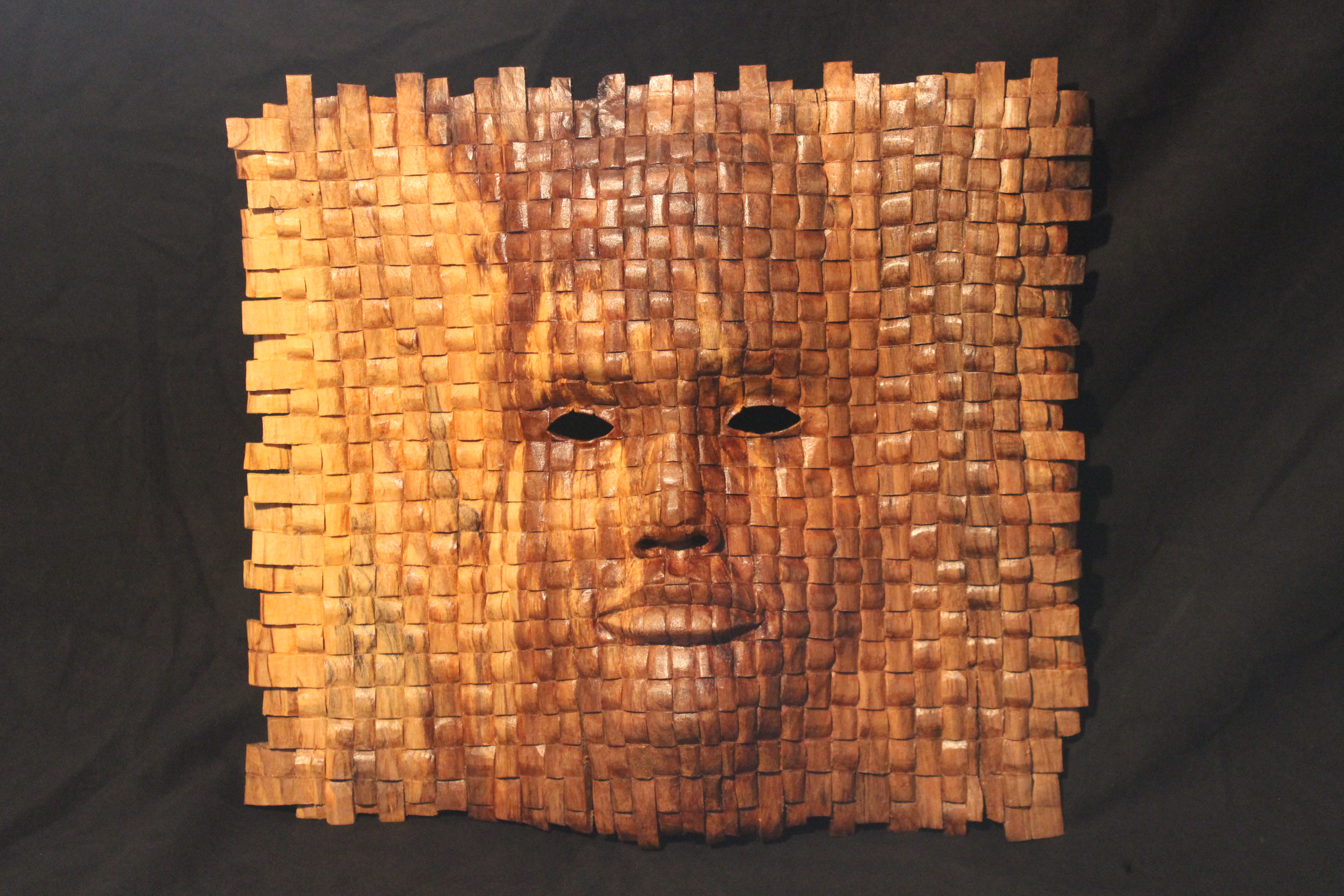
“Become Your Passion”Is A Carved Version Of A Woven Medium That Is Portrayed With My Own Medium In A Solid Piece Of Black Walnut.

At first glance, Become Your Passion appears to be woven. The surface seems to contain flexible strands crossing, bending, tightening, and folding over one another. It looks as though it might yield slightly beneath a fingertip. Then the illusion breaks: there is no thread, fiber, reed, or fabric. The entire sculpture was carved from one solid piece of black walnut.
That revelation changes the viewing experience completely. What initially looks soft is hard. What appears assembled is continuous. What seems woven together was actually uncovered by removing wood. It is the artistic equivalent of discovering that a fluffy-looking pillow is secretly a small, extremely well-dressed boulder.
Created by woodcarver and sculptor Daniel Marc Lefebvre, the piece measures approximately 16 by 15.5 by 3 inches. Its title is more than an encouraging phrase. It also describes the artist’s process: passion is not simply represented on the surface but physically shaped into the material through planning, patience, and countless controlled cuts.
Artist and artwork background:
A Woven Image Hidden Inside Solid Wood
Traditional weaving is based on separate elements. Lengthwise strands form the warp, while crosswise strands form the weft. Their repeated intersections create structure, rhythm, texture, and pattern. A woven object exists because many individual fibers cooperate. Remove enough of those fibers, and the whole thing begins reconsidering its career choices.
Become Your Passion imitates this visual language without using actual fiber. Its carved bands appear to pass over and under one another, creating the recognizable logic of a woven surface. Shadows collect beneath the raised sections, while highlights travel across the rounded ridges. These changes in light persuade the eye that one carved strand is sitting above another.
The illusion depends on more than simply cutting a checkerboard pattern into wood. Real weaving contains tension, compression, slight irregularity, and subtle changes in direction. The carved elements must therefore feel connected rather than stamped onto the surface. Each apparent strand needs its own path, thickness, edge, and relationship with neighboring forms.
The result is not a wooden copy of a basket or textile. It is an interpretation of weaving through the language of carvinga conversation between two materials that never actually meet.
Weaving principles and visual structure:
Why Black Walnut Makes the Illusion More Powerful
Color That Already Feels Finished
American black walnut is admired for its rich brown heartwood, which may include chocolate, gray-brown, purplish, or nearly black tones. Clear finishes can deepen that color while allowing the grain to remain visible. In a sculpture built around light and shadow, this natural darkness gives every carved recess extra visual depth.
A pale wood might emphasize the graphic pattern, but walnut gives the piece warmth and gravity. It makes the sculpture feel less like a technical demonstration and more like an object with history. The darker material also creates a quiet surprise: viewers expect woven work to be airy, lightweight, or flexible, yet walnut looks substantial even before its true solidity is understood.
Grain Becomes a Second Pattern
The carved weave is only one system of lines. The walnut grain creates another. Natural fibers formed during the tree’s growth continue through the artificial woven pattern made by the artist. Depending on the viewing angle, the grain may support the illusion, interrupt it, or remind the viewer that the apparent strands remain part of a single block.
This interaction is important. If every trace of the wood were concealed, the sculpture would become a very convincing trick but a less interesting material statement. Visible grain allows the deception and the truth to coexist. The eye says, “That is woven,” while the grain politely clears its throat and replies, “Absolutely not.”
A Material That Demands Respect
Black walnut is widely used for fine furniture, interior paneling, veneer, specialty objects, turning, and carving. It is workable, finishes beautifully, and can hold substantial detail. However, its grain can vary, and deep cuts made carelessly along the grain may cause sections to split or break away.
That risk becomes especially serious in a design made of narrow raised bands and recessed crossings. A damaged corner cannot simply be unwoven and replaced. Because carving is subtractive, every cut removes material permanently. There is no convenient “undo” button hiding behind the workbench.
Black walnut properties and traditional uses:
How a Solid Block Can Look Woven
The artist has not published a complete cut-by-cut manual for this particular sculpture, so its exact production sequence should not be treated as public fact. Visually, however, a work of this kind would require several carefully coordinated stages.
1. Designing the Interlaced Structure
Before carving begins, the pattern must make structural and visual sense. The apparent strands need to alternate consistently between over and under positions. A single confused crossing could disrupt the illusion, much like one person walking backward through a carefully organized marching band.
The design must also account for the grain direction, the thickness of the block, the deepest recesses, and the fragile areas left between cuts. Lefebvre’s background in graphics and visual design is relevant here. Composition, proportion, repetition, and negative space are not decorative afterthoughts; they are the blueprint of the sculpture.
2. Establishing the Major Depths
The broadest levels would likely be defined first. The artist must decide which portions remain closest to the original surface and which areas recede. Removing too much too early could weaken the apparent strands or flatten the transition between crossings.
This is where patience becomes a practical tool. The illusion is built through gradual changes in depth rather than dramatic excavation. Small differences can create convincing overlap once directional lighting reaches the finished surface.
3. Rounding and Separating the Strands
After the major pattern is established, the bands must begin to look flexible. Hard square edges would resemble a carved grid, not a woven medium. Rounded upper surfaces suggest tension and softness, while undercut edges generate shadows that visually separate one strand from another.
The carver must create enough separation to make the intersections readable without cutting so deeply that delicate sections become unstable. Every apparent gap is therefore both a visual choice and an engineering problem.
4. Refining the Surface
Fine carving, scraping, and sanding can remove tool marks that would distract from the illusion. At the same time, excessive smoothing could erase the crisp transitions responsible for the woven effect. The surface must look refined without becoming vague.
A clear finish can then enrich the walnut and reveal the grain. Because light is an active ingredient in the work, sheen matters. A highly reflective coating might create distracting glare, while a controlled satin appearance can help highlights define the curved strands.
Reductive carving practices and finishing considerations:
The Art of Making Hard Materials Look Soft
Become Your Passion belongs to a long artistic tradition of material illusion. Trompe-l’oeilFrench for “deceive the eye”is commonly associated with paintings that make flat surfaces appear three-dimensional. Yet sculptors and craft artists also use material deception to challenge assumptions about weight, texture, construction, and touch.
One famous comparison is Wendell Castle’s Ghost Clock. That sculpture appears to be a grandfather clock covered by a white cloth, but the drapery and hidden object were carved from laminated mahogany. Castle recreated the folds and softness of fabric in wood, turning a familiar domestic scene into an elegant visual puzzle.
Lefebvre’s sculpture creates a related but distinct illusion. Rather than imitating loose fabric draped over an object, it imitates the repeated construction of weaving. The challenge is not only reproducing softness; it is reproducing a process. The sculpture must convince viewers that separate strands have passed around one another even though no strand is truly separate.
This kind of art rewards a two-stage reaction. First comes belief: “I know what I am seeing.” Then comes correction: “Apparently, I do not.” The pleasure lies in moving between those two positions.
Trompe-l’oeil and carved material illusion:
What the Title “Become Your Passion” Suggests
The title can be read as motivational, but it avoids the usual advice to “follow” a passion. Following implies that passion is already somewhere ahead, waving enthusiastically beside a clearly marked trail. Becoming is more demanding. It suggests identity is formed through repeated action.
That interpretation fits the sculpture’s construction. A woven object becomes strong through repetition. One crossing is not cloth. One strand is not a basket. Structure develops as individual movements accumulate and support one another. In the same way, an artist does not become a skilled carver through one inspired afternoon and an unusually cooperative chisel.
Lefebvre’s own career reflects sustained practice. He has described beginning woodcarving in the 1990s, studying graphics and visual design, and later working as a sculptor in the Vancouver film industry. He continued creating original carvings and commissions outside that professional work, earning recognition at juried exhibitions and carving shows.
The sculpture can therefore be viewed as a compact autobiography in visual form. Design knowledge, carving experience, material familiarity, and persistence are interlaced just as convincingly as the walnut bands appear to be.
Artist background and professional development:
One Medium Portraying Another
The phrase “portrayed with my own medium” captures the most interesting conceptual feature of the artwork. Lefebvre does not abandon wood to explore weaving. Instead, he brings weaving into woodcarving. He translates the appearance and logic of one craft through the tools and limitations of another.
Translation always changes something. Thread can bend freely, accept dyes, stretch under tension, and move with air. Walnut cannot behave that way. It must be cut into an image of flexibility. The sculpture therefore preserves the visual identity of weaving while replacing its physical behavior.
This transformation also challenges old divisions between fine art and craft. Weaving and woodcarving have both been used to make functional objects, decorative work, ceremonial pieces, and museum sculpture. By merging their visual languages, Become Your Passion demonstrates that technique and concept do not need separate addresses.
The craftsmanship attracts attention first, but the idea keeps the work interesting. A purely technical imitation might inspire a quick “How did he do that?” This sculpture adds further questions: Why make wood behave like fiber? Why carve separate-looking strands from a continuous block? What does unity mean when individuality is only an illusion?
Light, Shadow, and the Viewer’s Movement
The sculpture cannot deliver its full effect through shape alone. Lighting activates the crossings. When illumination arrives from an angle, the raised bands catch highlights and cast shadows into the recesses. The carved pattern becomes more dimensional, and the walnut’s color shifts from warm brown to near black.
As viewers move, some intersections become clearer while others flatten. From a distance, the woven pattern may dominate. Up close, grain, tiny variations, and carved edges expose the material. The sculpture effectively changes identity according to viewing distance.
For display, soft directional light is preferable to harsh frontal illumination. Straight-on light can reduce the shadows that explain the carved depth. A slight angle reveals the relief more clearly without turning the piece into a dramatic villain delivering a monologue from a basement.
What Woodcarvers Can Learn From the Piece
The first lesson is to design for the chosen wood rather than forcing a design onto it. Grain direction, density, moisture movement, and possible weak points should influence the pattern from the beginning. Material knowledge is not separate from creativity; it is what allows creativity to survive contact with reality.
The second lesson is that convincing detail depends on large relationships. The sculpture works because the overall rhythm, depth pattern, and strand proportions are believable. Tiny refinements matter, but they cannot rescue a poorly organized structure.
The third lesson is restraint. Illusion carving does not necessarily require extreme depth. Carefully placed shadows, rounded edges, and consistent overlaps may achieve more than aggressive cutting. Removing additional wood is always possible. Putting it back usually requires glue, optimism, and a sudden willingness to call the mistake “mixed media.”
Finally, carving and sanding walnut produce airborne dust, so proper extraction, ventilation, eye protection, and suitable respiratory protection are important. Artistic passion is admirable; inhaling the project is not part of the creative process.
Woodworking dust and shop safety:
Why This Sculpture Connects With Online Audiences
Material illusions are especially effective online because they create an immediate reveal. A viewer sees an image, makes a confident assumption, reads the caption, and then returns to inspect every pixel like a detective who has just learned the basket is walnut.
The work also offers something increasingly valuable in a screen-heavy culture: evidence of physical labor. Tool control, surface refinement, planning, and risk remain visible even in a photograph. The piece reminds viewers that a handmade object records time. Every recess represents material removed; every surviving strand represents a decision not to remove more.
Its message is also accessible without being simplistic. Viewers do not need an art history degree, a secret decoder ring, or a 90-minute lecture to understand the surprise. Yet the longer they look, the more the sculpture opens into discussions about transformation, identity, repetition, craft, and devotion.
A Solid Expression of an Evolving Passion
Become Your Passion succeeds because its technical achievement and its meaning reinforce each other. The woven illusion is not merely a showcase of carving skill. It provides the sculpture’s central metaphor: identity is constructed through repeated crossings, accumulated effort, and relationships between individual actions.
The black walnut gives that idea permanence. Weaving is commonly associated with flexibility and connection, while solid wood suggests strength and continuity. By combining those qualities, Lefebvre creates an object that appears delicate but is materially unified.
The sculpture ultimately invites viewers to reconsider passion as something more substantial than enthusiasm. Passion is not only what someone enjoys discussing, collecting, or placing in an inspirational social-media caption. It is what remains after practice has been repeated long enough to reshape both the material and the maker.
Experiences Inspired by “Become Your Passion”
The following reflections describe common experiences that a viewer, developing artist, or woodworker might have while engaging with a piece like Become Your Passion. They are interpretive observations rather than a claim of having handled the original sculpture.
The Experience of Being Fooled
The first experience is simple delight. You look at the sculpture and mentally classify it as woven. Your brain sees crossings, raised strands, and familiar repetition, then files the object under “fiber.” Learning that it is one piece of walnut produces a small but satisfying shock.
That moment matters because adults rarely enjoy being wrong. We usually treat mistakes as tiny emergencies. Art offers a safer alternative: the mistake becomes the reward. The sculpture teaches that perception is fast, useful, and occasionally overconfident.
The Experience of Trying a Similar Carving
A beginner inspired by the work may sketch an interlaced pattern onto a small board and assume the project will be straightforward. After all, it is only a collection of over-and-under crossings. Then the carving begins.
Almost immediately, the pattern demands concentration. Every intersection must alternate correctly. Grain direction changes the behavior of the tool. A cut that feels smooth from one direction may tear fibers when approached from another. The spaces beneath the apparent strands must be deep enough to cast shadows but not so deep that the remaining wood becomes fragile.
This exercise quickly replaces admiration with respect. The finished sculpture no longer looks like a clever pattern carved during a relaxing weekend. It looks like the result of thousands of decisions made without losing sight of the whole composition.
The Experience of Learning Patience
Carving is a useful cure for the fantasy that passion should always feel exciting. Some sessions are thrilling. Others involve refining one edge, sharpening a tool, cleaning dust, checking symmetry, and then refining the same edge again because it has apparently developed personal standards.
Yet those repetitive stages are where control develops. The hands learn pressure, angle, and grain response through actions too small to appear dramatic. Progress becomes visible only when compared across days or weeks.
This is where the title becomes practical. To “become your passion” is to remain involved when the work stops performing for an audience. It means continuing through measurement, correction, maintenance, and uncertaintynot just through the moments worthy of a photograph.
The Experience of Seeing Failure Differently
Woodcarving also changes how failure is understood. Because removed material cannot be restored easily, mistakes have consequences. A broken strand or chipped edge may require redesigning the pattern rather than pretending nothing happened.
That limitation can make the process intimidating, but it also encourages presence. The carver learns to pause, examine the grain, make smaller cuts, and accept that confidence should occasionally consult evidence.
Failure becomes information about the material. Walnut is not being stubborn for entertainment; it is revealing how its fibers run. The artist’s job is to listen before making the next cut.
The Experience of Recognizing Your Own “Weave”
Even viewers who never touch a carving tool can relate to the sculpture. Most skills are woven from separate experiences: early curiosity, formal study, embarrassing experiments, useful criticism, repeated practice, and occasional success. From a distance, the result may look like one natural talent. Up close, it is a network of crossings.
That may be the most lasting message of Become Your Passion. The sculpture appears to contain many strands, yet it remains one piece. Human development works similarly. Jobs, hobbies, failures, teachers, influences, and personal obsessions may seem separate while they are happening. Over time, they can become parts of one recognizable identity.
Passion, then, is not a magical object waiting to be discovered beneath perfect lighting. It is something shaped through use. Like the carved weave in black walnut, it becomes convincing because the structure is repeated, refined, and carried through the entire piece.
Conclusion
Become Your Passion transforms solid black walnut into a convincing image of a woven medium. Its visual trick is immediately impressive, but its deeper strength comes from the harmony between subject, material, and message.
The apparent strands suggest flexibility, cooperation, and repeated effort. The continuous walnut block suggests unity, durability, and commitment. Together, they turn a familiar motivational phrase into something tangible: passion is not merely followed. It is carved into identity through practice.
Daniel Marc Lefebvre’s sculpture demonstrates what can happen when an artist understands a medium deeply enough to make it portray another. The walnut never stops being wood, yet for a moment it becomes thread, structure, movement, and metaphor. That is more than clever craftsmanship. It is material storytelling with a very sharp set of tools.
SEO Data
Note: This article presents a researched critical interpretation of the artwork. Descriptions of possible carving stages are identified as informed analysis because the artist has not publicly documented every production step for this specific piece.