
Most of us recognize a hammer, a screwdriver, and that mysterious wrench left over after assembling flat-pack furniture. Beyond the household toolbox, however, exists a wonderfully strange universe of specialized tools designed for jobs most people never performor even know exist.
Some of these niche professional tools measure the color of the sky. Others help a cow stand, inspect railroad tracks, navigate three-dimensional models, or deliberately trigger avalanches before nature does it at a less convenient time. They may look odd, but each one solves a precise problem better, faster, or more safely than an ordinary tool ever could.
Here are 30 fascinating specialized tools from science, medicine, agriculture, construction, conservation, transportation, and several occupations that deserve their own documentary series.
Why Specialized Tools Look So Unusual
A general-purpose tool is built to handle many ordinary tasks reasonably well. A specialized tool is created to perform one narrow task exceptionally well. Its shape, material, controls, and safety features are determined by the environment in which it operates.
That is why a clean-room pallet jack may be made almost entirely from stainless steel, an electrician’s pliers may contain no exposed metal, and a forestry instrument may resemble a giant corkscrew. These designs are not strange for the sake of being strange. They are the physical result of workers repeatedly saying, “There has to be a better way to do this.”
Industrial and Engineering Tools Built for One Job
1. Stainless Steel Clean-Room Pallet Jack
Ordinary pallet jacks can shed paint, trap contaminants, and develop rust. In pharmaceutical, semiconductor, and food-processing clean rooms, workers may use stainless steel pallet jacks with smooth, easy-to-sanitize surfaces. It is the warehouse equivalent of arriving at work in a surgical gown.
2. Network Cable Comb
A cable comb separates and aligns bundles of network cables before technicians secure them inside racks or pathways. The result is not merely satisfying internet-cabinet artwork. Organized cables are easier to trace, cool, inspect, replace, and troubleshoot when an entire office suddenly loses its connection five minutes before a presentation.
3. Non-Sparking Wrench
Facilities that handle flammable gases, fuels, or explosive vapors cannot always risk the spark produced when ordinary steel strikes another hard surface. Non-sparking wrenches made from suitable copper-based alloys reduce that danger. They can be expensive, but explosions remain notoriously poor budget-saving measures.
4. Insulated Electric-Vehicle Tool Kit
Electric-vehicle technicians work around high-voltage systems that demand specialized procedures and personal protective equipment. Their ratchets, sockets, screwdrivers, and pliers may be heavily insulated and individually rated for electrical work. The bright insulation is not decorative; it helps separate the technician from dangerous electrical energy.
5. Nonmetallic Fuse Puller
A fuse puller allows qualified electrical workers to grip and remove certain fuses without wrapping their fingers around a potentially hazardous component. Many models use electrically insulating materials and jaws shaped specifically for cylindrical fuses. It resembles an oversized pair of plastic tweezers with a much more serious résumé.
6. Bottoming Drill-Tap
A combination drill-tap can create a hole and cut internal threads during a coordinated machining operation. Bottoming versions are designed to form threads close to the bottom of a blind hole. Large industrial examples look like medieval weapons, except knights rarely worried about thread pitch.
7. Escalator Hoist
Escalator components are long, heavy, and inconveniently located inside buildings designed for people rather than machinery. Installation crews use specialized hoists, beams, and lifting fixtures to position trusses and internal assemblies safely. The equipment turns a seemingly impossible indoor lift into a controlled engineering operation.
8. Laser Rail-Profile Scanner
Railway inspection teams use profile scanners to measure the shape and wear of a rail head. Modern systems can use lasers, cameras, and positioning technology to detect changes that affect wheel contact and ride quality. To passengers it is a train track; to an inspector it is precision geometry stretched across a continent.
9. Standard Acoustic Tapping Machine
Building-acoustics laboratories use tapping machines to evaluate how impact noise travels through floors and ceilings. A row of mechanically operated hammers strikes the floor in a standardized pattern while instruments measure the sound below. Essentially, it is an upstairs neighbor engineered for consistency.
10. Remote-Controlled Demolition Robot
Compact demolition robots can carry breakers, crushers, shears, or buckets into places too hazardous or cramped for conventional excavators. Operators control them from a safer position while the machine tackles concrete, industrial structures, contaminated spaces, or unstable interiors. They are small, powerful, and entirely uninterested in preserving drywall.
Specialized Tools for Construction and Maintenance
11. Spider Lift
A spider lift is an aerial work platform mounted on a narrow tracked base with stabilizing outriggers that spread like legs. It can pass through tight entrances and operate on uneven ground where a large boom lift cannot go. Arborists, building-maintenance crews, and installers use it to reach awkward heights.
12. Solar-Panel Material Lift
Moving photovoltaic panels onto a roof by ladder is slow and risky. Solar installers may use inclined material lifts that carry panels, mounting rails, and equipment directly to roof level. The lift reduces manual handling and helps protect both workers and panels from a very expensive encounter with gravity.
13. Streetlight Service Truck
Streetlight crews commonly work from insulated or specialized aerial bucket trucks designed to reach fixtures above traffic. Storage compartments carry lamps, wiring, control equipment, and testing tools. The vehicle is part workshop, part elevator, and part highly visible reminder that the city would prefer its technicians not climb the pole.
14. Smoke-Detector Test Dispenser
Fire-alarm technicians test smoke detectors with pole-mounted cups that fit around the sensing unit and release an approved test aerosol. The procedure checks whether the detector responds and whether the alarm system receives the signal. Pressing the household test button alone does not verify every part of a commercial detection system.
15. SpaceMouse for 3D Navigation
Architects, engineers, animators, and product designers may use a SpaceMouse beside a standard mouse. Its pressure-sensitive controller lets users pan, rotate, tilt, and zoom through three-dimensional models. Watching an experienced operator use one can make ordinary mouse navigation feel like steering a submarine with two oven mitts.
Scientific and Environmental Field Tools
16. Cyanometer
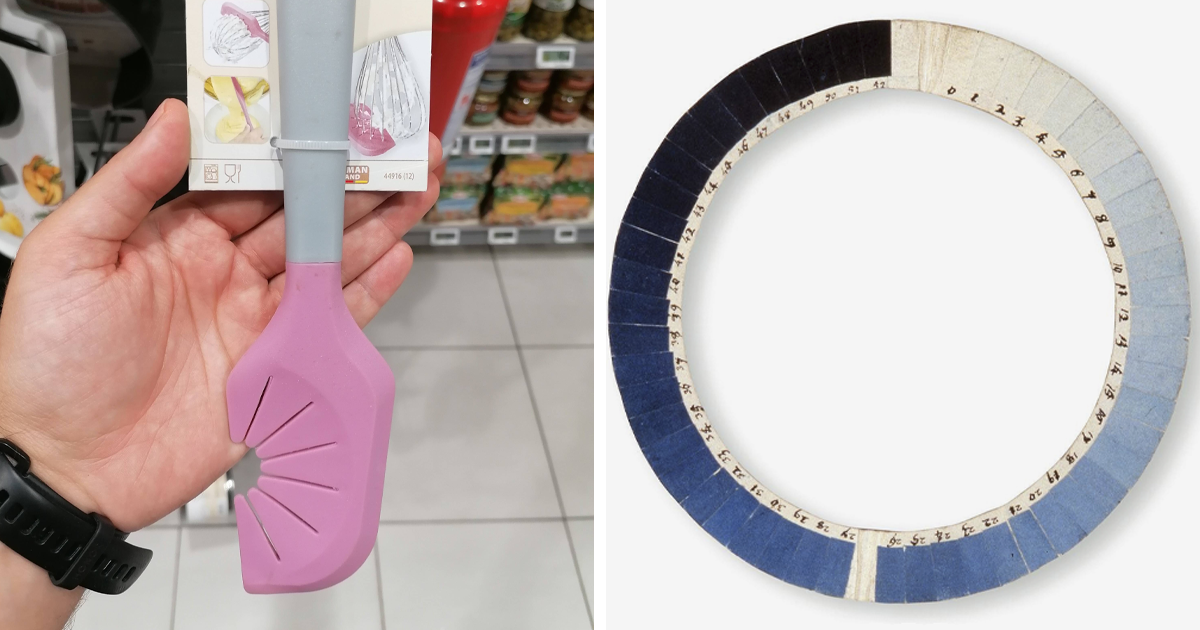
A cyanometer is a historical instrument used to compare the perceived blueness of the sky with a graduated set of blue shades. Early versions arranged the shades in a circle for visual matching. It may appear delightfully poetic, but it represents a serious attempt to turn atmospheric observation into comparable data.
17. Increment Borer
Foresters and tree researchers use an increment borer to remove a narrow core from a living tree. The core can reveal annual growth rings, tree age, growth rates, and evidence of environmental stress. Used correctly, the tool collects valuable information without requiring researchers to cut down the tree they are studying.
18. Munsell Soil Color Book
Soil scientists and archaeologists compare freshly exposed soil against standardized color chips in a Munsell book. The resulting notation helps them describe layers consistently instead of relying on phrases such as “sort of brown, but moodier.” Color differences can help distinguish natural deposits, disturbances, burning, drainage conditions, and human activity.
19. Schmidt Hammer
A Schmidt rebound hammer estimates the surface hardness of concrete or rock by measuring the rebound of a spring-driven mass. Engineers use the readings as part of condition surveys and comparative testing. It looks like a chunky mechanical flashlight, although shining it at a bridge will accomplish very little.
20. Large Wave Flume
Coastal-engineering laboratories use wave flumes to create controlled waves in long tanks. Researchers place scaled beaches, seawalls, structures, or sediment beds inside and observe erosion, flooding, and wave forces. It is an artificial ocean where the weather arrives on schedule and the coastline can be rebuilt after lunch.
Medical and Animal-Care Tools Most People Never Meet
21. Corneal Pachymeter
Eye-care professionals use pachymetry instruments to measure corneal thickness. The information can support glaucoma evaluation, corneal-disease assessment, and planning for certain eye procedures. Some systems use ultrasound while others use optical methods. Either way, they measure tissue far thinner than anything found in a typical household repair project.
22. Allergy Skin-Test Wheal Ruler
After a skin-prick allergy test, a clinician measures the raised reaction, called a wheal, and often records the surrounding redness. Transparent rulers or specialized gauges help document its size consistently. It is a tiny measuring task carrying considerably more meaning than checking whether a cookie will fit inside a jar.
23. Hoof Tester
Veterinarians and farriers use hoof testers to apply controlled pressure to different areas of a horse’s hoof. The animal’s response can help identify a painful region that deserves closer examination. The tool resembles long-handled pincers, but diagnosis depends on knowledge, technique, and interpretation rather than squeezing random parts of the foot.
24. Cow Hip Clamp
A hip clamp may be used by trained livestock handlers to assist a cow that cannot stand on its own. The device grips around the hip area and works with appropriate lifting equipment. It can support emergency care, but it must be applied carefully because improper lifting can cause additional injury.
25. Stenotype Machine
Court reporters and real-time captioners use stenotype machines with a compact keyboard that records phonetic combinations rather than individual letters. Skilled professionals can capture speech at more than 200 words per minute, with certification tests reaching 225 words per minute. Your laptop keyboard has suddenly developed performance anxiety.
Tools from Agriculture, Food Production, Art, and Conservation
26. Beekeeping Uncapping Fork
Before honey can be extracted, the wax caps sealing mature honey cells must be opened. Beekeepers use uncapping forks or knives to remove those caps while preserving as much comb as possible. The fork is especially useful around low spots that a straight knife may glide over.
27. Truffle Shovel
Truffle hunters use narrow shovels or digging tools to uncover fungi detected by trained dogs. The tool must remove soil precisely without slicing the valuable truffle or damaging the underground environment more than necessary. It is delicate excavation performed with the emotional intensity of buried-treasure recovery.
28. Mosaic Glass-Cutting Press
Mosaic artists and production studios use specialized cutters or lever-operated presses to divide glass and tile into small, repeatable shapes. The mechanical advantage reduces hand strain and improves consistency. What looks like a miniature industrial guillotine is actually helping create decorative patterns one tiny fragment at a time.
29. Violin Soundpost Setter
A violin’s soundpost is a small wooden dowel positioned inside the instrument between the top and back plates. Luthiers use slender, shaped setters to insert and adjust it through the f-hole. A movement of only a small distance can affect tone, balance, and response, so “close enough” is not a respected workshop philosophy.
30. Pop-Off Satellite Tag for Sharks
Marine researchers attach specialized archival tags to sharks and other large ocean animals. Certain tags collect depth, temperature, light, and movement data before releasing at a programmed time, floating to the surface, and transmitting information by satellite. It is a scientific message in a bottle that knows how to call home.
One More Remarkable Tool: Artillery Used for Avalanche Control
Some mountain safety teams use remotely delivered explosives or artillery systems to trigger unstable snow under controlled conditions. The objective is to release a smaller avalanche while roads, ski areas, and exposed zones are closed rather than waiting for a natural slide.
This work involves strict procedures, trained professionals, weather analysis, snowpack evaluation, and extensive safety controls. It may sound like an action-movie solution, but the real operation is methodical, technical, and focused on reducing risk.
What Working with Specialized Tools Is Really Like
The Tool Is Usually the Easy Part
Seeing an unusual professional tool for the first time often creates the same reaction: curiosity followed by the belief that its purpose must be obvious. Then the expert picks it up, performs six careful steps, checks three measurements, and reveals that the object has been misunderstood completely.
A stenotype machine, for example, is not simply a tiny keyboard. It requires users to learn a phonetic writing system, build rapid motor patterns, maintain accuracy under pressure, and translate chords into readable language. Likewise, a Schmidt hammer does not magically announce whether concrete is safe. The operator must prepare the surface, take appropriate readings, understand limitations, and interpret the results within a broader inspection.
Good Design Often Disappears into the Work
Experienced workers rarely pause to admire their specialized tools. A cable installer may treat a cable comb as ordinary, while visitors photograph the perfectly aligned wiring as though they have discovered a new art movement. A forester may calmly extract a tree core with an increment borer while an observer wonders why nobody mentioned that trees contain readable historical archives.
This difference in perspective is important. The public notices the strange shape; the professional notices whether the tool is calibrated, clean, sharp, complete, and appropriate for the task. What looks exotic from the outside becomes routine through repetition.
Training Changes What the Operator Can See
Specialized tools frequently extend expertise rather than replace it. A hoof tester provides pressure, but the veterinarian or farrier must understand anatomy and the animal’s response. A soil color book provides standardized chips, but the archaeologist must identify the correct layer, account for moisture, and connect the observation with the site’s wider context.
The same principle applies to medical instruments. A pachymeter can produce a corneal-thickness measurement, but the number gains meaning only when an eye-care professional considers other examination findings. Equipment generates information; trained people decide what that information means.
Safety Is Designed into the Object
Many unusual tools exist because the ordinary version would be unsafe. Non-sparking wrenches reduce ignition risks in certain hazardous environments. Insulated tools support electrical safety procedures. Remote demolition machines move operators farther from unstable structures. Solar-panel lifts reduce awkward manual carrying on ladders and roof edges.
These tools can create a misleading impression of invincibility. Insulation can be damaged. Lifting equipment can be overloaded. Test instruments can drift out of calibration. A specialized tool is one layer in a safety system, not permission to ignore training, inspections, protective equipment, or operating procedures.
The Best Tool May Solve an Incredibly Small Problem
Not every invention needs to transform civilization. The violin soundpost setter exists because placing a tiny wooden post through a narrow opening is frustrating, delicate work. An uncapping fork exists because a knife cannot reach every recessed patch of wax. A truffle shovel exists because a standard spade can turn a valuable fungus into expensive confetti.
These modest tools demonstrate a practical kind of creativity. Someone encountered the same inconvenience repeatedly, studied the movement required, and designed an object that made the task more controlled. The result may never appear in a hardware-store advertisement, yet it can save professionals hours over a working lifetime.
Expertise Makes Strange Equipment Look Effortless
The most memorable experience around niche tools is often watching a skilled operator. The machine itself may attract attention, but competence becomes the real spectacle. A court reporter captures rapid testimony without looking panicked. A luthier adjusts a soundpost by fractions of an inch. A technician moves through a three-dimensional model as naturally as walking through a room.
That apparent ease hides training, mistakes, maintenance, and repetition. Specialized tools are fascinating objects, but they are also reminders that professional skill is built gradually. Buying the tool may take five minutes. Learning when, why, and how to use it can take years.
Conclusion
The world is full of problems too precise for a hammer and too important for improvisation. That is where specialized tools earn their place. They help professionals collect reliable measurements, handle fragile materials, work in hazardous environments, care for animals, protect infrastructure, and study places humans cannot easily follow.
Some look futuristic, while others have changed little for generations. What they share is purpose. Every unusual curve, insulated handle, narrow probe, mechanical arm, or carefully marked scale reflects a real task faced by a real worker.
The next time you see an object that appears to be a cross between kitchen tongs and laboratory equipment, resist the temptation to press the mysterious lever. It may be worth thousands of dollars, require a license, or belong to someone whose entire afternoon depends on nobody pressing that lever.