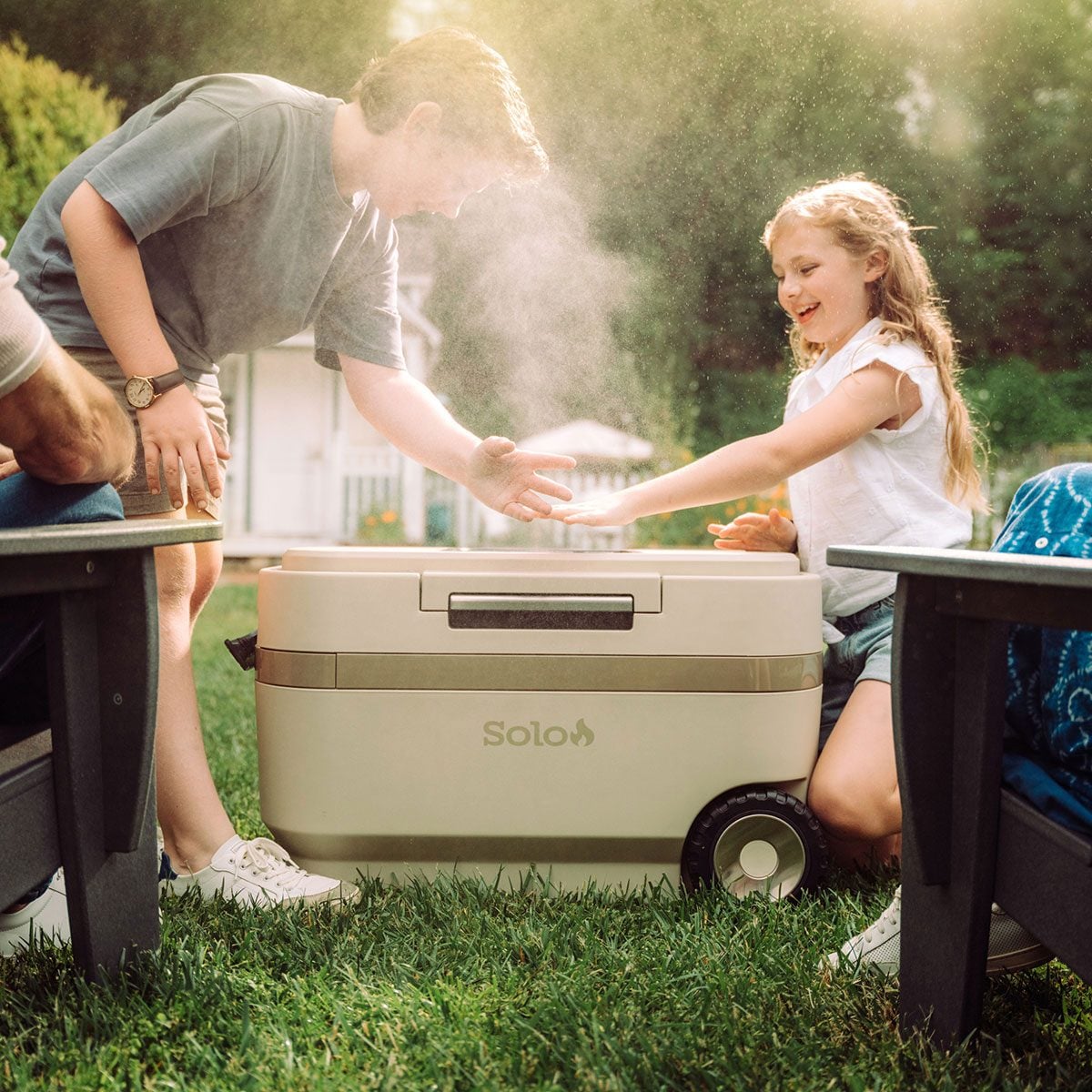

Solo Stove built its reputation by making fire pits that produce less smoke. For summer 2025, however, the outdoor-living brand decided to head in the opposite thermal direction. Its first major cooler, the Solo Windchill 47, does not simply protect sandwiches and beverages from the heat. It also uses ice, cold water, a heat exchanger, a fan, and a misting system to send cooling relief toward the people standing nearby.
In other words, Solo Stove looked at an ordinary ice chest and apparently asked, “Why is the lemonade getting all the comfort?”
The result is a 47-quart wheeled cooler that combines traditional insulated storage with a battery-powered personal cooling system. It is unusual, undeniably clever, and considerably more expensive than the cooler hiding in the back of your garage. Here is how it works, what was included at launch, and whether the Windchill 47 makes sense for your outdoor adventures.
Solo Stove Moves From Fire to Ice
Solo Stove officially introduced the Windchill 47 in May 2025 as its first cooler. The launch represented another step in the company’s expansion beyond smokeless fire pits and into a broader collection of outdoor-living products.
At launch, the Windchill 47 had a suggested price of $649.99. Preorders opened on May 14, 2025, with initial shipments scheduled to begin in early June. It was offered in two colors and initially sold through Solo Stove’s website.
That price immediately placed it in premium-cooler territory. The difference is that buyers were not paying only for insulation, wheels, and a rugged shell. A substantial part of the cost covered the powered cooling equipment built into the lid.
Solo Stove promoted the product as “the first cooler that cools you.” That is a catchy slogan, although cooler-and-airflow combinations existed before the Windchill. The more accurate distinction is that Solo Stove packaged cold storage, directed personal cooling, misting, device charging, and integrated accessories into one polished outdoor system.
What Is the Solo Windchill 47?
The Solo Windchill 47 is a foam-insulated hard cooler with a 47-quart internal capacity. Solo Stove says it can accommodate as many as 65 cans when loaded without ice. In normal cooler mode, it stores beverages, food, and ice much like any other premium hard-sided ice chest.
The interesting part lives in the lid. There, Solo Stove installed a heat exchanger, water pump, high-output fan, air outlet, control system, and rechargeable battery. Together, those components use the cold environment inside the cooler to produce a directed stream of cooler air outside it.
Solo Windchill 47 specifications
| Feature | Launch specification |
|---|---|
| Internal capacity | 47 quarts |
| Maximum can capacity | Up to 65 cans without ice |
| Weight | Approximately 42.4 pounds when empty |
| Length | 29.5 inches |
| Width | 18.8 inches |
| Height | 18.4 inches |
| Power | Rechargeable battery or plug-in adapter |
| Personal cooling | Heat-exchanger airflow and optional mist |
| Warranty | Three-year limited warranty |
The cooler’s empty weight is significant. At more than 42 pounds, it is heavier than many hard coolers with similar internal capacities. Fortunately, all-terrain wheels and a telescoping handle are standard equipment, because carrying it one-handed across a parking lot would be an ambitious way to begin leg day.
How Does the Windchill Cooler’s AC Work?
The term “air conditioning” deserves a little explanation. The Windchill does not contain a compressor-based refrigeration system like a window AC unit, portable room conditioner, or powered refrigerator. It cannot manufacture cold from electricity alone, and it does not continuously lower the temperature inside its storage compartment.
Instead, the cooler relies on the ice and cold water already inside it.
- Warm outdoor air enters the cooling system.
- A heat exchanger transfers heat from that air into the cold environment created by the ice and water.
- A battery-powered fan pushes the cooled airflow through an external vent.
- An adjustable hose can aim the stream toward a chair, picnic table, cooking station, or other nearby area.
- Mist mode can add a fine spray made from melted ice water.
When the mister is off, the system provides a directed cooling breeze without intentionally spraying water. When the mister is activated, evaporating droplets can make the airflow feel more refreshing, especially in hot, relatively dry conditions.
The important trade-off is simple: your ice has two jobs. It must keep the cooler’s contents cold while also absorbing heat from the air flowing through the system. Using the personal cooling feature will therefore consume some of the cooler’s stored cooling capacity. It is not free cold; thermodynamics remains stubbornly committed to doing paperwork.
Three ways to chill
Solo Stove positioned the Windchill around three forms of cooling:
- Insulated cold storage: Foam insulation helps preserve ice and protect food and beverages.
- Directed cool airflow: The fan and heat exchanger create a personal zone of cooler moving air.
- Fine mist: Meltwater can be pumped into the airflow for added evaporative relief.
The Windchill also provides multiple power and airflow settings. Lower-output operation can conserve battery power, while the strongest setting prioritizes immediate relief. It is best understood as personal outdoor cooling rather than whole-space climate control.
Battery Life and Runtime
The original Windchill 47 package included a rechargeable 10Ah battery. Solo Stove summarized the product as providing more than three hours of active cooling, although actual runtime depended heavily on the selected operating mode.
Early published specifications indicated that the 10Ah battery could run for roughly 9.5 hours on a low-power setting, about 4.5 hours at medium output, and approximately 2.5 hours at maximum output. An optional 17Ah battery extended those figures to about 16.2 hours on low, 7.6 hours on medium, and 4.5 hours on high.
Those estimates should not be interpreted as guaranteed real-world results. Battery age, outdoor temperature, fan speed, misting use, charging other devices, and operating conditions can all affect runtime. The cooler can also run from a compatible wall outlet, which is useful on a patio, near an RV hookup, or anywhere extension-cord access is practical.
Built-in USB-C and USB-A ports allow the battery to charge phones, speakers, and other small devices. That is convenient, but every phone rescue pulls energy from the same battery responsible for keeping the fan running. When the choice is between another hour of cool air and bringing a phone from 82% to 100%, the weather may help settle the debate.
Features Beyond the Built-In Cooling System
The Windchill 47 includes several details intended to make it function as more than an expensive box of ice with a fan attached.
Wheels and telescoping handle
Its wheels and luggage-style handle help manage the cooler’s considerable weight. The design is suitable for patios, campgrounds, paved tailgate lots, and reasonably firm trails. Deep sand, steep slopes, and rough stairways may still require two people and a healthy respect for gravity.
Directional vent hose
A flexible vent hose stores beneath the lid and connects to the external air outlet. It allows users to aim the cooling stream instead of hoping the breeze happens to choose the correct lawn chair.
Integrated bottle opener and drink storage
A built-in bottle opener, drink-holder accessories, and attachment points support the cooler’s role as a social hub. Optional accessories included a side table and additional drink storage.
Rear drain and lid support
A rear-facing drain simplifies emptying melted ice, while a lid kickstand helps keep the lid stable when opened. These are not dramatic innovations, but small conveniences become surprisingly important when a cooler is packed with ice, snacks, and 40 pounds of assorted beverages.
Traditional insulation
Solo Stove advertised ice retention of up to six days when the Windchill was used as a conventional cooler with the lid kept closed. As with all ice-retention claims, actual performance depends on ambient temperature, initial food temperature, ice quantity, opening frequency, and exposure to sunlight.
Where the Solo Stove Cooler With AC Makes Sense
The Windchill 47 is not designed to cool a bedroom, enclosed tent, garage, or entire patio. Its strength is creating a localized pocket of relief for people gathered close to the outlet.
Backyard cooking
Anyone standing over a grill in July knows that “outdoor chef” can quickly become “lightly seasoned human brisket.” Positioning the Windchill near the cooking area could make meal preparation more comfortable while keeping beverages close at hand.
Tailgating
Tailgate parties are a natural fit. The wheels help with transportation across parking lots, the cooler stores drinks, the battery removes the need for a generator, and the directed airflow can serve a few nearby chairs.
Youth sports
Parents and players spending hours beside a baseball, softball, soccer, or lacrosse field may appreciate a cooling station between periods of activity. It should complement shade, hydration, appropriate clothing, and heat precautionsnot replace them.
Camping and RV trips
At a developed campsite, the Windchill can serve as a cooler during the day and a personal cooling device around camp. Plug-in operation is particularly useful at powered sites. Its weight and dependence on ice make it less appealing for minimalist camping or any trip involving a long carry.
Boating and fishing
Its combination of cold storage, wheels, airflow, and misting may appeal to anglers and boaters. Buyers should still secure the cooler properly, protect its powered components, and follow the manufacturer’s instructions regarding water exposure.
Advantages of the Solo Windchill 47
- Genuinely useful multifunction design: It combines cold storage, personal airflow, misting, charging, and mobility.
- Portable operation: The rechargeable battery allows cooling away from electrical outlets.
- Directional airflow: The hose makes the system more practical than an unfocused fan.
- Large beverage capacity: A 47-quart compartment is suitable for families, parties, and group outings.
- Thoughtful convenience features: Wheels, a handle, bottle opener, drain, charging ports, and accessory mounts improve daily use.
- Plug-in flexibility: Owners can preserve battery power when an outlet is available.
Potential Drawbacks to Consider
The launch price was high
At nearly $650, the Windchill 47 cost much more than many capable wheeled coolers. Buyers could purchase a conventional cooler, a rechargeable fan, and plenty of ice for considerably less. The premium only makes sense when the integrated design will be used regularly.
It is heavy before you add anything
The 42.4-pound empty weight becomes much more intimidating after adding ice, food, and beverages. Wheels solve part of the problem, but they do not help when loading the cooler into a truck bed or carrying it upstairs.
Active cooling uses stored cold
The heat exchanger transfers outdoor heat into the ice and cold water. Running the cooling system can therefore shorten ice life compared with leaving the lid closed and using the Windchill only for storage.
Cooling is localized
This is not a substitute for indoor air conditioning. The breeze becomes less noticeable with distance, and wind can push it away from the intended target. For the best experience, users need to sit fairly close and aim the outlet carefully.
Misting performance depends on the weather
Mist can feel excellent in dry heat because water evaporates quickly. In very humid weather, evaporation happens more slowly, so the result may feel damp rather than dramatically cooler. The non-misting airflow mode may be the better choice on muggy days.
The system adds maintenance
A normal cooler needs cleaning and drying. The Windchill also has a pump, vent, hose, battery, ports, and other powered components that require proper care. Owners should drain it thoroughly, clean food residue promptly, allow the interior to dry, and store the battery according to the manufacturer’s directions.
Is the Solo Windchill 47 Worth It?
The Windchill 47 is worth considering for people who spend many hot days outdoors and value convenience more than minimum cost. It is especially compelling for frequent tailgaters, patio entertainers, sports families, RV travelers, and campers who already bring a large cooler and would otherwise carry a separate fan or misting device.
It is harder to justify for occasional picnics, short beach visits, solo travelers, or shoppers mainly concerned with maximum ice retention. A simpler premium cooler will be lighter, less expensive, easier to maintain, and better at focusing all its stored cooling power on food and drinks.
The smartest buying question is not, “Is AC in a cooler cool?” Of course it is cool. The smarter question is, “How many times each summer will I actually use the powered airflow?” If the answer is every weekend, the multifunction design may earn its space in the garage. If the answer is once during a Fourth of July cookout, the Windchill may become the world’s fanciest bottle opener.
A Realistic Windchill 47 Experience: What a Full Day Could Be Like
The following scenario illustrates the practical ownership experience based on the product’s design and published specifications rather than claiming a personal hands-on test.
Imagine preparing for a Saturday youth baseball tournament. The forecast calls for temperatures in the low 90s, the parking area is a long walk from the field, and the family will be outside from late morning until dinner. The night before, you charge the Windchill battery, chill the beverages in the refrigerator, and freeze several reusable ice packs. Prechilling matters because forcing warm cans and room-temperature food to cool inside the chest wastes ice before the day even begins.
In the morning, you load the cooler with ice, cold drinks, fruit, sandwiches, and a few towels sealed in waterproof bags. There is plenty of space, although reaching the advertised 65-can maximum would leave little room for ice or lunch. Like most capacity claims, the number is best treated as a stacking demonstration rather than a recommended menu.
At the tournament, the telescoping handle and wheels make the trip across the parking lot manageable. The cooler still feels substantial, especially when lifting it over a curb. Once it reaches the sideline, you position it beneath a canopy instead of leaving it in direct sunlight. That simple choice reduces the heat entering the cooler and helps both the ice and battery perform more effectively.
During the first game, Eco mode provides moving air without consuming maximum power. The breeze is most noticeable when a chair is positioned close to the hose. People several feet away may feel only a mild effect, particularly if natural wind carries the airflow in another direction. This quickly teaches the most important setup lesson: Windchill works best as a personal cooling station, not as outdoor central air.
By early afternoon, the temperature rises and some of the ice has melted. That is when Max mode becomes more appealing. Aiming the hose at the neck and upper body creates a more convincing sensation of relief than pointing it randomly across the seating area. The air does not turn the tournament into an October morning, but it can make the immediate space more tolerable.
Mist mode adds another layer of cooling. In a dry climate, the fine spray may evaporate quickly and feel refreshing. In humid conditions, you may prefer short bursts rather than continuous mist. Sunglasses, paper scorecards, uncovered food, and nearby electronics should stay out of the direct spray path.
Throughout the day, children open the cooler repeatedly, adults search for the drink that is somehow always at the bottom, and every lid opening allows warm air inside. The powered cooling system also transfers additional heat into the ice water. By late afternoon, ice retention is naturally lower than it would be if the cooler had remained closed and inactive. That is the cost of asking the ice to cool both the contents and the people.
The USB charging ports prove useful when a phone battery runs low, although charging should be used strategically when cooling runtime matters. At the end of the tournament, the rear drain makes it easy to remove excess water before loading the cooler into the vehicle. Reducing that water weight is a small act of kindness toward whoever drew the short straw and must lift it.
Back at home, the ideal routine is to empty the remaining contents, wash the interior with mild soap and water, wipe the hose and accessible surfaces, drain the system completely, and leave the lid open until everything is dry. The battery can then be recharged for the next trip.
That full-day experience reveals both sides of the Windchill concept. It demands more preparation and maintenance than an ordinary cooler, and it cannot defeat extreme heat by itself. However, when placed correctly, supplied with enough ice, and used near the people who need it, the system could make long outdoor events noticeably more comfortable. The best experience comes from treating it as a premium cooler plus a personal cooling stationnot as a magical refrigerator that also controls the weather.
Final Verdict
The Solo Windchill 47 was one of the most unusual outdoor product launches of 2025. It combined a capable 47-quart cooler with battery-powered airflow, optional misting, device charging, rugged wheels, and a directional vent system. The idea sounds like a summer gadget invented during an especially sweaty brainstorming session, but the underlying concept is practical: use the cold energy already stored in the cooler to provide relief to the people carrying it.
Its disadvantages are equally clear. The Windchill is heavy, expensive, dependent on ice, and designed for localized cooling. Running the system can reduce the amount of cold available for food and beverages, while high-power operation limits battery life.
For frequent outdoor hosts and travelers, those compromises may be reasonable. For everyone else, a conventional cooler and rechargeable fan remain the simpler value. Either way, Solo Stove succeeded in making the humble ice chest interesting againand possibly a little jealous of your home thermostat.