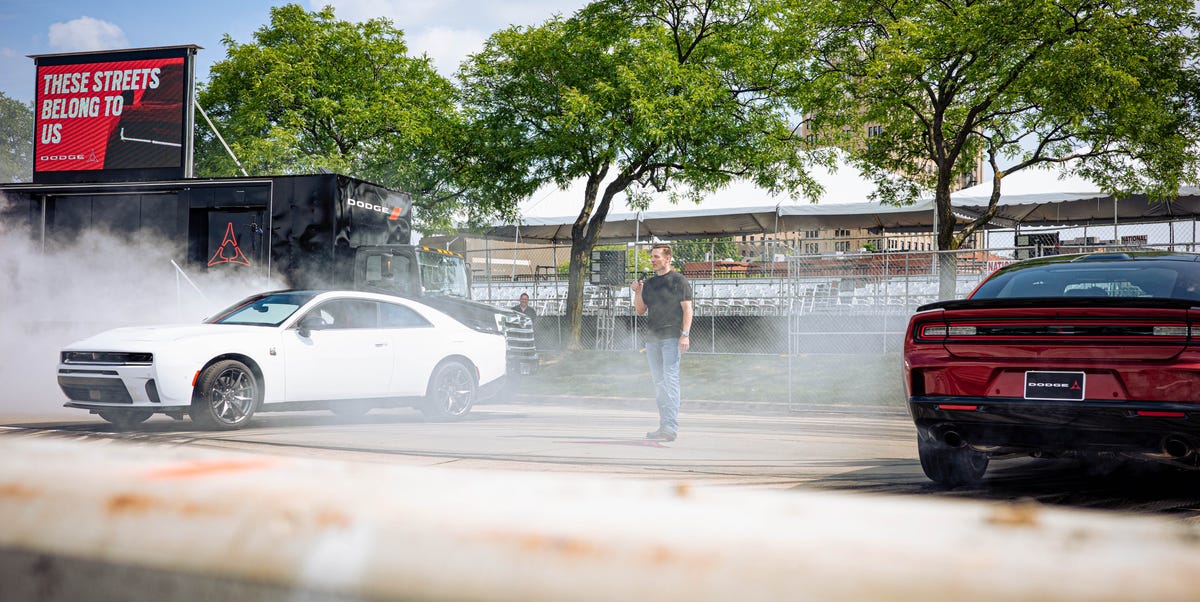

The Dodge Charger has never been a car for people who whisper when shouting is available. For decades, it has specialized in broad shoulders, questionable tire longevity, and the sort of acceleration that rearranges whatever you left loose in the center console.
The new Dodge Charger Sixpack keeps that attitude but changes nearly everything underneath it. Instead of relying on a traditional Hemi V-8, the gasoline-powered 2026 Charger uses a twin-turbocharged 3.0-liter inline-six. It comes with standard all-wheel drive, can switch to rear-wheel drive when the driver feels mischievous, and is available with either two or four doors. It even has a large liftback cargo area.
That combination makes the Charger Sixpack difficult to categorize. It is part muscle car, part grand tourer, part all-weather performance machine, and part enormous family hatchback wearing the expression of a nightclub bouncer. That odd mixture is precisely what makes it so freakin’ unique.
First, What Does “Sixpack” Actually Mean?
Longtime Mopar fans may associate the Six Pack name with Dodge’s legendary 440-cubic-inch V-8 equipped with three two-barrel carburetors. In the new Charger, however, SIXPACK is Dodge’s branding for its Hurricane 3.0-liter twin-turbo inline-six engine. The historical reference remains, but there are no carburetors hiding beneath the hood and no need to adjust anything with a screwdriver before breakfast.
The engine comes in two versions. The Charger R/T receives the standard-output SIXPACK S.O., producing 420 horsepower and 468 pound-feet of torque. The Charger Scat Pack uses the high-output SIXPACK H.O., which raises output to 550 horsepower and 531 pound-feet.
For perspective, the standard-output R/T makes more horsepower than the previous 5.7-liter Hemi-powered Charger R/T. Meanwhile, the 550-horsepower Scat Pack comfortably exceeds the 485 horsepower produced by the old 6.4-liter naturally aspirated Scat Pack V-8. The new engine may have two fewer cylinders, but it certainly did not arrive carrying an apology letter.
Dodge says the Scat Pack can accelerate from zero to 60 mph in approximately 3.9 seconds, complete the quarter-mile in about 12.2 seconds, and reach a top speed of 177 mph. The R/T targets zero to 60 mph in 4.6 seconds, a 12.9-second quarter-mile, and a 168-mph top speed. Independent testing has produced similarly quick results, with some Scat Pack tests recording 60 mph in as little as 3.7 seconds.
A Turbocharged Inline-Six Built for Serious Work
The high-output engine is more than a regular Hurricane with the boost knob turned toward “financially irresponsible.” It uses a cast-aluminum block, forged-steel crankshaft, forged-steel connecting rods, and forged-aluminum pistons. Twin Garrett turbochargers provide substantial boost, while the engine’s broad torque curve supplies strong thrust through much of the rev range.
Dodge says the high-output engine can deliver 88 percent of its peak torque at 2,500 rpm and more than 90 percent from 3,000 to 6,000 rpm. In everyday language, that means the driver does not need to wait for the tachometer needle to reach the stratosphere before the car starts moving with authority.
The standard-output R/T uses smaller turbochargers and a different intake arrangement. Although it gives away 130 horsepower to the Scat Pack, reviewers have noted that its smaller turbos can respond more quickly at lower engine speeds. The R/T may therefore feel eager and flexible around town, even if it cannot match the high-output version when the road opens up.
Both engines are paired with an eight-speed TorqueFlite automatic transmission. A manual gearbox is not offered, which will disappoint drivers who believe every performance car should include a clutch pedal and an occasional embarrassing stall in front of a coffee shop. Still, the automatic shifts quickly, keeps the engine in its boost range, and helps the Charger produce repeatable acceleration.
Standard AWD With Rear-Wheel-Drive Mischief on Demand
The Charger’s drivetrain may be its most unusual feature. Every Sixpack model comes with all-wheel drive, giving it strong launch traction and greater confidence in rain, snow, or cold weather. Yet Dodge understands that a muscle car unable to roast its rear tires would cause an identity crisis.
Drivers can select a rear-wheel-drive mode that disconnects the front axle and sends all available torque to the rear wheels. This makes burnouts, controlled slides, donuts, and other activities best enjoyed on a closed course possible without permanently sacrificing the security of AWD.
During normal cruising, the front axle can also disconnect when additional traction is unnecessary. This reduces drivetrain losses and helps improve efficiency. The Charger is therefore capable of behaving like an all-weather performance car, a rear-drive muscle machine, or a calmer highway cruiser depending on the selected mode.
Performance Features That Encourage Bad Ideas Responsibly
The Scat Pack includes performance functions such as Launch Control and Line Lock. Launch Control helps the car make consistent standing starts, while Line Lock holds the front brakes so the rear tires can spin. The latter is officially useful for warming the tires before a drag-strip run. Unofficially, it is useful for converting expensive rubber into smoke and social-media content.
A mechanical limited-slip rear differential helps distribute torque between the rear wheels. The available performance settings can also adjust throttle response, transmission behavior, steering weight, stability control, and drivetrain operation. Few modern cars offer such a broad transition from sensible AWD transport to deliberate rear-wheel-drive hooliganism.
It Shares a Platform With an EVand That Is Not a Bad Thing
The Sixpack is built on Stellantis’ STLA Large architecture, the same flexible platform used by the electric Charger Daytona. This multi-energy foundation was engineered to support both battery-electric and internal-combustion powertrains.
That fact may initially make traditionalists nervous, but it gives the new Charger several advantages. The body is structurally modern, the suspension is fully independent, the cabin incorporates current technology, and Dodge can offer dramatically different powertrains without designing two unrelated cars.
The gasoline Charger is also roughly 1,000 pounds lighter than the electric Daytona, depending on configuration. Unfortunately, “lighter” does not mean “light.” A Sixpack Scat Pack still weighs around 4,800 pounds, while the R/T is also well above 4,700 pounds. This is less a ballerina and more a linebacker who has taken advanced dance classes.
The chassis uses a multilink front suspension and an independent four-link rear layout. Available performance brakes include large Brembo components, while sportier suspension tuning is offered on higher trims and packages. Reviewers generally agree that the new Charger handles more precisely than its predecessor, although its considerable width and mass remain obvious on tight roads.
A Muscle Car Available With Two Doors or Four
Most performance cars force buyers to choose a category. The Ford Mustang is a two-door coupe. Performance sedans offer four doors but often lack traditional muscle-car styling. The Charger Sixpack simply refuses to choose.
Buyers can order it as a two-door coupe or a four-door sedan. Both body styles retain nearly identical fastback proportions, a broad stance, and a rear liftgate instead of a small conventional trunk opening. The four-door model adds easier rear-seat access without transforming the Charger into a visually ordinary family sedan.
The car is enormous. It measures roughly 206.6 inches long and nearly 80 inches wide, placing it closer in footprint to some full-size luxury cars than compact sports coupes. Navigating a narrow parking garage may feel like steering an aircraft carrier through a grocery aisle, but that size creates genuine passenger space.
The cabin accommodates five occupants, and the rear seat is far more usable than the token back seats found in many coupes. Folding the rear seats expands the cargo area to approximately 37.4 cubic feet. A Charger owner could attend a track day on Saturday, move several large boxes on Sunday, and conduct a school run on Mondayall while using the same car.
That practicality is not a side note. It is one of the Charger’s strongest advantages. Very few vehicles combine 550 horsepower, selectable rear-wheel drive, AWD traction, five-passenger seating, and hatchback-like cargo access.
The Design Looks Familiar but Functions Differently
The Sixpack shares much of its bodywork with the electric Charger Daytona, including the low roof, squared-off nose, full-width lighting, and wide rear haunches. However, several details identify the gasoline model.
The Sixpack trades the Daytona’s aerodynamic R-Wing front pass-through for a more traditional grille and larger cooling openings. A pronounced hood bulge helps package the inline-six and gives the front end a classic muscle-car profile. At the rear, actual dual exhaust outlets provide the visual clue that gasoline is being burned somewhere ahead.
The design references multiple generations of Charger without becoming a rolling costume. Its long hood and fastback roof recall classic models, while the lighting and clean surfaces keep the car contemporary. It looks retro enough to trigger recognition but modern enough that nobody will mistake it for a restored 1968 Charger at a gas station.
Most important, the two-door and four-door versions share the same basic shape. The sedan does not look like a practical afterthought, and the coupe does not sacrifice its rear hatch merely to satisfy a traditional body-style definition.
A Cabin That Finally Feels Like a New Generation
Inside, the Charger receives a technology-focused cockpit with a digital instrument cluster and a central Uconnect touchscreen. Depending on trim, equipment can include a 12.3-inch infotainment display, a larger digital gauge cluster, a head-up display, wireless smartphone connectivity, navigation, a panoramic glass roof, premium Alpine audio, ventilated seats, and 64-color ambient lighting.
The dashboard faces the driver, and the pistol-grip shifter provides a small visual connection to classic Mopar interiors. Dedicated performance pages display information such as boost pressure, temperatures, acceleration data, and drive-mode settings.
The atmosphere is significantly more sophisticated than the previous Charger’s aging cabin. That said, not everything is perfect. Some climate controls depend heavily on the touchscreen, and reviews have criticized certain touch-sensitive functions. The interior also contains enough menus and lighting configurations to make a 1970 Charger owner suspect the car is attempting to launch a satellite.
Nevertheless, the mixture of modern displays, physical performance controls, roomy seating, and everyday storage reinforces the Charger’s dual identity. It is designed to entertain the driver without making every passenger feel like punishment cargo.
How the Charger Sixpack Compares With the Old Hemi Cars
The absence of a V-8 is impossible to ignore. A naturally aspirated Hemi delivers an immediate, mechanical response and a deep exhaust note that a turbocharged six-cylinder cannot perfectly reproduce. For some buyers, the sound and emotional character of the V-8 mattered more than any stopwatch result.
The Sixpack engine sounds smoother, sharper, and more modern. It does not produce the same chest-thumping idle or low-rpm thunder. Drivers seeking the old Charger’s exact sensory experience will not find it here.
What they will find is more power, quicker acceleration, broader all-weather capability, improved chassis control, and a more advanced cabin. Car and Driver testing showed the 550-horsepower Sixpack Scat Pack reaching 60 mph and completing the quarter-mile more quickly than a previous 6.4-liter Challenger R/T Scat Pack Widebody. The older car remained lighter and performed better in some braking and handling measurements, illustrating the new Charger’s central trade-off: greater speed and versatility, but also greater size and complexity.
The Sixpack does not replace the Hemi’s personality. It creates a different kind of personalityone built around turbocharged torque, configurable traction, and digital adaptability. Whether that is progress or sacrilege depends largely on how many Hemi T-shirts are currently in the reader’s closet.
Is It a True Rival to the Ford Mustang?
On paper, the Charger Scat Pack and Mustang GT appear to be natural rivals. Both are American performance cars with rear-drive capability and enough horsepower to make an insurance quote interesting.
In practice, they approach the job differently. The Mustang is smaller, lighter, and available with a naturally aspirated V-8 and manual transmission. It feels more like a traditional sports coupe. The Charger is larger, roomier, more refined, standard with AWD, and dramatically more useful for passengers and cargo.
A comparison test characterized the Charger as a sophisticated, practical coupe capable of sports-car acceleration, while the Mustang delivered the more traditional and intimate performance experience. The Charger is not trying to out-Mustang the Mustang. It is offering buyers something the Mustang cannot: five-passenger space, a huge liftback, four-door availability, and winter-friendly AWD paired with switchable rear-drive behavior.
Choosing between them is therefore less about determining which car is objectively superior and more about deciding whether the buyer wants a compact performance instrument or a high-speed grand tourer that can swallow luggage, passengers, and possibly a small appliance.
The Downsides: Weight, Price, Sound, and Complexity
Uniqueness does not automatically equal perfection. The Charger Sixpack has several meaningful drawbacks.
It Is Heavy
The car’s mass affects braking, tire wear, steering feedback, and agility. Reviewers have found the Charger surprisingly capable on winding roads, but nobody is likely to confuse it with a lightweight sports car. Tight corners expose its size, and abrupt transitions remind the driver that nearly two and a half tons are participating in the discussion.
It Is Not Cheap
At launch, U.S. pricing started at approximately $51,990 for the R/T and $56,990 for the Scat Pack, including destination charges. Plus trims and option packages can push the total considerably higher. The small price gap between the base R/T and Scat Pack may make the 550-horsepower model especially tempting, although insurance, fuel, and tires may have their own opinions.
It Does Not Sound Like a V-8
The inline-six has authentic combustion noise and real exhaust outlets, but it lacks the lazy rumble and dramatic roar of a large-displacement Hemi. Some versions use speaker-enhanced engine sound, which reviewers have not universally praised.
More Technology Means More Things to Learn
Drive modes, touch controls, active drivetrain systems, electronic brake calibration, turbochargers, and configurable displays create tremendous versatility. They also make the car more complicated than the old formula of “large engine, rear tires, good luck.” Buyers planning long-term ownership may reasonably consider maintenance costs and first-year reliability when making a decision.
Who Should Consider the Dodge Charger Sixpack?
The Sixpack makes the most sense for drivers who want one performance car to handle nearly everything. It can commute comfortably, carry adults in the rear, tackle bad weather, transport bulky cargo, produce serious drag-strip numbers, and become rear-wheel drive for controlled track-day entertainment.
The R/T is suited to buyers who value responsiveness, all-weather traction, and everyday comfort more than maximum output. Its 420 horsepower is hardly modest, and its smaller turbos may feel lively during ordinary driving.
The Scat Pack is the obvious choice for drivers who want the full Sixpack experience. Its 550 horsepower, stronger performance hardware, and relatively small initial price increase over the R/T create a compelling package. However, option-heavy Scat Pack Plus models can become expensive quickly.
Drivers who prioritize a manual gearbox, low weight, V-8 sound, or razor-sharp handling may prefer a Mustang or a dedicated sports car. Those who need electric acceleration and home charging may prefer the Charger Daytona. The Sixpack occupies the strange and fascinating territory between them.
Conclusion: Why the Charger Sixpack Really Is Different
The new Dodge Charger Sixpack is unique because it refuses to preserve muscle-car tradition in a museum display. Instead, it takes the old ideasbig power, bold styling, straight-line speed, and rear-tire abuseand combines them with technologies that broaden what a muscle car can do.
Its twin-turbo inline-six produces up to 550 horsepower. Standard AWD makes that power usable in more conditions. Rear-wheel-drive mode preserves the possibility of smoky nonsense. Two- and four-door body styles expand its audience, while the large liftback and spacious cabin make it unexpectedly practical.
The Charger is heavy, expensive, and unable to duplicate the emotional thunder of a Hemi V-8. Yet judging it solely by what it lacks misses the point. There is no other new American performance car offering this precise combination of power, traction, body styles, passenger room, cargo capacity, and configurable personality.
It is not the old Charger with a smaller engine. It is a new kind of Chargerone that can launch through rain, haul a week’s worth of luggage, cruise quietly across several states, and then disconnect its front axle when the driver reaches a closed course. That is a wonderfully strange résumé, and it is why the Sixpack stands apart.
Extended Experience: What Living With the Charger Sixpack May Feel Like
The Daily Commute
In routine traffic, the Charger Sixpack’s most noticeable quality may not be its horsepower. It may be how ordinary the car can feel when the driver is not demanding fireworks. The eight-speed transmission shifts smoothly, the turbocharged engine supplies abundant low- and midrange torque, and the cabin provides the comfort and technology expected in a modern grand tourer.
The R/T should be particularly agreeable in this environment. Its 420 horsepower is more than enough for decisive freeway merging, yet its smaller turbochargers can deliver quick response without requiring an aggressive downshift. The Scat Pack always feels as though it is storing additional trouble beneath the accelerator, but it can still settle into a relaxed cruise.
The main adjustment is physical size. The long hood and wide body create a commanding view, but narrow parking spaces require attention. Available surround-view cameras and tire-to-curb views can help. Without them, positioning the car may feel like docking a very fast yacht.
A Wet or Snowy Morning
Traditional high-powered muscle cars often demand delicate throttle inputs when the weather becomes unpleasant. The Sixpack’s standard AWD changes that experience. Rather than turning every wet intersection into an involuntary drift lesson, the system can distribute power across four tires and help the car accelerate with greater stability.
Reviewers driving the R/T in snowy Vermont conditions found the AWD system gave the car genuine all-season usefulness. That does not make performance tires appropriate for every winter, nor does AWD shorten braking distances on ice. Proper seasonal tires remain essential. Still, the drivetrain allows owners in colder states to enjoy a Charger without automatically storing it every time the forecast includes a snowflake emoji.
A Mountain Road
On a sweeping road, the Charger reveals both its progress and its limitations. The independent suspension provides better control than older Chargers, and the car can generate impressive speed between corners. Strong brakes and abundant torque make it easy to slow, rotate, and accelerate away.
On tighter sections, however, the width and weight become impossible to ignore. The driver must plan braking zones and avoid treating the car like a compact sports coupe. Smooth inputs produce the best results. Charging into every corner as though auditioning for an action movie will quickly overwhelm the front tires and possibly the passenger’s enthusiasm.
The Charger feels most natural on broad, fast roads where its stability, power, and long wheelbase can work together. It is a grand-touring muscle car rather than a surgical track tool. Think sledgehammer with electronic calibration, not carbon-fiber scalpel.
A Drag Strip or Closed Performance Course
At a drag strip, the Sixpack’s contradictory personality suddenly makes complete sense. AWD helps the Scat Pack apply 550 horsepower without immediately vaporizing the tires, producing consistent launches and sub-four-second acceleration. The automatic transmission removes the variability of manual shifts, while Launch Control helps repeat the process.
Then the driver can select rear-wheel-drive mode and access Line Lock when conditions permit. The car that just used AWD to launch efficiently can now perform the tire-smoking ritual expected of a Dodge. This ability to alternate between maximum traction and maximum theater is one of the most memorable parts of the Sixpack experience.
A Weekend Trip
The liftback may be the feature that owners appreciate long after the novelty of Launch Control fades. The rear opening is wide, the seats fold, and the cargo area can accommodate luggage that would never fit comfortably through a conventional coupe trunk.
A couple could take the two-door model on a long road trip without packing like minimalists. A family could choose the four-door and gain easier rear access without giving up the Charger’s dramatic shape. Golf clubs, camping equipment, camera cases, or track-day tools should be much easier to load than they would be in most performance coupes.
The Ownership Reality
The Sixpack’s performance will bring predictable expenses. Wide tires are costly, enthusiastic driving consumes fuel, and insurance companies are rarely sentimental about 550-horsepower vehicles. EPA figures can reach approximately 17 mpg in the city and 26 mpg on the highway for certain configurations, but actual results will depend heavily on trim, tires, traffic, and how frequently the driver explores the boost gauge.
Early adopters should also remember that the new Charger combines a new platform, extensive electronics, an advanced AWD system, and a high-output turbocharged engine. Warranty coverage, service availability, and dealer competence should be part of the purchase discussion, not merely the horsepower number printed on the brochure.
Even with those considerations, the real-world appeal is easy to understand. The Charger Sixpack provides a sense of occasion without requiring the owner to tolerate the usual compromises of a dedicated sports car. It is fast enough to feel outrageous, comfortable enough to use regularly, practical enough to justify, and strange enough to remain interesting after the first month.
That may be its greatest achievement. The Sixpack does not merely generate impressive specifications. It offers several distinct experiences inside one enormous, unapologetic body: secure AWD commuter, relaxed highway cruiser, roomy family car, rapid grand tourer, drag-strip launcher, and rear-drive smoke machine. Few cars can switch personalities so convincinglyand even fewer do it while looking ready to argue with the entire parking lot.