
Comedy in 2021 had a strange assignment. Make people laugh while the world was still carrying pandemic anxiety, social unrest, streamon that everyone had somehow joined six subscription services just to find one sitcom. Easy, right?
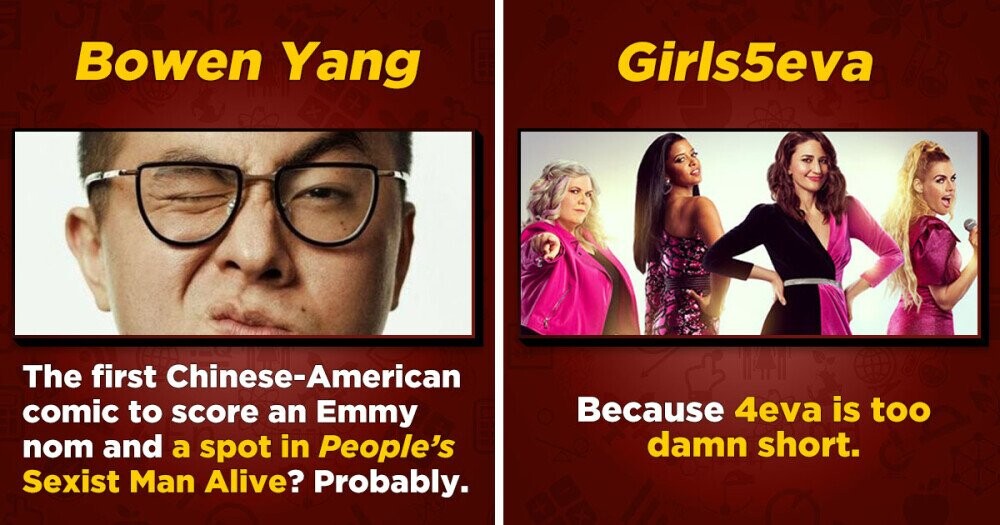
Against that chaotic backdrop, the inaugural 2021 ComedyNerd Cup offered an editorial snapshot of the year’s funniest achievements rather than a formal industry awards ceremony. Its central choices captured three very different ways comedy thrived: Girls5eva turned pop-music nostalgia into a joke machine, Bowen Yang became one of television’s most unpredictable breakout performers, and Bo Burnham’s Inside transformed a room, a camera, some lights, and a deeply unhealthy relationship with the internet into the overall winning work. ooking back, those selections feel like more than a collection of funny favorites. Together, Girls5eva, Bowen Yang, and Bo Burnham reflected the unusual shape of comedy in 2021: nostalgic but skeptical, absurd yet emotionally serious, extremely online, and increasingly willing to make the machinery of entertainment itself the punchline.
Why the 2021 ComedyNerd Cup captured an unusual year in comedy
The entertainment business had not returned to anything resembling normal in 2021. Production schedules had been disrupted, theatrical releases were still navigating uncertainty, and streaming platforms had become even more central to how audiences discovered new comedy. Yet funny people kept finding ways to work within those limitations.
That is what makes the ComedyNerd Cup concept interesting in retrospect. Instead of pretending the year had produced one neat, universally agreed-upon comedy champion, the selections highlighted several forms of humor. There was a musical sitcom about a forgotten girl group, a sketch performer capable of making a historical iceberg behave like a celebrity with a publicist, and a one-man musical special that made doomscrolling sound disturbingly catchy.
These were not interchangeable achievements. They represented three different comedy engines.
- Girls5eva used ensemble chemistry, rapid-fire jokes, and original music.
- Bowen Yang used character comedy, cultural fluency, and fearless absurdity.
- Bo Burnham used filmmaking, songwriting, self-examination, and digital satire.
The common ingredient was reinvention. In 2021, simply walking onto a stage and telling jokes was no longer the only model for major comedy. The funniest work could look like a sitcom, a viral Saturday Night Live segment, a pop song, a video essay, or an existential breakdown with excellent lighting.
Girls5eva: the comeback comedy that understood nostalgia
A one-hit wonder gets another chance
Created by Meredith Scardino and executive produced by figures including Tina Fey, Robert Carlock, and Jeff Richmond, Girls5eva begins with an irresistible comic premise. A fictional turn-of-the-millennium girl group reunites years after its brief moment of fame when a younger rapper samples its old hit.
The surviving members are no longer living synchronized-pop-star lives. Dawn, played by Sara Bareilles, has settled into family life. Wickie, played with magnificent diva energy by Renée Elise Goldsberry, remains determined to behave as though superstardom simply misplaced her address. Busy Philipps plays the cheerfully oblivious Summer, while Paula Pell’s Gloria brings bluntness, hunger, and wonderfully aggressive enthusiasm to the reunion.
The first season arrived on Peacock in May 2021 and quickly became notable for its extraordinarily high joke density, its ensemble performances, and songs that worked both as musical comedy and as suspiciously effective pop. Contemporary reviews repeatedly highlighted the show’s rapid-fire comic style, its cast chemistry, and its ability to parody the entertainment industry while still making the group’s comeback emotionally meaningful. The songs were not decoration; they were weapons
A weaker version of Girls5eva could have used generic songs as brief interruptions between sitcom scenes. Instead, the music became one of the show’s sharpest forms of satire.
The fictional group’s old material parodies an era when record labels packaged empowerment, innocence, sexuality, and commercial calculation into one sparkly product. The jokes work because the songs often sound close enough to genuine Y2K pop to trigger a moment of uncertainty. You laugh at the lyric and then, two hours later, discover the chorus has moved into your brain and started paying no rent.
The show’s musical approach also gave it room to discuss aging in an industry obsessed with youth. The women are trying to rebuild careers while dealing with families, failed expectations, changing bodies, old business arrangements, and a culture that once treated them as marketable products. Yet Girls5eva rarely turns into a lecture. The satire arrives disguised as a ridiculous lyric, an inflated celebrity memory, or Wickie behaving as though airport employment is simply an avant-garde phase of international fame.
That balance helped the series stand out. Pitchfork included both Girls5eva and Bo Burnham: Inside among its notable music-related screen works of 2021, underlining how central musical comedy was to the year’s creative identity. Why Girls5eva deserved the “funniest TV show” spotlight
The series could be delightfully silly without being empty. Beneath the throwaway references and elaborate pop-industry nonsense was a sincere story about friendship and creative ambition after the age when popular culture traditionally tells women to become somebody’s supportive mother.
That gave the show an unusual emotional foundation. The comeback mattered even when the comeback was a disaster. The women were not merely chasing fame; they were trying to decide whether an old dream could be rebuilt on healthier terms.
Also, it had jokes. So many jokes. A viewer could miss one while laughing at the previous one and immediately be hit by another. The show operated like a confetti cannon loaded by comedy writers who had apparently been told that unused punchlines would expire at midnight.
Bowen Yang: the breakout comedy star who could make anything a character
The Iceberg That Sank the Titanic changed the weather
Bowen Yang’s 2021 breakthrough can be summed up by one gloriously ridiculous question: What if the iceberg that sank the Titanic did not want to discuss the tragedy because it was busy promoting an album?
The Weekend Update appearance became one of Yang’s signature performances. Co-written with Anna Drezen, the sketch transformed a historical object into a defensive, celebrity-coded personality frustrated that interviewers kept bringing up an unpleasant event from the past. The premise was absurd. The commitment made it brilliant.
Entertainment Weekly reported on both the sketch’s development and Yang’s historic 2021 Emmy nomination. He became the first SNL featured player to receive an acting Emmy nomination, competing for Outstanding Supporting Actor in a Comedy Series. Official Television Academy records confirm the nomination. he Iceberg worked because Yang understood how modern public figures speak when they are simultaneously promoting something, managing a scandal, establishing boundaries, and performing outrage. The character was technically frozen water. Emotionally, it had an excellent publicist.
Bowen Yang’s comedy was built for the internet era
Yang’s rise also demonstrated how the relationship between sketch comedy and online culture had changed. A successful SNL character no longer lived only inside a Saturday-night broadcast. Clips traveled immediately across social media, where individual performances could become cultural events detached from the full episode.
Yang was particularly suited to that environment because his comedy language already felt fluent in internet behavior, celebrity culture, queer humor, fandom, and the tiny social codes that make a joke feel painfully specific.
His characters often begin with a premise that sounds impossible to sustain. Then Yang commits so completely that the audience stops questioning why an iceberg has an album or why a strange cultural figure has appeared at the Weekend Update desk. The joke becomes the character’s worldview.
His 2021 visibility also crossed directly into Girls5eva, where he appeared as a lip-syncing influencer. That overlap made him a fitting part of the ComedyNerd Cup story: one of the year’s biggest breakout comic performers appearing inside one of the year’s most celebrated new comedies. Representation mattered, but the comedy remained the engine
Yang’s career carried genuine historical significance. He had joined the SNL writing staff before becoming a cast member, and his presence marked an important step for Asian American and openly gay representation on one of American television’s longest-running comedy institutions. Contemporary profiles also emphasized that his significance was inseparable from the originality of his comic voice. hat distinction matters. A performer does not become a breakout star simply because a résumé contains meaningful firsts. Yang broke out because audiences remembered the characters, quoted the jokes, shared the clips, and waited to see what strange human or nonhuman entity he might become next.
Bo Burnham’s Inside: the comedy special that swallowed 2021 whole
One room, one performer, an entire digital civilization
Bo Burnham: Inside arrived on Netflix on May 30, 2021. Netflix described it as a musical comedy special shot and performed by Burnham alone over the course of an unusual year. That description is accurate in approximately the same way that “a boat trip encounters some complications” describes Titanic.
Inside is part comedy special, part musical, part filmmaking experiment, part internet satire, and part portrait of isolation. Burnham turns the act of creating the special into part of the special itself. Cameras, lights, cables, editing, retakes, and exhaustion are not hidden behind professional polish. They become characters in the story. he songs move between tiny observations and enormous subjects. Video calls with family become comedy. Instagram aesthetics become comedy. Billionaire worship becomes comedy. The internet becomes a carnival of limitless information, desire, outrage, distraction, and emotional overload.
The production is especially important. Burnham uses lighting, framing, projections, editing, and music to make one confined room feel constantly different. The physical space barely expands, but the visual language keeps mutating.
Why Inside became the ComedyNerd Cup winner
The ComedyNerd Cup’s overall choice of Inside made sense because few comedy projects were as inseparable from the emotional atmosphere of 2021. The Washington Post later described the special as one of the works that most strongly captured that year’s combination of isolation and digital overload, while The New Yorker included Burnham’s performance among its notable performances of 2021. ost importantly, Inside did not merely make jokes about lockdown. It examined what happens when work, entertainment, identity, performance, politics, shopping, friendship, and self-worth all get squeezed through the same glowing screens.
Burnham’s target was frequently himself. The special questions whether making socially aware comedy is useful, narcissistic, necessary, commercial, or all four before breakfast. That self-suspicion prevents the work from becoming a simple sermon. The performer delivering the critique is also trapped inside the system he is criticizing.
Critics praised the special’s combination of songwriting, direction, visual experimentation, and emotional discomfort. It later received six Emmy nominations and won three: Outstanding Directing for a Variety Special, Outstanding Writing for a Variety Special, and Outstanding Music Direction. The strangest trick: the songs escaped the room
For a project built around confinement, Inside traveled remarkably well.
The songs became part of online culture, circulating beyond the context of the full special. Some were discussed as comedy songs, others as social commentary, and still others simply became music people wanted to replay. The special eventually received a limited theatrical run after strong audience interest, producing the wonderfully ironic spectacle of people leaving their homes to gather in a room and watch a movie about a man who could not leave his room. hat crossover power was part of Inside‘s achievement. It was clearly comedy, but describing it only as stand-up felt insufficient. It was clearly music, but calling it an album missed the visual construction. It was clearly a film, but its relationship with a live comedy career remained central.
Sometimes the most important work in a genre is the work that makes the genre label start sweating.
What Girls5eva, Bowen Yang, and Bo Burnham had in common
At first glance, the three major ComedyNerd Cup subjects occupy completely different corners of entertainment. One is an ensemble streaming sitcom. One is a sketch performer. One is an auteur-like comedy special created largely in isolation.
Yet all three were deeply interested in performance itself.
Girls5eva asks what happens when manufactured pop identities collide with middle age and hindsight. Bowen Yang’s characters exaggerate the language of celebrity, public relations, trends, and cultural identity until familiar behavior becomes surreal. Inside repeatedly examines the act of turning oneself into content while simultaneously questioning the morality and psychological cost of doing so.
All three also understood that modern comedy audiences are media literate. Viewers know how branding works. They recognize influencer language, public apologies, nostalgia marketing, celebrity reinvention, and the desperate machinery behind viral moments.
The joke, increasingly, is not simply what happens onstage. The joke is how the stage is built.
The 2021 comedy experience: why these works felt different to audiences
To understand the impact of the 2021 ComedyNerd Cup, it helps to remember the experience of consuming entertainment during that period. Many viewers had spent months watching culture through laptops, televisions, phones, and increasingly tired eyes. The traditional separation between “going online” and “real life” had become almost comically outdated. Work happened online. Family birthdays happened online. Arguments happened online. Entertainment arrived online. Then, after finishing a show about the psychological consequences of living online, people naturally went online to discuss it.
Girls5eva offered one kind of relief. Watching it felt like stepping into an aggressively colorful comedy universe where jokes arrived too quickly for the day’s anxiety to interrupt. Its nostalgia was familiar but not passive. Instead of simply telling audiences that the late 1990s and early 2000s were wonderful, it poked at the era’s absurd fashion, manufactured pop personas, toxic industry practices, and questionable ideas about empowerment. For viewers who remembered that period, the experience was recognition mixed with embarrassment: “I loved this era” followed immediately by “Oh no, I loved this era.”
Bowen Yang offered another kind of comic experience: the joy of surprise. His best sketches often felt impossible to summarize without sounding as though the person describing them had suffered a mild head injury. “So, the Titanic iceberg is a celebrity promoting dance music…” should not be an easy route to television comedy. Yet the specificity of the performance made it work. Viewers could encounter the clip on television, YouTube, social media, or through a friend sending a message that simply said, “You need to see this.” That portability helped make Yang feel like a genuine breakout star of the streaming-and-clips era.
Inside, meanwhile, was harder to describe as simple relief. For many viewers, the experience moved constantly between laughter and discomfort. A catchy song might suddenly reveal a darker idea. A visually beautiful sequence could become claustrophobic. A joke about the internet could land while the viewer was, quite literally, watching Netflix on an internet-connected device while holding a second internet-connected device.
That contradiction made the special unusually sticky. It was difficult to finish Inside, close the laptop, and declare, “Well, that solved everything.” The work followed audiences back onto the platforms it criticized. Songs circulated on social media. Clips inspired analysis. Viewers debated where performance ended and vulnerability began.
Experiencing these three comedy phenomena together reveals why 2021 now feels like a transition point. Comedy was becoming increasingly hybrid. Sitcoms could function as pop albums. Sketch performers could become viral stars through individual digital clips. A comedy special could look like a meticulously directed musical film and inspire the kind of close reading normally reserved for prestige drama.
The audience experience changed too. People were not simply watching finished products. They were remixing them, quoting them, replaying songs, sharing clips, debating meanings, and carrying jokes between platforms.
Perhaps that is the strongest reason the ComedyNerd Cup choices still make sense. Girls5eva, Bowen Yang, and Bo Burnham did not merely produce funny material during a difficult year. They understood the strange media environment in which the audience was living.
One offered friendship and comeback energy. One offered brilliant absurdity. One held up a ring light and asked whether the entire internet experiment might be getting slightly out of hand.
Collectively, they made 2021 funnier than it had any reasonable right to be.
Conclusion: a snapshot of comedy learning new tricks
The 2021 ComedyNerd Cup remains an entertaining way to revisit a year when comedy had to adapt quickly. Girls5eva proved that nostalgia works best when it is willing to roast the past instead of worshipping it. Bowen Yang showed how a singular comic perspective could turn even an iceberg into a fully realized cultural personality. Bo Burnham’s Inside demonstrated that a comedy special could be funny, musical, cinematic, self-critical, and deeply uncomfortable at the same time.
None of these works followed a traditional formula. That was the point.
In a year defined by disrupted routines and changing media habits, the most memorable comedy often came from artists willing to break the container. A sitcom became a collection of earworms. A sketch became a viral cultural event. A locked room became an entire universe.
The ComedyNerd Cup may not have been actual gold, but its central 2021 selections captured something real: comedy was changing, the audience was changing with it, and the funniest artists were already several jokes ahead.
SEO Tags
Note: This article is an original synthesis based on contemporary U.S. entertainment reporting, criticism, official streaming information, and award records, rewritten for publication without reproducing source material.