
Some historic farmhouses are renovated so carefully that entering them feels like visiting a museum where touching anything might summon an alarm. Maison Collongue takes the opposite approach. Its centuries-old stone walls, vaulted ceilings, and worn steps are treated with respect, but they are not wrapped in decorative bubble wrap. Instead, they share the rooms with Scandinavian furniture, contemporary paintings, colorful rugs, and one famously sculptural Eames chair.
Located in France’s Luberon region, Maison Collongue demonstrates how a Provençal farmhouse can become thoroughly modern without losing the architectural evidence of its past. The project is not a predictable parade of lavender prints, distressed cabinets, and roosters wearing tiny waistcoats. It is quieter, smarter, and far more personal: an old rural property interpreted through the eyes of an art director.
Three Centuries of Provençal Architecture in One Property
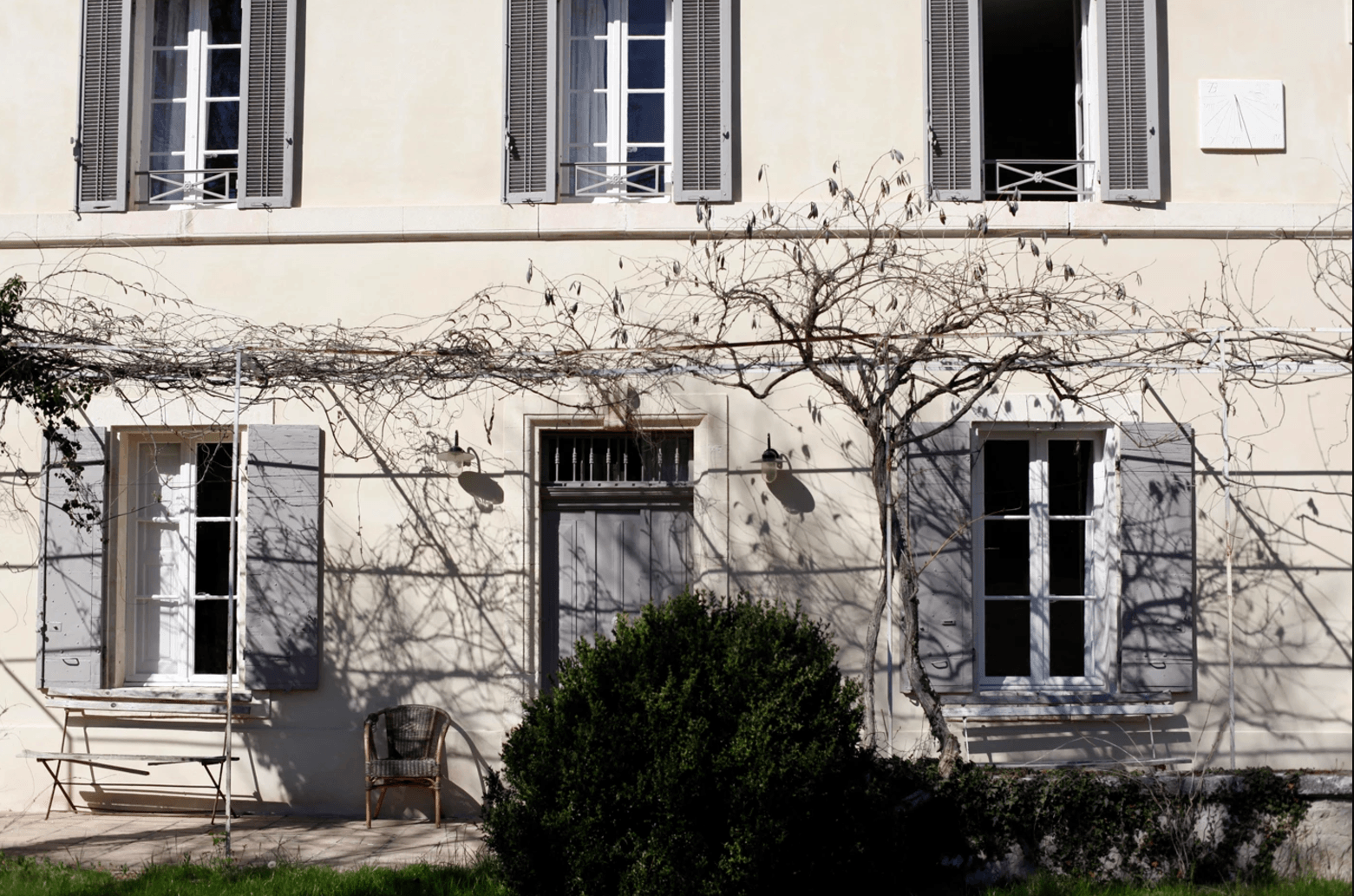
When Maison Collongue was documented as a guesthouse, it occupied approximately 10 acres planted with mature lime trees in the Luberon countryside. The property contained three principal buildings representing different chapters of regional architecture: a 17th-century farmhouse, an 18th-century structure once associated with silkworm cultivation, and a 19th-century house.
That timeline matters because Maison Collongue is not a single building frozen in one historical moment. It is a small architectural village that evolved alongside the land, local agriculture, and changing domestic habits. Stone walls, arched passages, irregular rooms, and changes in floor level reveal how rural buildings were expanded gradually rather than planned in one dramatic burst by an architect armed with a pristine roll of tracing paper.
Owner Guillaume Toutain, a former art director who had also studied architecture, approached the interiors with a visual editor’s discipline. Rather than disguising each building’s age, he used modern furniture and art to make the differences more legible. The result was described as a combination of 20th-century Scandinavian furniture and contemporary comfort, placed inside unmistakably Provençal structures.
The Architecture Is Allowed to Remain the Main Character
The most successful rooms at Maison Collongue begin with what was already there. Thick masonry, rough plaster, stone archways, vaulted ceilings, deep window openings, and well-worn stairs provide texture that no newly manufactured “farmhouse finish” can convincingly imitate.
Historic preservation principles generally favor retaining significant materials, spatial relationships, and character-defining features whenever they remain intact. Maison Collongue illustrates why that strategy works aesthetically as well as culturally. The original surfaces do not merely serve as a quaint backdrop. They determine how light enters, how one room connects to another, and how furniture is perceived.
A curved stone staircase, for example, needs little ornamental assistance. Place an elaborate console, patterned wallpaper, and six decorative baskets beside it, and the poor staircase begins competing in a reality show it never agreed to join. At Maison Collongue, the surroundings are kept spare enough for the masonry to register clearly.
This respect for the shell also makes the modern insertions more effective. Preservation does not require every new object to impersonate an antique. Guidance from preservation organizations increasingly recognizes that old buildings can accept new uses and contemporary elements when the significant architecture remains understandable. The productive tension between old and new is part of what gives Maison Collongue its energy.
Why Midcentury Furniture Works Against Ancient Stone
Midcentury modern furniture might appear to be an unlikely partner for a Provençal farmhouse. One belongs to an era of molded materials, streamlined manufacturing, and postwar experimentation; the other was built through generations of agricultural necessity. Yet both traditions often value honest materials, functional forms, and a close relationship with the human body.
The Eames La Chaise as a Sculptural Counterpoint
One of the most memorable combinations at Maison Collongue places an Eames La Chaise beneath a vaulted ceiling near a curved stone stair. Charles and Ray Eames designed the original La Chaise prototype in 1948. Its flowing shell behaves almost like a piece of abstract sculpture, while the irregular masonry around it is heavy, mineral, and deeply grounded.
The contrast works because the chair does not try to match the farmhouse. It answers it. The stone is massive; the chair appears weightless. The archways are ancient and hand-built; the seat embodies modern experimentation. Both have pronounced curves, however, so the conversation is not entirely argumentative. They disagree politely, which is more than can be said for many design committees.
La Chaise did not enter production until decades after its original design, yet it became one of the Eameses’ most recognizable creations. Its presence at Maison Collongue signals that the interiors are not simply “rustic with a modern chair added.” They are informed by serious design history.
Scandinavian Restraint Without Showroom Perfection
Vintage Scandinavian pieces bring clean profiles, natural materials, and functional proportions to rooms already rich in texture. A midcentury sideboard in the dining area offers storage without visually overpowering the stone architecture. Mixed dining chairs prevent the room from feeling like a catalog display, while simple task lamps introduce an almost workshop-like practicality.
This is an important distinction. Midcentury style at Maison Collongue is not used as a costume. There is no attempt to recreate a perfect 1958 living room. Individual pieces are selected for their form, usefulness, and ability to coexist with older surroundings. That collected approach makes the property feel inhabited rather than staged.
Modern Art Turns the Dining Room Into a Living Gallery
Contemporary art plays a structural role throughout Maison Collongue. In the dining room, framed and carefully illuminated works create the atmosphere of a small private gallery. The effect is sophisticated, but the room still functions as a place to eat, talk, and presumably negotiate who gets the last pastry.
The white and pale plaster walls provide visual breathing room around the artwork. Frames are not forced into perfect symmetry, and the furniture does not compete for attention. A vintage sideboard anchors the lower portion of the room, while pictures introduce color and movement above it.
Lighting is crucial to this balance. Focused illumination can establish hierarchy, emphasize individual works, and help art remain visible after the Mediterranean daylight fades. The goal is not to flood every surface with museum-level brightness. It is to create deliberate moments of attention while preserving the warmth expected from a dining room.
Maison Collongue also avoids the common mistake of choosing art merely because it matches the sofa. The paintings and objects appear to have their own identities. Their value lies partly in how they complicate the historic rooms, giving the eye something intellectually fresh to discover after it has admired the arches and beams.
White Guest Rooms That Never Feel Empty
The property’s five documented guest rooms used white across walls, floors, curtains, and bedding. In less thoughtful hands, this much white could make a bedroom feel like a freshly opened refrigerator. Here, architectural shadows, natural fabrics, colorful rugs, and vintage furniture supply depth.
The Chambre du Milieu introduced moments of blue, while the loftier Chambre Bastine paired a black-and-white rug with a collection of blue glass bottles. In the Grande Chambre, multicolored rag rugs grounded the pale interior. These accents do not interrupt the calm; they make it visible. Without color, the white would be merely neutral. With carefully placed color, it becomes an active canvas.
Simple black standing lamps create crisp silhouettes beside the beds. Built-in shelves hold art, architecture, and design books, reinforcing the feeling that guests are staying in the home of a visually curious collector. Linen sheets, feather pillows, linen-and-silk duvets, waffle-textured towels, and Italian-style showers add tactile comfort without requiring decorative theatrics.
White walls are especially effective in rooms with architectural irregularities because they unify surfaces while allowing beams, arches, windows, art, rugs, and furniture to become focal points. Maison Collongue uses white not as a shortcut to minimalism, but as a method of revealing texture.
A More Intelligent Version of French Country Style
Traditional French country interiors commonly feature weathered furniture, natural stone, warm neutrals, curved forms, antique accessories, and patterned textiles. Maison Collongue shares several of those ingredients, but it edits out much of the expected decoration.
There is little interest in manufacturing instant nostalgia. Rather than filling every wall with plates, mirrors, and pastoral prints, the interiors rely on authentic architecture and a limited number of strong objects. The farmhouse is French because it is actually in France and built from regional materials; it does not need a decorative beret.
This restraint shifts the house closer to a “new rustic” sensibility in which natural materials, pale finishes, relaxed textiles, and individually chosen vintage pieces replace excessive ornament. The rooms remain warm because the surfaces are imperfect, the furniture varies in age, and the textiles invite use. Minimal decoration does not produce minimal personality.
The lesson is useful beyond Provence: a home gains credibility when its design responds to its real architecture and geography. Copying generic French country motifs into every room is less convincing than identifying the textures, colors, objects, and proportions that genuinely belong to the place.
The Landscape Completes the Interior Design
Maison Collongue’s atmosphere extends beyond its walls. The property was described as being surrounded by fields, vineyards, and olive groves, with the Luberon hills forming the distant backdrop. Its gardens included mature trees, a fountain supplied by a natural spring, and a swimming pool measuring approximately 40 feet.
At the time the guesthouse was featured, breakfast was served outdoors, with organic ingredients used for nearly everything except the pastries. That exception seems reasonable. A breakfast without a proper French pastry would be less “wellness retreat” and more “international incident.” Yoga, massage, and wellness workshops were also among the documented offerings.
The garden is not scenery attached to the architecture. It regulates the pace of the property. Trees provide shade, gravel paths produce a distinct sound underfoot, and outdoor tables move daily rituals into the landscape. Provençal garden traditions often favor resilient Mediterranean plants, subdued greens, gravel, drought-tolerant perennials, and trees capable of providing open shade without blocking air movement.
Design Lessons to Borrow From Maison Collongue
Preserve Before You Decorate
Original stone, old plaster, arches, beams, floorboards, and irregular openings give a room qualities that cannot be purchased later. Repairing and revealing them should come before choosing decorative accessories.
Use Contrast Instead of Fake Historical Matching
A clean-lined chair can emphasize the age of a stone wall more effectively than a reproduction antique. New and old elements should communicate clearly rather than blur into an imitation of the past.
Let White Reveal Texture
White is most successful when several textures are present: plaster, linen, wool, timber, stone, glass, and metal. In a flat, featureless room, white may feel sterile. In an old farmhouse, it can make every bump, shadow, and hand-built curve more visible.
Give Art Room to Breathe
One substantial painting with thoughtful lighting may carry more authority than a crowded arrangement of decorative prints. Art should be selected for emotional or intellectual interest, not because its blue happens to match the throw pillows.
Mix Furniture by Character, Not by Set
Maison Collongue’s mixed dining chairs, sculptural seating, vintage school chair, utilitarian lamps, and midcentury storage demonstrate that consistency does not require identical pieces. Repeating materials, proportions, or colors can provide unity while allowing each object to retain its personality.
A Day at Maison Collongue: Experiencing the Design in Real Time
The documented spaces suggest that the Maison Collongue experience would begin not with a dramatic lobby, but with a gradual adjustment of the senses. Gravel shifts beneath your shoes. The air changes as you pass from the bright garden into a cool stone corridor. An archway frames the room ahead, and the thick walls soften exterior noise. The first impression is not luxury shouting through a megaphone. It is calm speaking at an indoor voice.
Morning would naturally belong to the garden. Under the lime trees, breakfast becomes part of the landscape rather than a service delivered in isolation. Bread, fruit, preserves, coffee, and the famously non-organic pastries would arrive with shadows moving across the table. Instead of checking the time, you might begin measuring the morning by the distance a patch of sunlight travels across the gravel.
Returning indoors would reveal details that photographs tend to flatten. Old plaster is not truly one color. It changes from warm cream to cool gray according to the direction of the light. Stone steps have softened edges where generations of feet passed through. A modern chair nearby appears sharper and more sculptural than it would in a conventional white-box apartment.
The art would likely reward repeated viewing. A picture noticed casually before breakfast might look entirely different under an evening lamp. Because the collection is installed in functioning rooms, guests would encounter it while eating, reading, climbing stairs, or looking for a place to set down a cup. That everyday proximity makes art feel less ceremonial and more companionable.
Afternoon invites a different rhythm. The pool provides a cool geometric counterpoint to the untidy abundance of the landscape. Vineyards, fields, and olive trees carry the eye toward the Luberon hills, while the architecture remains close enough to offer shade. A massage or yoga session would fit naturally into this environment, but so would the ancient wellness practice known as taking a nap.
Inside a guest room, the nearly all-white palette would make small possessions unusually noticeable: a book on a shelf, a blue bottle, a pair of shoes, or the rolled towels at the foot of the bed. The room does not overwhelm visitors with a theme. It leaves enough visual quiet for them to occupy it.
Evening would probably deliver the strongest expression of Toutain’s art-direction background. Focused lights isolate paintings in the dining room. Black lamps become graphic lines against pale walls. The vaulted ceilings retreat into shadow, and the modern furniture grows more intimate. What seemed like a gallery during the day becomes a domestic room again when people sit at the table.
The lasting experience of Maison Collongue is therefore less about any single collectible chair or picturesque arch. It comes from movement between contrasts: bright garden and cool interior, ancient stone and polished design, quiet bedrooms and expressive artwork, rural history and contemporary comfort. Nothing is required to surrender its identity. The farmhouse remains a farmhouse, the art remains challenging, and the furniture remains modern. Their ability to coexist is the real luxury.
Conclusion: Why Maison Collongue Still Feels Fresh
Maison Collongue offers a convincing alternative to formula-driven farmhouse design. Its interiors do not depend on trend-based signs, artificial distressing, or enough decorative lavender to concern a botanist. They succeed because the architecture is authentic, the modern furniture is deliberately chosen, and the art is treated as part of daily life.
The property’s most valuable lesson is that preservation and contemporary design are not enemies. Old rooms do not need to be returned to an imaginary historical perfection, and modern comfort does not require erasing every irregular surface. By keeping the Provençal masonry, simplifying the palette, and introducing objects with clear identities, Maison Collongue allows several centuries to occupy the same space without arguing over the armchair.