Exhausted Husband Working 84-Hour Weeks Considers Divorce After Wife Won’t Go Back to Work

An anonymous husband said he had spent years working up to 84 hours a week while his wife recovered from a mental health crisis and remained unemployed. When requests for part-time work, lower household spending, and more help at home went nowhere, exhaustion turned into resentmentand resentment turned into a call to a divorce lawyer. His story is not simply about whether one spouse should get a job. It is about burnout, financial pressure, unequal sacrifice, mental health, and what happens when a marriage stops functioning as a team.
Working 84 hours a week leaves very little room for anything resembling a life. Divide that schedule across seven days and you get an average of 12 hours of work every daybefore commuting, eating, showering, paying bills, or staring blankly into the refrigerator while wondering whether shredded cheese counts as dinner.
That was reportedly the routine of a husband who shared his marital crisis on Reddit. According to his account, his wife had stopped working after experiencing a mental breakdown during her fifth year as a teacher. She began therapy, and the couple later attended marriage counseling. What started as a temporary recovery period, however, had stretched to approximately five years.
During that time, the husband said he became the sole breadwinner. To maintain their home, cover expenses, service debt, and continue making retirement contributions, he accepted extra shifts that sometimes lasted 18 hours. His average workweek reached 84 hours. Eventually, he told his wife that something had to change.
The Argument Was About More Than Returning to Work
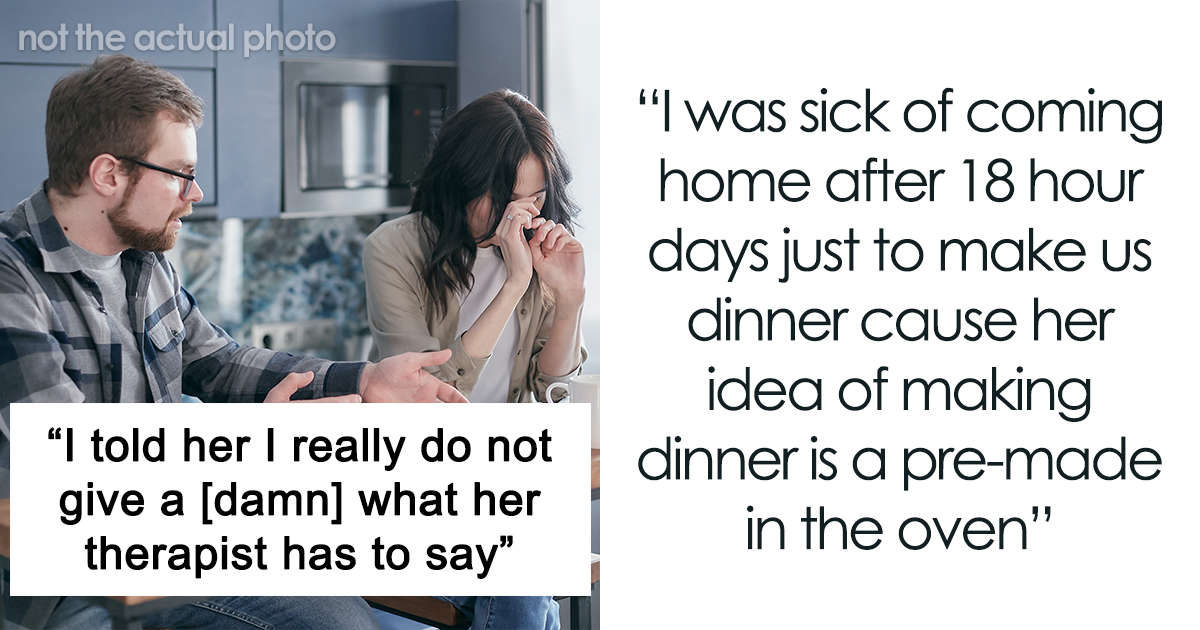
The immediate disagreement concerned whether the wife was ready to reenter the workforce. She reportedly said that she and her therapist believed returning too soon could damage her progress. The husband, already exhausted, felt that her therapist’s opinion had become a permanent shield against every practical conversation.
His frustration was not limited to her unemployment. He said she did little cooking, relied heavily on takeout or prepared meals, and had not developed other household skills that might reduce their expenses. After working a 12- or 18-hour shift, he was sometimes still responsible for making dinner.
That distinction matters. A stay-at-home spouse is not automatically failing to contribute. Managing a household, caring for children, preparing meals, handling appointments, and performing emotional labor can constitute substantial work. In this case, however, there were reportedly no children, and the husband believed he was carrying both the financial burden and a significant share of domestic responsibilities.
His message was essentially: “I cannot continue living like this.” Her interpretation appeared to be: “You do not respect my illness.” Both statements can exist in the same argument, but they are not equivalent. Recognizing depression does not require pretending that the supporting partner has unlimited energy, money, or emotional capacity.
An 84-Hour Workweek Is a Health Emergency in Slow Motion
Federal workplace-safety agencies warn that extended and irregular shifts can cause fatigue, physical stress, mental strain, impaired concentration, slower reaction times, and a greater risk of injuries. Long hours also reduce the time available for sleep, exercise, family relationships, and basic recovery.
The National Institute for Occupational Safety and Health has highlighted research associating workweeks of 55 hours or more with increased risks of stroke and death from ischemic heart disease compared with schedules of 35 to 40 hours. Eighty-four hours is not merely beyond that threshold; it waves at the threshold from another zip code.
Fatigue Does Not Stay at the Workplace
Chronic overwork follows people home. A fatigued employee may become irritable, emotionally detached, forgetful, or unable to enjoy activities that once provided relief. That does not mean the worker has stopped loving a spouse. It may mean the worker’s nervous system is operating on fumes and convenience-store coffee.
Research on work-family conflict has linked difficulty balancing professional and home demands with both burnout and lower marital satisfaction. Other studies suggest that the ability to mentally detach from work is associated with better day-to-day relationship satisfaction. An 84-hour schedule leaves almost no opportunity for that detachment.
The husband’s questionwhat happens if he has a mental breakdown too?was therefore reasonable. A household depending entirely on one dangerously overworked person does not have a reliable financial plan. It has a single point of failure wearing work boots.
Mental Illness Is Real, but So Are Household Limits
Depression can affect concentration, motivation, sleep, decision-making, appetite, energy, and a person’s ability to complete everyday tasks. Treatment may involve psychotherapy, medication, lifestyle changes, or a combination of approaches. Recovery timelines differ, and outsiders cannot responsibly diagnose the wife or declare that she should have recovered by a particular date.
Still, supporting someone with depression does not mean eliminating every expectation indefinitely. A treatment plan should ideally help the patient move toward improved safety, stability, functioning, and quality of life. Progress may begin with small steps: maintaining a routine, preparing a simple meal, managing one bill, volunteering briefly, taking a class, tutoring online, or attempting a few paid hours each week.
Returning immediately to a demanding classroom may have been unrealistic for the wife. Teaching can be emotionally draining, and the job associated with her breakdown might have felt impossible to revisit. But “not ready to teach full time” is different from “unable to explore any contribution whatsoever.” Remote tutoring, curriculum editing, substitute work, administrative support, or a career change could have been discussed without treating full-time teaching as the only available doorway.
Compassion Cannot Flow in Only One Direction
The husband’s anger did not give him permission to insult his wife. His language was harsh, and he later acknowledged that he had expressed himself badly. Yet poor delivery does not automatically invalidate the underlying problem.
A healthy relationship makes room for both partners’ suffering. The wife’s mental health mattered. The husband’s exhaustion, neglected medical care, social isolation, and financial fear also mattered. When every conversation focused exclusively on what he could do to protect her comfort, he began to feel less like a spouse and more like a human direct-deposit feature.
Recent research involving physicians found that greater career support from a spouse or partner was associated with better work-life satisfaction and lower odds of burnout, even after accounting for weekly work and household hours. Support does not always mean earning an equal paycheck. It can mean recognizing strain, adjusting expectations, reducing expenses, or actively helping the overloaded partner recover.
Why the Household Budget Became a Battlefield
The couple’s conflict was not simply about whether enough dollars entered the bank account. The husband reportedly earned slightly more than their previous combined income, which led his wife to question why money remained a concern.
His answer was crucial: the income figure concealed an unsustainable number of hours. A salary is not healthy merely because it covers the mortgage. If maintaining that salary requires the earner to work two full-time jobs, neglect medical appointments, and sleep poorly for years, the budget is balanced only on paper.
He suggested multiple compromises. His wife could try part-time work. They could cook more and reduce takeout. They could temporarily reduce spending. They could rent out the house and move into a smaller apartment. According to his account, these proposals were resisted because they might interfere with her recovery or change her environment.
Financial strain often becomes relationship strain because money represents more than currency. It represents safety, freedom, effort, fairness, and future choices. Research-based relationship resources consistently emphasize that couples handle economic stress better when they communicate openly and approach the problem as a shared challenge rather than using money as evidence in a courtroom-style argument.
In practical terms, the couple needed a budget built around sustainable labornot the maximum amount one exhausted person could earn before his body filed a formal complaint.
Unequal Labor Can Destroy Goodwill
Household labor is rarely divided with mathematical precision. One spouse may earn more while the other cooks, cleans, handles family logistics, or provides care. The goal is not necessarily a perfect 50-50 split every day. The goal is for both partners to believe the arrangement is fair and responsive to changing circumstances.
U.S. time-use data show that household work remains a significant part of daily life and that women, on average, spend more time on household activities than men. Pew Research Center surveys also find that satisfaction tends to be higher when couples perceive chores and family responsibilities as being shared fairly. Those broad patterns are important, but they do not decide the facts of one anonymous marriage. Any gender can become the overburdened partner.
Resentment usually grows when one partner feels that sacrifice has become invisible. At first, the husband may have viewed overtime as a temporary act of love. Over the years, temporary sacrifice became the permanent operating system of the marriage. Every additional shift then carried an unspoken question: “Why am I still doing this alone?”
Once that question appears, even small things become emotionally loaded. A takeout receipt is no longer just a takeout receipt. It becomes proof that his extra hours are not appreciated. An afternoon spent gaming is no longer harmless relaxation. It becomes evidence, in his mind, that one person gets recovery while the other gets another shift.
Was Considering Divorce an Overreaction?
Divorce should not be used as a weapon to frighten a struggling spouse into compliance. It is also not a moral failure to recognize that a relationship has become physically, financially, or emotionally unsustainable.
The husband could not force his wife to work. He could not force her to cook, reduce spending, change therapists, or accept a smaller home. What he could control was whether he remained in an arrangement that appeared to be destroying his health.
After reading responses, he said he planned to take a two-week vacation, stay with a friend, visit a doctor for the first time in four years, and consult a lawyer. He also noted that he had co-signed some of his wife’s debt and shared a joint account, making professional legal advice especially important.
Consulting a divorce attorney does not require immediately filing for divorce. It can help someone understand shared debts, assets, support obligations, housing options, and the consequences of separating. Decisions made from accurate information are usually safer than decisions made at 2 a.m. after an 18-hour shift and a dinner consisting of crackers.
What Could Have Happened Before the Marriage Reached This Point?
1. Establish a Maximum Sustainable Workweek
The household should have agreed that the husband’s extreme hours were temporary and created a firm date for reducing them. Health cannot remain the flexible category in a budget forever.
2. Create a Transparent Household Budget
Both spouses needed to see how many hours generated the income, not just the final paycheck. Expenses could then be ranked as essential, adjustable, or optional. Retirement contributions matter, but so do sleep and cardiovascular function.
3. Build a Gradual Return-to-Function Plan
A return-to-work plan could have started with manageable goals rather than an immediate leap into full-time teaching. Progress should have been reviewed periodically with qualified professionals, with attention to both the wife’s health and the husband’s capacity.
4. Separate Individual Therapy From Couples Decisions
An individual therapist’s primary responsibility is to the individual client. Major household decisions, however, affect both spouses. Couples counseling should provide a setting where neither person feels outnumbered and both partners’ health and financial realities receive serious attention.
5. Define Fair Contributions
If paid employment was temporarily impossible, the couple could have agreed on realistic nonfinancial contributions based on the wife’s abilities. Even limited cooking, budgeting, cleaning, appointment management, or online income might have reduced the husband’s load and signaled partnership.
Experiences Commonly Seen in Similar Relationships
The following examples are composite scenarios based on patterns commonly reported by couples facing burnout, unemployment, depression, and financial imbalance. They are not verified events from the anonymous couple’s life.
The “Temporary” Arrangement Without an End Date
In one common scenario, a spouse leaves a stressful job with the full support of their partner. Both people initially agree that recovery comes first. The employed spouse takes overtime “for a few months,” while the unemployed spouse attends therapy and rests.
The trouble begins when nobody defines what progress should look like. Six months becomes a year. A year becomes three. The working partner is afraid to ask questions because any discussion sounds like criticism. The recovering partner becomes anxious whenever employment is mentioned and interprets practical concerns as proof that love is conditional.
Eventually, the breadwinner no longer asks gently. The conversation arrives as an explosion containing several years of unspoken frustration. The unemployed spouse hears cruelty; the worker hears five years of silence finally escaping at once. Both are shocked by the intensity, even though the pressure had been accumulating in plain sight.
The High Income That Costs Too Much
Another couple may appear financially comfortable. Their mortgage is current, retirement accounts receive contributions, and restaurant deliveries arrive regularly. Friends assume they are doing well.
What outsiders do not see is that one spouse works nights, weekends, and holidays to preserve that lifestyle. The couple confuses adequate income with financial security. In reality, their household is vulnerable because everything depends on one person’s continued ability to perform at an extreme level.
When the worker proposes moving to a cheaper home or canceling subscriptions, the nonworking spouse views the changes as unnecessary because the bills are still being paid. The worker, meanwhile, sees every avoidable expense as another hour away from sleep. They are discussing the same budget but experiencing entirely different economies.
The Part-Time Compromise That Restores Partnership
Not every similar situation ends in separation. Some couples improve once they stop debating whether the recovering spouse is “fully ready” and begin identifying the smallest useful next step.
For example, a former teacher who cannot tolerate a classroom might tutor one student online twice a week. The income may be modest, but the emotional effect can be significant. It creates structure, rebuilds confidence, and shows the overworked partner that the burden is being acknowledged.
At the same time, the employed spouse reduces overtime, even if that requires a simpler lifestyle. The couple cooks basic meals, pauses nonessential purchases, and schedules monthly budget meetings. Nobody receives everything they want, but both regain a sense that sacrifice is shared.
The Necessary Separation
In other cases, one spouse refuses every form of change. Employment is rejected, household contributions remain minimal, spending reductions are treated as punishment, and counseling produces no mutually acceptable plan.
The working partner may then realize that remaining married is not preserving the relationship; it is preserving the arrangement. A temporary separation can provide rest, medical attention, legal clarity, and enough distance to evaluate whether reconciliation is possible.
Separation does not prove that the unemployed spouse’s illness was fake. It may simply show that two genuine needs became incompatible: one person needed indefinite protection from pressure, while the other needed immediate relief from an unsustainable burden.
Conclusion: A Marriage Cannot Run on One Person’s Exhaustion
The viral story attracted attention because its numbers were dramatic, but its central problem is familiar. Many relationships deteriorate not because the partners lack love, but because sacrifice becomes one-sided, communication becomes defensive, and temporary coping strategies quietly become permanent expectations.
The wife deserved serious, compassionate mental health treatment. The husband also deserved sleep, medical care, financial security, and a life outside work. Protecting one spouse’s recovery by sacrificing the other spouse’s health was never a stable solution.
Divorce may or may not have been the right final decision. The immediate decisionto stop working 84-hour weeks, seek medical care, understand his legal position, and admit that something had to changewas far harder to dispute.
A functional marriage does not require equal salaries, identical abilities, or perfectly divided chores. It does require mutual concern. When one partner says, “I am breaking,” the answer cannot forever be, “Please break more quietly.”