I Documented A Village In Bangladesh That Uses Natural Pigments To Create Murals That Disappear With The Rain

Note: This article is written in a documentary-style narrative and is based on real information about Tikoil, also known as Alpona Gram, in northwestern Bangladesh, along with broader research on Bangladeshi alpona traditions, natural pigments, folk art, and monsoon-season renewal.
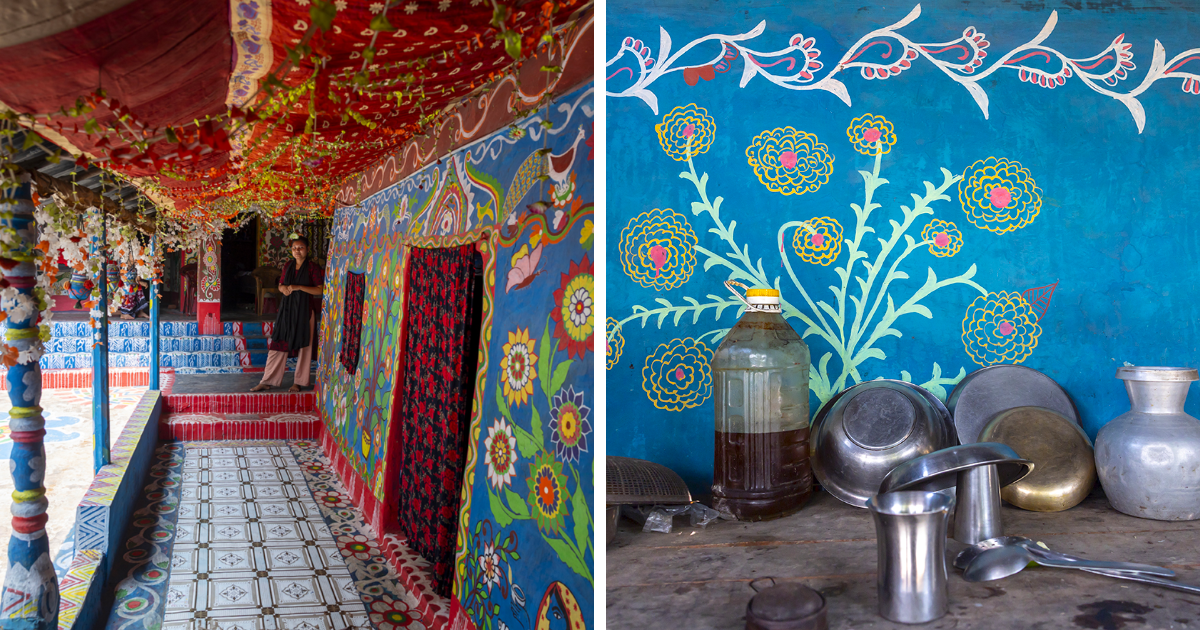
Some villages introduce themselves with a signboard. Others need a tour guide, a map, and a cup of tea before they begin to make sense. Tikoil, a village in Bangladesh’s Chapainawabganj district, introduces itself with color. The walls speak first. Flowers climb over mud houses. Birds stretch their painted wings across verandas. Peacocks, vines, trees, cattle carts, and village scenes turn ordinary homes into open-air galleries. Then the rain comes, and the gallery slowly disappears.
That is the strange and beautiful heartbeat of this place: its murals are not designed to last forever. Many are made, or were traditionally made, with natural pigments drawn from the land itselfrice powder, clay, leaves, seeds, chalk, and plant-based colors. The monsoon does not simply damage the art. It edits it. It blurs lines, softens petals, fades feathers, and eventually clears the wall for the next season’s imagination. In a world obsessed with permanent content, waterproof everything, and “limited lifetime warranties,” Tikoil offers a refreshing plot twist: beauty can be temporary and still matter deeply.
The Village Where Walls Become Living Canvases
Tikoil is often called Alpona Gram, or Alpona Village, because of its distinctive wall paintings inspired by the Bengali folk-art tradition known as alpona or alpana. Traditionally, alpona was created on floors for rituals, weddings, festivals, and household ceremonies. In many parts of Bengal, women used rice paste to draw white patterns by hand, turning floors, thresholds, courtyards, and sacred spaces into temporary works of art.
In Tikoil, that language moved upward. It climbed from the floor to the wall, from ritual space to everyday architecture. The result is a village where the home is not just shelter. It is also memory, identity, prayer, decoration, andlet’s be honesta much more charming alternative to beige paint.
Why Tikoil Became Known for Alpona Murals
The village’s reputation is closely associated with Daykhon Barman, a local woman widely recognized for helping popularize colorful alpona-style murals on the mud walls of homes. Older red-and-white designs already existed in the region, especially among Hindu households, but Daykhon expanded the visual vocabulary. She painted flowers, birds, trees, animals, and scenes from rural life. Other women watched, learned, experimented, and began decorating their own homes.
Over time, the practice grew into a shared village identity. Women, girls, and families contributed to the tradition, and the walls became a kind of collective album. Instead of being locked inside frames, the art lived outside where neighbors, children, visitors, goats, chickens, and the occasional suspicious duck could admire it.
Natural Pigments: Art Made From the Land
The most poetic part of the tradition is its relationship with materials. The colors are not random; they are rooted in the environment. White may come from rice powder or chalk. Red can come from local clay. Green can be drawn from leaves. Yellow, blue, and other tones may be created from fruits, seeds, or plant matter. These pigments are humble, earthy, and sometimes stubborn. They do not behave like factory-made paint, which is exactly why they feel alive.
Preparing natural pigments takes patience. Leaves may need soaking. Grains may need grinding. Clay must be mixed to the right consistency. A wall has to be cleaned, coated, and prepared before a motif appears. Nothing about the process says, “Five-minute craft hack.” It is slow work, made between chores, meals, family responsibilities, religious observances, and agricultural rhythms.
That slowness gives the murals their emotional power. Each painted bird carries labor. Each flower carries local knowledge. Each pattern is a small argument against the idea that rural creativity is simple or decorative only. These murals may be beautiful, but they are not merely “pretty walls.” They are cultural documents written in pigment.
The Tools Are Simple, But the Skill Is Not
Alpona is often made freehand. Artists may use fingers, cloth, cotton, twigs, handmade brushes, or simple tools adapted to the surface. The designs often depend on balance, repetition, symmetry, and flow. A flower might begin as a dot, then open into petals. A vine may curve around a doorway. A peacock may stretch across a wall with the confidence of a bird that absolutely knows it is the main character.
The simplicity of the tools can fool outsiders. Watching an experienced artist draw a smooth line by hand might make the process look effortless. It is not. The body remembers what the eye has studied for years. Hands learn by watching mothers, aunts, grandmothers, sisters, and neighbors. The school is the courtyard. The homework is the wall.
Why the Murals Disappear With the Rain
Bangladesh is shaped by water. Rivers, floods, monsoon rains, wetlands, and fertile alluvial soils influence daily life across the country. In Tikoil, rain is not just weather; it is part of the art cycle. Natural pigments on earthen walls are vulnerable to moisture. When the monsoon arrives, colors fade. Lines dissolve. Walls soften. Designs that once looked bright and crisp become ghosts of flowers and birds.
At first, this can feel tragic. Imagine spending weeks painting a wall, only to watch the sky rinse it away like a giant, moody art critic. But villagers often understand this impermanence differently. The rain is not only an ending. It is also an invitation. When the old mural disappears, a new one can be made. The wall becomes available again.
Impermanence as Renewal
This is where Tikoil’s murals become more than decoration. They express a philosophy of renewal. The artwork does not survive because each individual image lasts forever. It survives because the practice continues. A mural disappears, but the skill remains. A wall fades, but the memory of how to paint it passes to another generation. The rain erases the surface, not the tradition.
In that sense, the monsoon acts almost like a collaborator. A demanding collaborator, yesone with dramatic timing and zero respect for drying schedulesbut still a collaborator. It keeps the art moving. It prevents the village from becoming a museum frozen in one perfect version of itself.
Motifs That Tell the Story of Rural Bangladesh
The murals of Tikoil often feature motifs from nature and village life. Flowers, birds, trees, vines, fish, cattle, peacocks, household objects, and farming scenes appear across walls and rooms. These are not random decorative choices. They reflect the environment, the economy, the seasons, and the emotional world of the people who live there.
A painted cattle cart can point to older forms of transportation and agricultural life. A tree may symbolize growth, shade, fertility, or continuity. Birds bring movement to still walls. Flowers turn a mud house into a celebration. Geometric patterns add rhythm and order, proving that folk art can be both symbolic and wonderfully stylish.
Women as Cultural Archivists
One of the most important facts about the tradition is that women have carried it forward. Housewives, daughters, mothers, and grandmothers have preserved the knowledge through practice. In many communities, women’s art has historically been treated as domestic craft rather than “serious” art. Tikoil quietly challenges that assumption. Here, the domestic wall becomes a public artwork. The home becomes a gallery. The artist may not have a formal degree, but her work can define the identity of an entire village.
This matters because cultural heritage is not always kept in official archives. Sometimes it is kept in the wrist. Sometimes it is stored in a grandmother’s memory of how thick rice paste should be. Sometimes it survives because a child watches someone paint a flower and thinks, “I want to try.”
From Ritual Art to Community Identity
Alpona has deep ritual associations in Bengal. It has been used for religious ceremonies, weddings, harvest celebrations, Pahela Baishakh, Gaye Holud, and other cultural occasions. In modern Bangladesh, alpona also appears in public spaces, including roads, cultural events, and commemorations. It has moved between sacred, domestic, secular, and national spaces without losing its recognizable visual charm.
In Tikoil, that flexibility is visible. The murals connect religious tradition, household pride, tourism, local identity, and intergenerational learning. While Hindu households have been especially associated with the practice, the wider village environment reflects coexistence and cultural exchange. Visitors come not only to see painted walls, but also to witness how art can turn a small rural settlement into a destination.
The Tourist Effect: Blessing, Burden, and Selfies
Tourism brings attention, and attention can bring income, recognition, and preservation. It can also bring pressure. Once a village becomes famous for its painted walls, the murals are no longer only for the household or the festival. They are also for cameras, travel blogs, social media posts, and visitors who may or may not understand that someone’s home is not a theme park.
Responsible visitors should remember that Tikoil is a living village, not a stage set. The murals belong to real families. The best approach is simple: ask before taking close-up photos of people, respect private spaces, support local communities where possible, and avoid treating cultural heritage like a backdrop for one’s most dramatic scarf pose.
The Debate Over Synthetic Paint
Like many living traditions, Tikoil’s mural practice is changing. Some artists now use synthetic paints because they are brighter, easier to buy, and more durable. This shift is understandable. Natural pigments take time to prepare and may fade quickly. Store-bought paint can help a wall stay colorful longer, especially when families are busy and mud houses are gradually replaced by brick or concrete structures.
But durability comes with a cultural question: if the mural no longer disappears with the rain, does the tradition lose part of its rhythm? Some critics argue that frequent repainting is what keeps the skill alive. If a design lasts too long, artists may paint less often. Fewer repetitions could mean fewer chances for young people to learn. In other words, permanence might preserve the image while weakening the practice.
There is no easy answer. Traditions survive by adapting, but they can also be diluted by convenience. The challenge is not to freeze Tikoil in the past. The challenge is to protect the knowledge, meaning, and community participation that make the murals valuable in the first place.
What I Learned While Documenting the Village
Documenting a place like Tikoil changes how you look at walls. In most cities, walls are boundaries. They divide rooms, protect property, block noise, and occasionally hold a calendar that nobody updates after March. In Tikoil, walls are invitations. They ask you to slow down and read them.
The first thing I noticed was how the murals changed the mood of ordinary spaces. A kitchen wall painted with vines felt ceremonial. A bedroom decorated with birds felt less private in a strange way, as if the room had joined a larger village conversation. A veranda covered in flowers made the afternoon light look more generous. Even a small doorway could feel important when framed by hand-painted patterns.
The second thing I noticed was that the murals were not trying to impress in the way contemporary public art often tries to impress. They were not shouting for attention. They were simply there, woven into daily life. A woman might sweep a courtyard beside a painted wall. A child might run past a peacock without stopping. Someone might hang laundry across a mural that, in another country, would be protected behind a rope and guarded by a very serious museum employee.
That casual intimacy is part of the beauty. The art is not separated from life. It is touched by dust, smoke, rain, hands, seasons, and time. It is allowed to be useful, vulnerable, and imperfect. That makes it feel more human.
Experiences Related to the Topic: A Longer Reflection on Rain, Color, and Memory
Spending time with a tradition that accepts disappearance can be unexpectedly emotional. Most of us document life because we are afraid of losing it. We photograph meals before eating them, save messages we rarely reread, back up files to clouds with names that sound more spiritual than technical, and panic when a phone battery hits three percent. Tikoil’s murals suggest another way to think about memory. Maybe the point is not to keep everything unchanged. Maybe the point is to participate fully while it is here.
One experience that stayed with me was watching how people described fading. Outsiders often talk about fading as damage. In the village, fading can be part of the calendar. The rain arrives, the wall changes, and everyone knows what will happen next. There is sadness in that, but also relief. No artist has to make the final masterpiece. No wall has to carry one design forever. The next flower can be different. The next bird can be bigger. The next peacock can be even more dramatic, because apparently peacocks have never believed in subtlety.
Another experience was realizing how much ecological intelligence is hidden in traditional art. Natural pigments are not just materials; they are relationships. To make color from clay or leaves, artists must know the soil, the plants, the season, and the wall. They must understand texture, moisture, adhesion, and timing. This is science without a lab coat, design without software, and sustainability without a marketing department using the word “green” fourteen times in one paragraph.
The murals also made me think about authorship. In a city gallery, one name usually appears beside a work. In Tikoil, authorship feels wider. A mural may be painted by one woman, but the tradition belongs to many hands. Someone taught her. Someone prepared the wall. Someone fetched water. Someone watched the baby while the line work was finished. Someone praised the design, copied it, changed it, and passed it on. The village itself becomes the artist.
There is also a lesson here for modern design. We often treat durability as the highest standard. We want weatherproof surfaces, permanent finishes, and colors guaranteed not to fade. But in Tikoil, the fading is not failure. It creates a cycle of attention. When a mural is temporary, people notice it differently. They know it will not always be there. The artwork becomes an event, not an object.
That idea feels especially powerful in the age of digital culture, where images can circulate forever but often mean very little after a few seconds. A mural that disappears with the rain may have a shorter physical life than an online photo, but it can create a deeper local memory. People remember who painted it, which festival inspired it, which season washed it away, and how the next design began.
By the time I left, I understood that Tikoil’s murals are not only about color. They are about renewal, women’s creativity, rural knowledge, ecological materials, cultural pride, and the courage to make something beautiful even when you know it will vanish. That may be the most generous kind of art: it does not demand eternity. It asks only to be made, seen, loved, and made again.
Conclusion: A Village Painted in the Language of Rain
Tikoil’s disappearing murals remind us that heritage does not always survive by resisting change. Sometimes it survives by moving with it. The rain washes away natural pigments, but it also keeps the tradition alive by making room for renewal. The walls fade, but the hands remember. The designs vanish, but the village continues to paint.
For travelers, artists, designers, and culture lovers, Alpona Village offers a rare lesson in impermanent beauty. It shows that art does not need marble, glass, climate control, or a security guard named Harold to be meaningful. Sometimes it needs only mud walls, rice powder, clay, leaves, patient hands, and a sky full of rain.