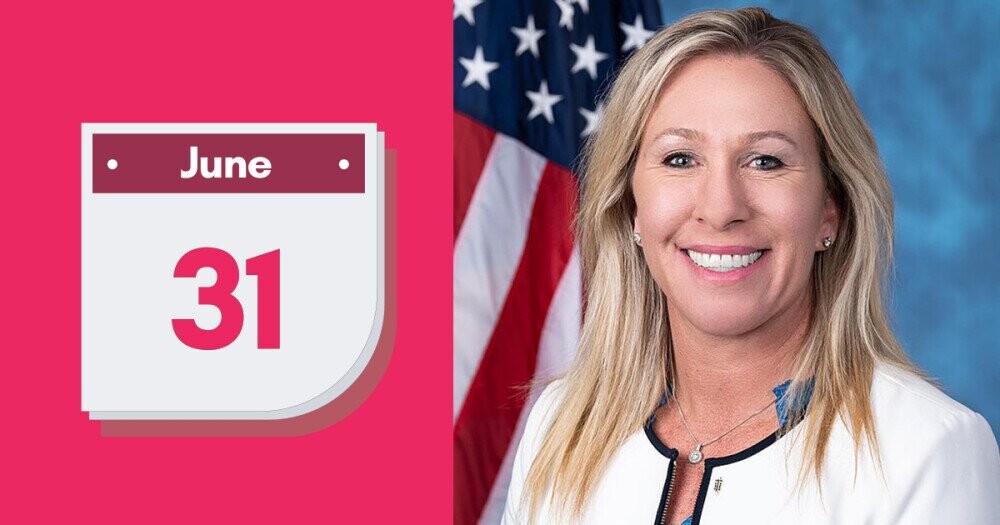

Some political stories arrive with sweeping constitutional questions, complex budget math, or enough legal footnotes to make a law student develop a nervous twitch. And then there are stories that can be summarized with a calendar, a red pen, and the quiet voice of every elementary school teacher whispering, “Thirty days hath September, April, June, and November.”
In June 2021, then-Rep. Marjorie Taylor Greene drew attention after sharing a letter demanding answers from President Joe Biden about COVID-19, Dr. Anthony Fauci, and pandemic-related controversies. The political substance of the letter was heated enough on its own, but one detail turned it into internet rocket fuel: the deadline requested was “June 31, 2021.” The trouble, of course, is that June 31 does not exist. June has 30 days. It always has. No congressional motion, cable-news segment, or strongly worded letter can add a bonus day to the month.
That tiny calendar error became a big online moment because it landed in exactly the kind of environment where politics, social media, pandemic anxiety, and public distrust were already colliding. The result was not just a joke about a missing date. It became a case study in how public communication works in the internet age: one typo, one screenshot, one odd deadline, and suddenly the message is no longer the message. The mistake is.
What Happened With the “June 31” Letter?
The basic story is simple. Greene said she had sent a letter to President Biden asking for answers related to the origins of COVID-19 and the role of Dr. Fauci, who had become a major target of Republican criticism after the public release of some of his emails. The letter reportedly demanded a response by June 31, 2021. That date immediately overshadowed the letter’s political claims because, as anyone who has ever flipped through a wall calendar knows, June ends on the 30th.
On paper, it may look like a small clerical error. People mistype dates. Staffers rush documents. Public officials sign letters prepared by aides. Anyone who has ever sent an email with “attached” in the body and no attachment in sight should probably show a little humility. But politics is not a forgiving group project. When a public figure builds a brand around certainty, confrontation, and calling out other people’s supposed failures, even a small mistake can become a giant neon arrow pointing back at the messenger.
Why the Mistake Went Viral
The internet loves three things: easy jokes, visible hypocrisy, and mistakes that require no expert knowledge to understand. “June 31” checked all three boxes. You did not need a background in virology, congressional procedure, or public health policy to get the punchline. You only needed to know how months work.
That accessibility made the story extremely shareable. A complicated debate about COVID origins can quickly become exhausting. But a politician demanding answers by an imaginary date? That is snack-sized political comedy. It fits into a tweet, a late-night monologue, a meme, a headline, and a comment section where everyone suddenly becomes the Supreme Court of Calendar Law.
The timing also mattered. In 2021, pandemic debates were already deeply polarized. Fauci had become a symbol: to many Americans, he represented scientific guidance during a crisis; to many critics on the right, he represented government overreach, shifting public-health advice, and unanswered questions about COVID’s origins. Greene’s letter entered that charged atmosphere. The “June 31” error gave opponents an easy way to dismiss the seriousness of the demand without debating every claim inside it.
The Real Lesson: Public Writing Has Consequences
The bigger takeaway is not that a person made a date mistake. The bigger takeaway is that public writing carries weight. A letter from a member of Congress is not a casual grocery list. It is an official communication meant to persuade, pressure, and signal seriousness. When the formatting, facts, or basic details are sloppy, the credibility of the entire message takes a hit.
That is especially true when the topic is public health. During the COVID-19 pandemic, Americans were bombarded with claims, counterclaims, theories, corrections, reversals, and viral posts that aged like unrefrigerated potato salad. In that environment, clarity mattered. Precision mattered. Even small errors could feed the impression that political messaging was being driven more by outrage than by careful analysis.
A “June 31” deadline is not a policy scandal by itself. It does not prove that every argument in the letter was wrong. But it does show how quickly a preventable mistake can damage the presentation of an argument. If the goal is to demand accountability, the document doing the demanding should probably pass the calendar test.
Marjorie Taylor Greene and the Politics of Attention
Greene’s political style has long depended on attention. She became nationally known not only for her conservative positions but also for provocative statements, confrontational media appearances, and controversial claims. That style can be powerful in modern politics because attention is currency. A viral clip can raise money, rally supporters, and push a politician into the center of the national conversation.
But attention is a double-edged sword. The same spotlight that amplifies a message also magnifies mistakes. Politicians who speak cautiously may seem boring, but they often avoid giving opponents easy material. Politicians who speak loudly and constantly can dominate the news cycle, but they also create more opportunities for errors, contradictions, and accidental comedy.
The June 31 episode fits that pattern perfectly. Greene wanted to make a serious accusation and apply pressure over COVID-related questions. Instead, much of the public conversation focused on whether she or her office had noticed that the date did not exist. The calendar became the headline. The policy argument became the background music.
Why “Apparently Doesn’t Know” Works as a Headline
The phrase “apparently doesn’t know” is doing a lot of work. It is not a courtroom verdict. It is a comic framing. The headline does not necessarily prove that Greene personally believes June has 31 days. It points to the public appearance created by the mistake. In media writing, that distinction matters.
Good satire and sharp commentary often focus on the gap between intention and presentation. Greene’s intention was to project seriousness and urgency. The presentation included a non-existent date. That gap is where the humor lives. The joke is not simply “someone made a typo.” The joke is that the typo appeared in a formal demand for accountability from a politician known for aggressively questioning the competence and honesty of others.
In other words, the calendar error became symbolic. It stood in for a broader critique: if you are going to accuse others of hiding the truth, start by checking the month.
The COVID Context Behind the Letter
The letter did not appear out of nowhere. In early June 2021, thousands of Fauci’s emails from the early pandemic period had been released through public-records requests. Conservative commentators and Republican politicians seized on the emails, arguing that they raised questions about COVID’s origins, public messaging, and Fauci’s role in pandemic policy.
At the same time, fact-checkers and science reporters warned that many viral interpretations of the emails were misleading or overstated. Some emails showed scientists discussing possibilities early in the pandemic, including questions about the virus’s origin. But early scientific uncertainty is not the same thing as proof of a cover-up. Science often begins with uncertainty, debate, and revision. Unfortunately, social media is not famous for handling nuance like a delicate family heirloom.
Greene’s demand for answers landed in that messy debate. Her critics saw the letter as another example of pandemic misinformation and political theater. Her supporters saw it as pressure for transparency. The June 31 date gave critics a simple, memorable way to frame the whole thing as unserious.
How a Small Error Can Defeat a Big Message
There is a practical communication lesson here for politicians, brands, writers, students, and anyone who has ever hit “publish.” Small errors can become the only thing people remember. A typo in a restaurant menu is funny. A typo in a medical instruction sheet is alarming. A typo in an official political letter can become a national joke.
That is because audiences use details as trust signals. If a document gets an obvious fact wrong, readers may wonder what else was handled carelessly. This may be unfair in some cases, but it is how credibility works. People rarely separate the argument from the packaging. A good point presented sloppily can lose to a weaker point presented clearly.
In Greene’s case, the “June 31” mistake was especially damaging because it was so easy to verify. Nobody needed a congressional investigation. Nobody needed classified documents. The evidence was right there in the calendar. June 31 is not hidden deep in a policy appendix. It is simply absent from reality.
Political Comedy and the Calendar Trap
Political comedy thrives on moments like this because they are instantly understandable. Late-night shows, humor sites, and social media users do not need to explain a complex regulatory dispute. They can simply point at the date and let the audience do the rest.
The calendar trap is also wonderfully nonpartisan in theory. Any politician from any party can make this mistake, and any politician from any party should expect to be roasted for it. Democracy may be divided, but the Gregorian calendar remains one of the last institutions with broad bipartisan support.
That is why the joke had legs. It was not just about Greene. It was about the comedy of official seriousness colliding with basic arithmetic. A formal letter with a fake date feels like a tuxedo worn with clown shoes: technically still an outfit, but good luck getting people to focus on the speech.
What Publishers Can Learn From the Story
For writers and editors, the June 31 episode is a reminder that proofreading is not a luxury. It is reputation insurance. Before publishing a news article, blog post, press release, product page, or official statement, check the simple things: dates, names, titles, numbers, links, and claims. The easier an error is to spot, the more embarrassing it becomes when readers spot it first.
There is also an SEO lesson. Viral political stories often succeed because they connect a specific searchable phrase with a broader public conversation. “Marjorie Taylor Greene June 31” is specific. “June has 30 days” is universal. Together, they create a headline that is both timely and evergreen. People may search for the incident, the joke, the context, or the broader pattern of political missteps.
For web publishers, the best version of this article is not just a dunk. It should explain what happened, why it mattered, and what the episode reveals about communication, credibility, and the modern outrage machine. The joke gets readers in the door. The analysis keeps them there.
Was the Reaction Fair?
Fairness depends on what claim is being made. If the claim is “a public letter included an impossible date,” that is fair. If the claim is “this proves Greene literally does not know how many days are in June,” that is more speculative. People make mistakes. Staffers make mistakes. Drafts move quickly. A typo can be a typo.
But public figures are judged by the communications they release. When a politician shares or signs a document, the public is allowed to evaluate it. That does not mean every typo deserves a week of outrage. It does mean that obvious errors are fair game, especially when the person involved is using the document to accuse others of incompetence or wrongdoing.
The strongest critique is not personal; it is professional. A congressional office should catch a fake date before a letter becomes public. That is not a partisan standard. That is basic office hygiene, somewhere between “spell the president’s name correctly” and “do not schedule a press conference for February 30.”
Experiences and Reflections Related to the June 31 Moment
Anyone who has worked around publishing, communications, or office paperwork knows the strange horror of the tiny mistake. You can spend hours shaping an argument, polishing a headline, checking the tone, and making sure the main point lands. Then one little detail escapes. A wrong date. A missing comma. A repeated word. Suddenly, the entire audience becomes a swarm of volunteer proofreaders with Wi-Fi.
The June 31 story feels familiar because it reflects a universal experience: the moment when a small oversight becomes bigger than the message. Students experience it when they submit an essay with the wrong year in the title. Businesses experience it when a sale banner says “Friday, April 32.” Newsletters experience it when they announce “tomorrow’s webinar” three days late. The mistake may be small, but readers notice because errors interrupt trust.
In politics, that effect becomes more intense. Political communication is competitive. Opponents are not reading generously. They are reading like raccoons looking for an unlocked trash can. If there is a weak spot, they will find it, drag it into the open, and invite everyone to look. That is not always noble, but it is predictable. Public life rewards preparation because public life is not graded on effort.
There is also a human lesson. The internet is very good at mockery and very bad at proportion. A fake date can be funny without becoming the entire measure of a person. At the same time, a public official should understand that precision matters, especially when discussing issues as serious as a pandemic, government accountability, and public trust. The best response to a mistake is usually not defensiveness. It is correction, humility, and better systems.
For editors, the practical experience is clear: create a final checklist. Check dates against a calendar. Confirm names and titles. Read numbers out loud. Ask one person who has not seen the draft to review it with fresh eyes. Automated tools can catch misspellings, but they may not catch “June 31” if the phrase looks structurally normal. Human judgment still matters.
For readers, the experience is also useful. A funny error can reveal carelessness, but it should not replace deeper analysis. Laugh at the calendar mistake, sure. It is allowed. June did not grow an extra day just to satisfy a congressional deadline. But after the laugh, ask better questions. What was the letter trying to accomplish? Were its claims supported? How did media outlets frame the story? Did the viral joke clarify the issue or distract from it?
That balance is where mature media literacy lives. Humor helps people notice politics. Analysis helps them understand it. The June 31 episode works because it is both silly and revealing. It shows how political branding, public health debate, online outrage, and basic proofreading can collide in one unforgettable date that never existed.
Conclusion
“Marjorie Taylor Greene Apparently Doesn’t Know That June Has 30 Days” is a headline built for the internet, but the story behind it is more than a calendar joke. It is a reminder that public communication depends on accuracy, especially when the topic is serious and the tone is accusatory. The June 31 mistake became viral because it was simple, visual, and impossible to defend on factual grounds. June has 30 days. That part is not up for debate.
The broader lesson is that credibility is fragile. A message can be passionate, timely, and politically useful, but if it contains a glaring basic error, the audience may remember only the error. For politicians, publishers, and anyone creating public content, the rule is simple: check the facts, check the tone, and please, for the love of calendars everywhere, check the date.
Note: This article is written for editorial and SEO publishing purposes. It is based on publicly reported events and avoids unnecessary source-link clutter inside the article body.