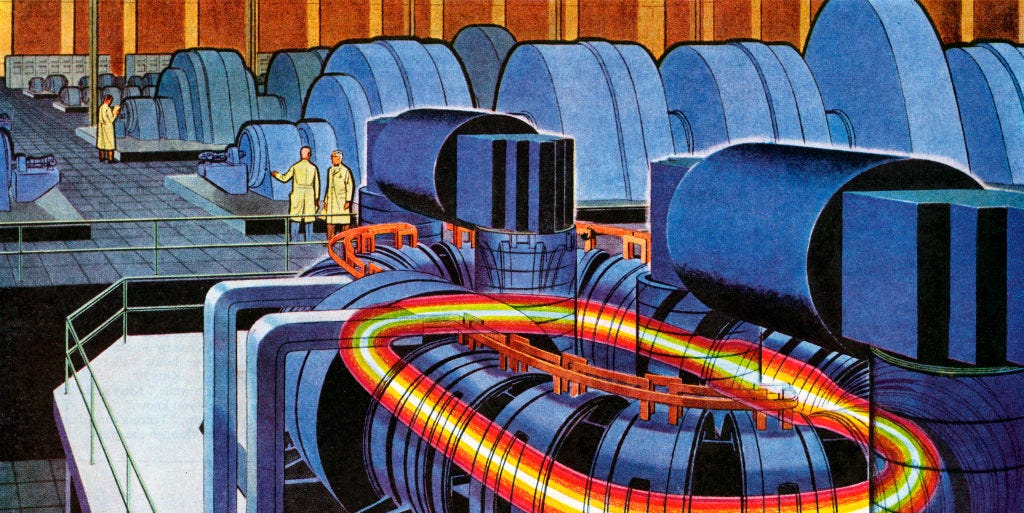

Nuclear fusion has spent decades sitting in the “almost there” folder of human ambition, right next to flying cars and printers that never jam. But lately, fusion reactor news has become much harder to dismiss. The field is no longer just a distant dream sketched on a chalkboard by physicists with heroic hair. It is now a fast-moving race involving national laboratories, private companies, artificial intelligence, high-temperature superconducting magnets, new plasma-control strategies, and tokamak reactors that look like giant metal doughnuts built by people who took science fiction personally.
At its heart, nuclear fusion is the process that powers the sun and stars. Instead of splitting heavy atoms apart, as nuclear fission does, fusion joins light atomic nuclei together, releasing energy. The most discussed fuel combination for early fusion power is deuterium and tritium, two forms of hydrogen. When they fuse under extreme heat and pressure, they produce helium, a neutron, and a large amount of energy. Sounds simple, right? Just heat a gas to more than 100 million degrees Celsius, keep it stable, stop it from touching the reactor wall, handle intense neutron radiation, and turn the energy into electricity. Easy weekend project.
The most mature path toward fusion energy is magnetic confinement, especially the tokamak reactor. A tokamak uses powerful magnetic fields to trap superhot plasma inside a torus-shaped chamber. The goal is to make the plasma hot, dense, and stable long enough for fusion reactions to become useful. In fusion vocabulary, that balance is often summarized by the “triple product”: temperature, density, and confinement time. In normal language, it means: keep the star soup hot, packed, and under control.
Why Fusion Energy Matters Now
The world needs clean, reliable, high-density energy. Solar and wind are expanding quickly, batteries are improving, and nuclear fission remains a major low-carbon power source. Fusion is attractive because it could eventually provide firm, carbon-free energy with abundant fuel resources and no runaway chain reaction. Unlike fission, fusion does not rely on splitting uranium atoms, and a fusion plasma naturally cools if the delicate operating conditions are lost. That does not make fusion magically risk-free, but it does make its safety profile very different from traditional nuclear reactors.
Fusion also has another big advantage: energy density. A working fusion power plant would produce enormous energy from small amounts of fuel. Deuterium can be extracted from water, while tritium could be bred from lithium inside a future reactor blanket. The engineering challenge is not finding enough fuel; it is building a machine tough enough to survive the environment it creates. Fusion scientists are basically trying to bottle a miniature star while politely asking the bottle not to melt.
Tokamak Reactors: The Doughnut-Shaped Workhorses of Fusion
The tokamak reactor was first developed in the Soviet Union and has become the best-known fusion reactor design. Its shape is often described as a doughnut, though no doughnut has ever required superconducting magnets, vacuum systems, plasma-facing materials, tritium breeding, and a control room full of nervous brilliance.
Inside a tokamak, plasma is heated until electrons are stripped away from atomic nuclei. Because plasma is electrically charged, magnetic fields can guide and confine it. The main magnetic field runs around the torus, while additional fields twist the plasma into a stable path. Heating systems, such as neutral beam injection and radio-frequency waves, push the plasma toward fusion-relevant temperatures.
Tokamaks dominate fusion reactor news because they have produced many of the strongest experimental results in magnetic confinement. Major tokamak programs include ITER in France, DIII-D in San Diego, NSTX-U at Princeton Plasma Physics Laboratory, and SPARC under construction by Commonwealth Fusion Systems in Massachusetts. Each machine has a different job. Some test plasma physics. Some study materials. Some explore compact reactor designs. Together, they form a global experiment in turning “what if?” into “plug it into the grid.”
Recent Fusion Reactor News: Real Progress, Real Caveats
National Ignition Facility Keeps Raising the Bar
One of the biggest fusion milestones came from the National Ignition Facility at Lawrence Livermore National Laboratory. NIF uses lasers, not a tokamak, to compress a tiny fuel capsule in an approach called inertial confinement fusion. In December 2022, NIF achieved fusion ignition, meaning the fusion reaction produced more energy than the laser energy delivered to the target. Later experiments improved performance, including a 2025 result that produced a record fusion yield of 8.6 megajoules from 2.08 megajoules of laser energy delivered to the target.
That is huge science news, but it is not the same as commercial fusion electricity. The total facility energy used to power the lasers is much larger than the laser energy reaching the target. NIF was built primarily for national security and high-energy-density physics, not as a power plant prototype. Still, ignition has changed the conversation. Fusion energy is no longer stuck at “can nature do this?” The better question is now, “Can engineers do it repeatedly, economically, and at power-plant scale?”
SPARC and ARC Push the Commercial Tokamak Race Forward
Commonwealth Fusion Systems, a company spun out of MIT research, is building SPARC, a compact high-field tokamak designed to demonstrate net fusion energy. SPARC relies on high-temperature superconducting magnets, which can create very strong magnetic fields in a smaller machine. Stronger magnets can improve confinement, allowing a reactor to shrink without giving up performance. In fusion engineering, smaller usually means cheaper, faster to build, and easier to iterate, though “small” here still means a serious industrial facility, not something you store next to the lawn mower.
CFS has also announced plans for ARC, a future grid-scale fusion power plant in Chesterfield County, Virginia. The company has described ARC as a plant intended to produce about 400 megawatts of electricity in the early 2030s. That timeline is ambitious, and the fusion world is allergic to guarantees for good reason. But the SPARC-to-ARC strategy is important because it links a near-term experiment to a proposed commercial power plant. That is exactly the bridge fusion has struggled to build for decades.
NSTX-U and the Spherical Tokamak Path
At Princeton Plasma Physics Laboratory, NSTX-U represents a different tokamak shape: the spherical tokamak. Instead of the classic wide doughnut, a spherical tokamak looks more like a cored apple. This geometry may allow high plasma pressure with relatively compact magnetic fields, which could matter for future fusion pilot plants. NSTX-U is described as the largest spherical tokamak in the United States and is expected to support research into plasma control, confinement, measurement techniques, and artificial intelligence tools.
Spherical tokamaks are exciting because they could offer a more compact route to fusion power. But compact machines also face severe engineering stress. Components near the center of the device must handle intense forces, heat, and neutron damage in limited space. In other words, the machine may be smaller, but the headaches are full-sized.
DIII-D and the Promise of Negative Triangularity
The DIII-D National Fusion Facility, operated by General Atomics for the U.S. Department of Energy, remains one of the most important tokamak research facilities in the United States. One area of intense interest is negative triangularity, a plasma shape that resembles a backward “D.” This configuration may help reduce damaging edge-localized modes, improve power handling, and offer a promising route for future fusion pilot plant designs.
Edge-localized modes, or ELMs, are sudden bursts of energy from the plasma edge. In a future reactor, uncontrolled ELMs could damage plasma-facing components. Avoiding them is like trying to cook a perfect soufflé inside a hurricane while the oven argues back. Research on negative triangularity, along with other approaches to plasma shaping and control, is helping scientists understand how future tokamaks might run at high performance without repeatedly punching their own walls.
The Hard Problems Fusion Still Must Solve
Plasma Stability
Plasma is not a polite substance. It wiggles, drifts, forms instabilities, and sometimes disrupts. A disruption can rapidly dump plasma energy into reactor walls and create large electromagnetic forces. For tokamak reactors, preventing and mitigating disruptions is one of the central challenges. Modern fusion research increasingly uses machine learning and advanced simulations to predict plasma behavior before it becomes a problem.
Artificial intelligence is becoming a practical tool in fusion, not just a buzzword sprinkled over grant proposals like glitter. Researchers are using AI to fill in missing diagnostic data, speed up calculations, predict instabilities, and develop real-time control strategies. The dream is a reactor control system that can sense plasma behavior and respond faster than human operators. Basically, fusion needs an autopilot for a tiny artificial star.
Materials That Can Survive the Reactor Environment
A commercial fusion reactor must survive extreme heat, high-energy neutrons, magnetic forces, and repeated operation. Plasma-facing materials, divertors, blankets, and structural components all need to tolerate punishment that would make ordinary industrial equipment resign immediately. Tungsten, advanced steels, liquid metals, lithium systems, and new alloys are all under investigation.
The divertor is especially important. It handles exhaust from the plasma, removing heat and particles. If the core plasma is the star of the show, the divertor is the overworked backstage crew catching flaming confetti. Future reactors need divertor systems that can handle enormous heat loads without eroding too quickly or contaminating the plasma.
Tritium Fuel and Breeding Blankets
Most near-term fusion power plant concepts rely on deuterium-tritium fuel. Deuterium is plentiful, but tritium is rare and radioactive with a half-life of about 12.3 years. A practical fusion reactor would likely need to breed tritium using lithium blankets that absorb fusion neutrons and produce more tritium. This is one of the biggest engineering and supply-chain questions in fusion energy.
A fusion plant must not only produce energy; it must also produce enough tritium to keep itself running. That means the blanket must manage heat, breed fuel, shield magnets, and integrate with power-conversion systems. It is not just a blanket. It is a fuel factory, heat exchanger, radiation shield, and engineering migraine wrapped around the plasma chamber.
Turning Fusion Heat Into Electricity
Even if a tokamak achieves high fusion gain, a power plant must still convert fusion energy into electricity efficiently and reliably. In most deuterium-tritium designs, fusion neutrons carry energy into a surrounding blanket, where heat is captured and used to drive turbines. This part sounds familiar because it resembles other thermal power plants. But the fusion environment makes the details much harder.
The balance of plant must handle maintenance, radiation effects, heat transfer, fuel processing, component replacement, and high availability. A reactor that works beautifully for one experiment but needs months of repair afterward is not a power plant. Commercial fusion needs steady operation, predictable maintenance, and economics that can compete in real energy markets.
Regulation: Fusion Moves Toward the Real World
Fusion regulation in the United States is developing quickly. The Nuclear Regulatory Commission has been working on a framework for fusion machines, especially after the ADVANCE Act updated the legal treatment of radioactive material produced by fusion devices. This matters because serious regulation is a sign that fusion is leaving the laboratory-only phase and approaching commercial deployment.
Clear rules help companies plan, investors evaluate risk, and communities understand safety requirements. Fusion developers often emphasize that fusion differs from fission because there is no self-sustaining chain reaction. However, fusion machines can still produce radiation, activated materials, tritium handling challenges, and industrial hazards. A strong regulatory pathway should encourage innovation while protecting workers, the public, and the environment.
Public and Private Fusion Funding Is Accelerating
The U.S. Department of Energy has expanded support for fusion through public-private partnerships, milestone-based programs, national laboratory collaborations, and research initiatives. DOE funding has supported fusion innovation, materials research, plasma science, diagnostics, and partnerships with private companies. The goal is not merely to prove fusion physics, but to build the ecosystem needed for fusion energy: suppliers, engineers, regulators, software tools, materials experts, and trained workers.
This ecosystem matters because fusion is not one invention. It is a stack of inventions that must all work together. Magnets, fuels, robotics, blankets, power electronics, diagnostics, simulations, control systems, and maintenance strategies must mature at the same time. Fusion is less like building a better battery and more like building a new kind of power industry from scratch while the physics keeps grading your homework.
Tokamak Reactors vs. Other Fusion Concepts
Tokamaks are not the only fusion design. Stellarators use twisted magnetic coils to confine plasma without relying as heavily on plasma current. Inertial fusion uses lasers or pulsed energy to compress fuel. Field-reversed configurations, magnetized target fusion, Z-pinches, and other concepts are also being explored. Each approach has strengths and weaknesses.
Tokamaks lead because they have the deepest experimental record and the clearest path to burning plasma physics. Stellarators may offer steady-state advantages but are complex to design and manufacture. Laser fusion has achieved historic ignition results but faces repetition-rate and efficiency challenges for power production. Alternative concepts may be more compact or mechanically simpler, but many have more physics risk. The likely future is not one winner overnight. Fusion progress will probably look like an ecosystem, with tokamaks leading near-term development while other designs compete, complement, and occasionally surprise everyone at the party.
What to Watch Next in Fusion Reactor News
The next few years could be unusually important. Watch SPARC assembly and first plasma milestones. Watch whether compact high-field magnets perform as expected inside complete reactor systems. Watch NSTX-U results as spherical tokamak research returns to full strength. Watch DIII-D studies on negative triangularity, disruption avoidance, and plasma exhaust. Watch NIF as it improves target gain and laser performance. Watch NRC rulemaking as fusion regulation becomes more concrete.
Also watch the boring-sounding areas, because they may decide the future. Materials testing, tritium breeding, supply chains, maintenance robotics, power conversion, and licensing may not generate splashy headlines, but they are essential. Fusion will not become commercial because one plasma shot made everyone cheer. It will become commercial when thousands of engineering details behave themselves in a plant that runs reliably and sells electricity at a sensible price.
Experience Section: What Following Fusion News Feels Like in the Real World
Following nuclear fusion news is a strange experience because it sits between breathtaking optimism and stubborn realism. One day, a laboratory reports a record fusion yield and the internet starts whispering “unlimited energy” like it just found a cheat code for civilization. The next day, an engineer reminds everyone that the reactor wall, tritium supply, neutron damage, and power-conversion system still have very strong opinions. Fusion is thrilling, but it does not reward impatience.
For students, fusion can feel like the ultimate science puzzle. It combines physics, mechanical engineering, electrical engineering, materials science, computer science, nuclear regulation, chemistry, and economics. A tokamak reactor is not just a machine; it is a final exam written by the universe. You learn about magnetic fields, then suddenly you need to understand vacuum pumps. You study plasma turbulence, then someone mentions neutron embrittlement. You think you are done, then tritium accounting walks into the room wearing steel-toed boots.
For energy watchers, fusion news requires a balanced mindset. It is reasonable to be excited when NIF improves ignition results, when SPARC construction advances, or when AI helps predict plasma behavior. These are real developments. At the same time, it is wise to be cautious about timelines that sound too perfect. Energy infrastructure moves slowly because it must be safe, financeable, reliable, and accepted by communities. Fusion has made impressive progress, but commercial plants must prove more than physics. They must prove uptime, maintainability, regulatory compliance, and cost.
For the general public, the most useful way to understand fusion is to avoid both extremes. Fusion is not a magic wand that will solve climate change next Tuesday. It is also not a joke that will always be “30 years away.” The field has changed. Private capital, better magnets, supercomputing, national laboratory partnerships, advanced manufacturing, and AI have created a different fusion landscape than the one that existed a generation ago. Today’s fusion race has real machines, real construction sites, real regulators, and real engineering plans.
The best personal experience with this topic is the feeling of watching an old promise become practical enough to argue about. That is progress. When people debate fusion economics, licensing, supply chains, and grid integration, it means fusion has moved beyond the poster-on-the-wall stage. The questions are harder now because the dream is closer to the ground. Tokamak reactors may still have a long road ahead, but that road is no longer imaginary. It has milestones, budgets, magnets, test campaigns, and plenty of coffee.
In the end, fusion teaches patience with a side of awe. It reminds us that some technologies are not apps; they are civilizations learning new tricks. Building a fusion power plant means learning to manage matter at star-like temperatures inside machines made on Earth by human hands. That is wonderfully ridiculous. It is also exactly the kind of ridiculous that has pushed science forward again and again.
Conclusion: Fusion Is Getting Serious
Nuclear fusion is moving from legendary promise toward practical engineering. Tokamak reactors remain the leading magnetic-confinement design, supported by decades of research and fresh momentum from high-field magnets, AI control systems, advanced plasma shaping, and public-private investment. Recent fusion reactor news from NIF, SPARC, NSTX-U, DIII-D, DOE programs, and U.S. regulatory work shows a field that is no longer asking only whether fusion can happen. It is asking how fusion can become reliable, economical, licensed, maintainable, and useful to the grid.
The road ahead is still difficult. Plasma stability, neutron-resistant materials, tritium breeding, heat exhaust, and plant economics are enormous challenges. But the direction is clear: fusion has entered a more serious era. The dream of clean, firm fusion energy is not guaranteed, but it is more technically grounded than ever. And if tokamak reactors can finally turn star power into steady power, future generations may look back at today’s fusion news and say, “That was when the doughnut started to matter.”
SEO Tags