41 Of The Most Important Photos In Photography History As They Signal A New Era

Note: This web-ready article is written in original American English and synthesized from established photography-history records, museum collections, archives, space agencies, and major photojournalism references. No source-link markup is included so it can be copied cleanly into a CMS.
Photography has always been more than a button, a lens, and someone whispering, “Hold still.” At its best, a photograph becomes a hinge in history: before the image, people saw the world one way; after it, something changed. The most important photos in photography history did not merely document events. They introduced new technology, redefined art, challenged politics, exposed injustice, changed public opinion, and occasionally made humanity gasp so loudly that even the camera seemed surprised.
From the earliest surviving camera image to Earth photographed from space, from Civil War battlefields to modern digital culture, these landmark photographs signal the arrival of new eras. Some made photography a scientific tool. Others made it an art form. Some became evidence. Some became symbols. A few became so famous that they entered public memory like visual folklorepassed around, debated, reinterpreted, and occasionally argued over at dinner parties by people who definitely did not read the museum label.
This is not a simple ranking of pretty pictures. It is a guided tour through 41 photographs that helped move photography forwardtechnically, culturally, politically, and emotionally.
Why These Historic Photographs Still Matter
Every photograph on this list marks a shift. The shift might be a new process, such as heliography, daguerreotype, cyanotype, color film, or digital imaging. It might be a new way of seeing, as in modernist street photography or conceptual self-portraiture. It might be a new kind of social force, as seen in war photography, documentary reform, environmental imagery, and global media icons.
In other words, these images are important because they changed what people believed photography could do. The camera went from scientific novelty to public witness, from studio luxury to mass communication, from silver plate to smartphone screen. Quite a career arc for a box that started out needing several minutes just to catch a person standing still.
41 Important Photos That Signaled a New Era
1. “View from the Window at Le Gras” Nicéphore Niépce, circa 1826–1827
Often called the oldest surviving camera photograph, Niépce’s view from an upstairs window in France announced the birth of permanent photography. It was blurry, stubborn, and technically difficultbut it proved that light itself could write an image. A new visual age had begun.
2. “Boulevard du Temple” Louis Daguerre, 1838
This Paris street scene is famous because it likely includes one of the earliest photographed human figures. The exposure was so long that moving crowds vanished, while a man having his shoes shined remained visible. Photography had begun to capture public life, even if only the patient survived the exposure.
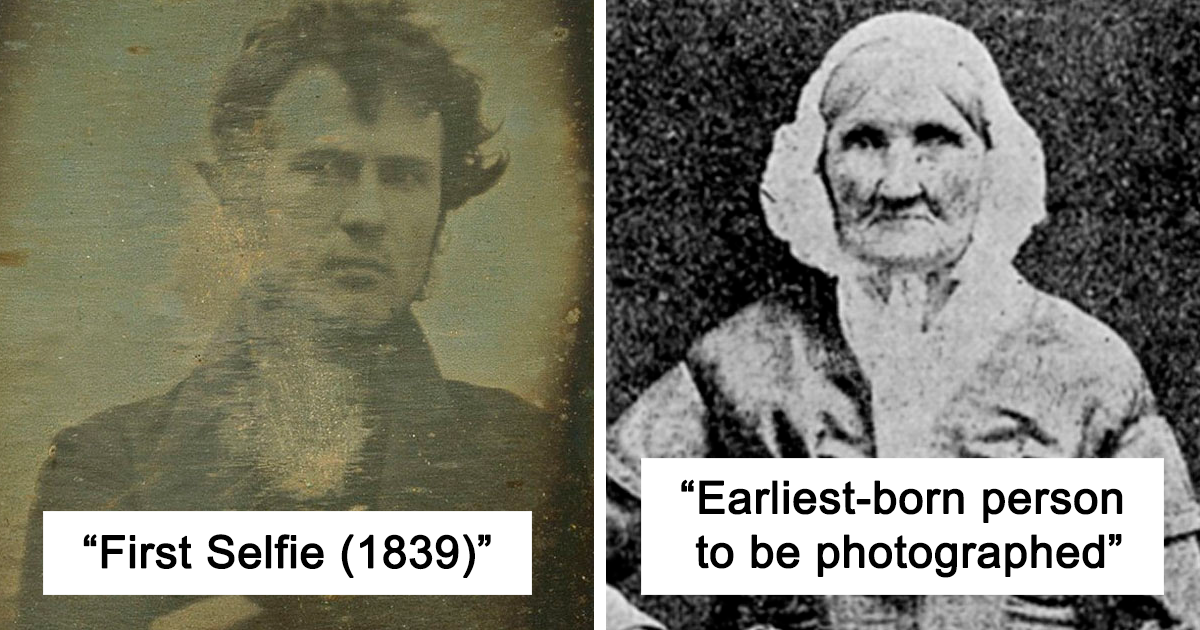
3. Robert Cornelius Self-Portrait Robert Cornelius, 1839
Cornelius’s daguerreotype self-portrait is widely recognized as one of the earliest photographic portraits in America. Long before front-facing cameras, filters, and “just one more selfie,” he stepped in front of his own camera and helped launch portrait photography.
4. “The Open Door” William Henry Fox Talbot, 1844
Talbot’s calotype process introduced the negative-positive system, making reproducible photography possible. “The Open Door” showed that photographs could be multiplied, distributed, and collectedan essential step toward photography as a mass medium.
5. “Photographs of British Algae” Anna Atkins, 1843–1853
Anna Atkins used cyanotypes to document botanical specimens, creating one of the first photographically illustrated books. Her work signaled a new era for scientific imaging and proved that photography could be both beautiful and usefulbasically the rare overachiever of art history.
6. “Valley of the Shadow of Death” Roger Fenton, 1855
Fenton’s Crimean War photograph brought battlefield landscapes to the public imagination. Though restrained by technology and censorship, it helped establish war photography as a serious documentary practice.
7. “The Dead of Antietam” Alexander Gardner, 1862
Gardner’s Civil War photographs, exhibited through Mathew Brady’s New York gallery, shocked viewers by showing the aftermath of battle. For many Americans, war stopped being an illustrated headline and became a field of bodies. Photojournalism had gained moral weight.
8. Julia Margaret Cameron’s Portraits Julia Margaret Cameron, 1860s
Cameron’s soft-focus portraits challenged the idea that photography had to be clinically sharp to be meaningful. Her expressive images helped push photography toward fine art, emotional interpretation, and psychological depth.
9. “Boston, as the Eagle and the Wild Goose See It” James Wallace Black, 1860
This early surviving aerial photograph offered a thrilling new viewpoint: the city seen from above. It opened the door to aerial mapping, reconnaissance, urban documentation, and the slightly unsettling realization that rooftops are not private.
10. “The Horse in Motion” Eadweard Muybridge, 1878
Muybridge’s sequential images of a running horse revealed movement too fast for the human eye. The project influenced science, motion studies, and eventually cinema. It proved photography could dissect time, frame by frame.
11. “Bandit’s Roost” Jacob Riis, 1888
Riis used flash photography to expose harsh living conditions in New York tenements. His images helped make photography a tool of social reform, showing that the camera could walk into dark corners and bring evidence back.
12. “The Steerage” Alfred Stieglitz, 1907
Stieglitz’s image of passengers aboard a ship became a milestone of modernist photography. Its layered geometry and social complexity helped argue that photography was not merely mechanical reproductionit could be composition, abstraction, and art.
13. “Wall Street” Paul Strand, 1915
Strand’s stark image of small human figures moving past massive architecture captured modern urban life with bold formal power. It signaled a new era of straight photography: sharp, direct, unsentimental, and visually intelligent.
14. “Power House Mechanic” Lewis Hine, 1920
Hine’s muscular industrial portrait turned the worker into a heroic figure within the machine age. It combined documentary purpose with careful composition, making labor visible at a time when industry often swallowed the individual.
15. Man Ray’s Rayographs Man Ray, 1920s
Man Ray created cameraless photographs by placing objects directly on light-sensitive paper. His rayographs helped photography enter Surrealism, reminding everyone that a camera was usefulbut not mandatory if imagination had already broken into the darkroom.
16. “Le Violon d’Ingres” Man Ray, 1924
By transforming a photographed back into a violin-like image, Man Ray fused portraiture, wit, desire, and visual trickery. It signaled photography’s power to alter reality rather than simply report it.
17. “Behind the Gare Saint-Lazare” Henri Cartier-Bresson, 1932
Cartier-Bresson’s image of a man leaping over water became a classic example of “the decisive moment.” It helped define street photography as timing, instinct, geometry, and luckall meeting for a split second before vanishing.
18. “Pepper No. 30” Edward Weston, 1930
Weston’s close-up of a pepper transformed an ordinary vegetable into sculptural form. The photograph signaled the fine-art potential of everyday objects and proved that still life could be dramatic without needing a fruit bowl to look fancy.
19. “Migrant Mother” Dorothea Lange, 1936
Lange’s portrait of Florence Owens Thompson became an enduring image of the Great Depression. It showed documentary photography’s ability to personalize economic disaster and turn statistics into a human face.
20. “Hindenburg Disaster” Sam Shere, 1937
Shere’s photograph of the airship explosion captured catastrophe in a single frame. The image became inseparable from the end of the airship era and demonstrated the growing power of fast-response news photography.
21. “The Falling Soldier” Robert Capa, 1936
Capa’s Spanish Civil War image became one of the most debated war photographs in history. Whether discussed as an authentic combat moment or a controversy in photojournalism ethics, it signaled the camera’s power to shape war memory.
22. “D-Day, Omaha Beach” Robert Capa, 1944
Capa’s blurred Normandy landing images captured the chaos of combat with terrifying immediacy. Their imperfection became part of their force, showing that technical roughness can sometimes feel more truthful than polished clarity.
23. “Raising the Flag on Iwo Jima” Joe Rosenthal, 1945
Rosenthal’s photograph of Marines raising the American flag became one of World War II’s most recognized images. It signaled a new era of photojournalistic symbolism, where one frame could become monument, poster, memory, and myth.
24. “V-J Day in Times Square” Alfred Eisenstaedt, 1945
This famous Life magazine photograph became a symbol of wartime victory and public release. Modern viewers also discuss its consent and context, proving that iconic images can change meaning as society reexamines the past.
25. “Dalí Atomicus” Philippe Halsman, 1948
Halsman’s staged portrait of Salvador Dalí, flying cats, water, furniture, and general glorious chaos showed photography’s theatrical potential. It made portraiture playful, surreal, and technically ambitious.
26. “Dovima with Elephants” Richard Avedon, 1955
Avedon’s fashion photograph placed elegance beside enormous animals, creating a dramatic contrast between couture and circus spectacle. It signaled fashion photography’s move into narrative, performance, and high art.
27. “Moonrise, Hernandez, New Mexico” Ansel Adams, 1941
Adams’s luminous landscape became a masterclass in exposure, printing, and tonal control. It strengthened the idea that landscape photography could be both environmental reverence and technical virtuosity.
28. “The Tetons and the Snake River” Ansel Adams, 1942
This grand Western landscape later traveled aboard Voyager as part of humanity’s visual message to the cosmos. It represents photography as cultural ambassador, wilderness testimony, and proof that rivers know how to compose themselves.
29. “Black Power Salute” John Dominis, 1968
At the Mexico City Olympics, Tommie Smith and John Carlos raised gloved fists during the medal ceremony. Dominis’s photograph became a defining image of athlete activism, civil rights, and protest on a global stage.
30. “Earthrise” William Anders, NASA Apollo 8, 1968
Seeing Earth rise above the Moon changed how people imagined the planet. “Earthrise” helped fuel environmental awareness by showing Earth as fragile, beautiful, and alone against space’s very dramatic black backdrop.
31. “Saigon Execution” Eddie Adams, 1968
Adams’s photograph of a street execution during the Vietnam War became one of the most influential and disturbing images of the conflict. It raised urgent questions about violence, context, journalism, and the split second that can define history.
32. “The Terror of War” / “Napalm Girl” 1972
The image of children fleeing a napalm attack in Vietnam became a powerful antiwar photograph. Long credited to Nick Ut, its authorship has faced renewed scrutiny, but its historical impact remains undeniable: it forced viewers to confront civilian suffering.
33. “The Blue Marble” NASA Apollo 17, 1972
This full view of Earth from space became one of the most widely reproduced photographs ever. It signaled the era of planetary consciousness, climate awareness, and the humbling discovery that Earth looks very small when the universe stops flattering us.
34. “Fire Escape Collapse” Stanley Forman, 1975
Forman’s photograph of a woman and child falling from a collapsed fire escape was horrifying, unforgettable, and consequential. It helped spur public attention to fire safety and showed photojournalism’s role in civic accountability.
35. “William Eggleston’s Red Ceiling” William Eggleston, 1973
Eggleston’s saturated color work helped legitimize color photography in the art world. His photographs of everyday American life suggested that color was not decorative fluffit was structure, mood, and meaning.
36. “Untitled Film Still #21” Cindy Sherman, 1978
Sherman’s staged self-portrait from her “Untitled Film Stills” series helped redefine photography as performance and critique. It opened new conversations about identity, gender, media stereotypes, and the camera’s role in constructing the self.
37. “Afghan Girl” Steve McCurry, 1984
Published on the cover of National Geographic in 1985, Sharbat Gula’s portrait became one of the most recognizable magazine images in history. It signaled the global reachand ethical complexityof humanitarian portrait photography.
38. “Tank Man” 1989
The image of a lone man standing before tanks near Tiananmen Square became a worldwide symbol of individual resistance. It showed how one anonymous figure, captured at the right moment, could challenge power visually across borders.
39. “The Vulture and the Little Girl” Kevin Carter, 1993
Carter’s photograph from Sudan won major recognition and sparked fierce debate about the ethics of witnessing suffering. It signaled a new era of scrutiny around photojournalism: when does documenting become helping, and who gets to decide?
40. “Bliss” Charles O’Rear, 1996
The rolling green hill used as the Windows XP wallpaper may be the most viewed photograph in everyday digital life. It signaled photography’s migration from gallery wall and newspaper page to desktop background, office cubicle, and collective computer memory.
41. The First Digital Camera Image Kodak, 1975
Engineer Steven Sasson’s early digital camera prototype at Kodak helped start the shift from film to electronic imaging. The image quality was modest, but the idea was volcanic. Photography was about to leave the darkroom and enter the data stream.
What These Photos Reveal About Photography’s Evolution
Taken together, these important photos in photography history show a medium constantly reinventing itself. Early photography was a technological miracle. Then it became a portrait business, a scientific tool, a documentary method, a battlefield witness, an artistic language, a commercial engine, and finally a digital habit so common that people now photograph lunch before confirming whether it tastes good.
The history of photography is also the history of access. In the 19th century, a photograph required chemistry, equipment, patience, and often a subject willing to remain statue-like. By the 20th century, smaller cameras allowed photographers to move through streets, wars, protests, studios, and homes. By the 21st century, cameras became attached to phones, and the number of images exploded beyond anything Niépce, Daguerre, or Talbot could have imagined.
Yet the lesson of these 41 photographs is not simply that cameras improved. The deeper lesson is that vision improved. Photographers learned how to use the camera not only to record what stood before them, but to interpret what it meant. A historic photo becomes important when it teaches people how to see differently.
Experiences and Lessons From Studying the Most Important Photos in Photography History
Spending time with landmark photographs is a surprisingly personal experience. At first, you may approach them like museum homework: famous image, famous photographer, famous date, please do not ask me to pronounce “daguerreotype” in public. But the longer you look, the more these images stop behaving like artifacts and start behaving like conversations.
One experience many viewers share is the shock of realizing how much a single frame can hold. “Migrant Mother” is not only about poverty; it is about worry, endurance, motherhood, government response, and the emotional architecture of a face. “Earthrise” is not only about space exploration; it is about suddenly seeing home from the outside. “The Steerage” is not only about passengers on a ship; it is about class, geometry, migration, and modern life. Great photographs work like compact novels. They do not need 300 pages; they just need one unforgettable arrangement of light.
For photographers, these images offer practical lessons. Muybridge teaches curiosity: ask a question nobody can answer, then build a method to answer it. Cartier-Bresson teaches patience: the world composes itself for a fraction of a second, and your job is to be ready when it does. Avedon teaches control: staging is not cheating when it reveals something true. Lange teaches responsibility: photographing people in hardship requires empathy, not visual tourism. Eggleston teaches bravery: ordinary subjects can become extraordinary when color, framing, and attention are taken seriously.
There is also an ethical lesson. Some of the most famous photographs in history are uncomfortable to view. War images, disaster images, and images of suffering force viewers to ask what photography should do with pain. Should it witness? Intervene? Persuade? Inform? Respect privacy? Expose injustice? The answer is rarely simple. That is why these photographs remain important. They do not let us relax into easy admiration.
Another experience is humility. Modern photographers have tools that earlier pioneers would have considered wizardry: autofocus, high ISO, burst mode, instant preview, editing software, cloud storage, and cameras small enough to lose under a couch cushion. But better tools do not automatically create better photographs. Many historic images were made with slow plates, heavy cameras, limited exposures, or dangerous working conditions. Their power came from timing, purpose, and vision.
For writers, editors, designers, and content creators, these photos are reminders that visuals shape memory faster than text. A strong photograph can become the emotional doorway into a topic. It can make readers care before they fully understand. That is why photography remains essential in journalism, history, branding, education, and digital storytelling.
Finally, these 41 photos encourage us to look more carefully at the images we create today. Most pictures now disappear into feeds within hours, but the habits behind great photography still matter: notice the light, respect the subject, understand the context, wait for the gesture, question the frame, and ask why the image should exist. A photograph does not need to become world-famous to matter. Sometimes it only needs to preserve a truth that would otherwise slip away.
Conclusion
The most important photos in photography history signal new eras because they changed the relationship between people and images. They made time visible, war undeniable, labor heroic, identity performative, Earth fragile, and digital photography inevitable. Some are beautiful. Some are painful. Some are controversial. All of them remind us that photography is not just about seeingit is about understanding what seeing can do.
From Niépce’s rooftop view to Kodak’s digital prototype, from Lange’s Depression-era portrait to NASA’s cosmic perspective, these photographs prove that a single image can carry science, art, politics, memory, and emotion at once. That is the magic trick photography keeps performing: it freezes a moment, then refuses to stay still in history.
SEO Metadata