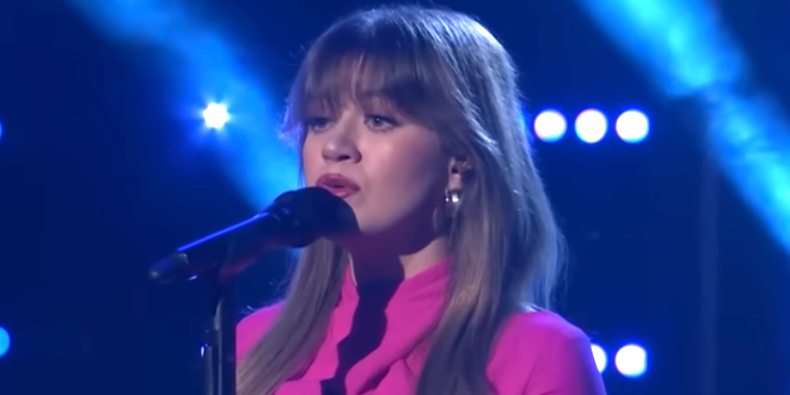

Some songs walk into a room wearing a crown. Whitney Houston’s “I Have Nothing” is one of them. It is not the kind of ballad singers casually toss into a set list between coffee sips and a wardrobe change. It is a vocal skyscraper, a full-body workout, and possibly a legally recognized stress test for the human diaphragm. So when Kelly Clarkson performed the Whitney Houston classic on The Kelly Clarkson Show, fans did exactly what fans do when the internet receives a high note with emotional consequences: they gasped, replayed, commented, and declared it “perfection.”
The performance arrived during a meaningful milestone: the 1,000th episode of Clarkson’s daytime talk show. That alone gave the moment a celebratory glow. But instead of choosing an easy, breezy number, Clarkson went straight for one of pop and R&B’s most intimidating ballads. Bold? Absolutely. Dangerous? Vocally, yes. Successful? Judging by fan reaction, very much so.
Kelly Clarkson’s Whitney Houston cover quickly became the kind of Kellyoke performance that reminds people why the segment has become a signature part of her show. It was not just about singing the notes. It was about honoring a legendary song while still sounding unmistakably like Kelly Clarkson: warm, powerful, slightly gritty, emotionally open, and technically sharp enough to make vocal coaches silently nod like proud uncles at a graduation.
Why Kelly Clarkson’s Whitney Houston Cover Hit So Hard
The reason this performance resonated is simple: Clarkson did not treat “I Have Nothing” like a karaoke mountain to conquer. She treated it like a story. Whitney Houston’s original version is famous for its dramatic build, crystal-clear phrasing, and soaring emotional intensity. Clarkson’s approach leaned into those strengths while adding her own personality. The arrangement was relatively stripped down, allowing the vocal to take center stage without a wall of production getting in the way.
That matters because “I Have Nothing” is not a song that tolerates shortcuts. It demands breath control, dynamic range, emotional pacing, and the ability to make huge notes feel earned rather than launched like fireworks from a county fair parking lot. Clarkson’s version worked because she understood the architecture of the song. She did not rush the emotional lift. She let the verses breathe, gave the chorus room to open, and saved the biggest vocal moments for when they would actually mean something.
Fans responded to that balance. Many listeners praised not only the power of Clarkson’s voice but also the ease with which she seemed to move through a famously difficult song. That “effortless” quality is part of her magic. Of course, singing like that is not effortless at all. It is the product of years of performance, instincts, technique, and probably a vocal warm-up routine that would make ordinary people need a nap.
The Kellyoke Effect: Why Fans Expect Greatness
Kellyoke began as one of the smartest ideas in daytime television: let one of the best live vocalists in modern pop open the show by covering songs people already love. It sounds simple, but simple ideas are often the ones that work best. Viewers tune in for celebrity interviews, human-interest stories, and Clarkson’s down-to-earth humor, but Kellyoke gives every episode a musical spark.
Over the years, Clarkson has covered rock, country, soul, pop, R&B, Broadway-adjacent power ballads, and songs that most singers would only attempt if someone promised them hazard pay. Her gift is not merely technical. It is interpretive. She can take a familiar song and make it feel freshly emotional without disrespecting the original. That is a rare skill, especially in an era where covers can sometimes sound like vocal gymnastics performed in a wind tunnel.
Her Whitney Houston covers, in particular, carry extra weight. Whitney’s catalog is sacred territory for many music fans. The songs are not only difficult; they are culturally beloved. A singer covering Whitney Houston is stepping into a room full of people who already have the original version tattooed on their musical memory. One wrong move and the comment section puts on its reading glasses.
Clarkson survives that pressure because she never appears to be imitating Houston. She honors the source material while singing from her own musical identity. That distinction is why fans often accept her versions even when they would side-eye another artist for attempting the same song.
Why “I Have Nothing” Is Such a Vocal Challenge
Released in 1993 as part of The Bodyguard soundtrack era, “I Have Nothing” remains one of Whitney Houston’s signature ballads. Written by David Foster and Linda Thompson, the song became a major hit and is remembered for its sweeping melody, dramatic key moments, and emotional directness. It is the kind of song that begins with vulnerability and ends somewhere near the clouds.
What makes it so difficult is not just the high notes. Plenty of songs have high notes. The real challenge is control. A singer has to keep the verses intimate without sounding small, build intensity without blowing out the emotional arc, and deliver the climactic moments without turning the performance into a vocal wrestling match. The song asks for precision and passion at the same time, which is basically the singer’s version of patting your head, rubbing your stomach, and solving taxes while wearing heels.
Clarkson’s strength has always been that she can combine polish with raw feeling. Her voice has a natural rasp when she pushes, but she also has the musical intelligence to pull back. In this cover, that combination helped the song feel alive rather than merely impressive. The result was a performance that gave fans the thrill of a big vocal moment without losing the emotional heart of the lyric.
Fans Calling It “Perfection” Makes Sense
When fans call a performance “perfection,” they are not usually grading it like a college exam. They are reacting to how it made them feel. In this case, “perfection” became shorthand for a cover that checked several boxes at once: respectful to Whitney Houston, vocally strong, emotionally believable, and exciting enough to replay.
The reaction also shows how much goodwill Clarkson has built with her audience. Viewers trust her with big songs because she has repeatedly shown that she approaches them with care. She is not just chasing viral applause. She is a singer who clearly loves music, understands other artists’ legacies, and still enjoys the thrill of stepping up to a vocal challenge.
That trust is important. Many artists can sing loudly. Fewer can make a familiar song feel personal. Clarkson’s fans know that when she covers a classic, she will usually bring a combination of vocal firepower and emotional honesty. That is why the response to this Whitney Houston cover felt so immediate. People were not surprised that she could sing it. They were delighted that she sang it so well.
Kelly Clarkson’s Career Prepared Her for This Moment
Kelly Clarkson did not become a trusted live vocalist overnight. Her public career began with American Idol, where she became the first winner of the American version of the competition in 2002. From the beginning, she was known for a voice that could move between pop clarity, rock bite, and soulful intensity. She later built a catalog that includes powerhouse singles, emotional ballads, and albums that showed far more range than the phrase “reality competition winner” could ever capture.
Her success also gave her something crucial: live-performance stamina. Singing on television is unforgiving. There is no hiding behind studio magic when the camera is on, the band is playing, and millions of viewers can pause, rewind, and discuss every note online. Clarkson has spent years performing under those conditions. That experience shows in Kellyoke, especially when she takes on songs associated with vocal legends.
She also brings a refreshing lack of stiffness. Some technically gifted singers can sound like they are carefully assembling a piece of furniture from a very expensive instruction manual. Clarkson sounds human. She laughs, talks, reacts, and then casually steps into a huge vocal moment as if she simply remembered she has one of the strongest voices in pop. That relatability makes the performance feel less like a museum piece and more like a live emotional event.
Honoring Whitney Houston Without Copying Her
The most important thing about covering Whitney Houston is knowing what not to do. Trying to duplicate Whitney note for note is usually a losing game. Houston’s tone, phrasing, agility, and emotional command were uniquely hers. A respectful cover should acknowledge that greatness without becoming a wax-museum version of the original.
Clarkson’s “I Have Nothing” performance succeeded because it did not feel like an imitation. She used her own tone, her own phrasing instincts, and her own emotional color. Where Houston’s original glides with pristine elegance, Clarkson often adds a little more earthy texture. That difference does not compete with the original; it creates a new angle on the same song.
This is why great covers matter. They do not replace the original. They start a conversation with it. Clarkson’s version reminded longtime Whitney fans of the song’s greatness while introducing younger or casual viewers to why this ballad still matters decades later. That is a win for everyone, including anyone who suddenly found themselves searching for the original after hearing Kelly’s version.
Why This Performance Worked on Daytime TV
Daytime television has a unique energy. It is not a concert arena, and it is not a late-night stage built around cool detachment. It is intimate, bright, conversational, and often deeply emotional. A performance like “I Have Nothing” can feel especially powerful in that setting because it arrives in the middle of a show designed around connection.
The 1,000th episode context made the song choice even more meaningful. Clarkson’s show has become known for mixing music, celebrity interviews, everyday heroes, humor, and heartfelt moments. Choosing a Whitney Houston classic for such a milestone felt like a statement: this show began with music at its core, and even after 1,000 episodes, Clarkson’s voice remains the anchor.
The stripped-down staging helped, too. When a song is this big, the smartest production choice is often restraint. Let the singer sing. Let the melody carry the drama. Let the audience hear the breath, the phrasing, the build, and the emotional release. Clarkson did not need explosions, flying platforms, or a choir descending from the ceiling. Though, to be fair, if a choir had appeared, the internet probably would have survived.
The Bigger Meaning Behind Fan Reactions
Fan reactions to this cover are about more than one performance. They reflect a larger appreciation for singers who can still deliver live vocals with personality and power. In a music landscape full of filters, snippets, edits, and algorithm-friendly hooks, a full-throated ballad performance can feel almost old-fashioned in the best way.
Clarkson’s cover reminded listeners that vocal storytelling still has a place. The song was not trendy. It was not built around a dance challenge. It did not need a meme to explain it. It simply gave a great singer a great song and allowed the moment to unfold. That kind of performance travels because people recognize sincerity when they hear it.
It also proves that Kellyoke is more than a cute segment name. It is a weekly reminder that Clarkson is not only a talk show host who can sing; she is a singer whose talk show gives her a living archive of musical interpretations. For fans, each cover becomes part of a growing library of “please release this officially” moments.
Experience Section: What It Feels Like to Watch This Cover as a Fan
Watching Kelly Clarkson cover Whitney Houston’s “I Have Nothing” is the kind of experience that starts casually and ends with someone whispering, “Wait, play that again.” At first, viewers may click because they recognize the song title or because Kellyoke has trained them to expect something good. Then the first lines arrive, and the room gets quieter. The performance asks for attention without begging for it.
For longtime Kelly Clarkson fans, the cover feels like a return to what made them love her in the first place. There is that familiar mix of power and openness, the sense that she is not just hitting notes but living inside the emotion. Fans who remember her early American Idol days can hear the same fearless quality that made her stand out, now refined by years of experience. It is not just “Kelly can sing.” Everyone knows that. It is “Kelly still sings like she has something to prove, even when she absolutely does not.”
For Whitney Houston fans, the experience is more delicate. Many listeners approach any Whitney cover with caution, and honestly, fair enough. Some songs are so iconic that hearing another version can feel like watching someone borrow a priceless antique vase while wearing roller skates. But Clarkson’s version earns trust quickly. She does not overdecorate the song. She gives it respect, space, and emotional seriousness. That makes the performance feel like a tribute rather than a challenge.
There is also a communal feeling to the reaction. One person watches, then sends it to a friend. A friend sends back a string of capital letters. Someone posts that they got chills. Someone else says they cried. Another person claims they were not ready, which is understandable because nobody is truly ready for a surprise Whitney-level ballad before lunch. The cover becomes a shared mini-event, the kind of internet moment that reminds people how fun it can be to simply admire talent together.
The performance also connects with anyone who has ever loved a big ballad. Songs like “I Have Nothing” are dramatic because feelings are dramatic. They are built for people who have sat in cars after a long day, turned the volume up, and briefly believed they too could deliver a flawless final chorus while merging onto the highway. Clarkson taps into that fantasy. She gives listeners the emotional release without making the song feel cheesy.
Another part of the experience is respect for craft. Even casual listeners can sense when a singer is doing something difficult. The breath control, the rise in intensity, the way Clarkson holds back before opening upit all creates tension and release. Viewers may not know the technical terms, but they know when their shoulders drop, their eyes widen, or their hand automatically reaches for the replay button.
In the end, the fan experience is a blend of nostalgia, admiration, surprise, and joy. Clarkson’s Whitney Houston cover works because it feels both grand and personal. It honors one of the greatest vocalists of all time while reminding everyone that Kelly Clarkson remains one of the rare modern singers who can step into a legendary song and make the moment feel alive. That is why fans called it “perfection.” Not because perfection is easy, but because for a few minutes, Kelly made it sound possible.
Conclusion
Kelly Clarkson’s cover of Whitney Houston’s “I Have Nothing” became a fan-favorite moment because it combined the right song, the right singer, and the right occasion. Performing the classic during the 1,000th episode of The Kelly Clarkson Show gave the moment extra emotional weight, but the real reason it spread was simple: Clarkson delivered.
Her version respected Whitney Houston’s legacy without copying it. It showcased vocal power without sacrificing feeling. It reminded viewers why Kellyoke has become such a beloved part of daytime television. Most importantly, it gave fans a performance worth replaying, praising, and calling “perfection” with absolutely no shame. Sometimes the internet overreacts. This time, it may have reacted exactly enough.