Woman Matches The Color Of The Paint She Outlines Her Vitiligo Spots With To Her Outfits, And People Can’t Get Enough

Note: This article is written for web publication in standard American English and is based on public reporting, dermatology references, and real information about vitiligo, body art, self-expression, and inclusive beauty.
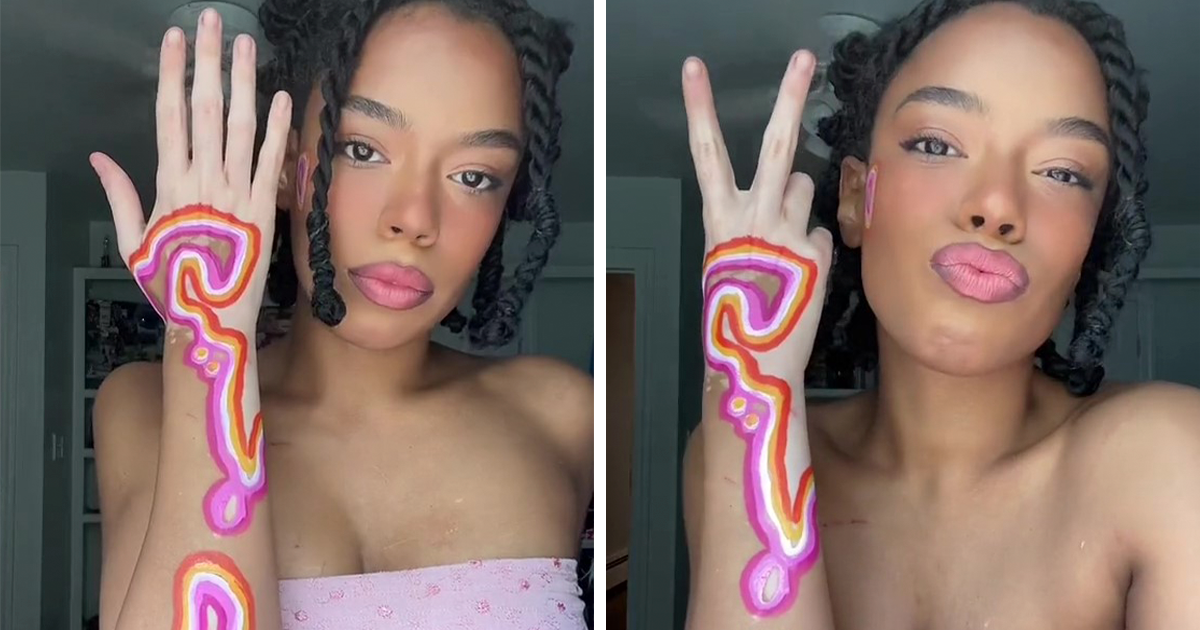
Some people accessorize with earrings. Some people bring out a statement bag. Amara Aleman? She turns her skin into a living artwork and matches the color of her painted vitiligo spots to her outfits. The result is joyful, bold, and impossible to scroll past without stopping for a second look.
Her creative project, often called “ArtSpots,” highlights the natural shapes created by vitiligo, a skin condition that causes areas of skin to lose pigment. Instead of hiding those lighter patches, Amara outlines and decorates them with colorful body paint. Sometimes the designs are delicate and floral. Sometimes they are bright, graphic, and playful. Often, they coordinate perfectly with what she is wearing, making her skin part of the full fashion moment.
And the internet, for once, has done something wholesome: people love it. Viewers have praised her confidence, creativity, and willingness to challenge the tired idea that beauty must look smooth, symmetrical, filtered, or “perfect.” Her work is not just visually striking; it also says something bigger about self-acceptance, representation, and the power of turning something painful into something personal, stylish, and deeply empowering.
Who Is Amara Aleman?
Amara Aleman is an artist, content creator, and former dancer who became widely known for transforming her vitiligo spots into colorful body art. After noticing changes in her skin in her twenties, she went through a difficult period of adjustment. Like many people who experience sudden visible changes, she struggled with identity, confidence, and the feeling that people might look at her differently.
That emotional part of the story matters. Vitiligo is not simply a “skin look” or a fashion aesthetic. For many people, it arrives with uncertainty. Will the spots spread? Will strangers stare? Will makeup cover it? Should it be covered at all? Those questions can become mentally exhausting, especially in a culture that has spent decades selling the fantasy of flawless skin in tiny glass bottles with suspiciously expensive caps.
Amara has spoken publicly about initially hiding her skin with clothing and makeup. She also stepped away from dancing for a time, which is significant because dance is not exactly a hide-in-the-corner activity. It asks the body to be seen. When your body starts looking different from what you have always known, being seen can suddenly feel complicated.
Over time, with support from loved ones and her own creative instincts, she began to see her skin differently. Her vitiligo spots were not mistakes to erase. They were shapes, patterns, and possibilities. That shift became the foundation of ArtSpots.
What Are “ArtSpots”?
ArtSpots are Amara’s colorful body paint designs that follow, outline, or decorate the natural borders of her vitiligo patches. Instead of trying to blend the spots into her surrounding skin tone, she does the opposite: she emphasizes them.
The effect is stunning because it flips the usual beauty script. Many beauty products are marketed around hiding texture, evening tone, and correcting what is framed as a flaw. Amara’s work says, “What if the thing you were told to conceal is actually the most interesting part of the look?” That is a powerful question, and apparently a very shareable one.
Her designs often match her outfits, turning body paint into an accessory. A bright top might be paired with painted outlines in the same color family. A playful dress might inspire swirls, petals, or decorative borders. The styling feels intentional from head to toe, as if her skin, clothing, nails, and makeup are all in conversation.
There is also a theatrical quality to it. Because Amara has a dance and performance background, her looks do not feel random. They feel staged in the best way: expressive, camera-ready, and full of personality. She is not just applying paint. She is creating a character, a mood, and a visual statement.
Why Matching Body Paint To Outfits Feels So Fresh
Fashion has always been about coordination. People match shoes to bags, lipstick to dresses, and nail polish to seasonal moods. But matching body paint to vitiligo spots adds a deeper level of personalization. No two vitiligo patterns are exactly the same, which means every design begins with a one-of-a-kind canvas.
That is why the looks feel so original. A floral dress can be copied. A popular makeup trend can be recreated. But Amara’s designs are shaped by her own skin. Her body is not just wearing the art; it is helping compose it.
This is one reason people respond so strongly to her content. In a social media world where trends often blur together, ArtSpots are instantly recognizable. They are colorful, meaningful, and deeply specific. That combination is rare. The internet can be a loud place, but authenticity still cuts through the noise like a neon eyeliner wing.
Understanding Vitiligo: More Than A Skin Difference
Vitiligo is a long-lasting autoimmune condition in which the immune system attacks melanocytes, the cells responsible for producing pigment in the skin. When these cells are destroyed or stop functioning, patches of skin become lighter or white. Vitiligo can appear anywhere on the body, including the hands, arms, face, legs, hair, and even areas inside the mouth.
The condition is not contagious. It is not caused by poor hygiene, and it is not something a person can pass to others through touch. However, vitiligo can be unpredictable. Some people develop only a few patches that remain stable for years. Others see new patches appear or existing ones grow over time.
Although vitiligo is often described as medically harmless, that phrase can be misleading if it ignores the emotional impact. A visible skin condition can affect self-esteem, social confidence, dating, work life, and mental health. People may face staring, rude questions, myths, or unwanted advice. Even well-intentioned comments can feel exhausting when they happen repeatedly.
This is why Amara’s work resonates. She is not pretending vitiligo is always easy. She is showing one way to reclaim the conversation. By decorating her spots, she moves from being looked at to being seen on her own terms.
From Hiding To Highlighting
The most compelling part of Amara’s story is the transformation from hiding her vitiligo to highlighting it. That shift is not as simple as waking up one morning and deciding to be confident. Self-acceptance often arrives slowly. It can involve grief, anger, awkwardness, support, experimentation, and a few “I am absolutely not leaving the house today” moments.
For Amara, art became a bridge. Painting her spots gave her a way to interact with her skin that was creative instead of critical. The process turned the mirror from a place of anxiety into a place of possibility. That matters because confidence is not always a speech you give yourself. Sometimes it is an action you repeat until your mind starts to believe your body is not the enemy.
Her ArtSpots also show that acceptance does not have to look quiet or neutral. It can be loud. It can be colorful. It can wear glitter, match a crop top, and ask the camera to get the good angle.
Why People Can’t Get Enough
People are drawn to Amara’s ArtSpots for several reasons. First, the visuals are beautiful. The colors pop, the lines are mesmerizing, and the outfit coordination makes each look feel complete. Even without knowing the story, the art is eye-catching.
Second, the message is uplifting without being cheesy. The internet has seen plenty of “love yourself” slogans slapped onto products, posters, and mugs. Amara’s content feels more grounded because it comes from lived experience. She is not just saying confidence is possible. She is demonstrating it in real time, one painted design at a time.
Third, her work gives representation to people with vitiligo and other visible differences. Representation matters because people need to see bodies like theirs portrayed as beautiful, stylish, artistic, and worthy of attention for the right reasons. When someone with vitiligo sees Amara’s designs and thinks, “Maybe I do not have to hide,” that is more than a viral moment. That is a meaningful cultural shift.
The Role Of Social Media In Changing Beauty Standards
Social media can be brutal. It can make people compare their everyday face to someone else’s edited vacation face, which is a deeply unfair competition. But social media can also make room for beauty that traditional media overlooked for years.
Creators like Amara use platforms such as TikTok and Instagram to bypass old beauty gatekeepers. They do not need a magazine editor, a fashion campaign, or a cosmetics brand to tell them their look is worth showing. They can post it directly, and audiences can respond directly.
That direct connection is part of why ArtSpots became so powerful. People with vitiligo can comment, message, share, and connect. People without vitiligo can learn. Parents of children with vitiligo can show them an example of someone celebrating skin that looks different. The comment section becomes more than applause; it becomes a community.
Body Art As Self-Expression
Body art has a long history, from ceremonial painting to tattoos, makeup, performance art, and fashion photography. What makes ArtSpots special is how it blends body art with self-acceptance. The designs are temporary, but the message lasts longer than the paint.
There is also something beautifully practical about using body paint as fashion. It allows for change. One day the design can be pink and romantic. Another day it can be electric blue and dramatic. The spots remain part of the canvas, but the mood can shift with the outfit, the season, the event, or the creator’s imagination.
This flexibility matters. People with visible differences are often pressured into one of two roles: hide completely or become inspirational all the time. Amara’s work offers a third option: play. She can be serious, stylish, silly, glamorous, experimental, or all of the above. Her skin does not lock her into one story.
Fashion, Confidence, And The Joy Of Being Seen
When Amara matches the color of her painted vitiligo outlines to her outfits, she creates a full-body styling language. It is not just “Here is a cute outfit.” It is “Here is a look built around exactly who I am.” That is the kind of fashion that feels alive.
Many people understand the confidence boost that comes from wearing something that feels right. The perfect jacket can change your posture. A great pair of shoes can make a grocery store aisle feel like a runway, even if the runway is mostly cereal boxes and one suspiciously wobbly cart. Amara takes that feeling further by making her skin part of the styling process.
Her looks remind viewers that confidence is not about pretending insecurities never existed. It is about choosing how much power those insecurities get. By painting the very spots she once hid, Amara changes the visual focus. The spots are no longer something to explain. They are the main event.
Important Care Notes For Vitiligo And Body Paint
Anyone inspired by Amara’s ArtSpots should remember that skin safety matters. Vitiligo patches can be more sensitive to sunburn because they have less pigment. Sun protection, protective clothing, and guidance from a dermatologist can be important parts of caring for skin with vitiligo.
People interested in body paint should use products made for skin, avoid harsh craft paints, patch-test when appropriate, and remove products gently. If the skin is irritated, broken, burned, or inflamed, it is better to let it heal before applying cosmetics or paint. Art is wonderful, but angry skin has a way of filing a complaint immediately.
It is also worth noting that no one with vitiligo has to decorate, cover, treat, or display their skin to be valid. Some people love makeup. Some prefer bare skin. Some pursue medical treatment. Some do not. The empowering choice is the one made by the person living in that skin.
What Amara’s Story Teaches About Beauty
Amara Aleman’s ArtSpots challenge one of the most stubborn beauty myths: that beauty depends on sameness. Smooth skin, even tone, symmetrical features, predictable shapesthese have long been treated as the gold standard. But real beauty is often more interesting than that. It has contrast, texture, history, personality, and surprise.
Her work does not ask viewers to ignore vitiligo. It asks them to see it differently. That distinction is important. Acceptance is not always about pretending differences are invisible. Sometimes it is about making differences visible in a way that feels proud, creative, and self-directed.
In that sense, ArtSpots are not just decorative. They are a visual argument. They say that a changing body can still be a beautiful body. They say that confidence can be built through creativity. They say that fashion can include skin, story, and identitynot just fabric.
Experiences Related To Vitiligo Art, Style, And Self-Acceptance
One of the most relatable experiences connected to Amara’s story is the quiet ritual of getting dressed while managing how visible you want to be. Many people with vitiligo, scars, birthmarks, acne, alopecia, stretch marks, or other visible differences know this moment well. You stand in front of the closet and ask questions that go beyond style. Will this sleeve cover my arm? Will this neckline show the spot on my chest? Will people ask about my skin? Do I feel like explaining anything today? Suddenly, choosing a shirt becomes emotional labor. The outfit is not just about color and comfort; it is also about boundaries.
That is why Amara’s approach feels so refreshing. Matching paint to an outfit transforms the dressing process from defense into design. Instead of asking, “How do I hide this?” the question becomes, “How can I make this part of the look?” That shift can feel small from the outside, but from the inside, it can be enormous. It turns the closet into a creative studio instead of a battlefield.
Imagine someone preparing for a summer party. In the past, they might have reached for long sleeves despite the heat because they did not want questions about their skin. Inspired by ArtSpots, they might choose a sleeveless yellow dress and outline a few patches with soft gold body paint. The goal is not to perform confidence for strangers. The goal is to feel ownership over the moment. If someone asks, “What is that?” the answer can be simple: “It is body art.” No apology required.
Another common experience is the first time someone receives a positive reaction to something they once felt ashamed of. That can be disorienting in the best way. A person may spend years thinking a visible difference is the first thing others notice in a negative way. Then one day, someone compliments it, not with pity, but with genuine admiration. That kind of reaction can loosen old fear. It does not erase every insecurity, but it creates a new memory for the brain to hold onto.
For younger people with vitiligo, seeing a creator like Amara can be especially meaningful. Children and teenagers are often navigating identity while also dealing with peer pressure, comments, and comparison. A confident adult turning vitiligo into art sends a message that lectures cannot always deliver: your skin does not disqualify you from being stylish, loved, photographed, celebrated, or cool. In fact, your difference may become part of your signature.
Parents can also learn from this approach. A child with vitiligo may not want constant reassurance that “nobody notices.” Sometimes people do notice. A more helpful message might be: “Your skin is yours, and you get to decide how you feel about it today.” Some days that may mean sunscreen and no discussion. Other days it may mean colorful paint, stickers, temporary designs, or a matching outfit. The point is choice.
Adults can relate, too. Many people carry old insecurities long after childhood ends. A visible difference can affect dating photos, job interviews, beach trips, weddings, and casual social events. Amara’s work does not magically remove those pressures, but it offers a creative tool. It reminds people that they can experiment with visibility. They can be bare-faced one day, covered the next, decorated the day after that, and none of those choices cancel the others out.
Ultimately, the experience behind this topic is not only about vitiligo. It is about reclaiming the parts of ourselves we were taught to minimize. Whether that part is skin, body shape, hair texture, disability, age, or personal style, the lesson is similar: you do not have to wait for the world to approve of you before you begin treating yourself like art.
Conclusion
Amara Aleman’s outfit-matching vitiligo body art is more than a viral beauty trend. It is a celebration of creativity, self-acceptance, and personal style. By outlining her vitiligo spots with colorful paint, she turns something she once struggled with into an expressive signature. Her ArtSpots invite viewers to rethink what beauty can look like and remind people with visible differences that they deserve to be seen on their own terms.
Her story also shows the best side of internet culture: a creator shares something vulnerable and inventive, and people respond with admiration, connection, and encouragement. In a world obsessed with filters, Amara’s art feels refreshingly human. It is colorful, imperfect, personal, and full of life. And yes, it matches the outfit beautifully.