
For most of spaceflight history, getting around has meant carrying fuel, burning fuel, worrying about fuel, and then having a very dramatic meeting about how much fuel is left. NASA’s solar sail technology wants to rewrite that old script with something almost poetic: sunlight as propulsion. No roaring engine. No giant fuel tank. No “please do not run out of propellant halfway to the asteroid” energy. Just an ultra-thin reflective sail catching the momentum of photons from the Sun.
That may sound like science fiction wearing a lab coat, but NASA’s Advanced Composite Solar Sail System, often called ACS3, has brought the idea closer to practical reality. The mission launched in 2024 aboard a Rocket Lab Electron rocket and deployed a large reflective sail in low Earth orbit. The goal is not simply to look majestic in space, although it does that nicely. The real goal is to test whether lightweight composite booms and sail materials can support future spacecraft that maneuver using solar radiation pressure instead of conventional rocket propellant.
The big story is simple: NASA is very close to proving a scalable version of solar sail propulsion that could change how small spacecraft explore the solar system. The complicated story involves carbon-fiber booms, attitude control, sail dynamics, sunlight pressure, orbital maneuvers, and the kind of engineering patience usually reserved for folding a fitted sheet perfectly on the first try.
What Is NASA’s Solar Sail, Exactly?
A solar sail is a spacecraft propulsion system that uses sunlight to move. Light is made of photons, and while photons do not have mass, they do carry momentum. When they strike and reflect off a shiny sail, they give the spacecraft a tiny push. One photon is not exactly a gym bro. But trillions upon trillions of photons arriving continuously can create steady thrust over time.
Unlike a chemical rocket, which delivers powerful bursts of acceleration, a solar sail provides gentle, continuous propulsion. It is less like a cannon blast and more like a whisper that never stops. In space, where there is no road friction and no atmospheric drag in deep space, that whisper can matter a lot.
Why ACS3 Matters
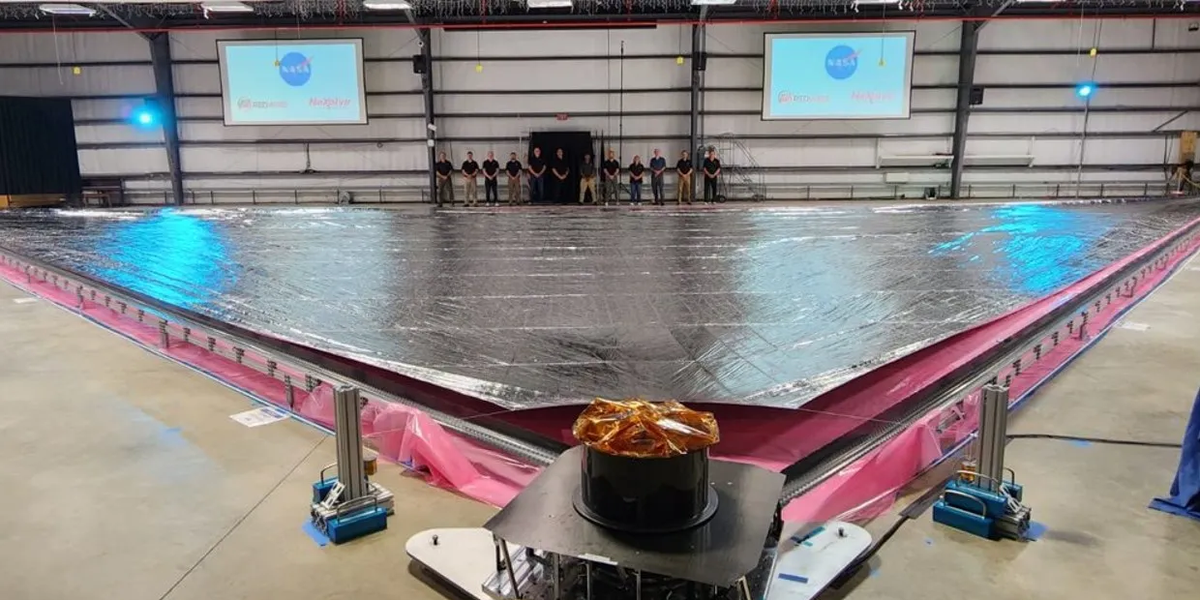
NASA’s Advanced Composite Solar Sail System is a technology demonstration, which means its main job is to prove that key hardware works in the actual space environment. ACS3 uses a CubeSat spacecraft body and deploys a square solar sail roughly the size of a small apartment. The sail is supported by lightweight composite booms designed to be stiffer, lighter, and more temperature-resistant than older metallic boom designs.
That boom technology is the secret sauce. A solar sail is only useful if it can be packed tightly for launch and then unfold reliably in orbit. Spacecraft do not get second chances with a handy step stool and a human saying, “Hold this corner while I pull.” Everything has to work remotely, under vacuum, in sunlight and shadow, while the spacecraft is moving thousands of miles per hour.
How Sunlight Can Push a Spacecraft
The basic physics of solar sailing is elegant enough to make a textbook blush. Sunlight carries momentum. When a photon hits a reflective surface and bounces away, it transfers a small amount of that momentum to the sail. The push is tiny, but it keeps happening as long as sunlight reaches the sail.
Think of it like holding an umbrella in a strong breeze, except the “breeze” is sunlight and the umbrella is an engineered sheet of reflective material in space. Also, you are not standing on a sidewalk looking silly. You are orbiting Earth and testing the future of propellantless spacecraft propulsion.
The direction of travel depends on the angle of the sail. By tilting the sail relative to the Sun, mission operators can use sunlight to raise or lower an orbit, adjust a trajectory, or maintain unusual positions in space. This is why solar sails are interesting for long-duration missions, space weather monitoring, asteroid reconnaissance, and deep space communication relays.
The Big Milestone: Deployment in Space
One of the most important achievements for NASA’s solar sail mission was the deployment of the sail and its supporting booms. Deployment is the “please work, please work, please work” moment of every spacecraft with moving parts. ACS3 had to extend four composite booms from a compact CubeSat and pull the sail into a stable square shape.
NASA confirmed that the boom and sail system successfully deployed in space. That is not a small victory. It means the mission met a primary objective: demonstrating that a compact spacecraft can unfurl a large sail structure in orbit. For future solar sail spacecraft, this is the difference between a cool concept drawing and an actual flight-proven technology.
After deployment, onboard cameras captured views of the reflective sail and booms. Because ACS3 is in low Earth orbit, the deployed sail may be visible from the ground under the right conditions, appearing as a bright moving object when sunlight glints from its surface. In other words, NASA accidentally made a space kite that skywatchers can try to spot. Science is serious, but it is allowed to sparkle.
Why NASA Says This Is Only the Beginning
The deployment success is huge, but solar sailing is not just about unfolding a shiny sheet. The next major challenge is controlled flight. A spacecraft must orient its sail correctly, maintain stability, communicate with Earth, manage power, and execute maneuvers that prove sunlight can change its orbit in a measurable way.
NASA reported that ACS3 continued to analyze data after deployment while the spacecraft slowly tumbled in orbit. That tumbling was expected after the attitude control system was placed in a safe state during deployment. Attitude control is what lets a spacecraft point itself properly, whether toward the Sun, Earth, a target, or a communications station. Without stable pointing, solar sailing becomes less like navigation and more like a leaf enjoying a confusing afternoon.
The team also studied a slight bend in one of the booms. Importantly, NASA indicated that the bend was not expected to prevent future sailing maneuvers. This is the kind of practical learning that technology demonstrations exist to uncover. Ground testing is essential, but space has a talent for finding the fine print.
What Makes Composite Booms So Important?
Solar sails have a design problem that sounds simple but is brutally difficult: the sail must be enormous compared with the spacecraft, yet lightweight enough to launch affordably and strong enough to hold its shape. That is where composite booms come in.
ACS3’s booms are made with composite materials, including carbon-fiber-reinforced structures. These materials can be rolled or packed into a small volume and then deployed in space. Once extended, they provide the stiffness needed to support the sail. If the booms are too heavy, the spacecraft loses efficiency. If they are too flexible, the sail shape becomes difficult to control. If they fail to deploy, everyone has a very quiet day in mission control.
NASA’s interest in composite booms goes beyond ACS3. Similar deployable structures could support antennas, sunshades, drag sails, communications systems, and future large-scale solar sails. In other words, ACS3 is testing a technology family, not just one shiny spacecraft accessory.
Solar Sail Propulsion vs. Traditional Rocket Propulsion
Traditional rockets are powerful and necessary for launch. No solar sail is lifting a spacecraft off Earth like a cosmic bedsheet with ambition. To escape Earth’s gravity, rockets still do the heavy lifting. But once a spacecraft is in space, solar sails offer something rockets cannot: propulsion without carrying fuel.
Every pound of propellant launched into space costs money and limits mission design. A spacecraft that needs less fuel can carry more instruments, last longer, or attempt missions that would otherwise be too expensive. Solar sails do not eliminate all spacecraft limitations, but they remove one of the biggest headaches in mission planning: finite propellant.
The tradeoff is thrust. Solar sails accelerate slowly. They are not useful when a mission requires quick, forceful maneuvers. But for long missions where patience is acceptable, continuous sunlight can add up. Give a solar sail enough time, and its tiny push can become strategically powerful.
How ACS3 Builds on Earlier Solar Sail Missions
NASA is not starting from scratch. Solar sailing has a history full of bold experiments, impressive successes, and a few “well, that was educational” moments.
IKAROS Proved Interplanetary Solar Sailing
Japan’s IKAROS mission, launched in 2010, became the first spacecraft to demonstrate solar sailing in interplanetary space. It used a large membrane and showed that sunlight could provide measurable acceleration. IKAROS was a major milestone because it proved that solar sailing was not just a clever idea from conference slides.
LightSail 2 Showed Small Spacecraft Could Sail
The Planetary Society’s LightSail 2 mission demonstrated that a small spacecraft could use sunlight to alter its orbit around Earth. It launched in 2019 and operated until its atmospheric reentry in 2022. LightSail 2 helped show that CubeSat-scale solar sailing is practical, even though atmospheric drag in low Earth orbit eventually wins the wrestling match.
NASA’s NEA Scout Highlighted the Promise and Risk
NASA’s Near-Earth Asteroid Scout was designed to use a solar sail to visit a small asteroid after launching with Artemis I. Although the mission encountered communication issues and did not complete its planned asteroid flyby, its design showed why solar sails are attractive for small spacecraft: they can give tiny missions deep-space mobility without requiring large propulsion systems.
What Solar Sails Could Do in the Future
If ACS3 and its successors mature the technology, solar sails could open several exciting mission types. One of the most practical is space weather monitoring. A solar sail could maintain a position sunward of Earth, giving earlier warnings of solar storms that may disrupt satellites, power grids, communications, and navigation systems.
Solar sails could also support reconnaissance of near-Earth asteroids. Small spacecraft could hitch rides on larger launches, deploy sails, and gradually navigate toward targets. This would make asteroid exploration more affordable and frequent, which matters for both science and planetary defense.
Another possible use is communication relay support for crewed exploration. Future missions to the Moon, Mars, or deep space could benefit from lightweight spacecraft placed in useful orbits without carrying large fuel reserves. Solar sails may also help spacecraft reach unusual orbital positions that are difficult to maintain with conventional propulsion.
The Challenges NASA Still Has to Solve
Solar sail propulsion sounds beautifully simple until engineering arrives with a clipboard. A solar sail must be ultra-light, highly reflective, durable, and controllable. It must survive temperature swings, radiation, micrometeoroids, deployment stress, and the long-term effects of the space environment.
Control is especially tricky. The sail is large compared with the spacecraft body, so small changes in orientation can have big effects. Mission teams must understand how the sail flexes, how sunlight pressure interacts with its shape, and how the spacecraft responds over time.
Another challenge is scale. A small solar sail can demonstrate technology, but ambitious future missions may need much larger sails. Larger sails mean larger deployment systems, more structural complexity, and more demanding control strategies. ACS3 is a stepping stone toward those bigger systems.
Why “So Close” Is the Right Phrase
NASA’s solar sail is so close to harnessing sunlight for propulsion because the hardest early milestone has already happened: the sail deployed in space. The next step is proving controlled maneuvering. Once a spacecraft can reliably use sunlight to raise and lower its orbit, solar sailing moves from promising demonstration to practical mission tool.
This is how space technology often advances. It does not leap from idea to routine operation overnight. It crawls, unfolds, tumbles a little, phones home, gets analyzed by engineers, and then tries again. Progress is not always glamorous, but it is usually data-rich.
ACS3 is valuable even when things are imperfect. A slight boom bend, a slow tumble, or a cautious low-power mode can teach engineers how future systems should be designed. Spacecraft demonstrations are not auditions for perfection. They are workshops where reality gets a vote.
Why Solar Sailing Captures the Imagination
There is something wonderfully human about solar sailing. It borrows an ancient ideausing a sail to traveland moves it into the space age. Mariners once crossed oceans by reading wind and sky. Future spacecraft may cross deep space by reading sunlight and orbital mechanics.
That connection makes solar sails easier to understand than many advanced propulsion concepts. You do not need a Ph.D. to grasp the basic idea: sunlight pushes, the sail catches, the spacecraft moves. Of course, you may need several Ph.D.s to make it work reliably in orbit, but the concept itself has a rare elegance.
Solar sailing also appeals because it feels efficient. Space exploration is often associated with giant rockets, explosive launches, and enormous budgets. A solar sail suggests another path: lighter, slower, smarter, and powered by the star we already have conveniently installed at the center of the solar system.
Experiences and Lessons Inspired by NASA’s Solar Sail
Following NASA’s solar sail progress feels a little like watching someone assemble a high-tech camping tent in orbit. At first, the mission seems simple: pack a sail, launch it, unfold it, and let sunlight do the work. Then the details appear. The sail has to deploy evenly. The booms must remain stiff. The spacecraft has to keep power flowing, communicate with Earth, and eventually point itself with enough accuracy to turn sunlight into navigation. Suddenly, that “simple” idea has more moving parts than a garage door opener designed by a philosopher.
One practical lesson from ACS3 is that breakthrough technology often arrives in stages. People love dramatic headlines, but engineering usually advances through careful demonstrations. The mission does not have to zoom to Mars tomorrow to be important. By proving that a large sail can deploy from a compact CubeSat, ACS3 gives future mission designers real flight data. That data is gold. It tells engineers what worked, what flexed, what bent, what surprised them, and what should be improved before building something larger.
Another lesson is patience. Solar sailing is not fast in the dramatic sense. It will not pin astronauts to their seats or make popcorn fly across the cabin. Its strength is persistence. The push of sunlight is tiny, but it does not require refueling. That is a useful reminder beyond spaceflight: small, steady forces can produce big changes when they are applied consistently. Solar sails are basically the orbital version of good habits, except shinier and harder to fold.
ACS3 also shows why small spacecraft matter. CubeSats have changed space exploration by making missions cheaper, faster to develop, and more flexible. A microwave-oven-sized spacecraft testing a sail roughly the size of a small apartment is exactly the kind of ambitious mismatch that makes modern space technology exciting. Instead of waiting for one huge mission to prove everything at once, agencies can fly focused demonstrations that build confidence step by step.
For skywatchers, the mission adds a personal connection. Knowing that a reflective sail may be visible from the ground makes the technology feel less abstract. Somewhere above Earth, a spacecraft is testing how to ride sunlight. That is not just a line in a mission update. It is a real object crossing the sky, carrying a future where spacecraft may travel farther with less fuel and more finesse.
The biggest experience-related takeaway is that exploration is not only about speed or size. Sometimes the most revolutionary idea is quiet. A solar sail does not roar. It does not burn. It does not leave a fiery trail. It simply opens itself to sunlight and lets physics do the pushing. That is the charm of NASA’s solar sail mission: it is both delicate and bold, simple and difficult, ancient in inspiration and futuristic in execution. If ACS3 helps NASA master that balance, sunlight propulsion could become one of the most elegant tools in the next era of space exploration.
Conclusion
NASA’s solar sail work is approaching a turning point. ACS3 has already demonstrated a major piece of the puzzle by deploying its sail and composite booms in orbit. The remaining challenge is to show controlled solar sailing maneuvers that prove sunlight can reliably alter a spacecraft’s path. If NASA succeeds, future missions may use solar sails for space weather monitoring, asteroid exploration, communications support, and deep-space travel that does not depend on carrying large amounts of propellant.
The idea is almost poetic: a spacecraft moving through the solar system by catching sunlight. But behind that poetry is serious engineering. ACS3 represents a practical step toward spacecraft that are lighter, more efficient, and capable of operating for long periods using the Sun itself as a propulsion source. The future of space travel may not always roar. Sometimes, it may simply unfurl.
Note: This article is based on real public information from NASA mission updates, NASA small spacecraft technology materials, and recognized space science references, rewritten in original American English for web publication.