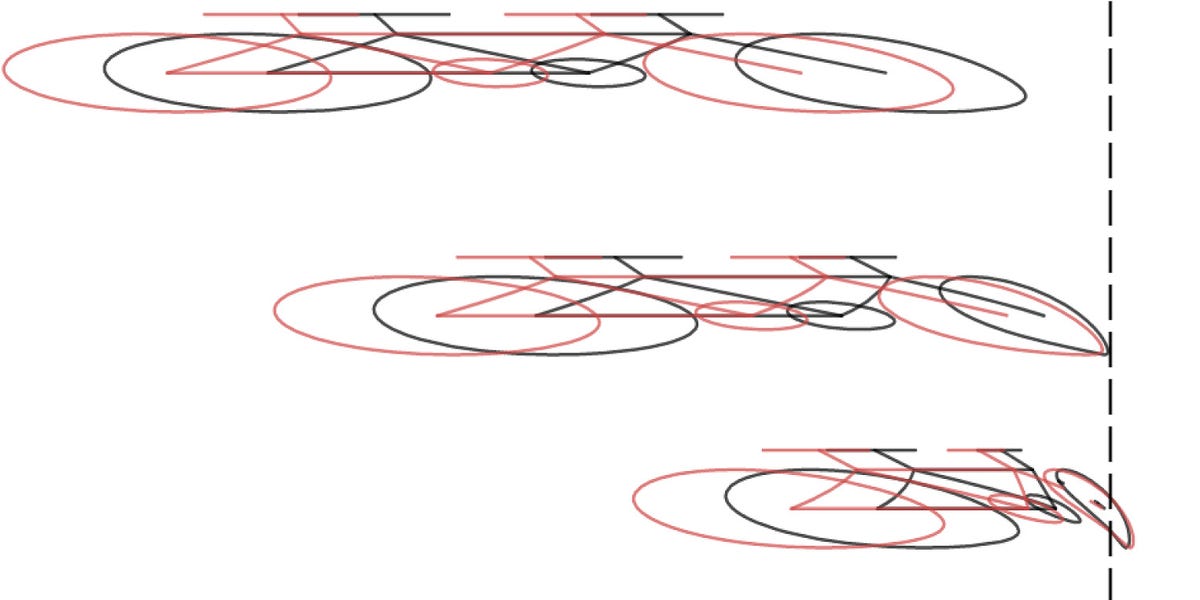

Imagine standing on a sidewalk when a cyclist blasts past at nearly the speed of light. You expect a blur, maybe a heroic whoosh, possibly a tiny sonic boom of bad decisions. But physics has a stranger answer: the cyclist would not simply look like a stretched-out cartoon streak or a flattened pancake on wheels. The rider, bike frame, wheels, colors, and even the timing of what you see would be transformed by special relativity.
The “light-speed cyclist” mystery is a famous physics puzzle inspired by George Gamow’s thought experiments and later revisited by researchers using modern calculations. The big question sounds simple: what would a cyclist look like while traveling close to light speed? The answer is not simple at all. It involves time dilation, length contraction, relativistic Doppler shift, the finite speed of light, and the difference between what is physically measured and what is visually seen.
In plain English, the mystery is solved like this: a near-light-speed cyclist would appear warped because light from different parts of the bicycle reaches your eyes at different times. The image you see is not a single “now” from the cyclist. It is a patchwork of photons that left the wheels, frame, helmet, pedals, and rider at slightly different moments. At everyday speeds, that delay is too tiny to notice. Near light speed, it turns the whole scene into a cosmic funhouse mirror.
What Is the Light-Speed Cyclist Mystery?
The light-speed cyclist mystery asks what would happen if a bicycle and rider moved at an extreme fraction of the speed of light. Since the speed of light in a vacuum is exactly 299,792,458 meters per second, even “almost light speed” is wildly beyond anything a bicycle could actually achieve. Your weekend group ride may feel fast after three coffees, but relativity is not impressed.
The thought experiment is useful because a bicycle is visually familiar and mechanically interesting. It has a frame moving forward, wheels rotating, pedals spinning, and a rider whose body is not a simple solid block. That makes it a perfect object for exposing the difference between ordinary motion and relativistic motion.
At normal cycling speeds, classical physics works beautifully. The front wheel goes forward, the rider ages normally, the jersey remains the same color, and spectators mostly worry about whether the cyclist will stop at the red light. But as speed approaches light speed, classical intuition breaks down. The cyclist’s measured length contracts along the direction of motion. The rider’s moving clock ticks more slowly from the observer’s point of view. Light from the approaching cyclist shifts toward bluer wavelengths, while light from the receding cyclist shifts toward redder wavelengths. Brightness and apparent direction also change.
The First Important Answer: No Cyclist Can Actually Reach Light Speed
Before solving the visual mystery, we need to remove one tempting misunderstanding. A real cyclist, bicycle, spaceship, baseball, or any object with mass cannot reach the speed of light. As a massive object accelerates closer to light speed, the energy required to keep accelerating it grows without limit. In practical terms, the universe keeps saying, “Nice try, but no.”
Massless particles such as photons travel at light speed in a vacuum. Massive objects can approach light speed in particle accelerators, but they cannot cross the line. So the light-speed cyclist is not a build plan for the world’s most illegal e-bike. It is a thought experiment designed to reveal how space, time, and vision behave under Einstein’s special relativity.
Measured Shape vs. Seen Shape: The Trick Behind the Mystery
Many people learn that objects moving near light speed undergo Lorentz contraction. That means the cyclist and bicycle would be measured as shorter along the direction of travel by an outside observer. If the bicycle were moving left to right, its front-to-back length would be contracted. That sounds like the bike should look squashed.
But here is the twist: what you measure is not always what you see. A measurement can compare positions at the same time in a chosen reference frame. Vision does something messier. Your eyes receive light that left different parts of the object at different times. The rear wheel is farther from you than the front wheel at some moments, and the light from it must travel a different distance. By the time all those photons arrive together, they represent different moments in the bike’s journey.
This is why a fast-moving object may appear rotated or distorted rather than simply compressed. This visual effect is often associated with the Terrell-Penrose effect, which showed that relativistic objects can look as if they are turned in space. The object is still physically length-contracted in the relativistic sense, but the visual image is shaped by light-travel delay.
Why a Near-Light-Speed Bike Would Look So Weird
A bicycle is not just a rectangle rolling down the road. The frame moves forward, but the wheels rotate. The top of a wheel moves forward relative to the bike’s center, while the bottom of the wheel is momentarily close to stationary relative to the road in ordinary rolling motion. At near-light speeds, these velocity combinations become deeply non-intuitive because speeds do not add in the simple everyday way.
In normal life, if a cyclist is moving at 20 miles per hour and tosses a bottle forward at 10 miles per hour, a roadside observer may treat it as roughly 30 miles per hour. Near light speed, that simple addition fails. Einstein’s velocity addition rules prevent any material part of the bike from exceeding light speed. That matters for the spinning wheels. You cannot simply say, “The bike is moving near light speed, and the top of the wheel adds more speed, so the rim goes faster than light.” Relativity does not allow that shortcut.
The result is a bicycle whose apparent wheel geometry, spoke positions, and frame alignment would look bizarre to a spectator. Parts of the wheel would be seen from different “times,” producing a distorted picture. The bike may appear twisted, rotated, stretched in one region, compressed in another, and color-shifted depending on whether parts are moving toward or away from the observer.
The Role of Light Delay: The Universe Has a Shipping Time
The easiest way to understand the mystery is to remember that light is fast but not instant. When you look at the Moon, you see it as it was about 1.3 seconds ago. When you look at the Sun, you see it as it was about eight minutes ago. When you look at a cyclist across the street, the delay is so tiny your brain does not care.
Near light speed, however, delay becomes the star of the show. Suppose a cyclist is racing past you from left to right. Light from the front wheel, rear wheel, handlebars, helmet, and pedals must all arrive at your eyes at the same viewing moment. But those photons did not leave the bike at the same time. Some left earlier, some later. Your single visual snapshot is actually assembled from many emission times.
This makes the cyclist appear visually rearranged. A part of the bike that is farther away may be shown as it looked earlier in the ride. A closer part may be shown from a later moment. The observer receives a blended history, not a clean present. That is the heart of the light-speed cyclist mystery solved.
Color Changes: The Cyclist Gets a Relativistic Paint Job
The cyclist would not only change shape. The colors would shift too. When an object moves toward you at relativistic speed, light waves are compressed, shifting toward the blue end of the spectrum. When it moves away, the light stretches toward red. This is called the relativistic Doppler effect.
So our imaginary cyclist may not keep the same jersey color. A red jersey moving toward you at extreme speed could appear shifted toward other wavelengths. A receding cyclist could appear reddened or dimmed. At truly extreme speeds, some visible light could shift outside human vision altogether. The cyclist might become brighter in the forward direction due to relativistic beaming, with light concentrated ahead like a cosmic headlight.
This does not mean the cyclist’s clothing has actually changed color. It means the light reaching the observer has changed wavelength. The rider is not suddenly sponsored by a galaxy; the universe is just doing wave physics.
Would the Cyclist Look Faster Than Light?
Here is another strange point: under some viewing conditions, parts of the cyclist’s image may appear to move faster than light across your field of view. This does not violate relativity because no matter, energy, or information is actually traveling faster than light. It is an apparent motion created by geometry and light-arrival timing.
A similar idea appears in astronomy when jets from distant active galaxies seem to move across the sky at superluminal speeds. The material is not truly breaking the cosmic speed limit. Instead, it is moving close to light speed at an angle toward Earth, and light emitted at different points along the path reaches observers in a compressed timeline. The apparent motion can look faster than the real motion.
For the cyclist, the same principle helps explain why the visual image can be so misleading. The bike’s apparent position, apparent length, and apparent wheel motion are not the same as their physical values in a simple classroom diagram.
Why the Mystery Needed Modern Calculations
Early explanations of relativistic motion often focused on simple objects such as rods, clocks, or trains. Those examples are useful, but they hide a lot of visual complexity. A bicycle is harder. It has rotating parts, three-dimensional structure, and a rider whose body occupies space. Add binocular human vision, and the problem becomes even richer.
Modern studies have reanalyzed the cyclist scenario in three dimensions and considered what a human observer would actually perceive. That matters because two eyes do not work exactly like a single camera. Binocular vision estimates depth by comparing two slightly different images. At relativistic speeds, those two images can contain different timing distortions. Your brain would try to interpret a scene that is physically consistent but visually outrageous.
The solution is not “the cyclist becomes flat.” It is more subtle: the cyclist’s measured dimensions obey special relativity, while the seen image is distorted by the arrival times of photons, Doppler shifts, and changes in brightness and direction. The mystery is solved by separating measurement from appearance.
A Simple Example: The Fast Bicycle Wheel
Picture a bicycle wheel rolling slowly. At the bottom contact point, the wheel is instantaneously at rest relative to the ground. At the top, the rim moves forward faster than the wheel’s center. This is easy to visualize at normal speeds. Now imagine the center of the wheel moving at a huge fraction of light speed. You cannot use ordinary arithmetic to add the rim’s rotational speed to the bike’s forward speed. Relativistic velocity addition takes over.
Also, a perfectly rigid wheel is impossible in relativity. Signals that hold matter together cannot travel faster than light. If one part of a wheel changes motion, the information about that change cannot instantly reach every other part. This means the classical idea of a perfectly rigid spinning bicycle wheel becomes physically unrealistic at extreme speed.
That is why the light-speed cyclist is so educational. It starts with a familiar object and quickly forces us to update our assumptions about motion, shape, and simultaneity. The humble bicycle becomes a physics professor with pedals.
What the Observer Would Actually Notice
If a near-light-speed cyclist passed by, an observer would not experience the event like a normal race. First, the cyclist would be visible for an extremely short time. Second, the direction of incoming light would be altered by relativistic aberration, making objects appear shifted toward the direction of motion. Third, the cyclist’s appearance would change rapidly as the rider approached, passed, and receded.
Approaching the observer, the cyclist could appear brighter and blueshifted. Near the closest pass, the visual distortion would become most dramatic. After passing, the cyclist would become redshifted and dimmer. The image would not simply glide smoothly like a bike in a slow-motion sports commercial. It would be compressed, delayed, warped, and reassembled by the physics of light.
For a human observer, this could be confusing or even impossible to interpret in real time. Our brains evolved to track thrown rocks, running animals, and perhaps the occasional shopping cart with a bad wheel. We did not evolve to process bicycles traveling at 99.9 percent of light speed.
Why This Mystery Matters Beyond a Fun Thought Experiment
The light-speed cyclist mystery is fun, but it is not just a physics party trick. It teaches a serious lesson about observation. Science often depends on understanding the difference between what an instrument records and what is physically happening. Telescopes, cameras, particle detectors, radar systems, and medical imaging tools all require interpretation.
Relativity also matters in real technology. Particle accelerators depend on relativistic calculations. GPS satellites must account for relativistic time effects to maintain accuracy. Astronomers studying fast jets, neutron stars, black holes, and cosmic rays must consider how speed changes observed light. The cyclist is fictional, but the physics is real.
In a sense, the cyclist is a friendly doorway into deep science. Nobody needs to ride a bicycle into a particle accelerator to learn from the idea. Please do not test that sentence. The point is that a simple object can reveal why Einstein’s universe is stranger, stricter, and more elegant than everyday intuition suggests.
Common Myths About the Light-Speed Cyclist
Myth 1: The cyclist would look exactly flattened.
Not exactly. The cyclist would be measured as length-contracted in the direction of motion, but the visual appearance would include rotation-like distortion and light-travel-time effects. Seeing and measuring are not the same process.
Myth 2: The wheels could spin parts faster than light.
No. Relativistic velocity addition prevents material parts from exceeding light speed. Ordinary speed addition works at low speeds, not near light speed.
Myth 3: The cyclist would experience everything normally while outsiders see weird effects.
From the cyclist’s own frame, their local experience may feel normal, but the outside world would appear distorted to them too. Relativity is reciprocal, though acceleration and changing frames can complicate the story.
Myth 4: This is only science fiction.
The cyclist is fictional, but the physics behind the thought experiment is real. Time dilation, Doppler shift, relativistic beaming, and light-travel-time effects are used in modern physics and astronomy.
Experience-Based Reflections: What This Mystery Teaches Us in Everyday Life
The most useful way to connect with the light-speed cyclist mystery is to start with ordinary experiences. Watch a bicycle wheel under a streetlight and you may notice the spokes blur or seem to slow down. Film a spinning wheel with a phone camera and it may appear to rotate backward. That is not relativity; it is frame rate and sampling. But it gives a helpful emotional preview: what we see is not always a perfect copy of what is happening.
Another everyday comparison is a thunderstorm. You see lightning before you hear thunder because light travels much faster than sound. The delay tells you distance. With the cyclist mystery, we are dealing with light itself, so the delay is usually invisible. But when the object moves nearly as fast as the light carrying its image, the delay becomes impossible to ignore. The universe is no longer delivering a live broadcast. It is sending a complicated highlight reel with timestamps missing.
There is also a lesson for anyone who rides a bike. Cycling teaches you that speed changes perception. At a walking pace, you notice cracks in the pavement, leaves, storefronts, and the person ahead deciding whether to turn without signaling. At a fast downhill pace, your attention narrows. Your body understands that reaction time matters. Relativity takes that familiar feeling and pushes it to an extreme where even light-arrival time becomes part of the experience.
The mystery also makes science feel more human. A bicycle is not an abstract dot in a textbook. It has tires, handlebars, spokes, a chain, and probably one squeak that refuses to be fixed. Using a cyclist helps people visualize special relativity without starting with equations. It says, “Here is something you know. Now let’s send it into Einstein’s universe and see what breaks.” What breaks is not the bicycle first; it is our intuition.
For writers, teachers, and curious readers, the light-speed cyclist is a reminder that good explanations often begin with familiar images. A train, an elevator, a clock, a flashlight, or a bike can carry readers into difficult ideas. The trick is not to make physics smaller, but to make the doorway wider. Once readers step through, they discover that the strange result has rules. The cyclist looks warped for reasons we can analyze, not because physics has developed a flair for drama.
The final experience-related takeaway is humility. Human senses are excellent for survival at ordinary speeds. They are not built to intuit near-light-speed travel, quantum fields, or black hole horizons. That does not make the universe unknowable. It means we need mathematics, experiments, models, and patient explanations. The light-speed cyclist mystery is solved, but it leaves behind something even better than an answer: a sense that reality is deeper than it looks from the sidewalk.
Conclusion: The Mystery Is Solved, and the Answer Is Relativity
The light-speed cyclist mystery is solved by understanding the difference between physical measurement and visual appearance. A cyclist moving near light speed would be affected by special relativity: time dilation, length contraction, relativistic velocity rules, Doppler color shifts, brightness changes, and visual distortion caused by light arriving from different parts of the bike at different times.
The cyclist would not simply look like a flat pancake on wheels. The image could appear rotated, warped, color-shifted, and strangely rearranged. The bicycle’s wheels make the problem especially fascinating because their rotating parts cannot be treated with ordinary speed addition. Relativity keeps every material part below light speed while transforming what an outside observer would see.
In the end, this famous thought experiment is more than a clever puzzle. It shows why Einstein’s ideas still matter, why observation requires interpretation, and why even a bicycle can become a vehicle for exploring the deepest rules of space and time. Not bad for something with pedals.
Note: This article is written for web publication in standard American English, using real physics concepts and reputable scientific context without inserting direct source links.