
Note: This article synthesizes real information from electronics manufacturing, materials science, conductive adhesive products, reliability research, and soldering standards. Source links are intentionally omitted for clean web publishing.
Introduction: The Tiny Joint Holding the Tech World Together
Every smartphone, laptop, medical sensor, car control module, smartwatch, gaming console, and humble TV remote depends on one surprisingly dramatic little hero: the electrical joint. For more than a century, solder has been the go-to material for making those connections. Heat it, melt it, let it flow, and suddenly a loose component becomes part of a working circuit. It is the electronics world’s version of “put a ring on it.”
But solder is not perfect. It requires heat, specialized equipment, careful process control, flux chemistry, cleaning decisions, and quality inspection. High temperatures can stress delicate components, warp flexible substrates, or damage temperature-sensitive materials. Lead-free solder, now standard in much commercial electronics, solved important environmental concerns but introduced its own manufacturing challenges, including higher processing temperatures and different reliability behavior.
That is why metallic glue, also called conductive adhesive, electrically conductive epoxy, conductive paste, silver glue, or cold solder, has attracted so much attention. Some versions contain silver, copper, nickel, carbon, gallium-based liquid metals, or microscopic metal structures. Others, such as room-temperature metallic bonding systems, are designed to form metal-like connections without the traditional hot soldering process.
So, will metallic glue replace solder? The realistic answer is: not completely, but it will replace solder in more places where heat, flexibility, miniaturization, or unusual materials make solder awkward. Solder is not heading for retirement yet, but conductive adhesives are definitely getting invited to more meetings.
What Is Metallic Glue?
Metallic glue is not the same thing as the superglue hiding in a kitchen drawer next to batteries, rubber bands, and at least three mystery screws. Ordinary glue usually insulates electricity. Metallic glue is designed to conduct electricity while also bonding surfaces together.
Most electrically conductive adhesives use a polymer base, such as epoxy, silicone, or acrylic, mixed with conductive particles. Silver is especially common because it offers excellent electrical conductivity and resists oxidation better than many other metals. Copper, nickel, gold, carbon, and newer liquid-metal fillers may also be used depending on cost, conductivity, flexibility, and reliability needs.
How Conductive Adhesives Work
In a basic conductive epoxy, the resin holds everything in place while metal particles form electrical pathways through the cured material. If enough conductive filler is added, the particles touch or nearly touch, allowing current to pass through. This is why filler loading matters so much. Too little metal, and the adhesive behaves more like plastic. Too much metal, and the material can become hard to dispense, brittle, expensive, or difficult to process.
There are two major categories worth knowing:
- Isotropic conductive adhesives: These conduct electricity in all directions and are often used for die attach, component bonding, repair, shielding, and some circuit connections.
- Anisotropic conductive adhesives: These conduct mainly in one direction, usually vertically through the bond line, which makes them useful for fine-pitch electronics, displays, sensors, and flexible circuits where sideways short circuits would be a very expensive bad day.
What Makes Solder So Hard to Beat?
Before declaring solder outdated, it helps to understand why it has survived so long. Solder is not merely sticky metal. It creates a metallurgical bond. When properly heated, solder wets metal surfaces, flows into the joint, and forms a strong conductive path with low electrical resistance. The process is fast, scalable, inspectable, and deeply understood across the electronics industry.
Modern surface-mount technology depends heavily on solder paste and reflow ovens. Manufacturers can place thousands of components onto printed circuit boards, run them through a carefully controlled thermal profile, and produce reliable assemblies at enormous volume. Solder also has a useful self-centering effect during reflow. As molten solder wets pads and component leads, surface tension can help pull tiny components into alignment. That is a neat trick. Glue, as talented as it may be, generally does not perform that little dance.
Solder also has decades of standards, training, inspection criteria, repair techniques, and failure analysis knowledge behind it. Engineers know what a good solder joint should look like. They know common defects such as bridges, voids, tombstoning, cold joints, insufficient wetting, and cracked joints. The industry has built an entire quality-control universe around solder. Replacing that universe is not as simple as squeezing a shiny paste from a syringe and calling it progress.
Why Metallic Glue Is Getting Serious Attention
Even though solder is powerful, electronics are changing. Devices are thinner, more flexible, more heat-sensitive, and more integrated than ever. Wearables, medical patches, foldable displays, solar cells, flexible sensors, Internet of Things devices, and miniaturized modules often use materials that dislike high-temperature soldering. Plastic films, textiles, paper-based electronics, glass substrates, and delicate semiconductor structures can deform, crack, or degrade under heat.
This is where metallic glue becomes attractive. Conductive adhesives can often cure at lower temperatures than solder reflow, and some can cure at room temperature. That opens the door to bonding components on substrates that would not survive conventional soldering.
Key Advantages of Metallic Glue
Lower processing temperature: Conductive adhesives can reduce thermal stress on components and circuit boards. This is useful for heat-sensitive sensors, LEDs, microelectronics, displays, and flexible substrates.
Lead-free assembly: Many conductive adhesives avoid lead entirely, making them attractive in industries focused on environmental compliance and safer manufacturing practices.
Bonding unusual materials: Metallic glue can bond metals to glass, plastics, ceramics, textiles, and other materials that may be difficult or impossible to solder directly.
Mechanical flexibility: Some adhesive systems, especially silicone-based or liquid-metal-based materials, can bend, stretch, or absorb mechanical stress better than rigid solder joints.
Thermal management: Certain metallic glues conduct heat as well as electricity, allowing them to serve as thermal interface materials for chips, LEDs, power modules, and other heat-generating components.
Fine-pitch potential: Anisotropic conductive adhesives can help connect very small pads without creating shorts between neighboring conductors.
MesoGlue and the Dream of Room-Temperature Metal Bonding
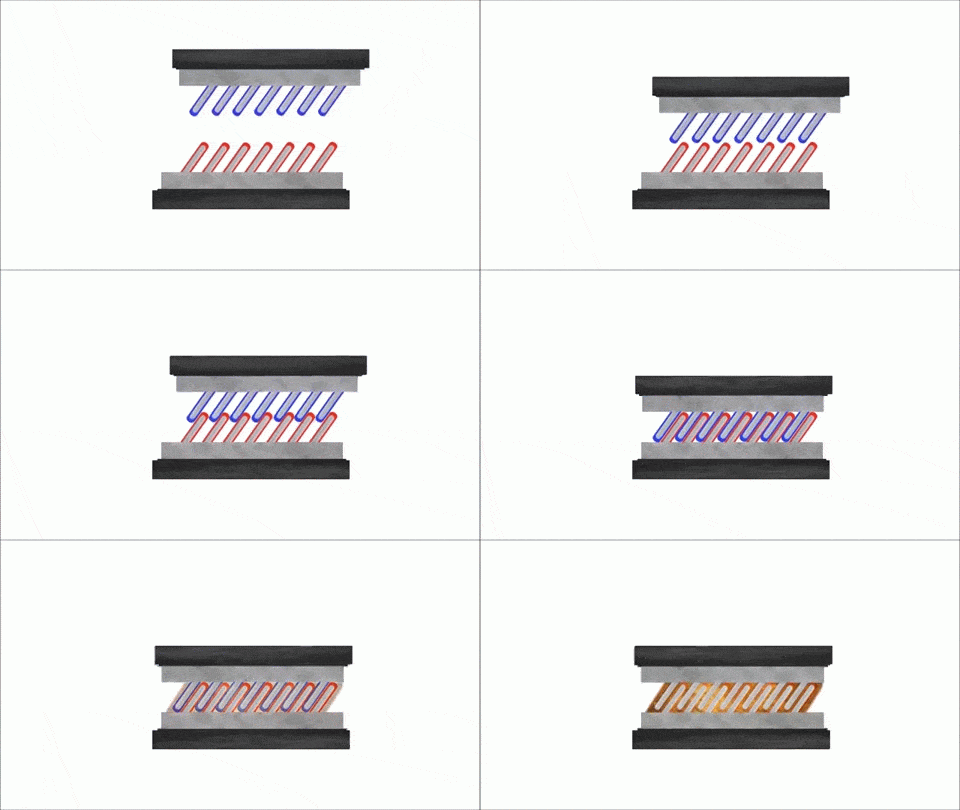
One of the most interesting examples in this field is MesoGlue, a room-temperature metallic bonding technology developed around metal nanorods. The concept is different from ordinary silver epoxy. Instead of simply suspending conductive particles in a resin, the technology uses microscopic metal structures that interlock and form a conductive bond under pressure at ambient temperature.
The appeal is obvious: no soldering iron, no reflow oven, no high-temperature process, and potentially strong electrical and thermal conduction. Such technology has been discussed for applications including solder replacement, thermal interface bonding, device attachment, solar cells, computer components, mobile devices, and metal-to-glass bonds.
That sounds like science fiction wearing safety glasses, but the larger idea is very real: electronics manufacturers want bonding methods that work at lower temperatures while still carrying current and heat reliably. Room-temperature metallic glue could be especially valuable in advanced packaging, compact electronics, and assemblies where every degree of heat matters.
Where Metallic Glue Can Replace Solder Today
Metallic glue is not waiting for some far-off future. Conductive adhesives are already used in real electronics. The question is not whether they work. The question is where they work best.
1. Heat-Sensitive Components
Some components cannot tolerate soldering temperatures. Conductive epoxy can attach these parts without exposing them to high heat. This is useful for delicate sensors, certain LEDs, small modules, and specialty devices where thermal damage would reduce performance or yield.
2. Flexible and Wearable Electronics
Solder joints can crack when repeatedly bent, stretched, or twisted. Flexible electronics need connections that can survive motion. Conductive adhesives, especially flexible formulations and liquid-metal-based materials, can better match the movement of polymer films, textiles, and soft substrates. For smart clothing, medical patches, flexible sensors, and wearable circuits, metallic glue may be less of a substitute and more of a necessity.
3. Solar Cell Interconnects
Solar cells are thin, fragile, and sensitive to thermal and mechanical stress. Conductive adhesives can connect solar cell elements while reducing heat exposure and stress on the cell surface. This makes them attractive in photovoltaic module assembly, especially as manufacturers chase better efficiency and lower breakage rates.
4. Die Attach and Microelectronic Packaging
Silver-filled epoxies are widely used for die attach applications, where semiconductor chips must be bonded to packages or substrates. In these cases, the adhesive may provide electrical grounding, heat transfer, and mechanical attachment. Solder remains important in packaging, but conductive adhesives already occupy a valuable space in microelectronics.
5. Repair of Traces and Low-Stress Connections
Conductive epoxy can repair damaged copper traces, reconnect broken pads, or create low-current conductive paths where soldering would be risky. For hobbyists and repair technicians, it can be useful when heat might melt plastic, lift a pad, or make a tiny disaster even tinier and sadder.
6. EMI and RFI Shielding
Conductive adhesives are also used for electromagnetic interference shielding. They can attach shielding materials, create conductive seals, and help control unwanted electrical noise in devices such as medical electronics, telecom equipment, automotive modules, and consumer products.
Where Solder Still Wins
Metallic glue has promise, but solder remains the champion in many mainstream electronics applications. It is fast, low-resistance, relatively inexpensive, and compatible with massive automated manufacturing lines.
1. High-Volume PCB Assembly
For standard printed circuit board assembly, solder paste and reflow remain incredibly efficient. Pick-and-place machines, stencil printing, reflow ovens, inspection systems, and repair workflows are optimized around solder. Conductive adhesive would need to beat not only solder’s performance but also the entire soldering ecosystem.
2. High-Current Connections
Solder generally offers lower electrical resistance than most conductive adhesives. For power electronics, battery tabs, high-current connectors, and thermal-heavy applications, resistance matters. A tiny increase in resistance can mean extra heat, voltage drop, or long-term reliability problems.
3. Long-Term Reliability in Harsh Environments
Conductive adhesives can be sensitive to moisture, temperature cycling, mechanical creep, oxidation, and changes in contact resistance over time. Solder has its own failure modes, but those modes are well studied. For aerospace, automotive safety systems, defense electronics, medical implants, and industrial controls, proven reliability is not optional. It is the whole game.
4. Rework and Inspection
A solder joint can often be reheated, removed, inspected, and repaired using established techniques. Conductive adhesives may require curing, scraping, solvents, mechanical removal, or full part replacement. Inspection can also be harder because a good adhesive joint may not have the same visual clues as a solder fillet.
5. Cost and Storage
Silver-filled adhesives can be expensive. Some have limited shelf life, require refrigeration, need precise mixing, or demand controlled curing conditions. In high-volume manufacturing, small cost differences become large enough to make finance departments develop a nervous twitch.
The Environmental Question: Is Metallic Glue Greener?
Conductive adhesives can support greener electronics by reducing lead use, lowering processing temperatures, and enabling repair or flexible assembly methods. Lower heat can mean lower energy demand during production. Solder-free assembly may also help with new recycling and component recovery strategies in certain designs.
However, “greener” depends on the full material life cycle. Silver mining and refining have environmental impacts. Epoxy resins may be difficult to recycle. Some adhesives are not easily reversible. A solder-free product is not automatically sustainable if the adhesive makes repair or material separation harder.
The better conclusion is that metallic glue can be part of more sustainable electronics, especially when it enables lower-temperature processing, longer product life, or easier assembly on recyclable substrates. But the material must be chosen carefully. Sustainability is not a sticker; it is a system.
Will Metallic Glue Replace Solder in Consumer Electronics?
In consumer electronics, metallic glue will likely grow in specialized areas rather than replace every solder joint. Smartphones, laptops, tablets, earbuds, and wearables already use many types of joining technologies: solder, adhesives, thermal compounds, conductive films, compression contacts, and mechanical connectors. The future is not one material replacing all others. It is a toolbox getting bigger.
Metallic glue may become more common in flexible displays, camera modules, antennas, sensors, heat spreaders, batteries, and tiny assemblies where low-temperature bonding provides an advantage. Solder will likely remain dominant for mainstream board assembly because it is reliable, fast, familiar, and cost-effective.
Will Metallic Glue Replace Solder in Industrial and Automotive Electronics?
Industrial and automotive electronics are tougher territory. These systems face vibration, humidity, temperature swings, long service lives, and strict reliability expectations. Conductive adhesives can be valuable in sensors, power modules, EMI shielding, and specialty assemblies, but replacing solder across an entire automotive control board would require extensive qualification.
Automakers and industrial manufacturers do not change interconnect materials because a lab result looks cool. They test, age, cycle, shock, vibrate, bake, freeze, and generally treat materials like contestants on a survival show. Metallic glue must prove stable contact resistance, mechanical strength, chemical resistance, and manufacturability before it can replace solder in mission-critical systems.
The Most Likely Future: Solder and Metallic Glue Working Together
The most realistic future is hybrid. Solder will continue to connect most standard components on rigid printed circuit boards. Metallic glue will expand in applications where solder struggles: flexible substrates, wearable electronics, low-temperature assembly, fragile components, unusual materials, thermal interfaces, repair, and advanced packaging.
That may sound less dramatic than “metallic glue kills solder,” but it is more accurate. Technology rarely replaces a mature process overnight. Instead, new materials win one application at a time. Conductive adhesives will not storm the castle. They will quietly move into the rooms where solder was already uncomfortable.
Practical Buying and Design Considerations
If you are considering metallic glue for a project, do not choose it only because the phrase “cold solder” sounds magical. Check the electrical resistance, cure schedule, operating temperature range, bond strength, substrate compatibility, flexibility, humidity resistance, shelf life, and rework method.
For low-current repairs or bonding heat-sensitive parts, silver conductive epoxy may work beautifully. For high-current traces, power electronics, or mechanical load-bearing joints, solder or mechanical fastening may still be safer. For flexible circuits, look at flexible conductive adhesives or anisotropic materials designed for bending. For production, test the exact joint under real conditions before trusting it in the field.
In other words, metallic glue is not a universal miracle paste. It is a specialized engineering material. Treat it with respect, test it properly, and it can solve problems solder cannot. Treat it like glittery craft glue, and it will teach you humility with a multimeter.
Conclusion: Replacement? No. Revolution? Maybe.
Will metallic glue replace solder? In some applications, yes. In all applications, no. Conductive adhesives and room-temperature metallic bonding technologies are already valuable alternatives for heat-sensitive components, flexible electronics, solar cells, microelectronic packaging, trace repair, and unusual materials. They offer lower processing temperatures, design flexibility, and exciting possibilities for future electronics.
But solder remains hard to beat in mainstream PCB assembly. It provides low resistance, fast processing, proven reliability, easy inspection, and deep industry support. Metallic glue still faces challenges in cost, curing, long-term reliability, contact resistance, rework, and high-volume manufacturing adoption.
The smarter prediction is that metallic glue will not replace solder everywhere. It will replace solder where solder is the wrong tool. As electronics become thinner, softer, smaller, and more heat-sensitive, that list will grow. Solder will keep its job. Metallic glue will keep getting promoted.
Hands-On Experiences and Practical Lessons About Metallic Glue vs. Solder
When people first hear about metallic glue, the reaction is often the same: “Great, so I never have to solder again?” That is understandable. Soldering can be intimidating. It involves heat, fumes, flux, tiny pads, shaky hands, and the occasional moment where a component launches itself into another dimension. Conductive glue sounds friendlier. Just dab, press, cure, and celebrate. In real use, however, the experience is more nuanced.
For small repairs, metallic glue can feel wonderfully convenient. Imagine a damaged copper trace on a low-current circuit board, a loose battery contact in a simple device, or a fragile wire that cannot handle much heat. In those situations, silver conductive epoxy can be a useful rescue material. The best results usually come from careful surface preparation. The contact area should be clean, dry, and free of oxidation, oils, dust, and loose coating. A quick scrape, gentle cleaning, and steady application can make a big difference.
The most common beginner mistake is using too much adhesive. More glue does not always mean more conductivity. A thick blob can cure unevenly, spread into places it should not, or create a weak mechanical shape. Conductive adhesives often work best as controlled, thin bond lines with enough surface contact to carry current. This is the opposite of the “peanut butter on toast” approach, which may be emotionally satisfying but electrically suspicious.
Curing is another practical lesson. Some conductive epoxies cure at room temperature, but many reach better performance with heat curing. Even when a material feels hard on the surface, it may not have reached its final strength or conductivity. For real projects, following the manufacturer’s cure schedule matters. If a product says it needs several hours, give it several hours. Electronics are not impressed by impatience.
Compared with solder, metallic glue also changes how repairs feel mechanically. A solder joint becomes metal and can be reheated. A cured conductive adhesive becomes a filled polymer. It may be strong, but it behaves differently under bending, pulling, vibration, and thermal expansion. On a rigid board with a low-stress connection, that may be fine. On a connector that gets plugged and unplugged daily, a glued joint may fail sooner unless it is reinforced mechanically.
One practical example is wire attachment. Conductive glue can connect a small wire to a pad, but the wire should not be left unsupported. If the wire moves, the adhesive joint may crack or peel. A good repair often combines electrical connection with strain relief. That might mean adding a non-conductive epoxy, tape, clamp, or mechanical support nearby. In professional design, electrical and mechanical functions are often separated for this reason.
Another lesson comes from resistance measurement. A solder joint usually has extremely low resistance when done correctly. A conductive adhesive joint may show higher resistance, especially if the contact area is small or the adhesive is not fully cured. For signal-level circuits, this may be acceptable. For power delivery, heaters, motors, LED strips, or battery connections, extra resistance can become heat. Heat becomes trouble. Trouble becomes a small, dramatic smell.
For hobbyists, metallic glue is most satisfying when used for repairs, experiments, conductive traces, delicate components, and situations where soldering is genuinely unsafe for the material. For manufacturers, it is most valuable when it solves a specific production problem: lower temperature, flexible bonding, thermal transfer, fine-pitch connections, or compatibility with sensitive substrates. In both cases, the winning mindset is the same: use metallic glue as an engineering tool, not as a shortcut around good design.
The best personal rule is simple: choose solder when you need a proven, low-resistance, reworkable metal joint on solderable surfaces. Choose metallic glue when heat is the enemy, flexibility matters, the substrate cannot be soldered, or the geometry makes solder impractical. When both could work, test both. A five-minute assumption can become a five-hour repair. The multimeter, not wishful thinking, gets the final vote.
SEO Tags