
Some things feel so modern that we mentally file them next to smartphones, streaming subscriptions, and tiny coffee cups that cost as much as lunch. But history loves a plot twist. Many everyday ideassnacks, makeup, shoes, maps, board games, plumbing, and even vending machinesare not new at all. They are ancient. Very ancient. “Your great-grandparents used this” ancient? No. More like “someone used this before the pyramids had fully entered the group chat” ancient.
This article explores fascinating things that are much older than you think, using real archaeological discoveries, museum research, and historical evidence. The goal is not just to list surprising facts, but to show what these old inventions reveal about human nature. We have always wanted comfort, beauty, entertainment, convenience, food that does not require too much effort, and a way to avoid walking barefoot on questionable ground. In other words, ancient people were not as different from us as we sometimes imagine.
Why So Many “Modern” Things Are Actually Ancient
When we think of ancient history, we often picture stone tools, sandals, clay pots, and people staring dramatically at the horizon. That image is not wrong, but it is incomplete. Ancient societies were full of inventors, cooks, engineers, artists, merchants, and very practical problem-solvers. They were not waiting around for modern life to begin. They were building it piece by piece.
Many old inventions seem modern because they solve problems we still have today. People needed food that could be stored, clothing that protected them, games to pass the time, cosmetics for style and ritual, and systems for water, money, security, and navigation. The technology has changed, but the human needs behind it are surprisingly familiar.
1. Bread Is Older Than Farming
Bread feels like the symbol of settled civilization: farms, grain, ovens, kitchens, and cozy breakfasts. But the oldest direct evidence of bread-making dates back roughly 14,400 years, from a hunter-gatherer site in northeastern Jordan. That means people were baking bread thousands of years before agriculture became widespread.
This discovery flips the usual story. Instead of farming leading to bread, bread may have helped encourage farming. Early flatbread made from wild cereals was probably not a fluffy supermarket loaf. It was more like a rustic cracker or wrap, but still: someone gathered plants, ground them, mixed them with water, and baked them. Somewhere in the deep past, a person basically invented brunch.
2. Beer May Be About 13,000 Years Old
If bread is ancient, beer is not far behind. Archaeological evidence from Raqefet Cave in present-day Israel suggests that Natufian people brewed a beer-like beverage around 13,000 years ago. This was not the crisp, refrigerated lager you might order during a ballgame. It was likely thick, cloudy, fermented, and ceremonial.
Still, the point stands: humans were experimenting with fermentation long before stainless-steel breweries, craft beer flights, or someone explaining hops to you for 20 minutes. Beer may have been connected to ritual gatherings, community life, and early food processing. It also shows that human creativity in the kitchen started earlyand occasionally came with bubbles.
3. Chewing Gum Goes Back Thousands of Years
Chewing gum may feel like a convenience-store product, but humans have been chewing sticky substances for a very long time. Archaeologists have found ancient pieces of birch tar, sometimes called prehistoric gum, with tooth marks still visible. One famous piece from Denmark is about 5,700 years old and preserved enough genetic material to reveal details about the person who chewed it.
Birch tar was likely used as an adhesive, but people may also have chewed it to soften it, relieve tooth discomfort, or simply because humans like having something to chew. That means ancient gum was less “bubblegum flavor” and more “forest hardware store,” but it still counts.
4. Tattoos Are Older Than Many Civilizations
Tattoos are often discussed as modern self-expression, but body art has deep roots. Ötzi the Iceman, a natural mummy discovered in the Alps, lived more than 5,000 years ago and had dozens of tattoos. These markings were not colorful sleeve designs or tiny inspirational quotes near the wrist. They were simple lines and crosses placed on parts of the body that may have been connected to pain or therapeutic practices.
The exact purpose is still debated, but the evidence is clear: people were marking skin thousands of years before tattoo parlors, electric needles, and the phrase “I got it on vacation.” Whether symbolic, spiritual, medicinal, or decorative, tattoos are part of one of the oldest human conversations about identity and the body.
5. Makeup Has Been Around for Millennia
Cosmetics are not a modern vanity project. Ancient Egyptians used kohl eyeliner, pigments, oils, and skin preparations thousands of years ago. Eye makeup was aesthetic, social, religious, and possibly practical, since some compounds may have helped protect against glare or infection. Beauty routines in ancient Egypt were not casual; they were part of culture, status, health, and ritual.
So the next time someone acts like makeup is a recent trend, remind them that ancient people were contouring civilization long before beauty influencers found ring lights. The packaging has changed. The human desire to decorate, protect, and present ourselves has not.
6. Toothbrushes Started as Chew Sticks
The modern nylon-bristle toothbrush is relatively recent, but tooth-cleaning tools are ancient. Early forms of toothbrushes existed as chew sticks around 3000 BCE. People chewed one end of a twig until it frayed, then rubbed it against their teeth. It sounds simple because it was, but it worked well enough to survive across cultures for thousands of years.
Modern dental care has improved dramatically, thankfully. Still, the basic idearemove food, clean the mouth, avoid tooth troublehas been with humanity for ages. Ancient people may not have had mint gel toothpaste in a tube, but they understood one eternal truth: teeth are important, and tooth pain is nobody’s idea of a good weekend.
7. Board Games Are Nearly as Old as Written History
Board games are not just rainy-day entertainment. They are among the oldest forms of structured play. Senet, an ancient Egyptian board game, was played as early as around 3100 BCE. Game boards have been found in tombs, and images show people playing in scenes from ancient Egypt.
Senet was not merely a time-killer. Over time, it took on religious and symbolic meaning, connected with the journey through the afterlife. Imagine if your family game night also involved cosmic destiny. Suddenly losing at Monopoly does not feel quite so dramatic.
8. Popcorn Is an Ancient Snack
Popcorn feels tied to movie theaters, microwaves, and the mysterious ability to get kernels in every sofa cushion. But evidence from Peru shows that people were preparing corn-based foods, including early forms related to popcorn, as much as 6,700 years ago. Ancient coastal communities were using corn long before it became the buttery bucket snack we know today.
No, they were not watching superhero sequels while eating it. But the basic pleasure of a crunchy snack is extremely old. Humanity may disagree on politics, fashion, and the proper way to load a dishwasher, but apparently we have always understood snacks.
9. Shoes Looked Surprisingly Modern 5,500 Years Ago
A leather shoe found in Armenia’s Areni-1 cave is about 5,500 years old and looks shockingly familiar. It was made from a single piece of leather, had laces, and was preserved in remarkable condition. It is older than many famous ancient monuments, yet its design is easy to recognize.
The shoe reminds us that practical design can stay useful for a very long time. Protect the foot, fit the shape, tie it securely, and keep moving. That formula still works. Fashion may reinvent itself every season, but “please keep rocks away from my toes” has never gone out of style.
10. Socks With Sandals Are Ancient Too
Yes, socks with sandals have historical backup. Ancient Egyptian socks dating to the Roman period were designed with divided toes, making them suitable for wearing with sandals. Some surviving examples are colorful, carefully made, and more stylish than the stereotype suggests.
This may be the strongest evidence that fashion debates are eternal. Somewhere, centuries ago, someone probably looked at split-toe socks and said, “Bold choice.” And someone else probably replied, “My feet are warm, Marcus.”
11. Vending Machines Date Back to the First Century
The vending machine seems like a modern monument to convenience: insert money, receive snack, avoid human interaction. But one of the earliest known vending machines was described by Hero of Alexandria in the first century CE. His device dispensed holy water when a coin was inserted.
The mechanism used the weight of the coin to operate a lever and release a measured amount of liquid. It was clever, practical, and wonderfully dramatic. Today’s vending machines give us chips. The ancient version gave people sacred water. Different product, same basic business model: coin goes in, item comes out.
12. Roman Concrete Was Built to Last
Concrete is not new, and ancient Roman concrete has impressed engineers for centuries. Roman structures, harbors, and monuments have survived for around 2,000 years, often in harsh environments. Recent research has explored how Roman mixtures, including volcanic ash and lime-based materials, helped make some of this concrete remarkably durable.
Modern construction is more complex and uses different standards, but Roman concrete proves that ancient engineering was not primitive. It was clever, tested, and deeply practical. The Romans did not just build for the weekend. They built like they expected tourists to still be taking photos two millennia later.
13. Fast Food Existed in Ancient Pompeii
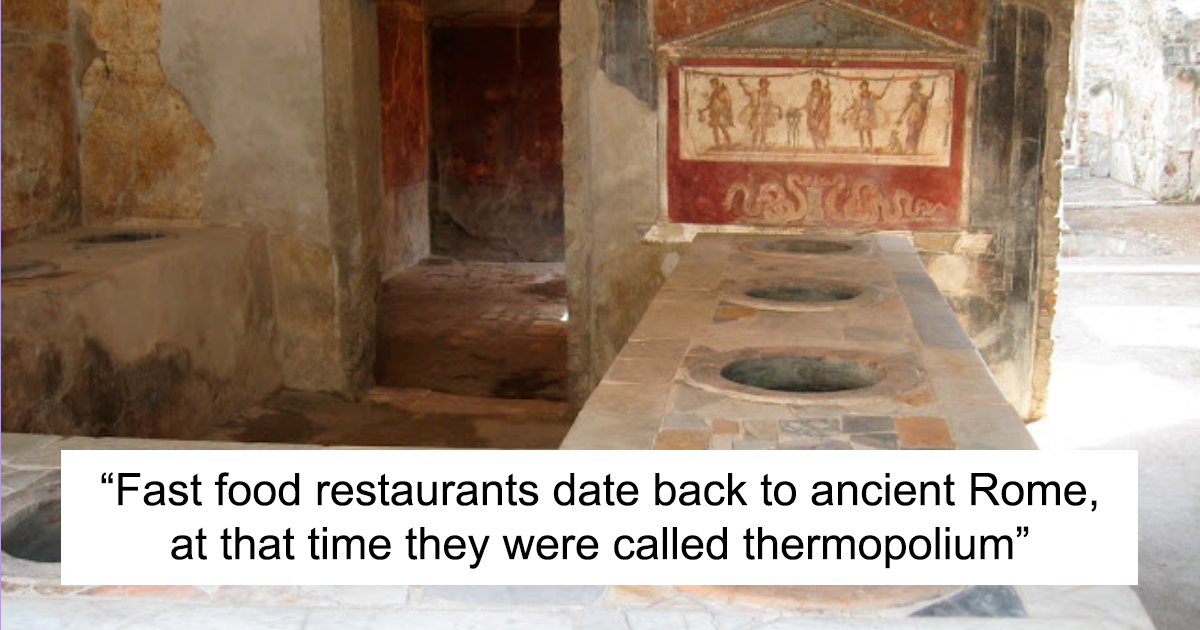
Fast food is often treated as a modern invention, but ancient Romans had their own version. Pompeii had thermopolia, street-side counters where people could buy ready-to-eat food and drinks. Many city dwellers did not have full kitchens at home, so these food stalls served an important daily function.
Some thermopolia were decorated with painted counters and images that may have advertised what was served. It was not drive-through dining, but it was definitely food on the go. Ancient Rome had busy workers, hungry residents, and small businesses serving quick meals. Add a loyalty app and the concept becomes alarmingly familiar.
14. Plumbing and Toilets Are Thousands of Years Old
Indoor plumbing feels like a triumph of modern life, but sophisticated sanitation systems go back thousands of years. The Minoans on Crete and the Indus Valley Civilization both developed advanced drainage and water systems around 4,000 years ago. Some ancient sites included flushing toilets, channels, and planned sanitation infrastructure.
This matters because plumbing is not just a comfort feature. It is a marker of urban planning, public health, engineering, and social organization. Ancient cities knew that water management could make or break daily life. Also, let us be honest: once humans discovered plumbing, nobody wanted to go backward.
15. Maps Are Older Than Most People Imagine
Digital maps make navigation feel modern, especially when a calm robot voice tells us to turn left after we already missed the turn. But mapmaking is ancient. Some of the oldest known maps date back thousands of years, and the Babylonian Map of the World, often dated to the first millennium BCE, shows how ancient people represented geography, power, and imagination.
Old maps were not always accurate by modern standards, but they were powerful tools. They helped people organize space, tell stories, define territories, and understand their place in the world. In a way, every map says, “Here is what we know, here is what we think, and here is where the dragons might be.”
16. Snow Goggles Were Ancient Sunglasses
Before designer sunglasses, Indigenous Arctic peoples developed snow goggles to reduce glare from bright snow and ice. These goggles were made from materials such as bone, wood, ivory, or baleen, with narrow slits that limited light exposure while preserving vision.
This is brilliant design: simple, portable, and perfectly adapted to the environment. It also proves that innovation does not always mean adding more technology. Sometimes it means understanding a problem so well that the solution looks obvious after someone else invents it.
What These Old Things Teach Us About Human Ingenuity
The most surprising part of these ancient inventions is not just their age. It is how recognizable they are. Bread, beer, gum, cosmetics, shoes, games, snacks, vending machines, maps, fast food, and plumbing all speak to ordinary human needs. We want to eat, gather, look good, stay comfortable, protect ourselves, have fun, and make life easier.
History is often taught through kings, wars, dynasties, and dates. Those things matter, but everyday objects can be just as revealing. A shoe tells us about movement. A board game tells us about leisure. A piece of gum tells us about habits, health, and even DNA. A snack bar in Pompeii tells us that people two thousand years ago also wanted dinner without cooking.
Experience Notes: How Seeing Ancient “Modern” Things Changes the Way We Think
One of the best ways to understand things that are much older than you think is to visit museums, archaeological exhibitions, or historical sites with the mindset of a detective. Instead of looking only for the biggest statue or the shiniest gold object, look for the ordinary things: combs, shoes, cups, dice, kitchen tools, writing tablets, keys, cosmetic containers, and children’s toys. These quiet objects often create the strongest connection to the past.
There is something oddly moving about seeing an ancient shoe. A crown may impress you, but a shoe feels personal. Someone wore it. Someone walked in it, perhaps across a dry landscape, through a village, into a cave, or toward a home that no longer exists. The shape may be old, but the need is familiar. We all understand tired feet.
The same feeling happens with ancient food evidence. Learning that people baked bread before farming makes the past feel less like a dusty timeline and more like a kitchen full of trial and error. Maybe the first bread was an accident. Maybe it was a special food for gatherings. Maybe someone burned it and pretended that was the plan. Anyone who has cooked dinner while distracted can relate.
Ancient games create another powerful connection. A board game from Egypt or the Near East reminds us that play is not a luxury invented by modern free time. People have always made room for rules, competition, luck, and laughter. A game board scratched into a floor can say as much about human life as a royal inscription. It says people paused. They gathered. They cared about winning, losing, and probably arguing about the rules.
Even ancient sanitation systems can change your perspective. Plumbing is easy to ignore until it stops working. Seeing evidence of old drainage channels, toilets, or water systems makes you appreciate the engineering behind comfort. It also proves that ancient urban life required planning, cooperation, and maintenance. Cities have always depended on invisible systems. The pipes may not be glamorous, but civilization owes them a thank-you card.
These experiences also make modern life feel less separate from the ancient world. We often imagine progress as a straight line from “primitive” to “advanced,” but history is messier and more interesting. Ancient people solved problems with the tools, materials, and knowledge available to them. Sometimes their solutions were so good that we still recognize them thousands of years later.
There is also a humbling lesson here. We are not the first people to value convenience, beauty, entertainment, or clever design. We are part of a very long human habit of improving daily life. Our gadgets may be new, but many of our desires are ancient. The next time you eat bread, chew gum, put on shoes, play a board game, use a map, order fast food, or admire good plumbing, remember: you are participating in traditions much older than you think.
Conclusion
The past is not as distant as it looks. Many things we consider modern have roots reaching back thousands of years. Ancient people baked bread, brewed beer, cleaned their teeth, wore makeup, played games, built durable concrete, made maps, developed plumbing, grabbed quick meals, and designed practical eyewear for harsh environments. They were curious, inventive, stylish, hungry, playful, and occasionally brilliant in ways that still surprise us.
That is what makes the history of everyday objects so fascinating. It turns archaeology into a mirror. When we look closely at the ancient world, we do not just see strangers in sandals. We see people solving familiar problems with unfamiliar tools. We see the beginnings of habits that still shape our lives. And sometimes, we see that the “new” thing on our desk, in our closet, or in our kitchen is actually part of a story older than empires.
Note: This article is synthesized from reputable museum, university, science, archaeology, and history sources in the United States, including research-based materials from institutions such as the Smithsonian, Library of Congress, MIT, the Metropolitan Museum of Art, National Geographic, Scientific American, and major historical publications.