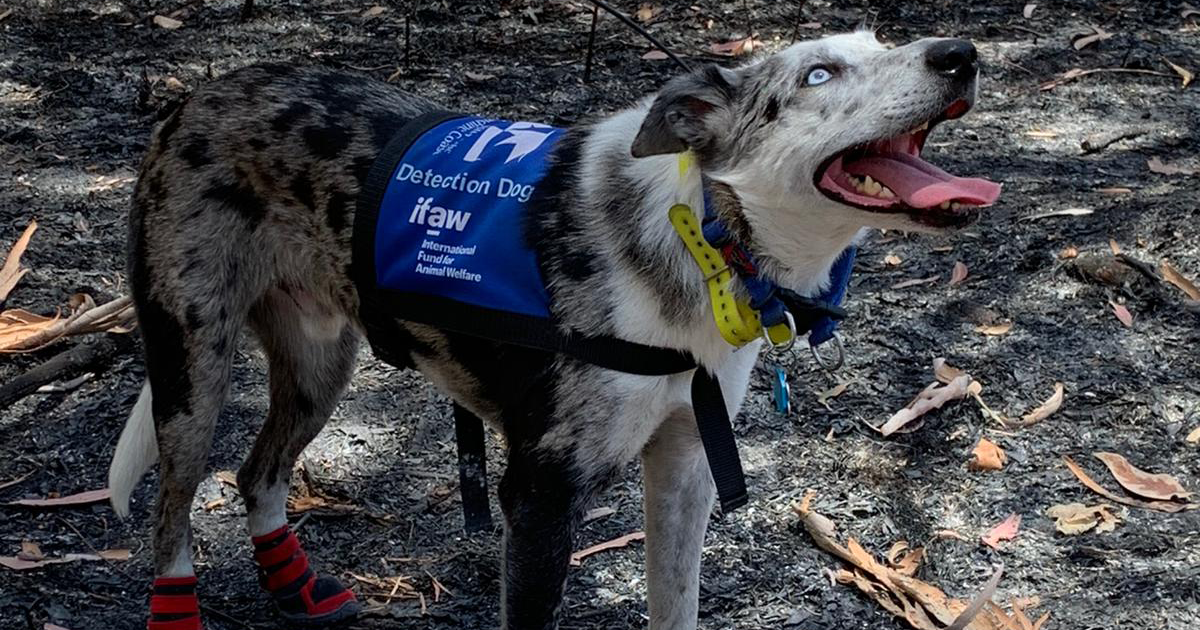
This Hero Dog Has Been Tasked With Finding Koalas That Have Survived Australia’s Bushfires

In a world where most dogs are thrilled to locate a tennis ball under the couch, one remarkable rescue dog was trained for a far more serious mission: finding koalas hidden in the blackened forests after Australia’s devastating bushfires. His name is Bear, and yes, the name is charmingly confusing. Bear is not a bear. He is a dog. But after what he has done for injured and displaced koalas, he may deserve his own superhero cape, preferably one with paw prints and a built-in snack pocket.
Bear, an Australian Koolie and detection dog, became internationally known during Australia’s 2019–2020 “Black Summer” bushfire crisis. While flames destroyed vast areas of habitat and left wildlife rescuers facing heartbreaking conditions, Bear used his nose to do what humans often could not: locate surviving koalas tucked high in trees, silent, camouflaged, dehydrated, burned, or too weak to move. His work helped rescuers reach animals that might otherwise have gone unseen.
This is not just a cute animal story, though it does come with a very photogenic dog in little protective boots. It is also a story about wildlife conservation, disaster response, scent detection science, and the urgent future of koalas in a changing climate.
Meet Bear, the Koala Detection Dog
Bear was not always destined for fame. Before becoming one of the most beloved wildlife rescue dogs in the world, he was a rescue dog whose high energy and intense drive made him a difficult fit for an ordinary home. Many dogs like Bear are labeled “too much.” They chew, dig, pace, obsess over toys, and behave as if someone installed a rocket engine where their patience should be.
But in conservation detection work, those traits can be gold. The same focus that makes a dog challenging in a living room can make him brilliant in the field. Bear’s intense motivation, stamina, and love of play made him an ideal candidate for training. Instead of being scolded for being unstoppable, he was given a job worthy of his energy.
Bear was trained through the University of the Sunshine Coast’s Detection Dogs for Conservation program, with support from the International Fund for Animal Welfare. His specialty was unusual even among wildlife detection dogs: he was trained to detect live koalas by the scent of their fur. That matters because koalas are famously hard to spot. They sit still, blend into eucalyptus trees, and often remain high above the ground. After fires, when landscapes are smoky, unstable, and visually confusing, finding them becomes even harder.
Why Koalas Needed a Four-Legged Search Expert
Koalas may look like plush toys designed by a committee of sleepy grandmothers, but they are wild marsupials with very specific needs. They depend heavily on eucalyptus forests for food, shelter, and movement. When bushfires tear through those forests, the damage can be catastrophic. Animals may die in the flames, suffer burns, inhale smoke, lose access to food, or become stranded in fragmented habitat.
The 2019–2020 bushfires were among the most destructive wildlife disasters in modern history. Conservation estimates found that nearly three billion mammals, birds, reptiles, and frogs were killed or displaced. Koalas were among the most visible symbols of the crisis because they are slow-moving, tree-dwelling, and tied so closely to the forests that burned.
Even when koalas survived the fire front, their troubles were not over. Some had burned paws from crossing hot ground. Others were dehydrated because their leafy food sources had been scorched. Some were starving. Some were sick. Some were simply too hidden for rescuers to find quickly. That is where Bear’s nose became a life-saving tool.
How Bear Finds Surviving Koalas
A detection dog does not search the way a person searches. Humans look for shapes, movement, and clues. Dogs read the world through scent. Bear could move through burned habitat and detect the scent of koala fur, alerting his handlers when koalas were nearby. Once Bear signaled interest, trained responders could investigate the area, look up into the canopy, assess the animal, and decide whether rescue or veterinary care was needed.
This work required more than a good nose. Bear had to be steady around wildlife, obedient in unpredictable terrain, comfortable in protective gear, and able to work without chasing the animals he was trained to find. That last part is crucial. A koala detection dog cannot behave like a cartoon dog spotting a squirrel. The goal is calm detection, not chaos with a tail.
Bear also became known for wearing protective boots while working in fire-affected areas. Those boots were not a fashion statement, though he did wear them with runway-level confidence. They protected his paws from ash, sharp debris, and hot or unstable ground. In disaster zones, even a highly trained dog needs the right equipment to stay safe.
Bear’s Role During the Black Summer Bushfires
During the bushfire crisis, Bear and his team searched burned areas in New South Wales and Queensland. Reports from conservation groups credited Team Bear with finding more than 100 injured, sick, dehydrated, or starving koalas between late 2019 and early 2020. Those koalas could then be assessed, treated, rehabilitated, and, when possible, released back into suitable habitat.
One of the most powerful parts of Bear’s story is that he did not simply help locate animals; he helped restore hope. In places where people had lost homes, wildlife sanctuaries, and entire landscapes, the sight of a goofy, energetic dog finding survivors in the ashes carried emotional weight. Bear became a reminder that disaster response is not only about numbers. It is also about individual lives.
Every koala found mattered. For a species already under pressure from habitat loss, disease, vehicle strikes, dog attacks, drought, and climate-driven extreme events, saving surviving animals can support local recovery. One rescued koala may represent future breeding potential, genetic value, or the survival of a population in a badly damaged area.
Why Detection Dogs Are So Valuable in Wildlife Conservation
Wildlife detection dogs are increasingly used around the world because they can find evidence that humans miss. Some dogs locate scat, nests, invasive species, rare plants, or endangered animals. Others help track disease, monitor population health, or support anti-poaching work. Their noses are astonishingly sensitive, but their real value comes from the partnership between dog, handler, ecologist, veterinarian, and rescue team.
In koala conservation, detection dogs can help researchers estimate where koalas live, how many may be present, and whether animals survived after a disaster. Bear’s work also showed how scent detection can complement technology such as drones and thermal cameras. Drones can scan difficult areas from above, while dogs can investigate scent on the ground. Together, they create a stronger search system than either method alone.
This matters because speed is critical after a bushfire. Injured wildlife may have only a narrow window for survival. A koala with burned paws, dehydration, or smoke-related illness needs help quickly. The faster rescuers can locate animals, the better the chance of treatment and recovery.
The Bigger Conservation Problem Facing Koalas
Bear’s story is inspiring, but it also points to a larger problem: koalas should not have to depend on emergency rescue dogs to survive. In parts of eastern Australia, koalas are now listed as endangered under national environmental law. Their decline has been driven by multiple overlapping threats, including habitat clearing, disease, vehicle collisions, dog attacks, drought, heat stress, and increasingly severe fires.
Habitat loss is especially damaging because koalas need connected eucalyptus forests. When land is cleared for development, roads, agriculture, or other uses, koala populations can become isolated. Isolated koalas have fewer safe pathways to food, mates, and shelter. They are also more likely to cross roads or enter suburban areas where dogs and cars become major risks.
Climate change adds another layer of danger. Hotter, drier conditions can increase fire risk and reduce the quality of eucalyptus leaves. Heat waves can push koalas beyond their comfort zone, forcing them to climb lower in trees or seek water in risky places. The bushfires made these threats impossible to ignore, but they did not create them from nowhere. They intensified a crisis already underway.
From Rescue Dog to Conservation Icon
Bear’s journey is one of the reasons his story resonated so widely. He was not a perfect pet who became useful because he was calm and convenient. He was a high-drive rescue dog who needed the right purpose. Once he found that purpose, he became extraordinary.
That lesson extends beyond koala rescue. Many working dogs in conservation, search and rescue, and detection roles are dogs that might overwhelm an average household. They need structure, stimulation, and a job. When matched with expert trainers, those so-called difficult traits can become lifesaving strengths.
Bear also helped change how the public thinks about conservation work. Instead of presenting wildlife science as distant or abstract, his story made it immediate. People who might not read a technical report about post-fire koala surveys would absolutely stop scrolling for a dog in boots searching for koalas. Bear became a bridge between science and public emotion, which is no small achievement for someone who probably still considers a ball the peak of civilization.
What Bear’s Story Teaches Us About Disaster Response
Australia’s bushfires showed that wildlife disaster response requires planning before flames arrive. Trained detection dogs cannot be created overnight. Neither can veterinary networks, rehabilitation centers, habitat maps, emergency funding, or volunteer coordination. The success of teams like Bear’s depends on years of preparation, research, and training.
It also shows the importance of collaboration. Bear’s work involved conservation scientists, animal welfare organizations, handlers, local rescuers, veterinarians, land managers, and communities. No single person, dog, drone, or organization can solve a disaster of that scale alone. Effective wildlife rescue is a team sport, even when one of the star players has paws.
For readers in the United States and elsewhere, the message is still relevant. Wildfires are not only an Australian issue. Fire seasons are intensifying in many parts of the world, including the American West. Wildlife rescue, habitat protection, and climate resilience are global concerns. Bear may have searched for koalas, but the model of combining science, trained animals, and emergency response has lessons far beyond eucalyptus forests.
How People Can Support Koalas and Wildlife Recovery
Not everyone can train a koala detection dog, and honestly, most of us are still negotiating basic obedience with dogs who pretend not to understand “drop it.” But there are practical ways people can help wildlife conservation.
Support reputable rescue and conservation groups
Organizations involved in wildlife rescue, veterinary care, habitat restoration, and scientific monitoring need consistent support, not only during viral disasters. Emergency donations matter, but long-term funding helps teams prepare before the next crisis.
Protect and restore habitat
Koalas need connected forests. Habitat restoration, wildlife corridors, and responsible land-use policies are essential. Planting trees is helpful when it is done strategically with local ecological guidance, but protecting existing mature habitat is often even more important.
Take climate and fire preparedness seriously
Stronger fire planning, better land management, and climate action all affect wildlife survival. Reducing risk before disasters happen is far more effective than trying to rescue every animal afterward.
Keep domestic animals under control
In koala habitat, dog attacks are a serious threat. Responsible pet ownership, secure yards, and leash use can reduce harm to wildlife. A good dog can save koalas; an unmanaged dog can endanger them. The difference is training, supervision, and human responsibility.
Bear’s Legacy Continues
After years of service, Bear eventually retired, leaving behind an extraordinary legacy. Conservation teams have continued looking for the next generation of detection dogs that can carry on this work. The ideal candidate is not necessarily the easiest pet. In fact, the next great koala-saving dog may be a ball-obsessed whirlwind currently driving someone mildly bananas in a shelter or foster home.
That is part of the beauty of Bear’s story. It reminds us that value is not always obvious at first glance. A dog once seen as too intense became a conservation hero. A burned forest that looked lifeless still held survivors. A single search team could make the difference between an injured koala being missed and that same koala receiving care.
Bear did not stop the bushfires. He did not restore every lost tree or save every animal. But he did what heroes often do: he showed up, used his gifts, and helped where help was urgently needed. Sometimes hope arrives with a wagging tail, blue eyes, muddy boots, and absolutely no understanding of how famous it has become.
Field Experiences and Lessons Inspired by Bear’s Koala Rescue Work
Stories like Bear’s feel powerful because they bring the reality of wildlife rescue down to ground level. It is one thing to read that millions or billions of animals were affected by fires. It is another to imagine a search team walking through a burned forest, where the air smells of ash, branches crack underfoot, and every surviving tree might hold a frightened koala too weak to call attention to itself. In that setting, the work becomes quiet, careful, and deeply personal.
One important experience from koala rescue work is the emotional contrast between devastation and discovery. A burned landscape can appear empty at first. The silence after a fire can be overwhelming. Then a dog like Bear catches a scent, alerts his handler, and suddenly everyone looks up. There may be a koala pressed against a blackened trunk, nearly invisible from the ground. That moment changes the mood. The forest is no longer only a place of loss; it is a place where life is still holding on.
Another lesson is that rescue work is rarely dramatic in the movie-trailer sense. It is slow, repetitive, and physically demanding. Teams may walk long distances over unstable ground. They must watch for falling branches, heat pockets, sharp debris, and stressed wildlife. A detection dog must stay focused despite distractions, while handlers must read subtle changes in body language. A pause, a shift in posture, or a sudden pull toward a scent cone can matter. The dog is not simply wandering around being adorable, although Bear certainly managed that part too. He is working as part of a disciplined search system.
There is also a humbling lesson about technology. Drones, thermal cameras, mapping tools, and veterinary science all play important roles in modern conservation. Yet a dog’s nose can still detect what machines and human eyes may miss. The best results often come when old and new tools are combined. In the field, success is not about choosing between science and instinct. It is about letting each method do what it does best.
Bear’s story also changes how people view rescue animals. Many dogs in shelters are overlooked because they are too energetic, too focused, or too demanding for a typical home. But with the right assessment and training, some of those dogs may become exceptional working partners. Bear’s life suggests that “too much” can become “exactly enough” when matched with the right mission. That idea is useful far beyond wildlife rescue. Sometimes potential looks like a problem before someone understands how to guide it.
Finally, Bear’s work reminds us that conservation is not only about saving species in the abstract. It is about individual animals, local habitats, and the people willing to keep searching when the situation looks bleak. A single rescued koala may seem small against a continental disaster, but survival is built from individual lives. Each koala found, treated, and returned to the wild becomes part of a larger recovery story.
For readers, the experience to take away is simple but lasting: hope is active. It is not just feeling sad when forests burn or sharing a heartbreaking photo online. Hope means training the dog, funding the rescue team, protecting the habitat, supporting the veterinarian, planting the right trees, and preparing before the next emergency. Bear became famous because he found koalas, but his deeper legacy is the reminder that every skill, even a dog’s obsession with scent and play, can become a tool for repair when placed in service of life.
Conclusion
Bear the koala detection dog became a symbol of courage, science, and second chances during one of Australia’s darkest environmental disasters. Trained to locate live koalas by scent, he helped rescue teams find vulnerable animals hidden in burned forests after the Black Summer bushfires. His story is charming, yes, but it is also serious. It highlights the fragility of koala populations, the importance of habitat protection, and the growing role of conservation detection dogs in wildlife rescue.
In the end, Bear’s heroism was not loud or flashy. It was practical. He sniffed, searched, alerted, and helped people save animals that might otherwise have disappeared into the ash. For a dog once considered too much to handle, that is a pretty spectacular plot twist.