
Note: This article is written for web publishing and synthesizes real engineering concepts behind cable-driven motion simulators, winch-controlled robotics, virtual reality platforms, and large-scale simulator design.
When a Room Becomes a Ride
Most people hear the words “cables and winches” and think of tow trucks, elevators, construction cranes, or that one garage door that sounds like it is auditioning for a horror movie. But in the right hands, cables and winches can become something far more exciting: a motion simulator capable of throwing a person through virtual space with enough realism to make the brain politely question reality.
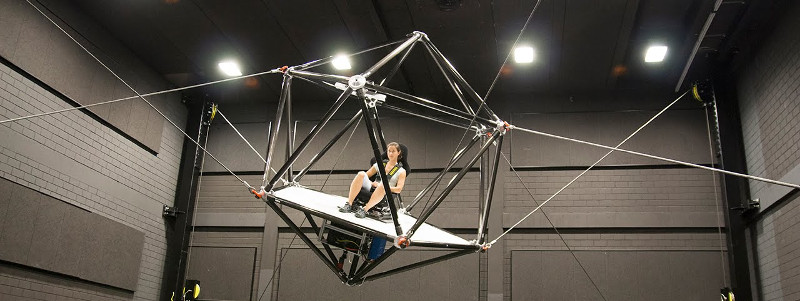
The idea behind Cables And Winches Become An Awesome Simulator is beautifully simple on the surface and deliciously complex underneath. Instead of using a traditional motion platform with rigid hydraulic legs, a cable-driven simulator suspends or pulls a cabin using multiple steel cables attached to powerful winches. By precisely winding and unwinding those cables, the system moves the cabin forward, backward, sideways, up, down, and through rotations that mimic driving, flying, racing, or other high-motion experiences.
In other words, it is a giant robotic puppet stageexcept the puppet is a human sitting inside a simulator cabin, and the puppet master is a control system with more math than a college engineering exam.
What Is a Cable-Driven Motion Simulator?
A cable-driven motion simulator is a robotic platform that uses tensioned cables rather than rigid arms to control movement. The cabin or cockpit is connected to several cables, and each cable is attached to a motorized winch. When one cable shortens and another lengthens, the platform changes position. When all cables coordinate together, the cabin can move smoothly through a large three-dimensional workspace.
This type of system belongs to a broader family called cable-driven parallel robots. In a parallel robot, multiple actuators work together to control one moving platform. The familiar Stewart platform, often used in flight simulators, uses six mechanical legs or linear actuators. A cable-driven robot does something similar, but it replaces those heavy legs with cables. That single change opens a big door: lower moving mass, larger workspace, and potentially higher acceleration.
Because cables can pull but not push, the simulator must keep the cables under proper tension at all times. That is the engineering catch. A cable robot is not just “hang a chair from wires and hope.” It requires careful geometry, real-time control, motor synchronization, safety monitoring, and software that knows where the cabin is, where it should be, and how not to turn the whole thing into the world’s most expensive swing set.
Why Cables and Winches Are So Clever
The genius of cables and winches is that they separate the heavy machinery from the moving cabin. In many traditional motion simulators, actuators are attached directly to the platform. That means the system must move not only the pilot or driver but also part of its own mechanical structure. It is like trying to sprint while carrying your treadmill.
With a cable-driven simulator, the winches can be mounted around the room, often on the walls, ceiling, or structural frame. The cabin itself can stay relatively lightweight. Less mass means the system can respond faster, accelerate harder, and cover a bigger area. This is especially useful for virtual reality and high-performance driving or flight simulation, where convincing motion cues matter.
Big Workspace, Big Immersion
A conventional simulator can tilt, shake, and move a limited distance. That is enough for many training environments, but it has limits. A cable-driven simulator can use the volume of an entire room, allowing longer travel paths and more dramatic motion. A well-designed system can create the sensation of braking, cornering, climbing, diving, or sliding without requiring a full racetrack or runway.
Lower Moving Mass
Because the cabin can be built from lightweight materials such as carbon fiber or aluminum, the winches spend more of their power moving the user and less of it fighting unnecessary structure. This makes cable-driven simulators attractive for research environments where engineers want high acceleration and fast response without building a giant hydraulic monster.
Flexible Configurations
Cables can be routed and arranged in different layouts. A simulator can be optimized for driving, flying, human perception studies, rehabilitation, robotics testing, or entertainment. Change the cabin, update the software, adjust the control model, and the same general architecture can support different simulation experiences.
How the System Actually Works
At the heart of the simulator are several core components: winches, cables, sensors, a cabin or platform, control software, and safety systems. Each winch must know exactly how much cable it has released. Each cable must maintain safe tension. The platform must move along planned trajectories without unwanted jerks, slack, or instability.
Imagine the cabin suspended in the middle of a large frame by eight cables. If the front-left cable shortens while the rear cables lengthen, the cabin moves toward the front-left. If upper cables adjust together, the cabin can rise or tilt. If the control system coordinates all eight winches at once, the cabin can follow a complex path that feels like a vehicle accelerating, banking, or changing direction.
That “feel” is where the magic lives. Simulators do not need to reproduce every real-world force perfectly. Instead, they create enough motion cues to persuade the human vestibular systemthe inner-ear motion sensor that is very confident and occasionally very gullible. Pair those cues with a visual display or VR headset, and the brain starts filling in the gaps. Suddenly, a cabin in a lab feels like a race car, aircraft, spacecraft, or futuristic elevator operated by a caffeinated robot.
Cable Simulators vs. Traditional Motion Platforms
Traditional six-degree-of-freedom motion platforms are proven, reliable, and widely used. They can pitch, roll, yaw, heave, surge, and sway. They are especially common in aviation training, vehicle development, and entertainment attractions. However, their motion range is usually limited by the length and geometry of their actuators.
Cable-driven simulators take a different route. They trade rigid legs for long cables, making it easier to build a large motion envelope. This can allow a cabin to travel meters rather than inches. For applications that need extended lateral movement or strong acceleration cues, that is a major advantage.
Still, cable systems are not automatically better for every use. They require a strong frame, precise control, careful cable tension management, and serious safety planning. Cables can vibrate, stretch slightly, or become slack if poorly controlled. Winches must respond quickly and consistently. The entire setup has to behave like an orchestra, not a group project where one motor forgot the deadline.
Where This Technology Can Be Used
Driving Simulation
Racing simulators are one of the most obvious uses. A cable-driven motion simulator can reproduce acceleration, braking, cornering, bumps, and slides with dramatic physical feedback. When combined with a realistic steering wheel, pedals, projection system, or VR headset, the driver can experience much more than a vibrating seat and a screen.
For professional driver training, this matters. Engineers can test how drivers react to dangerous conditions without putting anyone on an actual road. Researchers can study distraction, fatigue, reaction time, and vehicle control. Automotive teams can evaluate cockpit design, driver assistance systems, and handling behavior in a repeatable environment.
Flight Simulation
Flight simulation is another natural fit. A cable-driven system can mimic takeoff, turbulence, banking, diving, and rapid changes in direction. While professional flight simulators already use sophisticated motion bases, cable robots offer a different kind of workspace and may support experimental aircraft training, perception research, or high-motion demonstrations.
Virtual Reality Experiences
Virtual reality becomes far more convincing when the body feels motion that matches what the eyes see. A headset can show a canyon flight, a roller coaster, or a futuristic city chase, but without motion, the user may still feel like they are standing in a room wearing expensive goggles. Add cable-driven motion, and the illusion becomes stronger.
This is not just about fun. VR motion platforms can support research into balance, spatial perception, motion sickness, human-machine interaction, and training for complex tasks. They can also help designers build better immersive environments by testing how visual and physical cues work together.
Robotics and Human Perception Research
Cable-driven simulators are valuable in labs because they allow researchers to study how people perceive motion. The system can generate controlled movement patterns, repeat them consistently, and collect data on human response. This is useful for neuroscience, psychology, vehicle design, and robotics.
The Engineering Challenges Behind the Fun
It is tempting to look at a cable simulator and think, “That seems easy. Eight winches, some cables, a cabin, done.” That is the same energy as looking at a rocket and saying, “Metal tube, fire at bottom, space at top.” The concept may be simple, but the execution is not.
Cable Tension Must Be Controlled
Cables only work when they are pulling. If one goes slack, control accuracy suffers and the platform may move unpredictably. The system must constantly calculate how much tension each cable needs and adjust the winches accordingly. This is a major part of cable-driven robot control.
Safety Is Non-Negotiable
A simulator moving a human at high acceleration needs redundant safety systems. Emergency stops, mechanical limits, software monitoring, overload detection, cable inspection, and protected operating zones are essential. The more powerful the simulator, the more seriously safety must be treated.
Motion Cueing Requires Smart Software
A simulator does not simply copy the motion of a virtual vehicle. Real vehicles may travel hundreds of meters, while the simulator has a limited workspace. Motion cueing software translates vehicle behavior into physical movements the platform can safely perform. It must create convincing sensations without running out of room or making the rider feel like they have been placed inside a washing machine during a tax audit.
Latency Can Break the Illusion
If the visuals say “turn left” and the body feels the motion a fraction too late, the user notices. Low latency between visual display, control input, and platform movement is critical. This is especially true for VR, where mismatched cues can cause discomfort.
Why This Idea Feels So Futuristic
Cable-driven simulators feel futuristic because they make a room behave like a machine. The walls are no longer passive; they become part of the robot. The empty space becomes the workspace. The cabin becomes a moving object controlled from all sides by invisible geometry and very visible cables.
There is also something wonderfully theatrical about it. A traditional simulator hides its actuators under the platform. A cable-driven simulator shows its muscles. You can see the cables stretching across the space, the winches doing their work, and the cabin floating or darting through the room. It looks like engineering, robotics, and theme-park imagination got together and decided to skip the boring meeting.
SEO Analysis: Why People Search for Cable and Winch Simulators
The topic Cables And Winches Become An Awesome Simulator fits several search intents. Some readers are curious about the viral engineering concept. Others are researching cable-driven robots, motion simulator platforms, VR simulator technology, or winch-controlled robotics. A smaller but passionate group may be exploring DIY simulator ideas, robotics projects, or advanced mechanical design.
For search engines, this article connects an attention-grabbing headline with useful technical context. It explains what the system is, how it works, why it matters, and where it can be applied. That combination helps satisfy both casual readers and technically minded visitors.
Practical Examples of the Concept
A cable-driven motion simulator can be imagined in several practical ways. In a racing scenario, the cabin might tilt and shift as the virtual car brakes into a corner. The front cables pull down slightly, side cables create lateral motion, and the visual display shows the track rushing toward the windshield. The driver feels weight transfer, even though the simulator is not actually traveling at racing speed.
In a flight scenario, the system can simulate a steep bank or rapid climb. The cabin rotates, rises, or shifts while the display shows the horizon moving. The rider’s body receives motion cues that match the view, creating a stronger sense of flight.
In a research scenario, the simulator can reproduce controlled motion patterns again and again. Scientists can test how users respond to acceleration, delay, vibration, or visual mismatch. Unlike a real vehicle test, the experiment can be paused, repeated, adjusted, and measured under controlled conditions.
Can DIY Builders Make Something Similar?
At a small scale, yes. At human-carrying scale, proceed with extreme caution. Hobbyists can experiment with cable robots using lightweight platforms, small motors, microcontrollers, 3D-printed parts, and safe loads. For example, a small cable-driven camera rig or tabletop motion platform can demonstrate the same principles without risking anyone’s spine, ceiling, or security deposit.
Building a simulator that carries a person is a different category. It requires structural engineering, motor sizing, braking systems, fail-safe design, electrical safety, software validation, and careful testing. This is not a weekend project unless your weekend includes a professional engineering team, a safety officer, and possibly a waiver written by someone who drinks coffee from a beaker.
Experience Section: What It Feels Like to Understand a Cable-and-Winch Simulator
The first time you watch a cable-driven simulator in action, it feels almost wrong in the best possible way. Your eyes expect heavy mechanical arms, hydraulic cylinders, and a platform bolted to the floor. Instead, you see a cabin suspended in space by cables that look too simple for the job. Then the winches move, the cabin glides, and your brain quietly updates its definition of “machine.”
The experience is fascinating because the technology is both familiar and unfamiliar. Everyone understands a cable. Everyone understands a winch. A cable pulls; a winch winds. Simple. But when eight of them work together under computer control, the system becomes something much smarter than its parts. It is like watching a group of ordinary kitchen utensils assemble a gourmet meal. You recognize the tools, but the result still feels like wizardry.
For someone interested in simulators, the most impressive part is not just the movement. It is the coordination. A motion simulator must be smooth enough to feel real but responsive enough to feel immediate. If it moves too gently, the illusion feels weak. If it moves too aggressively, the user may feel uncomfortable. The sweet spot is where the physical motion supports the virtual world without calling attention to itself.
That balance is harder than it sounds. In a racing simulator, for example, the system must suggest acceleration even though it cannot actually send the driver down a highway. It may tilt the cabin, shift the platform, and use short bursts of movement to create the sensation of force. The user’s eyes see speed, the body feels motion, and the brain combines the signals into one believable experience. When it works, it feels like cheating physics with permission.
Another memorable part is the scale. Small simulators can be fun, but a cable-driven room-scale simulator has presence. It does not feel like a toy. The cables stretch across the workspace, the winches look industrial, and the cabin becomes the center of a carefully controlled mechanical web. There is a sense that the entire room has been recruited into the simulation.
From a design perspective, cable-driven simulators also teach a useful lesson: innovation often comes from replacing one obvious component with a less obvious one. Traditional simulators use rigid supports because rigid supports are intuitive. They push, pull, hold, and resist. Cables are less intuitive because they only pull. But that limitation forces smarter control, lighter construction, and larger movement possibilities. The weakness becomes part of the design advantage.
If you have ever used a basic racing wheel or VR headset, you can imagine how much this changes the experience. A steering wheel gives your hands feedback. A headset gives your eyes a world. A cable-driven simulator gives your body a reason to believe the lie. That is the big leap. The simulation moves from “I am watching something” to “something is happening to me.”
Of course, the technology also inspires healthy respect. Anything that moves a human with powerful winches deserves careful engineering. The fun part is visible; the safety part is mandatory. Behind every impressive motion is a stack of calculations, sensors, braking systems, and design decisions keeping the experience controlled. The best simulator is not the one that moves the wildest. It is the one that delivers thrilling motion while making safety look boring. Boring safety is beautiful safety.
In the end, the experience of exploring Cables And Winches Become An Awesome Simulator is a reminder that great engineering often feels like a magic trick after the homework is hidden. The cables look simple. The winches look familiar. The cabin looks like it should not be able to dance through space. Then the system comes alive, and suddenly a room becomes a racetrack, a sky, a canyon, or a laboratory for the human sense of motion.
Conclusion
Cables And Winches Become An Awesome Simulator is more than a catchy headline. It describes a serious and exciting branch of robotics where cable-driven motion platforms can create large, fast, immersive movement for simulation, research, training, and virtual reality. By replacing heavy rigid actuators with tensioned cables and powerful winches, engineers can build systems with lower moving mass, larger workspaces, and dramatic motion capability.
The concept is not simple to execute. It demands precise control, careful tension management, real-time software, strong structures, and serious safety planning. But when everything works together, the result is spectacular: a simulator that feels less like a machine under a seat and more like an entire room transformed into motion.