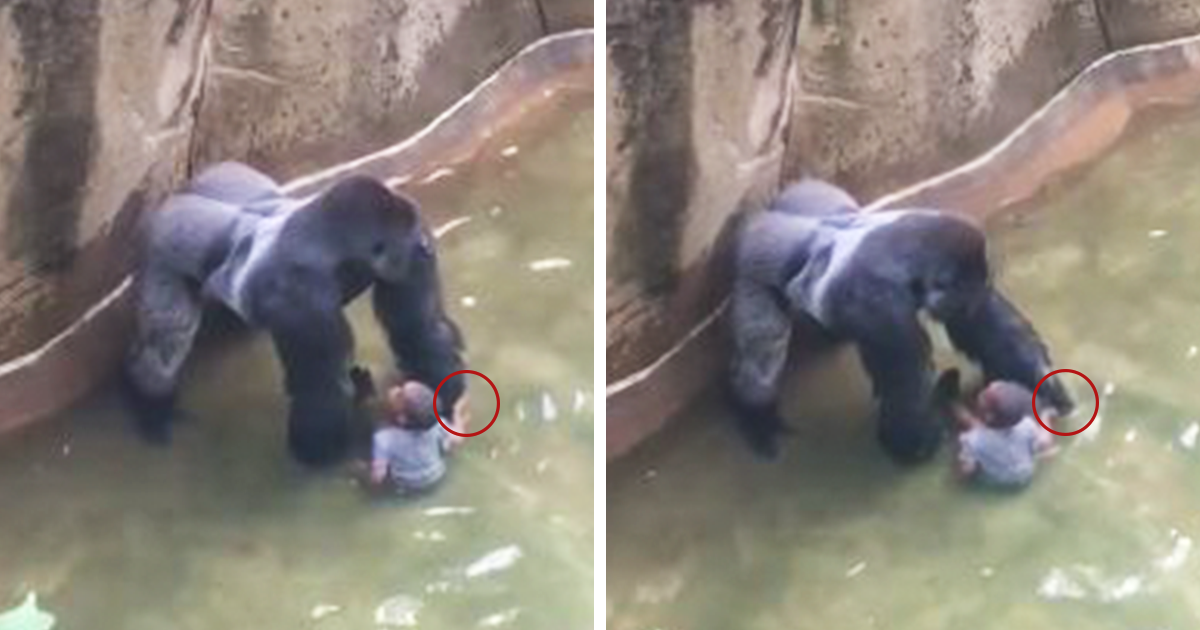

Few zoo stories have traveled through the internet quite like the death of Harambe, the 17-year-old western lowland gorilla shot at the Cincinnati Zoo in 2016 after a young boy entered the Gorilla World exhibit. Years later, the phrase “new video reveals gorilla was holding hands with boy before being shot” still pulls readers back into the same difficult question: was Harambe a danger, a protector, or something heartbreakingly impossible to define in a few seconds of shaky footage?
The answer is not as simple as the internet wanted it to be. In the viral clips, Harambe can be seen standing near the child, moving him through the shallow moat, and at certain moments appearing calm or even gentle. Witnesses said the gorilla looked curious. Some viewers focused on a moment that looked like hand-holding. Others saw a powerful, unpredictable animal in a chaotic emergency. And zoo officials, faced with a child inside an enclosure with a 400-plus-pound silverback, made a decision that still sparks debate a decade later.
This article looks at what the video appeared to show, what zoo officials said, why the response team used lethal force, and why Harambe became not only a tragic animal story but also one of the strangest cultural symbols of the social media age.
What Happened at Cincinnati Zoo?
On May 28, 2016, a young boy climbed through a public barrier at Cincinnati Zoo’s Gorilla World exhibit and fell into the moat inside the habitat. The zoo later stated that two female gorillas were called back indoors, but Harambe, the adult male silverback, remained in the yard with the child.
The encounter lasted roughly 10 minutes. That may not sound long when you are waiting for microwave popcorn, but in an emergency involving a child and a powerful wild animal, 10 minutes is an entire lifetime wearing running shoes.
Video recorded by visitors showed Harambe near the child in the moat. At times, the gorilla appeared to stand over him. At other times, he moved quickly through the water with the boy. Those contrasting images became the heart of the controversy. One frame could look protective; another could look terrifying. The internet, naturally, tried to turn a complicated emergency into a courtroom drama with comment sections as the jury box.
The “Holding Hands” Moment: Why It Changed the Conversation
The claim that Harambe was holding hands with the boy came from footage and witness descriptions showing a brief, surprisingly gentle-looking interaction. Some viewers interpreted the moment as evidence that Harambe was trying to protect the child rather than harm him.
That interpretation gained emotional power because gorillas are intelligent, socially complex animals. They use touch, posture, and proximity in ways that can look deeply familiar to humans. A large hand near a small hand makes the human brain immediately reach for a story: comfort, concern, rescue, maybe even kindness.
But animal behavior experts and zoo officials warned against reading the footage as if Harambe were a person in a gorilla costume. Gorillas are not villains, but they are also not babysitters. Even when a gorilla is not acting with harmful intent, its size and strength can make any sudden movement dangerous. A silverback does not need to “mean harm” to cause harm. That is one of the saddest parts of the entire event.
Was Harambe Protecting the Boy?
Some witnesses believed Harambe was protective. One witness said the gorilla appeared curious and was not striking the child. Others noted that Harambe stood between the child and the crowd at certain moments, which seemed to suggest shielding behavior.
Still, “seemed” is doing a lot of heavy lifting here. Video can show action, but it does not always reveal intention. A gorilla moving a child away from noise might be protective. It might also be a stress response. A gorilla standing over a child might look like guarding. It might also be dominance, confusion, or investigation. When thousands of people online replay the clip, pause it, zoom it, argue over it, and assign motives, the footage becomes less like evidence and more like a Rorschach test with fur.
The most responsible conclusion is this: Harambe may not have been trying to hurt the boy, but the child was still in serious danger. Those two ideas can be true at the same time.
Why the Zoo Chose to Shoot Instead of Tranquilize
One of the most common questions after the incident was simple: why not use a tranquilizer?
Cincinnati Zoo officials explained that tranquilizers do not work instantly. A dart can take several minutes to have an effect, and the impact of the dart itself could have startled or agitated Harambe. In an already tense situation, officials said those extra minutes could have increased the danger to the child.
That explanation did not satisfy everyone. Many animal lovers felt that every possible nonlethal option should have been tried. But zoo emergency teams are trained to prioritize immediate human life when a child is inside a dangerous animal enclosure. From their perspective, this was not a theoretical debate. It was a live emergency with seconds ticking loudly.
It is easy, from a couch and with a replay button, to imagine a cleaner ending. Real emergencies are rude that way. They rarely pause for a committee meeting.
The Barrier Question: Could the Incident Have Been Prevented?
After the shooting, attention quickly shifted from Harambe’s behavior to the enclosure itself. How did a child get into a gorilla habitat in the first place?
The Cincinnati Zoo said the Gorilla World barrier had passed previous inspections and had been used safely for decades. After the incident, the zoo modified the public barrier before reopening the exhibit, adding a taller railing, solid wood beams, and knotted rope netting.
Later reporting on a USDA review said the barrier was found not to be in compliance with federal standards for keeping the public separated from primates. The zoo responded by emphasizing its long safety record and prior inspection history. In plain English: the zoo argued that the barrier had been considered acceptable before the incident, while regulators later concluded that, in practice, it had failed to prevent public access.
This is one of the most important lessons from the Harambe case. Safety systems should not merely pass inspection on paper. They must work when a curious child, a distracted second, and gravity all decide to collaborate.
Why Harambe Became a Global Internet Symbol
Harambe’s death was tragic, but tragedy alone does not explain why his name became a global meme. Many animals die in sad circumstances. Few become shorthand for an entire era of online culture.
Several forces collided. The incident involved a beloved zoo animal, a child in danger, viral video, public outrage, parent-shaming, animal rights debate, and the moral messiness of choosing between two lives. Social media took all of that and tossed it into the blender at maximum speed.
People posted tributes. Others made jokes. Petitions circulated. Comment sections exploded. Harambe became a symbol of grief, absurdity, outrage, and internet chaos. In Cincinnati, however, the story remained more personal. For zoo staff and local residents, Harambe was not just a meme. He was a living animal known by keepers, visitors, and conservation supporters.
The Human Side: The Child, the Family, and Online Judgment
The child survived, and reports said his injuries were not life-threatening. But the family became the target of intense online criticism. Many people blamed the parents, especially the mother, for the boy entering the enclosure. Authorities later declined to file criminal charges, saying the evidence did not show reckless or intentional conduct.
That detail matters. Online outrage often moves faster than verified facts. A few seconds of video can create millions of confident opinions from people who were not there, did not investigate the scene, and have never tried supervising young children in a crowded public place. Toddlers are basically tiny escape artists with snack requests.
This does not mean supervision is unimportant. It means public judgment should be careful. The incident was a tragedy, not a sporting event where strangers get points for the harshest comment.
What the Video Really Teaches Us
The video of Harambe and the boy is powerful because it refuses to fit neatly into one emotional box. It shows tenderness and danger. It shows confusion and urgency. It shows an animal whose behavior can be interpreted in multiple ways, and humans forced to make an irreversible decision under pressure.
For animal welfare advocates, the footage raises questions about captivity, exhibit design, emergency planning, and whether great apes belong in public display environments at all. For zoo professionals, it highlights the difficulty of balancing conservation, education, public access, and safety. For parents, it is a reminder that barriers are not babysitters. For internet users, it is a warning that viral clips rarely include the full context, even when they feel emotionally complete.
Harambe and Conservation: The Loss Beyond the Meme
Harambe was a western lowland gorilla, a species facing serious pressure in the wild from habitat loss, disease, and poaching. His death was not only the loss of one zoo animal but also a blow to breeding and conservation planning. Cincinnati Zoo officials had hoped Harambe could contribute to the long-term genetic health of the managed gorilla population.
That conservation context was often buried beneath memes and arguments. But it is essential. Gorillas are not props for human debate. They are intelligent animals with social lives, family structures, and ecological importance. If Harambe’s story continues to matter, it should matter not only because of one viral video but because gorillas everywhere deserve serious protection.
Why the Story Still Feels Unsettled
The Harambe incident remains unsettled because people want moral clarity and the event offers very little of it. Was the gorilla gentle? At moments, it appeared so. Was the child in danger? Yes. Did the zoo face an impossible decision? Absolutely. Could better barriers have prevented the event? Very possibly. Did the internet behave with compassion and wisdom afterward? Let’s just say the internet did what the internet does, which is rarely the same thing as wisdom.
The “holding hands” detail matters because it captures the emotional contradiction at the center of the story. It makes Harambe harder to see as a threat and easier to mourn as an individual. But it does not erase the danger of the situation. The tragedy is that both feelings are valid.
Experiences and Reflections Related to the Harambe Incident
Anyone who has visited a zoo with children understands how quickly calm can turn into chaos. One moment, everyone is admiring the gorillas. The next, someone needs water, someone drops a pretzel, and a child decides that the most interesting thing in the world is the one place clearly marked “do not enter.” Family outings are beautiful, educational, and occasionally powered by pure panic.
The Harambe story reminds visitors that zoos are not theme parks with fur. They are places where real animals live, and many of those animals are powerful beyond ordinary imagination. A gorilla behind a barrier may look peaceful, almost familiar. He may sit, eat, watch people, and seem like a wise uncle judging everyone’s footwear. But the barrier is there for a reason. Respecting it is not optional; it is the basic agreement that makes public animal exhibits possible.
For parents and caregivers, the experience-related lesson is not “never look away for one second,” because that standard is unrealistic. Human beings blink. Children move. Life happens. The better lesson is to create layers of safety. Hold hands near exhibits. Keep small children in front of you, not drifting behind. Read warning signs out loud. Turn safety into part of the adventure: “We stay behind the rail because this is the gorilla’s home.” Kids often respond better when rules have a reason, not just a parental command delivered in the traditional exhausted whisper.
For zoos, the lesson is equally clear. Good design anticipates human mistakes. A strong safety system assumes that visitors may be distracted, tired, excited, or traveling with children who believe barriers are personal challenges. Railings, landscaping, glass, netting, signage, staff presence, and crowd control all work together. If one layer fails, another should catch the problem before it becomes a crisis.
For online audiences, the Harambe incident is a case study in emotional responsibility. It is natural to react strongly to video of an animal being killed. It is also natural to worry about a child in danger. But compassion should be wide enough to include the animal, the child, the family, and the staff who had to make a terrible decision. Turning tragedy into harassment helps no one. It does not bring back Harambe. It does not make children safer. It only teaches the internet to be louder next time.
The most useful way to remember Harambe is not through blame alone. It is through better barriers, better public awareness, stronger conservation support, and more thoughtful conversations about animals in captivity. The hand-holding moment may always remain emotionally powerful, but the larger message is practical: wild animals deserve respect, children deserve protection, and public spaces must be designed for the unpredictable reality of human behavior.
Conclusion
The video suggesting Harambe was holding hands with the boy before being shot remains one of the most haunting details of the Cincinnati Zoo tragedy. It gives the story its emotional weight, but it should not flatten the facts. Harambe may have shown moments that looked gentle or protective, yet the child was still in a dangerous situation with an immensely strong animal. The zoo’s response team chose lethal force because they believed the child’s life was at immediate risk.
Nearly a decade later, Harambe’s story still matters because it sits at the intersection of animal welfare, parenting, zoo safety, conservation, viral media, and public judgment. It asks us to feel grief without ignoring danger, to demand better systems without pretending emergencies are simple, and to remember that behind every viral clip is a real event with real consequences.