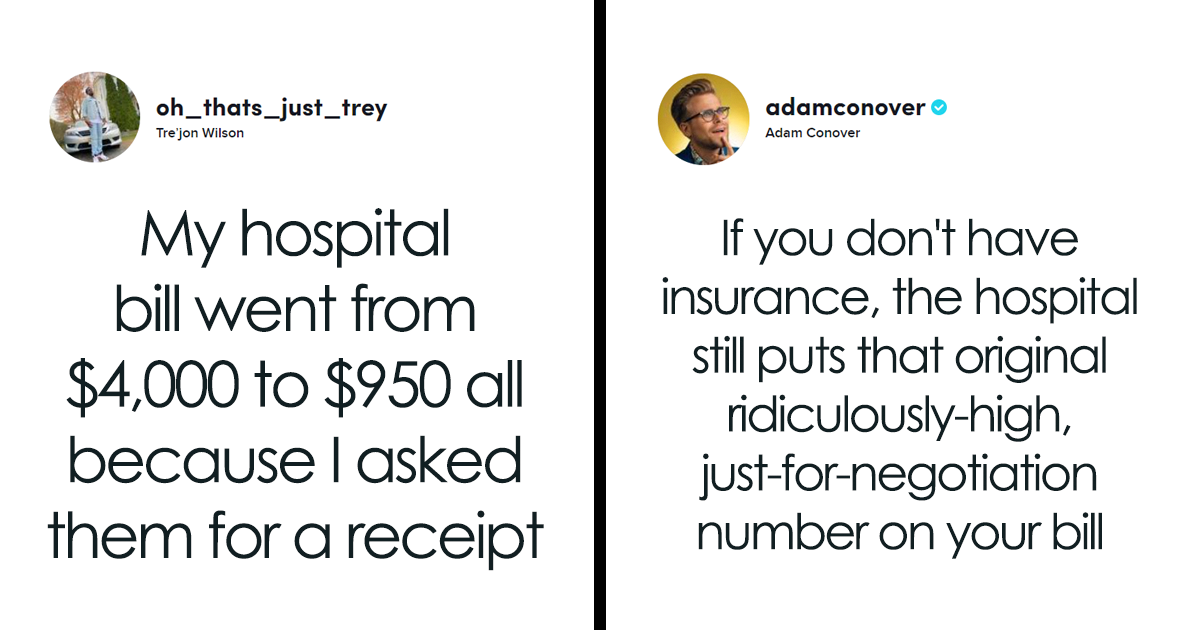

“`
Editorial note: This article explains broad hospital-pricing patterns and consumer protections in the United States. It is not legal, medical, or individualized financial advice.
A guy explaining American hospital bills online may sound like the beginning of a comedy sketch. Unfortunately, the punchline often arrives in an envelope marked “Amount Due.” One emergency room visit can generate a bill that looks less like a receipt and more like the operating budget of a small town.
The explanation is not simply that doctors earn good salaries or that hospitals charge $40 for a bandage. The real story involves negotiated insurance rates, hospital market power, administrative complexity, facility fees, expensive staffing, specialized equipment, public-program payments, and a pricing system in which nearly everyone pays a different amount for the same service.
In other words, an American hospital bill is not one price. It is the final result of several overlapping systems, each bringing its own rules, codes, contracts, and enthusiastic collection of acronyms.
The First Surprise: A Hospital Bill Is Not a Normal Price Tag
When you buy groceries, the price on the shelf is generally the price at the register. Hospital pricing does not work that way. A medical service can have several prices at the same hospital:
- The hospital’s gross or “chargemaster” price
- A discounted cash price
- A negotiated rate for each insurance company
- A Medicare or Medicaid payment rate
- The amount the patient ultimately owes after insurance adjustments
The chargemaster is an enormous internal catalog assigning prices to hospital services, supplies, medications, rooms, and procedures. Those figures may appear on a bill, but insured patients and insurers frequently do not pay the full listed amount. The insurer instead applies a contracted rate, commonly called the allowed amount.
That distinction matters. A bill might show $25,000 in total charges, while the insurer’s negotiated amount is $11,000. The insurer may then pay part of that $11,000, leaving the patient responsible for a deductible, copayment, or coinsurance.
The original $25,000 is still shocking, of course. It is also one reason medical bills can feel like someone spun a roulette wheel, added a comma, and mailed the result.
Why Are Hospital Bills in the USA So Expensive?
1. Private Insurers Often Pay Much More Than Medicare
One of the biggest explanations is not that Americans use hospitals dramatically more often than people in other wealthy nations. It is that prices paid for many hospital and physician services are higher.
Research comparing private health plans with Medicare has found that employers and commercial insurers may pay hospitals roughly two and a half times what Medicare would have paid for the same services at the same facilities. The exact difference varies widely by hospital, state, insurer, and type of care.
Medicare generally sets payment rates through federal formulas. Private insurance rates, however, are negotiated between insurers and health systems. A large hospital network that patients and employers consider essential can demand much higher payments because an insurer may be unable to market a competitive plan without including it.
That is less like bargaining over a used car and more like negotiating with the only bridge out of town.
2. Hospital Consolidation Increases Bargaining Power
Hospital mergers are often promoted as a way to coordinate services, share technology, reduce duplication, or rescue financially struggling facilities. Some combinations may provide genuine operational benefits. However, a substantial body of research has linked greater hospital consolidation with higher commercial prices, without consistent evidence of matching improvements in quality.
When one health system owns multiple hospitals, imaging centers, outpatient clinics, and physician practices in a region, insurers have fewer alternatives. The system may be able to negotiate higher rates because excluding it from an insurance network would make that network unattractive to customers.
Consolidation can also change how services are billed. A physician’s office purchased by a hospital may begin billing as a hospital-owned outpatient department. The medical visit may feel exactly the same to the patient, but a new facility fee can suddenly appear.
3. Facility Fees Add a Second Layer of Charges
A facility fee pays for the hospital infrastructure surrounding a service. It can help support nursing staff, medical equipment, security, laboratories, electronic systems, building maintenance, regulatory compliance, and emergency readiness.
The controversy begins when facility fees appear for care delivered in an ordinary-looking outpatient office. A patient may receive one bill for the clinician and another for the hospital facility, even though the appointment involved one room, one conversation, and one impressively cold examination table.
Facility fees have become an important contributor to emergency department and outpatient spending. They can also create large differences between the cost of a procedure performed at an independent clinic and the same procedure performed at a hospital-owned location.
4. Hospitals Must Be Ready Around the Clock
Hospitals are not simply buildings where scheduled appointments occur. Emergency departments, trauma services, operating rooms, laboratories, intensive care units, pharmacies, and imaging systems may need to function 24 hours a day.
A hospital must maintain trained staff and expensive equipment even when a particular service is temporarily quiet. It may need surgeons, nurses, respiratory therapists, pharmacists, laboratory professionals, and technicians available for unpredictable emergencies.
This readiness is costly. The price of an emergency visit therefore reflects more than the minutes a clinician spends in the room. It also helps fund the broader system required to respond when someone arrives with a heart attack, stroke, severe infection, or traumatic injury at 3:17 a.m.
That does not explain every high charge or excuse every pricing decision. It does explain why comparing an emergency department with a neighborhood walk-in clinic is not always an apples-to-apples exercise. One is a clinic. The other is a miniature city that never sleeps.
5. Labor Is a Hospital’s Largest Expense
Health care depends on highly trained people, and hospitals employ a lot of them. Nurses, physicians, technicians, therapists, pharmacists, custodians, dietary workers, billing specialists, security personnel, and administrators all contribute to hospital operations.
Labor shortages can force hospitals to offer higher wages, overtime, retention bonuses, or temporary staffing contracts. Specialized personnel are particularly expensive because their education and licensing require years of training.
Recent hospital-industry reports indicate that labor remains the largest category of hospital expense. Supplies, drugs, implants, and technology add further pressure. A modern hospital consumes everything from disposable gloves and sterile tubing to pacemakers, surgical robots, ventilators, and multimillion-dollar imaging systems.
6. Administrative Complexity Eats an Enormous Slice of the Pie
American health care has an administrative system so complex that it sometimes appears to be testing whether paperwork can reproduce on its own.
Hospitals must work with numerous insurers, each offering multiple plans with different networks, deductibles, prior-authorization rules, coding requirements, appeal procedures, and payment policies. Employees must verify coverage, document treatment, assign billing codes, submit claims, respond to denials, correct errors, appeal decisions, and pursue unpaid balances.
Insurers maintain their own teams to review those claims. Employers hire consultants to choose plans. Patients call everyone involved, often receiving three different explanations and a hold-music playlist they now know by heart.
Research has estimated hundreds of billions of dollars in hospital and clinical administrative costs. Not all administration is wasteful; medical records, safety programs, quality monitoring, and fraud prevention are necessary. Still, the fragmented U.S. payment system demands far more billing and insurance activity than simpler systems in many peer countries.
7. Drugs, Devices, and Medical Technology Can Be Extremely Expensive
Hospital-administered medications may include chemotherapy, biologic drugs, clotting treatments, anesthesia agents, and other products that cost far more than common retail prescriptions. Surgical implants and devices can also carry significant prices.
Hospitals must store, track, prepare, and safely administer these products. Some require refrigeration, specialized pharmacy facilities, or careful monitoring. Advanced technology can improve diagnosis and treatment, but innovation rarely arrives wearing a clearance sticker.
The result is a difficult balance. Patients want access to the latest lifesaving treatments, yet the cost of purchasing, maintaining, and operating advanced technology is eventually reflected in insurance premiums, government spending, and hospital bills.
8. Unpaid Care and Uneven Reimbursement Create Additional Pressure
Hospitals provide emergency treatment regardless of a patient’s ability to pay. They also deliver charity care and absorb some unpaid bills. Medicare and Medicaid rates are set by government policy, while commercial payments are negotiated.
Hospitals often argue that low public-program payments and uncompensated care require higher payments from private insurers. Economists continue to debate how much true cost shifting occurs and how much high commercial pricing reflects market power instead.
The safest conclusion is that uncompensated care and reimbursement differences are real financial pressures, but they do not fully explain why prices vary so dramatically among hospitals offering similar services.
9. Insurance Protects Patients and Confuses Them at the Same Time
Insurance can prevent a catastrophic medical event from becoming financially impossible. It can also make the price of care almost invisible until the bill arrives.
A patient may know that a hospital is “in-network” but not know the insurer’s negotiated price. Even when the price is available, calculating personal responsibility requires knowing the remaining deductible, copayment, coinsurance rate, out-of-pocket limit, and whether every participating clinician is covered.
Consider a hospital procedure with an allowed price of $10,000. A patient who has not met a $3,000 deductible may owe that amount first. If the plan then requires 20% coinsurance, the patient could owe an additional portion until reaching the annual out-of-pocket maximum.
The hospital’s price may therefore be high, the insurer may receive a major discount, and the patient may still owe thousands of dollars. Everyone can truthfully claim a discount occurred, while the patient wonders whether selling a kidney would create another hospital bill.
Why Can the Same Procedure Have Wildly Different Prices?
Hospital prices are local and contractual. One insurer may have greater bargaining power than another. One hospital may dominate its region. A teaching hospital may provide specialized services that smaller facilities cannot offer. A procedure may include different supporting services, anesthesia arrangements, or physician fees.
Location also matters. Prices can vary among states, cities, hospitals in the same city, and even insurance plans at the same hospital. Quality differences do not always explain those variations.
Federal hospital price-transparency rules require hospitals to publish machine-readable pricing files and provide consumer-friendly information for shoppable services. These disclosures can help employers, researchers, insurers, and patients compare prices. However, the files can be enormous, technically complicated, or difficult for an ordinary patient to interpret.
Transparency is useful, but a 900-megabyte spreadsheet is not exactly bedside reading.
Why Emergency Care Is Especially Difficult to Shop For
Price comparison works best for scheduled services such as imaging, laboratory testing, or elective procedures. It works badly when someone cannot breathe.
During an emergency, patients rarely have the ability to call multiple hospitals, verify every clinician’s network status, request written estimates, and select the most affordable CT scanner. They go to the nearest appropriate facility and deal with the financial consequences later.
The federal No Surprises Act now protects many insured patients from certain out-of-network emergency bills and from some out-of-network charges at in-network facilities. It also gives uninsured or self-paying patients rights related to good-faith estimates and disputed bills.
Those protections are important, but they do not eliminate deductibles, coinsurance, high in-network prices, or every possible billing dispute.
What Patients Can Do When a Hospital Bill Looks Wrong
Request an Itemized Bill
Ask for a detailed statement showing each service, supply, medication, and billing code. A one-line balance does not provide enough information to identify duplicate charges, incorrect quantities, or services you do not recognize.
Compare the Bill With the Explanation of Benefits
Your insurer’s explanation of benefits, commonly called an EOB, should show the billed charge, network discount, allowed amount, insurer payment, and patient responsibility. The EOB is not itself a bill, but it can reveal whether the provider is asking for more than the insurer says you owe.
Check the Network Status
Confirm that the hospital and the individual clinicians were processed correctly. Emergency physicians, anesthesiologists, radiologists, pathologists, and laboratories may bill separately. Ask whether federal or state surprise-billing protections apply.
Ask for a Coding Review
You do not need to accuse anyone of wrongdoing. Simply ask the billing department to review questionable codes, duplicated services, or unexpected levels of care. Billing errors can occur, but so can misunderstandings about what a code includes.
Apply for Financial Assistance
Tax-exempt nonprofit hospitals must maintain written financial assistance policies. Depending on income, household size, state law, and hospital policy, a patient may qualify for free or discounted medically necessary care.
Do not assume that having insurance makes you ineligible. Underinsured patients with large deductibles may also qualify under some policies. Ask for the application, eligibility standards, required documents, and deadline in writing.
Negotiate Before Using a Credit Card
Ask whether the hospital offers a lower cash settlement, hardship discount, interest-free payment plan, or extended payment schedule. Moving the balance to a high-interest credit card can transform one expensive problem into an expensive problem wearing a smaller, angrier problem as a hat.
Can the System Be Fixed?
No single reform will solve every cause of expensive hospital bills. The most promising approaches address several layers at once:
- Stronger enforcement of price-transparency requirements
- Simpler and more standardized billing rules
- Closer review of hospital mergers and anticompetitive contracting
- Reduced payment differences based only on the location of care
- Better access to independent outpatient centers when medically appropriate
- Clearer financial assistance and billing-dispute procedures
- Insurance designs that do not expose patients to unaffordable cost sharing
Policymakers must also protect emergency readiness, rural access, teaching programs, and specialized services. Cutting payments indiscriminately could threaten facilities that genuinely operate on narrow margins. The goal should not be to pretend hospitals are inexpensive businesses. It should be to distinguish necessary costs from prices produced mainly by complexity or market leverage.
A Composite Patient Experience: One Night in the ER and Months of Paperwork
The following scenario is a composite illustration based on common American billing patterns. It is not presented as the verified story of one particular patient.
Jordan wakes at 1 a.m. with severe abdominal pain. By 2 a.m., the pain is intense enough to make standing difficult. Searching for the cheapest emergency department is not a serious option, so Jordan’s partner drives to the nearest in-network hospital.
At the hospital, Jordan checks in, answers insurance questions, receives blood tests and medication, and undergoes a CT scan. An emergency physician evaluates the results and rules out appendicitis. The final diagnosis is a kidney stone. Jordan goes home around sunrise with discharge instructions, a prescription, and no meaningful idea what the visit cost.
Three weeks later, the hospital’s online portal displays total charges of $18,400. Jordan briefly considers changing their legal identity.
The insurance EOB provides a different picture. The insurer’s network contract reduces the hospital charge to an allowed amount of $8,900. Insurance pays $5,200. Because Jordan still had a large deductible and then owed coinsurance, the EOB lists patient responsibility of $3,700.
Then two additional bills arrive. The emergency physician group requests $540, while the radiology group bills $310 for interpreting the CT scan. Jordan had assumed the hospital bill covered every person involved. It did not.
The experience now becomes administrative rather than medical. Jordan calls the insurer, waits on hold, and learns that the radiologist’s claim was initially processed incorrectly. The insurer agrees to review it. The hospital billing office sends an itemized statement containing dozens of lines, including laboratory panels, medications, imaging, supplies, and an emergency facility fee.
Nothing on the statement says, “This is why a four-hour visit costs more than a used car.” Each line has a description, code, quantity, and price, but the relationship between the listed charges and the insurer’s allowed amount remains difficult to follow.
Jordan asks whether financial assistance is available. The representative initially offers a monthly payment plan. Jordan specifically asks for the hospital’s written financial assistance policy instead. The application requires proof of income, household information, recent tax documents, and insurance records.
After submitting the paperwork, Jordan qualifies for a partial hardship discount. The hospital reduces the patient balance by $1,250. Meanwhile, the insurer reprocesses the radiology claim as protected in-network cost sharing, lowering that separate bill.
The remaining balance is still painful, but Jordan arranges an interest-free payment plan rather than putting the entire amount on a credit card. The final out-of-pocket cost is substantially lower than the first wave of statements suggested, although resolving it takes multiple calls, two uploaded applications, several portal messages, and more patience than the kidney stone itself seemed to require.
This composite experience captures one of the most frustrating parts of American hospital billing: the first number is not always the final number, but patients must know which questions to ask. They must distinguish charges from allowed amounts, bills from EOBs, hospital services from independent physician services, and payment plans from genuine financial assistance.
People who are sick, injured, exhausted, or grieving are effectively asked to become temporary insurance investigators. Those with limited time, language access, internet access, or financial knowledge may pay more simply because they cannot navigate the process.
The practical lesson is not that every bill contains an error or that every charge can be negotiated away. It is that a large hospital bill deserves careful review before payment. Request details, compare documents, appeal incorrect processing, ask about legal protections, and apply for assistance when needed. The system may be complicated, but complexity should not be mistaken for inevitability.
Conclusion
So, why are hospital bills in the USA so expensive? Because American hospital pricing combines genuinely expensive medical operations with high commercial payment rates, concentrated provider markets, extensive administrative work, facility fees, costly labor, advanced technology, insurance cost sharing, and limited opportunities for patients to shop during emergencies.
The viral “guy explains it” version may fit into a short video, but the full answer is a maze. Hospitals carry real costs and provide essential care. At the same time, wide price variations and complicated billing cannot always be explained by quality or clinical necessity.
Patients cannot redesign the entire health care system from a billing-office phone call. They can, however, ask for an itemized statement, compare it with the insurer’s records, challenge incorrect charges, investigate surprise-billing protections, and request financial assistance. In American medicine, asking questions is not being difficult. Sometimes it is the only discount code available.