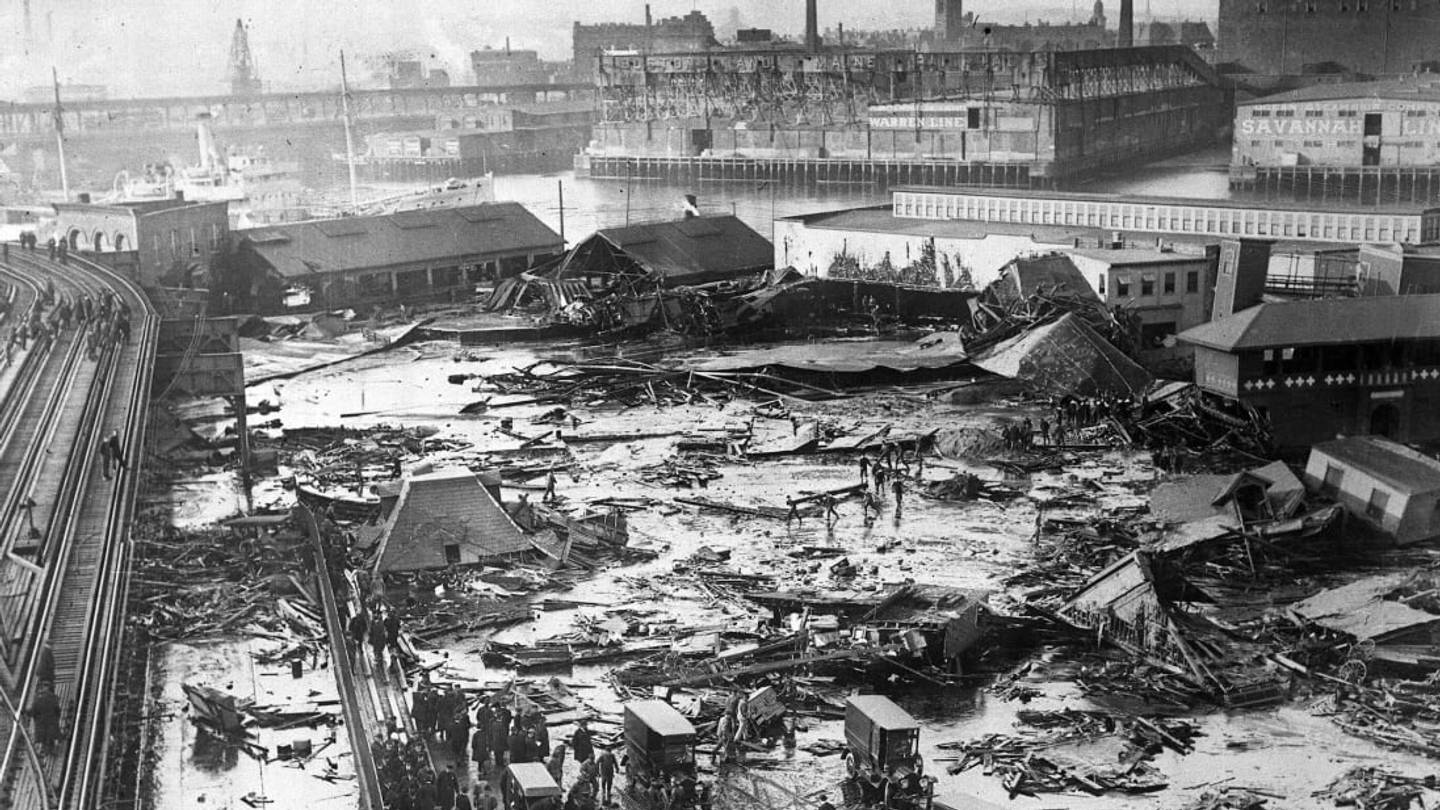

Boston history contains revolutions, tea parties, championship parades, and one industrial disaster so strange that it can initially sound like a tall tale told after an unusually creative dinner. Yet the Great Molasses Flood of 1919 was painfully real. On January 15, a massive storage tank burst in Boston’s North End, releasing millions of gallons of molasses into crowded streets. The dark wave demolished buildings, swept away vehicles, trapped residents, and killed 21 people.
More than a century later, the Boston Molasses Disaster still deserves serious attention. Beneath its bizarre headline lies a story about immigrant neighborhoods, ignored warning signs, engineering negligence, emergency courage, corporate accountability, and the safety rules modern Americans often take for granted.
“`
Boston Before the Great Molasses Flood
In 1919, Boston’s North End was a busy waterfront neighborhood filled with homes, small businesses, warehouses, elevated railway lines, and industrial facilities. It was also home to a large Italian immigrant community. Families lived and worked close to the harbor, often within sight of the enormous steel tank that would eventually transform an ordinary winter afternoon into one of the strangest disasters in American history.
Why Was Boston Storing So Much Molasses?
Molasses was far more commercially important in the early twentieth century than it may seem today. It was not merely waiting to become gingerbread, baked beans, or something hidden in the back of a grandmother’s pantry. Companies fermented molasses to produce industrial alcohol, which was used in manufacturing and, during World War I, in the production of explosives and munitions.
The Purity Distilling Company built its Commercial Street storage tank in 1915. The operation later came under the control of United States Industrial Alcohol, commonly abbreviated as USIA. Ships delivered molasses to the waterfront, where it was pumped into the tank before being transferred to a distilling facility in Cambridge.
The cylindrical tank stood approximately 50 feet tall and 90 feet across. When nearly full, it held about 2.3 million gallons of molasses. That was not a respectable quantity of pancake topping. It was thousands of tons of dense liquid stored above a populated neighborhood.
Warning Signs That Should Never Have Been Ignored
The tank did not fail without warning. Residents reported that it leaked, sometimes badly enough that local children collected dripping molasses in containers. Witnesses also remembered hearing groaning or rumbling noises whenever the tank was heavily filled.
Instead of treating visible leakage as a message from the laws of physics, the company reportedly painted the tank brown, making the stains less obvious. It was the industrial equivalent of covering a check-engine light with tape and congratulating yourself on repairing the car.
A Tank Built in a Hurry
Later investigations found serious problems with the tank’s design, construction, and oversight. The project had not received adequate review from qualified engineers. The tank was assembled quickly, and it was not fully tested with water before being placed into service. Such a test could have revealed weaknesses without involving millions of gallons of heavy syrup.
Modern engineering analysis has identified several likely defects. Parts of the steel shell were too thin for the stresses placed upon them. Rivet holes created areas where cracks could develop, and the steel itself was relatively brittle. Researchers have paid particular attention to stress near a large manhole at the bottom of the tank, where failure may have begun.
No single detail excuses the rest. Temperature, internal pressure, material quality, rivet design, repeated loading, and inadequate inspection probably interacted. The central lesson is less mysterious: a huge industrial structure was allowed to operate despite visible evidence that it was not behaving safely.
January 15, 1919: The Tank Bursts
Boston had recently experienced bitter cold, but temperatures rose quickly on January 15, reaching roughly 40 degrees Fahrenheit. A fresh shipment of comparatively warm molasses had also been added to the colder material already inside the tank. The temperature change may have increased internal pressure through expansion and fermentation, placing additional strain on an already defective structure.
At approximately 12:30 p.m., witnesses heard an alarming series of sounds. Some described deep rumbling and grinding. Others compared the snapping rivets to machine-gun fire. Then the giant tank tore apart.
A 25-Foot Wave Moving at Highway Speed
Approximately 2.3 million gallons of molasses rushed outward. Later estimates placed the leading wave as high as 25 feet and its speed at around 35 miles per hour. Precise measurements were impossible amid the chaos, but physical modeling has shown that the extraordinary speed described by witnesses was credible.
Molasses is denser than water, so the wave carried enormous force. Steel plates and rivets became projectiles. Wooden structures shattered. Freight cars were pushed aside. A firehouse was knocked from its foundation, and part of the elevated railway structure was damaged. The force reportedly lifted or displaced vehicles and swept people from their feet before they had time to understand what was happening.
The popular phrase “slow as molasses” was not especially comforting that afternoon. Under pressure, warm molasses can flow rapidly. As the flood spread and cooled, however, it became thicker. That combination made the disaster uniquely deadly: the molasses moved fast enough to destroy buildings and then became viscous enough to trap people in the wreckage.
The Human Cost of the Boston Molasses Disaster
Twenty-one people died, and approximately 150 were injured. The victims included workers, residents, children, drivers, firefighters, and people who happened to be passing through the neighborhood. Some were crushed by structures or metal debris. Others drowned or suffocated after being pinned beneath the thick liquid.
The dead ranged widely in age. Ten-year-old Maria DiStasio was among the youngest victims. Other victims were laborers supporting families, city employees performing routine duties, and North End residents whose homes stood near the tank. Several horses also died, some trapped so severely that rescuers could not save them.
Remembering the Great Molasses Flood requires moving beyond its almost unbelievable premise. Calling it merely “weird history” risks turning real suffering into trivia. It was an industrial catastrophe that struck a working-class immigrant neighborhood whose residents had little influence over the company operating beside their homes.
Why Escape Was So Difficult
A person caught in water can sometimes swim or float. Molasses creates different physical problems. Its density and viscosity resist movement, while debris carried by the flood creates additional hazards. Victims who attempted to pull themselves free could sink deeper or become exhausted. Cold winter air further thickened the syrup and increased the danger of hypothermia.
Rescuers also struggled to maintain footing. Every surface was slippery, heavy, and sticky at the same timea combination that sounds impossible until one remembers that history occasionally has a very dark sense of irony.
Rescue Workers Enter the Molasses
Help arrived quickly. Cadets from the Massachusetts Nautical School training ship stationed nearby were among the first organized rescuers at the scene. They entered the flooded area, pulled survivors from debris, and tried to control crowds gathering around the disaster zone.
Boston police officers, firefighters, Red Cross personnel, medical workers, soldiers, sailors, and neighborhood residents joined the effort. Temporary medical facilities were established nearby. Workers used ladders, ropes, stretchers, and whatever tools were available to reach people trapped beneath ruined buildings.
The operation continued through the night and into the following days. Rescuers had to clear heavy debris while wading through molasses that clung to clothing, equipment, boots, and skin. Some victims were found days later. One body carried into Boston Harbor was not recovered for months.
Cleaning a Neighborhood Coated in Molasses
Once the immediate rescue ended, Boston faced an unusually stubborn cleanup. Fresh water alone was not effective enough. Crews pumped salt water from the harbor, which helped break down the molasses. Sand was spread over streets to absorb the syrup and provide traction.
Workers scraped buildings, railway supports, pavement, and vehicles. The sticky residue traveled beyond the North End on shoes, wagon wheels, streetcars, and clothing. Portions of Boston reportedly became tacky reminders of the disaster even when they were nowhere near the original tank.
Major cleanup work lasted for weeks, while traces of the molasses remained much longer. Generations of Bostonians repeated the claim that the North End smelled sweet on hot summer days. Whether every later whiff was chemical residue or local folklore is difficult to prove, but the story became part of the neighborhood’s memory.
The Company Blames Anarchists
United States Industrial Alcohol denied that negligent construction caused the collapse. The company argued that anarchists had bombed the tank. The claim was politically convenient. The United States was entering the first Red Scare, when fears of radicals, immigrants, labor activists, and political violence were widespread.
Bombings had occurred in the country, so sabotage was not an unimaginable theory. However, the company lacked convincing physical evidence that an explosive device destroyed the tank. The accusation also shifted attention away from leaks, inadequate testing, questionable steel, and the absence of proper engineering supervision.
Because many North End residents were Italian immigrants, the sabotage argument carried an ugly undertone. It encouraged suspicion of the community harmed by the disaster rather than scrutiny of the company that owned the failed structure.
The Landmark Molasses Flood Lawsuit
Survivors, relatives, property owners, and public agencies filed claims against USIA. More than 100 cases were eventually consolidated into a major legal proceeding commonly associated with Dorr v. United States Industrial Alcohol Company.
The hearings became a marathon of engineering evidence, witness testimony, material analysis, maps, calculations, and competing theories. Court-appointed auditor Hugh W. Ogden heard hundreds of days of testimony before issuing his findings in 1925.
Negligence, Not Sabotage
Ogden rejected the company’s bombing theory and concluded that structural failure caused the disaster. Responsibility rested with United States Industrial Alcohol because the tank had been improperly designed and constructed without adequate attention to safety.
The company ultimately paid approximately $628,000 in damages, a substantial sum at the time. Money could not restore the lives lost, but the ruling mattered. It demonstrated that a powerful corporation could be held financially accountable when cost-cutting and poor oversight endangered the public.
How the Flood Influenced Engineering Safety
The Great Molasses Flood did not single-handedly create every modern building code, but it became part of a broader transformation in American engineering and construction oversight. Governments increasingly required plans for major structures to include calculations, professional review, permits, inspections, and signatures from qualified engineers or architects.
Professional engineering licensure expanded during the same era. Large tanks and industrial structures could no longer be treated as oversized do-it-yourself projects. Someone with recognized technical qualifications had to take responsibility for determining whether a design could withstand its expected loads.
Lessons That Still Apply
The disaster continues to offer practical lessons for engineers, executives, regulators, and ordinary citizens:
- Visible leaks are warnings, not cosmetic inconveniences.
- Safety testing should happen before equipment enters full service.
- Qualified engineers must review structures capable of harming the public.
- Material selection matters as much as overall design.
- Companies must investigate employee and community concerns rather than hide them.
- Emergency planning should account for unlikely but high-consequence failures.
The tank’s owners did not lack clues. They lacked an adequate response to those clues. That distinction is what makes the flood more than an old engineering mystery.
Remembering the Victims, Not Just the Molasses
The disaster is often introduced through humor because a “molasses flood” sounds absurd. Humor can make history approachable, but remembrance requires balance. The event should not be reduced to a collection of sticky puns, impressive numbers, and jokes about slow-moving syrup.
The people who died were not characters in a quirky anecdote. They were children, parents, immigrants, laborers, and public servants. Their families spent years seeking compensation while defending themselves against claims that political extremists, rather than corporate failures, had caused the tragedy.
Remembering the Boston Molasses Flood also means recognizing the North End as a living community rather than a dramatic backdrop. Residents had reported warning signs. After the collapse, they became rescuers, witnesses, plaintiffs, mourners, and keepers of the story.
Extended Experience: Walking the Flood’s Footprint Today
A visit to the former disaster site creates a curious contrast between past and present. The tank once stood near Commercial Street on land now occupied by the Langone and Puopolo park area. Today, visitors encounter recreational spaces, waterfront views, athletic fields, passing traffic, and the ordinary sounds of the modern North End. Nothing about the setting announces that millions of gallons of molasses once tore through it.
That normality is part of the experience. Stand near the park and imagine a steel cylinder rising roughly five stories above the neighborhood. Its diameter would cover a considerable portion of the surrounding space. Then picture the tank filled almost to the top with a liquid heavier than water. The scale becomes more understandable when measured against trees, buildings, and people rather than reduced to a number in a history book.
A small memorial marker recalls the disaster. It is easy to miss, which has prompted debate about whether Boston should create a more prominent tribute. Finding it can feel oddly appropriate, however. Much of urban history survives in small signs, buried foundations, changed street lines, and stories carried by residents. A quiet park may conceal an industrial site; a playground may sit over concrete that once supported a tank.
Walking along Commercial Street also helps explain why the flood was so destructive. The neighborhood was dense. Homes, workplaces, transportation lines, warehouses, and the harbor were packed together. The tank was not isolated in a remote industrial zone. It stood beside the daily routes of workers, schoolchildren, drivers, and families.
For a deeper remembrance experience, examine archival photographs before visiting. In those images, steel panels curl across the ground, buildings lie in splinters, and rescuers stand ankle- or knee-deep in dark residue. Compare recognizable features with the modern waterfront. The exercise transforms old photographs from distant evidence into records of a real place beneath today’s streets.
Visitors may also follow portions of the Boston Harborwalk or explore nearby North End landmarks. The neighborhood is famous for colonial history and Italian American culture, yet the flood adds another layer: the history of industrialization, immigration, labor, urban risk, and corporate power. It reminds us that cities are shaped not only by celebrated leaders but also by workers, engineers, business decisions, accidents, and legal struggles.
Some people still repeat the tradition that molasses can be smelled on especially warm days. Treating that claim as folklore rather than a guaranteed tourist attraction prevents disappointment. Boston has many aromas, and most are more likely to come from restaurants, bakeries, traffic, or the harbor. Still, the legend reveals how strongly scent became connected to communal memory. The sweetness that would normally suggest food or comfort became associated with destruction.
The most meaningful experience is to pause and read the victims’ names. Statistics communicate scale, but names restore individuality. Twenty-one deaths can sound like a historical total; 21 separate people had families, routines, plans, and unfinished conversations. Remembering them turns a famously unusual disaster into a human one.
Leaving the site, the enduring lesson becomes clear. Catastrophes rarely begin at the moment of collapse. They begin with rushed work, weak oversight, dismissed complaints, hidden leaks, and decisions that place production above safety. The flood arrived suddenly, but the conditions that created it had been developing for years.
Conclusion: A Strange Disaster With a Serious Legacy
Boston’s Great Molasses Flood of 1919 remains unforgettable because it combines the improbable with the devastating. A giant wave of syrup traveled through city streets, yet there was nothing comical about its human cost. Twenty-one people died, about 150 were injured, and an immigrant neighborhood was torn apart by an industrial structure that should have been safer.
The resulting investigation and lawsuit exposed weak engineering, inadequate testing, ignored warnings, and attempts to avoid responsibility. The disaster helped strengthen the principle that companies must prove major structures are safe before placing communities at risk.
More than a century later, the best way to remember the Great Molasses Flood is not simply to marvel that it happened. It is to recognize why it happened, honor those who suffered, and refuse to paint over the leaksliterally or otherwisewhen public safety is at stake.