
A kitchen faucet is easy to underestimate. It sits quietly behind the sink while countertops, cabinets, and appliances collect compliments. Yet the faucet may be touched dozens of times a day, from filling the first coffee pot in the morning to attacking the mysterious saucepan someone “left to soak” three nights ago.
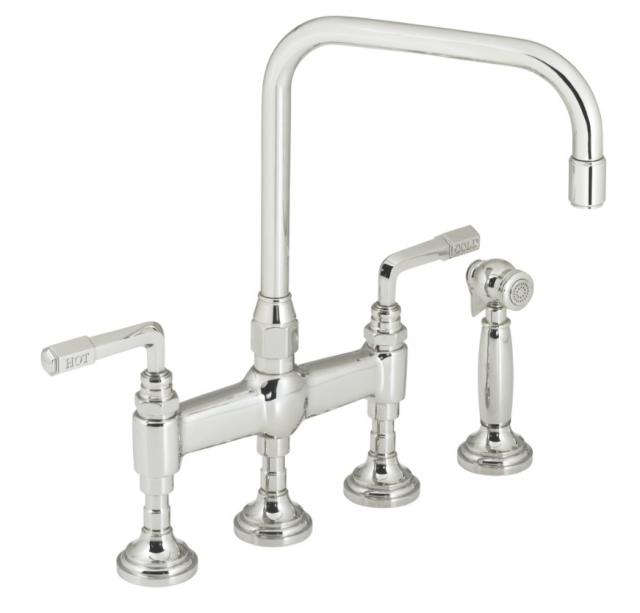
For Town kitchen faucets approach this hardworking role with considerably more ceremony. The collection is associated with celebrated designer Michael S. Smith and draws inspiration from the polished elegance of traditional New York apartments. Its signature kitchen model combines a bridge-style body, separate lever handles, a tall curved spout, and a matching side spray. The result looks historic without requiring homeowners to sacrifice modern plumbing performance.
This guide examines the design, features, installation requirements, everyday usability, maintenance, and ownership experience of For Town kitchen faucets. It also explains who should consider oneand who may be happier with a simpler faucet that does not arrive dressed for dinner at the Plaza.
What Is a For Town Kitchen Faucet?
The For Town kitchen faucet is a luxury deck-mounted bridge faucet produced by Kallista. Rather than hiding the hot and cold water connections below the counter, a bridge faucet visually connects the two handles above the sink deck. The architecture becomes part of the design, giving the fixture a more substantial and traditional presence.
The best-known model in the collection includes two lever handles, a high arched spout, and a separate side spray. Its styling evokes the carefully tailored interiors of a 1930s Park Avenue apartment: formal enough to feel special, but restrained enough to avoid looking like a prop from a historical drama.
Official specifications identify several important features:
- Solid-brass construction
- A maximum flow rate of 1.8 gallons per minute
- A 9-1/4-inch spout reach
- A 360-degree rotating spout
- A separate side spray
- A four-hole deck-mount installation
- Polished chrome and nickel silver finish options
These details place the faucet firmly in the traditional luxury category. It is not designed to disappear into the background. It is meant to serve as visual hardware, functional plumbing, and a small piece of kitchen architecture all at once.
Why the Bridge Design Stands Out
It Makes the Plumbing Part of the Decoration
A standard single-handle faucet concentrates nearly everything into one compact body. A bridge faucet spreads the components across the sink deck, allowing the handles, connecting bar, and spout to form a balanced composition.
That extra visual structure works especially well in kitchens with paneled cabinetry, marble or soapstone counters, farmhouse sinks, traditional millwork, or vintage-inspired lighting. The faucet can provide a sense of age and permanence even in a newly built home.
Separate Handles Offer Deliberate Control
The hot and cold water supplies are controlled independently. Some homeowners enjoy the precise, familiar ritual of adjusting two handles. Others may find it less convenient than moving a single lever with one wrist while holding a raw chicken in the other hand.
This is largely a lifestyle decision. Two-handle faucets reward intentional use and visual symmetry. Single-handle models prioritize speed and one-handed control. Neither arrangement is universally better; they simply serve different preferences.
The Tall Spout Adds Working Clearance
The elevated curved spout provides useful room for stockpots, mixing bowls, pitchers, and deep roasting pans. A 9-1/4-inch reach also helps position the water stream farther into a generously sized basin.
However, a tall faucet must be matched carefully to the sink. A strong stream falling into a shallow basin can create splash. Before buying, consider the sink depth, drain location, water pressure, and point where the stream will land. Beautiful proportions are wonderful; dry shirt sleeves are also wonderful.
How the Side Spray Changes Daily Use
The matching side spray handles tasks that would otherwise be performed by a pull-down faucet head. It can rinse vegetables, clean sink corners, remove food from plates, and direct water into a container that does not fit comfortably beneath the main spout.
A separate sprayer also preserves the clean silhouette of the bridge faucet. The main spout remains visually uninterrupted because it does not need to conceal a retractable hose.
There are practical trade-offs. A side spray occupies an additional sink hole and needs clear space below the countertop for its hose. The hose must move freely without catching on shutoff valves, cleaning supplies, garbage-disposal components, or the heroic collection of reusable shopping bags living under the sink.
Homeowners who constantly use a spray function may prefer an integrated pull-down head. Those who value traditional styling and use a sprayer only for specific tasks may find the side-spray arrangement more attractive.
Materials, Finishes, and Visual Character
Solid-Brass Construction
The For Town faucet uses solid-brass construction, a common choice for premium fixtures because brass can be shaped precisely and provides a substantial, durable foundation. Material quality matters, but buyers should still review the current specification sheet, drinking-water certifications, installation instructions, and warranty terms for the exact model and finish being ordered.
Polished Chrome
Polished chrome has a bright, reflective surface that feels crisp and formal. It coordinates easily with stainless-steel sinks and appliances while creating a sharper contrast against dark stone or painted cabinetry.
Chrome is also honest about fingerprints and water spots. It does not conceal evidence; it presents it to the household like a tiny, judgmental mirror. Regular wiping with a soft cloth keeps the finish looking its best.
Nickel Silver
Nickel silver offers a warmer and generally softer visual effect. It can coordinate beautifully with warm white cabinets, natural wood, unlacquered brass accents, antique hardware, and traditional interiors.
Because finish names and appearances vary among manufacturers, do not select a faucet solely from a small image on a screen. View a physical sample or showroom display under lighting similar to the lighting in your kitchen. A finish that looks cool gray under store LEDs may appear noticeably warmer at home.
Is a For Town Faucet Right for Your Kitchen?
This faucet is best suited to a renovation in which the sink area is intended to become a focal point. It makes particular sense in traditional, transitional, cottage, English-inspired, or classically American kitchens.
It may be an excellent fit when:
- You want a true bridge-faucet silhouette.
- Your sink or countertop can accommodate four holes.
- You appreciate separate hot and cold controls.
- You want a freestanding side spray rather than a pull-down head.
- The kitchen includes premium cabinetry, stone, hardware, and appliances.
- You are willing to maintain a polished decorative finish.
It may be less suitable when:
- You need one-handed temperature adjustment.
- Your sink has only one usable mounting hole.
- You prefer touchless or voice-activated operation.
- You use a pull-down spray head constantly.
- You want the easiest possible DIY replacement.
- Your renovation budget needs to prioritize structural or mechanical work.
A luxury faucet cannot repair a poor kitchen layout, undersized sink, damaged plumbing, or lack of counter space. Address the practical bones of the room first. Jewelry looks better after the house is standing upright.
Installation Requirements to Check Before Ordering
Confirm the Four-Hole Configuration
The faucet requires four mounting holes: two for the handles, one for the spout assembly, and one for the side spray. Existing sinks and countertops may not have the correct number, spacing, or diameter of holes.
Adding holes may be possible in wood, solid-surface material, stainless steel, or certain stones, but every material requires the correct tools and technique. Cutting finished stone should generally be left to an experienced fabricator. One improvised drill session can turn a luxury upgrade into an expensive geology lesson.
Measure the Spout Landing Point
Use the published 9-1/4-inch reach to estimate where the stream will fall. Ideally, it should land near the drain or within the central working area of the bowl. A stream that lands too close to the back wall encourages splashing, while one that extends too far may interfere with sink accessories.
Check Vertical and Rear Clearance
Verify that the faucet will not collide with a low windowsill, shelf, backsplash ledge, or inward-opening window. Leave enough room to operate the handles comfortably and clean around the base.
Inspect the Cabinet Below
The cabinet must have room for supply connections and unrestricted movement of the side-spray hose. Consider the garbage disposal, water filter, instant-hot system, soap dispenser bottle, drain pipes, and stored items before deciding that the empty-looking cabinet is actually empty.
Consider Professional Installation
An experienced DIYer may be capable of installing a deck-mounted faucet, but a high-value four-hole bridge fixture deserves careful handling. A plumber can verify shutoff valves, supply connections, deck thickness, hose routing, seals, and water pressure while reducing the risk of scratches or leaks.
After installation, every connection should be inspected under running water. Check again after several hours and the following day, because a slow leak may not introduce itself with the dramatic confidence of a burst pipe.
Water Flow and Performance
The For Town model has a maximum flow rate of 1.8 gallons per minute. This provides a practical balance between useful kitchen performance and controlled water consumption. Actual results will also depend on household water pressure, supply-line condition, valve position, and mineral buildup.
If flow decreases over time, inspect the aerator or outlet for debris before assuming the faucet itself has failed. Sediment and mineral deposits can restrict water passage, particularly after plumbing repairs or in hard-water areas.
Buyers should also confirm that the exact faucet is approved for local installation requirements and carries appropriate drinking-water certifications. NSF guidance recommends selecting faucets and plumbing components certified for contact with drinking water, while federal lead-free rules limit the weighted lead content of wetted plumbing surfaces.
Cleaning and Long-Term Care
Luxury finishes usually respond best to gentle, consistent care rather than occasional chemical warfare. For routine cleaning, use a soft damp cloth and a small amount of mild dish soap. Rinse away residue and dry the faucet immediately with a clean microfiber cloth.
Avoid abrasive pads, powdered cleansers, aggressive scale removers, bleach, ammonia, and strong solvents unless the faucet manufacturer specifically approves them for the exact finish. Products that are safe for a stainless-steel sink may damage decorative faucet plating.
Additional care habits include:
- Wiping away water droplets after heavy sink use
- Cleaning around handle bases with a soft cloth
- Preventing cleaners from sitting on the finish
- Keeping the side-spray hose free from cabinet obstructions
- Watching for changes in spray pattern or flow
- Checking supply connections periodically for moisture
Kallista publishes product-specific care documents and service-parts information. Follow those instructions before trying internet cleaning tricks involving vinegar bags, mystery powders, power tools, or anything described as “industrial strength.”
Warranty and Service Considerations
Kallista’s published residential faucet warranty provides qualifying original homeowners with limited lifetime protection against leaks and drips, subject to the stated conditions, exclusions, manufacturing date, proof-of-purchase requirements, and installation context.
Finish coverage, commercial applications, labor costs, removal expenses, and consequential damage may be treated differently. Read the complete warranty before purchasing and retain the receipt, model information, finish code, installer invoice, and photographs of the completed installation.
Serviceability matters with any premium fixture. Confirm that cartridges, seals, spray components, and other replacement parts are available through authorized channels. A faucet should be more than beautiful on installation day; it should remain supportable years later.
For Town Faucets Versus Modern Pull-Down Faucets
A modern single-handle pull-down faucet is generally easier to operate with one hand, simpler to fit into a one-hole sink, and more convenient for frequent spraying. Many models also offer touch activation, motion sensing, magnetic docking, or multiple spray patterns.
The For Town faucet offers a different kind of value. Its exposed bridge structure, separate controls, solid visual weight, and dedicated side spray make the sink area feel designed rather than merely equipped.
Choose the modern pull-down faucet when speed, flexibility, and integrated features lead the priority list. Choose For Town when architectural character, craftsmanship, traditional controls, and visual permanence matter more. This is not a contest between good and bad. It is a contest between a highly capable multitool and a beautifully made fountain pen.
A Realistic Ownership Experience: What Daily Life May Feel Like
The first noticeable change after installing a For Town kitchen faucet is not the water flow. It is the way the sink wall suddenly looks finished. A plain basin can begin to resemble a deliberately composed work area, especially when the faucet is paired with stone countertops, an apron-front sink, paneled cabinets, or traditional cabinet hardware.
During ordinary cooking, the tall spout provides welcome clearance. A large pasta pot can slide beneath it without the awkward tilting required by a low faucet. The rotating spout is useful over a double-bowl sink, and the side spray reaches corners that the fixed stream cannot. Rinsing leaves, cleaning a roasting pan, and washing debris toward the drain become noticeably easier.
The two handles create a more deliberate rhythm. Adjusting temperature takes an extra movement compared with a single lever, but the controls feel intuitive after a short adjustment period. Some users may enjoy the tactile ritual. Others will discover exactly how often they previously turned on the faucet with an elbow.
Cleaning habits also become more visible. A polished faucet positioned beneath bright kitchen lighting will show droplets, fingerprints, and soap residue. Fortunately, a quick wipe with a microfiber cloth usually restores the shine. The key is frequency. Thirty seconds of routine care is far easier than negotiating with a hardened mineral crust six months later.
The under-sink cabinet may require a small reorganization. The side-spray hose needs a clear path, so tall bottles, filter housings, and cleaning caddies cannot be allowed to block it. This inconvenience is minor once the cabinet is arranged properly, although it may finally reveal that no household requires seventeen nearly empty spray bottles.
The strongest ownership benefit is emotional rather than mechanical. A well-chosen faucet can make an everyday activity feel more considered. Filling a kettle or washing produce does not become glamorous, but the fixture adds a satisfying sense of quality to the routine. That feeling is difficult to capture on a specification sheet and is one reason homeowners invest in designer plumbing.
The potential disappointment appears when the faucet is selected for appearance without measuring the sink. If the water lands poorly, the basin is too shallow, or the four-hole layout is incorrect, even an elegant fixture can become frustrating. Successful ownership therefore begins before installation, with careful measurements, finish samples, and an honest review of how the household actually uses the kitchen.
For a design-focused renovation, For Town can be the detail that connects cabinetry, hardware, sink, and stone into one coherent composition. For a busy household that values touchless controls and an integrated spray wand above all else, it may feel unnecessarily formal. The best experience comes from matching the faucet to the user rather than asking the user to adapt to the photograph in a catalog.
Final Verdict
For Town kitchen faucets combine traditional bridge-faucet architecture with modern solid-brass construction, a practical 1.8-gallon-per-minute flow rate, a rotating spout, and a useful side spray. Their strongest qualities are visual presence, craftsmanship, generous sink clearance, and compatibility with elegant traditional or transitional interiors.
The trade-offs are equally clear. Installation requires four holes, the two-handle layout is less convenient for one-handed use, the side-spray hose needs cabinet clearance, and decorative finishes require regular care. The luxury price also means measurements, installation, and finish selection should never be treated casually.
For homeowners building a carefully detailed kitchen, the For Town faucet can serve as a functional centerpiece rather than an anonymous plumbing component. It is refined, substantial, and unapologetically traditionala faucet that handles dirty dishes while looking as though it has never heard of them.
Note: Product specifications, finishes, availability, pricing, certifications, service parts, and warranty terms may change. Verify the current model documentation and local plumbing requirements before ordering or installation.