
Customer acquisition cost, or CAC, is one of those business metrics that sounds simple until someone actually asks for the number. Then the room gets quiet, the CFO reaches for a spreadsheet, and the marketing team suddenly remembers an urgent meeting. The question “Do you know the customer acquisition costs of Slack and Dropbox?” is especially interesting because both companies became famous for growing through product-led growth, freemium adoption, word-of-mouth, and bottom-up workplace usage.
But here is the honest answer: Slack and Dropbox did not publish one neat official CAC figure labeled “Here you go, internet.” Instead, we have to estimate their customer acquisition costs using public filings, sales and marketing expenses, paid customer growth, revenue data, and the mechanics of their freemium models. That makes this topic less like reading a price tag and more like solving a SaaS detective storywith fewer trench coats and more spreadsheets.
The result is still useful. By looking at Slack and Dropbox, we can understand how modern software companies reduce acquisition costs, turn free users into paid customers, and build growth loops that make the product itself do a surprising amount of selling.
What Is Customer Acquisition Cost?
Customer acquisition cost is the amount a company spends to win a new paying customer. The basic formula is:
CAC = Sales and Marketing Costs ÷ New Customers Acquired
In SaaS, the calculation can get tricky. Should customer success costs count? What about free-user infrastructure costs? Should we measure gross new customers or net new customers after churn? Should expansion revenue count? These questions matter because SaaS growth is not a straight line. A company may spend money today to acquire free users who convert months later, upgrade years later, or invite coworkers tomorrow.
That is exactly why Slack and Dropbox are such fascinating examples. Their acquisition engines were not built only on ads or cold calls. They used product experience, collaboration, sharing, referrals, and workplace adoption to lower friction. In plain English: the product walked into the customer’s office before the salesperson did.
The Big Problem: Slack and Dropbox Did Not Report Exact CAC
Before estimating numbers, we need a disclaimer big enough to wear a reflective vest: these are not official CAC figures. They are practical estimates based on public financial data.
Public companies report sales and marketing expenses. They may report paid customers, paying users, revenue, average revenue per user, and retention metrics. But they rarely disclose the exact internal CAC calculation because it depends on assumptions. For example, Slack counted “paid customers” as organizations with three or more users on a paid subscription plan. Dropbox counted “paying users,” where one person could count more than once if they had multiple paid licenses.
So comparing Slack and Dropbox is not apples to apples. It is more like apples to very organized cloud-storage oranges. Still, the comparison teaches a lot about SaaS customer acquisition strategy.
Slack’s Customer Acquisition Cost: A High-Value B2B SaaS Estimate
Slack’s public S-1 filing showed a powerful product-led growth engine. As of January 31, 2019, Slack had more than 88,000 paid customers, up from 59,000 the year before. That means Slack added about 29,000 net new paid customers during that fiscal year.
Slack’s sales and marketing expense for fiscal 2019 was about $233.2 million. If we divide that by roughly 29,000 net new paid customers, we get an estimated CAC of about $8,000 per net new paid customer.
A Simple Slack CAC Estimate
- Fiscal 2019 sales and marketing expense: About $233.2 million
- Paid customers added: About 29,000 net new paid customers
- Estimated CAC: About $8,000 per net new paid customer
Some SaaS analysts have estimated Slack’s CAC in a similar range, around the high thousands per paid customer, depending on whether they use gross customer additions, cohort modeling, or net customer growth. The exact number changes with methodology, but the story remains the same: Slack could spend thousands of dollars to acquire a company because each paid organization had the potential to expand dramatically over time.
That expansion is crucial. Slack reported a net dollar retention rate of 143% as of January 31, 2019. In normal-human language, that means existing paid customers, as a group, were spending much more over time even after accounting for contraction and churn. When a customer can grow from one team to many departments, a higher upfront CAC can still make economic sense.
Why Slack Could Afford a Higher CAC
Slack was not selling a $5 impulse purchase. It was selling workplace collaboration software that could spread across teams, departments, and entire enterprises. A small team might start with Slack for project communication. Then another team joins. Then IT notices. Then leadership asks why half the company is already using it. Suddenly, Slack is no longer “that chat app”; it is workplace plumbing.
Slack’s growth model blended three acquisition channels:
1. Self-Service Adoption
Teams could sign up and begin using Slack without a long sales process. This lowered adoption friction and helped Slack generate bottom-up demand.
2. Free-to-Paid Conversion
Slack’s free plan allowed users to experience the product before paying. The product created its own proof of value. Once teams needed more searchable history, security, administration, or integrations, upgrading became logical.
3. Enterprise Sales Expansion
Slack also invested heavily in direct sales. This mattered because large companies need compliance, security reviews, procurement, onboarding, and executive buy-in. The sales team did not replace product-led growth; it harvested and expanded it.
That is why Slack’s CAC should not be judged like a consumer app install cost. Slack’s customer was often an organization, not a single individual. One acquired customer could represent hundreds, thousands, or even tens of thousands of paid seats over time.
Dropbox’s Customer Acquisition Cost: The Freemium Machine
Dropbox is a different kind of CAC story. The company became a classic example of freemium growth. Users signed up for free storage, shared files, installed the app across devices, and invited other people into the Dropbox ecosystem. The product spread because sharing a file naturally introduced someone else to Dropbox. That is not just acquisition. That is acquisition wearing a friendly “I shared a folder with you” costume.
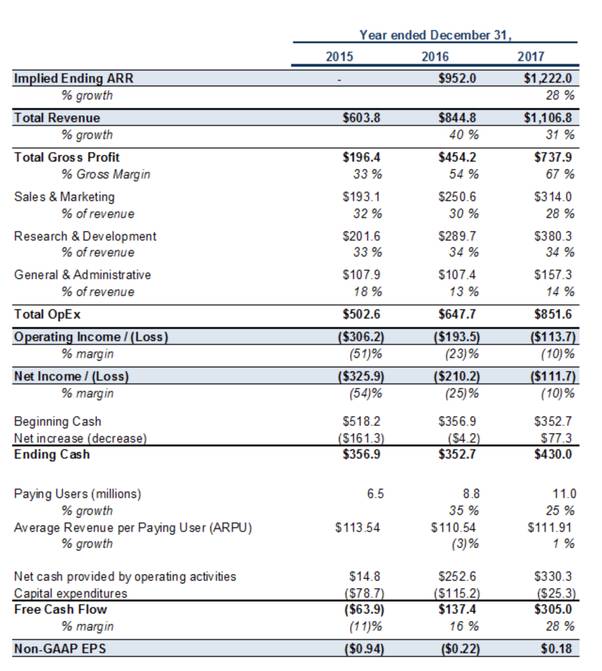
In its S-1 filing, Dropbox reported more than 500 million registered users and 11 million paying users as of December 31, 2017. It also generated over 90% of revenue through self-serve channels. That self-serve model is central to understanding Dropbox’s lower acquisition cost per paying user.
A Simple Dropbox CAC Estimate
Dropbox spent about $314 million on sales and marketing in 2017. Its paying users grew from 8.8 million in 2016 to 11.0 million in 2017, or roughly 2.2 million net new paying users.
- 2017 sales and marketing expense: About $314 million
- Net new paying users: About 2.2 million
- Estimated CAC: About $143 per net new paying user
Using the same simple method for 2016, Dropbox spent about $250.6 million on sales and marketing and added roughly 2.3 million net new paying users. That produces an estimated CAC of about $109 per net new paying user.
These figures are much lower than Slack’s estimated CAC per paid customer, but remember the unit is different. Dropbox measured paying users, while Slack measured paid customer organizations. A Dropbox paying user might be one individual subscriber. A Slack paid customer could be a business account with many employees.
Why Dropbox’s CAC Looked So Efficient
Dropbox’s acquisition advantage came from a few simple but powerful forces.
1. File Sharing Created Viral Loops
When a Dropbox user shared a folder or file, the recipient encountered Dropbox. The product turned normal usage into distribution. This is the SaaS equivalent of a restaurant where every customer walks out carrying a sandwich board.
2. The Free Product Had Real Utility
Dropbox was useful even before payment. Free storage, syncing, and sharing gave users a reason to install the product and build habits. That reduced the need for heavy upfront persuasion.
3. Self-Serve Revenue Reduced Sales Friction
Because more than 90% of Dropbox revenue came from self-serve channels around the IPO period, Dropbox did not need a massive outbound sales force to support every conversion. Users could upgrade through the app or website.
4. The Market Was Broad
Dropbox solved a nearly universal problem: people needed to store, access, and share files across devices. The addressable audience was huge, from students and freelancers to small teams and large organizations.
Slack vs. Dropbox CAC: Which Company Was More Efficient?
At first glance, Dropbox appears far cheaper. An estimated $100 to $150 per net new paying user looks tiny next to Slack’s estimated $8,000 per net new paid customer. But that comparison can mislead.
Slack’s unit was an organization. Dropbox’s unit was a paying user. Slack’s customer could expand from a few users to a company-wide deployment. Dropbox’s paying user often started as an individual subscription, although Dropbox Business later expanded the company’s team opportunity.
A better way to think about it is this:
- Dropbox had a lower estimated CAC per paying user.
- Slack had a higher estimated CAC per paid customer, but stronger enterprise expansion potential per account.
- Both companies used product-led growth to reduce dependency on traditional outbound selling.
- Both relied on free usage to create trust, habit, and internal demand.
If Dropbox was a masterclass in consumer-style freemium distribution, Slack was a masterclass in bottom-up B2B adoption plus enterprise expansion. Dropbox slipped into daily file workflows. Slack slipped into daily communication. Both products became more valuable as more people used them.
The Role of Product-Led Growth in Lowering CAC
Product-led growth means the product itself drives acquisition, activation, retention, and expansion. Slack and Dropbox are frequently discussed in this category because users could discover value without first enduring a sales demo, three follow-up emails, and a calendar invite titled “quick 15-minute sync” that somehow lasts 47 minutes.
In product-led businesses, CAC can be reduced because:
- Users can try before buying.
- Happy users invite other users.
- In-product prompts guide upgrades.
- Sales teams focus on high-intent accounts rather than educating every prospect from scratch.
- Usage data helps identify which users or teams are ready to convert.
For Dropbox, the product-led motion was tied to storage, syncing, and sharing. For Slack, it was tied to team communication, integrations, and collaboration. In both cases, the free product was not just a sample. It was the top of the funnel.
Why Free Users Are Not Actually Free
One of the biggest mistakes in CAC analysis is assuming free users cost nothing. Free users still require servers, support, onboarding, product development, security, and customer experience resources. Slack specifically noted that sales and marketing expenses included customer experience and technical operations costs for users on the free version. Dropbox also had major infrastructure costs because storing and syncing files is not powered by fairy dust and motivational quotes.
This means freemium CAC has two layers:
Free User Acquisition Cost
This is the cost to attract and support a free user. It may be low on the marketing side, especially when word-of-mouth is strong, but infrastructure costs can still be meaningful.
Paid Customer Acquisition Cost
This is the cost of converting enough free users into paying customers to justify the entire system. If only a small percentage converts, the economics still work only when paid users generate strong lifetime value.
That is why Dropbox’s 500 million registered users and 11 million paying users are both impressive and sobering. A huge free user base creates reach, but the business depends on converting and retaining enough paying users.
Lessons for SaaS Founders and Marketers
Slack and Dropbox prove that lowering CAC is not only about buying cheaper ads. It is about designing a product and go-to-market motion that makes adoption natural.
Lesson 1: Build a Product People Can Try Quickly
The faster users experience value, the less money you need to spend explaining it. Dropbox let users sync and share files. Slack let teams communicate in channels. The “aha moment” was built into usage.
Lesson 2: Make Sharing Part of the Workflow
Dropbox grew when users shared files. Slack grew when teams invited coworkers. The best acquisition loop is not a pop-up begging for referrals. It is a workflow where inviting others makes the product more useful.
Lesson 3: Use Sales Where It Adds Leverage
Product-led growth does not mean “never hire salespeople.” Slack shows the opposite. Sales can be extremely valuable when it expands accounts, closes enterprise deals, and turns grassroots adoption into company-wide contracts.
Lesson 4: Measure CAC by Segment
A blended CAC number can hide important differences. Free users, individual subscribers, small teams, enterprise accounts, and expansion deals all have different economics. Smart SaaS teams separate these segments instead of forcing one average number to explain everything.
Lesson 5: Retention Makes CAC Work
A low CAC is not enough if customers leave quickly. Slack’s high net dollar retention showed that existing customers expanded. Dropbox’s large self-serve base worked because enough users paid and stayed. CAC is only half the story; lifetime value is the other half.
So, What Were the Customer Acquisition Costs of Slack and Dropbox?
Using a simple public-data estimate, Slack’s CAC was roughly $8,000 per net new paid customer around fiscal 2019. Dropbox’s CAC was roughly $100 to $150 per net new paying user around 2016–2017. A SaaStr analysis also discussed a Dropbox blended acquisition estimate of about $180 per user when considering ARPU and payback assumptions, while other SaaS analysts emphasized Dropbox’s unusually strong self-serve efficiency.
The exact answer depends on the formula. The strategic answer is clearer: Slack and Dropbox reduced customer acquisition costs by making their products easy to adopt, easy to share, and valuable before payment. Dropbox leaned harder into massive freemium distribution. Slack combined freemium adoption with enterprise sales and expansion.
Both companies remind us that the best CAC strategy is not always “spend less.” Sometimes it is “make every dollar work harder because the product is doing part of the selling.”
Experience-Based Insights: What Slack and Dropbox Teach in Real Growth Work
When you study customer acquisition costs from the outside, it is tempting to treat the numbers like a scoreboard. Slack: around $8,000 per paid customer. Dropbox: around $100 to $150 per paying user. Done. Publish the spreadsheet, grab coffee, declare victory. But in real growth work, CAC is not just a number. It is a reflection of how customers discover value, how fast they trust the product, and how naturally they bring other people into it.
One practical lesson from Dropbox is that simple products can create powerful acquisition loops when sharing is part of the core behavior. Dropbox did not need every user to sit through a webinar called “The Future of Cloud-Based File Synchronization.” People had a file. They needed to send it. Dropbox made that action easy. The recipient became a potential user. That is the kind of growth loop marketers dream about while pretending not to check campaign dashboards every seven minutes.
In content marketing and SEO, the Dropbox lesson translates beautifully. If your product or content solves a common problem, make it easy to share, bookmark, reuse, and recommend. A helpful calculator, checklist, template, or guide can behave like Dropbox’s shared folder. It travels because it is useful. The acquisition cost drops because distribution is baked into the experience.
Slack teaches a slightly different lesson. Team communication is inherently multiplayer. Slack became more useful as more coworkers joined, but enterprise adoption still required trust, security, integrations, and leadership approval. That means growth teams should not worship product-led growth as if sales teams are ancient museum artifacts. The strongest model is often hybrid: let users adopt the product naturally, then use sales and customer success to expand serious accounts.
From a practical business perspective, this is where many startups make mistakes. They either hire a sales team too early, before product usage shows real demand, or they wait too long and allow large accounts to remain under-monetized. Slack’s model suggests a better path: watch product usage carefully, identify teams where adoption is already spreading, and then help those accounts expand with a human touch.
Another experience-based takeaway is that free users should be treated as future economic signals, not vanity trophies. A million free users sounds impressive, but if they never activate, invite, return, convert, or influence paid adoption, they are mostly a server bill with a nice haircut. Dropbox and Slack worked because free usage created behavior, habit, and network effects. The free plan had a job. It was not just a generous gift basket from the SaaS gods.
For marketers, founders, and SEO teams, the real question is not “How can we copy Slack or Dropbox?” It is “What is our version of the natural invitation?” For Dropbox, it was sharing a file. For Slack, it was inviting a teammate into a channel. For another business, it might be sending a report, collaborating on a design, embedding a widget, sharing a dashboard, or inviting a client to approve a document.
The final experience lesson is that CAC must always be paired with retention and expansion. Paying $8,000 to acquire a customer can be brilliant if that customer grows into a six-figure annual account. Paying $80 can be terrible if the customer cancels next month. Slack and Dropbox became famous not because their acquisition costs were magically low in every context, but because their acquisition systems connected to long-term usage. The product did not merely attract customers. It gave them reasons to stay.
Conclusion
The customer acquisition costs of Slack and Dropbox are not official fixed numbers, but public data allows useful estimates. Slack’s CAC was likely in the thousands of dollars per net new paid customer because it sold to organizations with strong expansion potential. Dropbox’s CAC was likely much lower per paying user because its freemium, self-serve, file-sharing model scaled across millions of individuals.
The bigger lesson is that CAC is not just a marketing metric. It is a product strategy metric, a pricing metric, a retention metric, and a growth design metric. Slack and Dropbox won attention because their products spread through real work habits. That is the dream: customers do not feel like they are being acquired. They feel like they found something usefuland then they invite everyone else.
Note
This article uses public financial filings, SaaS benchmark research, and reputable business analysis to estimate customer acquisition costs. Because Slack and Dropbox did not publish a single official CAC figure, all CAC numbers are practical estimates based on sales and marketing expenses, net new paid customers or paying users, and publicly reported growth metrics.