
For decades, buying a newly built house came with a simple warning: new costs more. Fresh paint, untouched appliances, modern floor plans, and the rare privilege of knowing nobody else has dropped spaghetti behind the stove all carried a predictable price premium.
That rule has not exactly disappeared, but it has become far less useful. In today’s U.S. housing market, the new housing market premium is no longer measured only by the difference between two listing prices. Buyers must compare mortgage incentives, repair risk, insurance costs, energy efficiency, location, lot size, construction quality, and the likelihood that a transaction will actually close on schedule.
In other words, the premium has changed shape. Sometimes a newly built home still costs more. Sometimes it sells for less than a comparable resale property. And sometimes the “cheaper” home becomes the expensive one after the roof, air conditioner, plumbing, and electrical panel decide to form a repair-cost boy band.
The Traditional New-Home Premium Is Shrinking
New construction has historically commanded a premium because buyers receive newer systems, current building standards, warranties, customization options, and lower immediate maintenance needs. Industry estimates have commonly placed that traditional premium around 10% to 15% over existing homes.
Recent sales data, however, show how dramatically the relationship has changed. In the first quarter of 2026, the median price of a newly built single-family home was approximately $403,200, compared with $404,600 for an existing home. In the fourth quarter of 2025, the median new-home price was also below the existing-home median. These national medians do not prove that every new house is cheaper than every resale house, but they do show that the old premium is no longer automatic.
The shift is even more surprising because construction costs remain elevated. Builders are paying more for developed land, labor, materials, financing, transportation, insurance, and regulatory compliance. Normally, those pressures would push new-home prices upward. Instead, weak buyer demand has forced many builders to redesign homes, shrink lots, reduce square footage, simplify finishes, and offer aggressive financial incentives.
Why Builders Can Compete More Aggressively Than Homeowners
An individual homeowner may be emotionally attached to a price. A builder is usually attached to a sales schedule.
Builders have construction loans, payroll expenses, inventory targets, quarterly reporting goals, and entire communities that must continue moving toward completion. An unsold finished home costs money every day. That gives builders a stronger incentive to negotiate than many resale sellers, particularly owners who already hold low-rate mortgages and are in no hurry to move.
In July 2026, 37% of surveyed builders reported cutting prices, with an average reduction of 6%. At the same time, 63% were using sales incentives, marking the sixteenth consecutive month in which at least 60% of builders offered incentives. Those offers may include mortgage-rate buydowns, closing-cost credits, upgraded appliances, design-center allowances, or discounted inventory homes.
That does not mean builders are handing out houses like supermarket samples. The advertised incentive may require the buyer to use the builder’s preferred lender or title company. It may apply only to selected homes, certain closing dates, or specific loan programs. Still, a motivated corporate seller can often adjust the total deal faster than a homeowner who needs a particular sale price to fund the next move.
The Mortgage-Rate Premium May Matter More Than the Price
At a national average mortgage rate of 6.55% in mid-July 2026, financing remains one of the largest obstacles facing buyers. A modest rate reduction can therefore be worth more than a dramatic-looking discount on the purchase price.
Consider a buyer borrowing $400,000 with a 30-year fixed mortgage. At 6.55%, the principal-and-interest payment is about $2,541 per month. At 5.55%, it falls to roughly $2,284. That one-percentage-point reduction saves approximately $258 per month, or more than $3,000 during the first year. Taxes, insurance, and other expenses are not included in this example.
A builder-funded rate buydown can therefore create a meaningful monthly-payment advantage, even when the new home’s sticker price is slightly higher. This is one reason comparing sale prices alone can produce the wrong conclusion.
Permanent and Temporary Buydowns Are Not the Same
A permanent buydown reduces the mortgage rate for the full loan term. A temporary buydown lowers payments for an introductory period before the rate rises to its final level. Buyers should ask for a full loan estimate, calculate payments after the temporary discount expires, and compare the builder’s preferred financing with independent lender offers.
Zillow and Redfin both advise buyers to examine whether builder incentives are true savings or packages tied to financing terms, fees, and inventory restrictions. The free refrigerator is charming, but it should not distract anyone from a loan that costs thousands more over time.
Mortgage Lock-In Gives New Construction an Unusual Advantage
Millions of existing homeowners refinanced or purchased homes when mortgage rates were unusually low. Selling now could mean replacing a mortgage near 3% with one above 6%, creating what economists call the mortgage lock-in effect.
Freddie Mac previously estimated the average value of that lock-in effect at about $55,000 per household in its portfolio, with particularly large benefits for loans originated in 2020 and 2021. A homeowner may therefore refuse to sell unless a job change, family need, divorce, retirement, or sufficiently attractive price makes moving worthwhile.
Builders do not have a treasured 3% mortgage tucked into a kitchen drawer. Their job is to sell inventory. As a result, newly built homes have become an important source of available supply in markets where existing owners remain reluctant to list.
Existing-home inventory has improved, but the recovery remains uneven. Realtor.com reported that active listings in June 2026 were up only modestly from a year earlier and still about 11% below typical 2017–2019 levels. This continuing shortage helps explain why some resale sellers can hold firm even while builders across town are advertising financing specials.
New Homes Are Smaller, Denser, and Farther Out
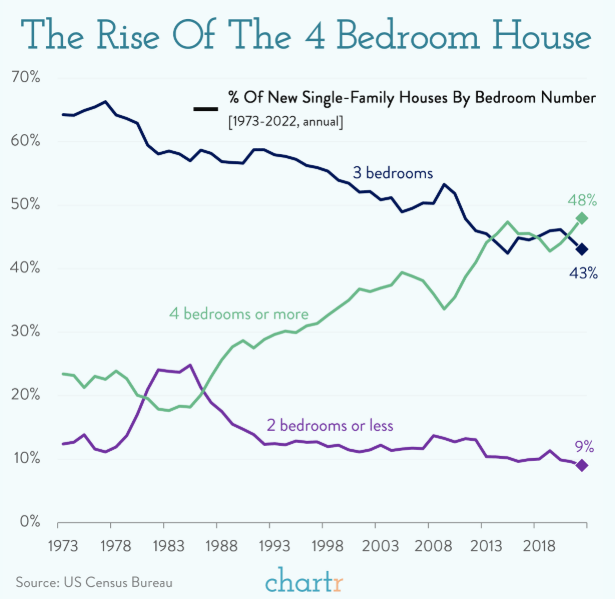
One reason new-home prices have become more competitive is that the product itself is changing. Builders have reduced average home sizes, placed houses on smaller lots, emphasized townhouses and attached properties, and concentrated construction in lower-cost metropolitan areas.
This is not automatically bad. A compact floor plan can use space more efficiently than an older house with formal rooms nobody visits except during hide-and-seek. Smaller lots also reduce landscaping and irrigation expenses. However, buyers must avoid treating national median prices as a direct comparison of identical homes.
A new 1,800-square-foot home on the suburban edge is not economically identical to a 2,200-square-foot resale home in an established neighborhood near major employers. The new property may offer a warranty, modern systems, and better financing. The existing home may offer a shorter commute, mature trees, a larger yard, established schools, and a neighborhood where construction trucks are no longer the dominant wildlife.
Location Can Restore the Premium Quickly
New construction remains particularly expensive in dense urban markets where buildable land is scarce, approvals are slow, and construction is complex. Realtor.com research has found substantial urban new-construction premiums in many metropolitan areas, while the largest discounts tend to appear in parts of the South and West where builders can produce larger communities at scale.
Regional numbers can also be distorted by the types of homes being sold. The Northeast may show a very large new-home premium because new construction there is scarce and often concentrated in higher-end projects. Nationally, another study may show almost no premium because a large share of new homes is being built in comparatively affordable Southern markets. Both findings can be accurate.
The Maintenance Premium Is Becoming More Important
The purchase price is merely the cover charge for homeownership. After closing come property taxes, insurance, utilities, association fees, repairs, and maintenance.
Harvard’s Joint Center for Housing Studies reported that property taxes increased 31% between 2019 and 2025, while average monthly homeowners insurance premiums jumped 72%. With non-mortgage ownership costs rising rapidly, buyers have less room in their budgets for an unexpected roof replacement or a heating system that chooses Christmas morning to retire.
A newly built home can provide several years of lower repair exposure because major components are new and may be covered by builder or manufacturer warranties. A resale property may still be an excellent value, especially when it has been carefully maintained, but buyers should estimate the remaining life of the roof, HVAC equipment, water heater, windows, appliances, foundation systems, and sewer line.
The key metric is not simply “new versus used.” It is the expected cost of ownership during the buyer’s likely holding period.
Energy Efficiency Creates a Realbut UnevenPremium
Modern construction can offer tighter building envelopes, better insulation, higher-performance windows, efficient heating and cooling equipment, and improved ventilation. Those features may lower monthly utility bills and improve comfort.
However, “new” does not automatically mean “high performance.” Building codes differ by state and municipality, and workmanship still matters. Buyers should request energy ratings, equipment specifications, insulation details, blower-door results where available, and estimated utility costs.
ENERGY STAR states that certified homes are at least 10% more energy-efficient than homes built only to minimum code requirements. Certified properties also undergo independent inspections and testing. That verified performance can justify a premium more convincingly than a sales brochure featuring a suspiciously enthusiastic family standing beside a thermostat.
The Certainty Premium: Builders Can Make Closing Easier
A completed or nearly completed new home may offer something increasingly valuable: transaction certainty. There is no existing seller waiting to find another house, no disagreement about a rent-back period, and usually less competition from buyers attempting to win with emotional letters and decorative baked goods.
Builders can coordinate financing, title services, inspections, and closing dates. They may also accept government-backed financing or contribute toward costs that a resale seller would reject.
Yet new construction introduces different uncertainties. An unfinished home may be delayed by weather, labor shortages, inspections, utility connections, or materials. Contract language may give the builder considerable flexibility regarding completion dates and substitutions. Buyers should review deadlines, deposit rules, cancellation rights, escalation clauses, warranty coverage, and the process for correcting defects.
Independent representation still matters. The builder’s sales representative works for the builder, even when offering coffee, compliments, and a tote bag sturdy enough to carry your financial documents.
Why the Market Still Feels Expensive
The shrinking new-home premium does not mean housing has suddenly become affordable. It means two expensive categories have moved closer together.
New-home sales fell to an annualized pace of 580,000 in May 2026, while the median new-home sale price was $424,900. Builders were carrying substantial unsold inventory, yet high mortgage rates continued to limit demand. Single-family construction and permits also weakened during the summer as builders faced expensive land, materials, labor, and financing.
At the same time, national house prices remained above year-earlier levels. FHFA reported a 1.7% annual increase during the first quarter of 2026, even though gains varied significantly across regions. The result is a market with slower appreciation, more negotiation, and improved selection in some citiesbut no broad return to pre-pandemic affordability.
Mortgage demand reflects this push and pull. Applications for new-home purchases increased 2.4% year over year in June, but weekly purchase activity weakened again in mid-July as rates rose. Buyers are interested when the numbers work; they are simply less willing to make the numbers work through optimism alone.
How Buyers Should Calculate the New Housing Market Premium
A useful comparison should cover at least five years of ownership rather than focusing exclusively on the closing table.
1. Compare the Effective Purchase Price
Start with the final negotiated price, then subtract genuine builder credits and seller concessions. Add lot premiums, design upgrades, mandatory options, transfer fees, and closing expenses. A model home’s advertised base price may exclude half the features that made the model attractive.
2. Compare Identical Financing Scenarios
Request loan estimates from the builder’s lender and at least one independent lender. Compare the interest rate, annual percentage rate, points, lender fees, mortgage insurance, and total interestnot merely the first year’s payment.
3. Estimate Repairs and Replacements
For an existing home, use the inspection report to create a five-year capital plan. For new construction, include post-closing expenses such as window coverings, landscaping, fencing, gutters, appliances, and improvements excluded from the contract.
4. Price the Location
Calculate commuting time, transportation expenses, school preferences, property taxes, insurance availability, flood or wildfire exposure, and access to services. A $20,000 discount can disappear quickly when it adds two cars and hundreds of commuting hours each year.
5. Consider Resale Competition
Buying in an unfinished community may mean competing with the builder when selling later. The builder can offer brand-new homes, financing incentives, and shiny model kitchens while the resale owner offers a lovingly maintained shrub. Buyers planning to move within a few years should study the community’s construction timeline carefully.
Buyer Experiences: What the New Premium Feels Like in Practice
The most common experience begins with sticker shock followed by spreadsheet shock. A buyer tours a resale home listed at $425,000 and a new home advertised at $439,000. The resale property initially appears cheaper. Then the inspection identifies an aging roof, a 14-year-old air conditioner, original windows, and an electrical panel that requires further evaluation. The new home includes a closing-cost credit and a permanent mortgage-rate buydown. Suddenly the higher-priced property produces the lower monthly payment and fewer near-term repairs.
Another buyer experiences the opposite. The builder advertises a home at an appealing base price, but the desired lot carries a $15,000 premium. Flooring, cabinets, lighting, appliances, and structural options add another $45,000. Backyard fencing and window coverings are not included. By the time the contract is complete, the “affordable” new home costs considerably more than a renovated resale property nearby. The lesson is memorable: never compare a builder’s base price with a resale home’s finished price.
Location often becomes the emotional turning point. Buyers may love the open kitchen, warranty, efficient HVAC system, and enormous pantry in a new development. Then they drive to work during rush hour. A commute that looked manageable on a quiet Saturday becomes an hour of brake lights and increasingly personal conversations with the navigation system. Some buyers accept the tradeoff because they work remotely or value extra space. Others decide that an older, smaller home near employment and established amenities offers the better lifestyle premium.
Construction timelines create another distinctive experience. Buyers choosing a to-be-built home may enjoy selecting finishes and watching the property take shape. They may also encounter delays, substitutions, and uncertainty about the exact closing date. Renters can face lease-extension costs, while homeowners selling another property must coordinate two transactions. A completed inventory home usually provides more certainty and may attract larger incentives because the builder wants it off the balance sheet.
Home inspections remain important even with brand-new construction. Buyers sometimes assume a municipal inspection and builder warranty make an independent inspection unnecessary. In practice, inspectors may find incomplete insulation, grading problems, damaged roof materials, poorly adjusted doors, plumbing leaks, missing sealant, or malfunctioning outlets. Most issues are fixable, but they are easier to address before closing than after the moving truck arrives and everyone discovers the upstairs shower has ambitions of becoming a downstairs waterfall.
Resale buyers experience a different kind of uncertainty. A well-maintained older home may perform beautifully for years, particularly when the roof, mechanical systems, plumbing, and electrical components have already been updated. It may also provide mature landscaping, a larger lot, a finished patio, blinds, storage, and neighborhood amenities that would cost thousands to recreate. The challenge is separating cosmetic age from expensive functional age. Old cabinet doors are not an emergency. A failing sewer line is considerably less decorative.
The strongest buyer experiences usually share one habit: they compare total ownership costs instead of arguing over whether new or existing homes are universally better. They request detailed estimates, inspect carefully, negotiate incentives, review warranties, study taxes and insurance, and test the commute. They also preserve cash reserves after closing. A new home may need landscaping and furniture; an existing home may need repairs. Either one can become stressful when the buyer spends every available dollar acquiring it.
Ultimately, the new housing market premium feels less like paying extra for untouched countertops and more like choosing which risks to purchase. New construction may offer financing support, efficiency, warranties, and predictable maintenance. Existing homes may provide better locations, larger lots, established neighborhoods, and valuable improvements. The best deal is the property whose advantages match the buyer’s actual lifenot the one with the most persuasive banner beside the highway.
Conclusion: The Premium Has Become Personal
The modern new-home premium cannot be summarized by a single national percentage. Builders have become more aggressive, the supply of resale homes remains constrained, and mortgage incentives can make a new home cheaper on a monthly basis even when its list price is higher.
At the same time, smaller floor plans, distant locations, lot premiums, upgrade packages, homeowners association fees, and future resale competition can erase those benefits. Existing homes may carry repair risks, but they can also include valuable land, mature neighborhoods, completed improvements, and superior access to jobs and services.
The smartest buyer compares effective price, financing, maintenance, utilities, location, insurance, taxes, warranties, and resale prospects. In the new housing market, “premium” no longer means merely paying more. It means deciding what certainty, convenience, location, and risk are worth to you.