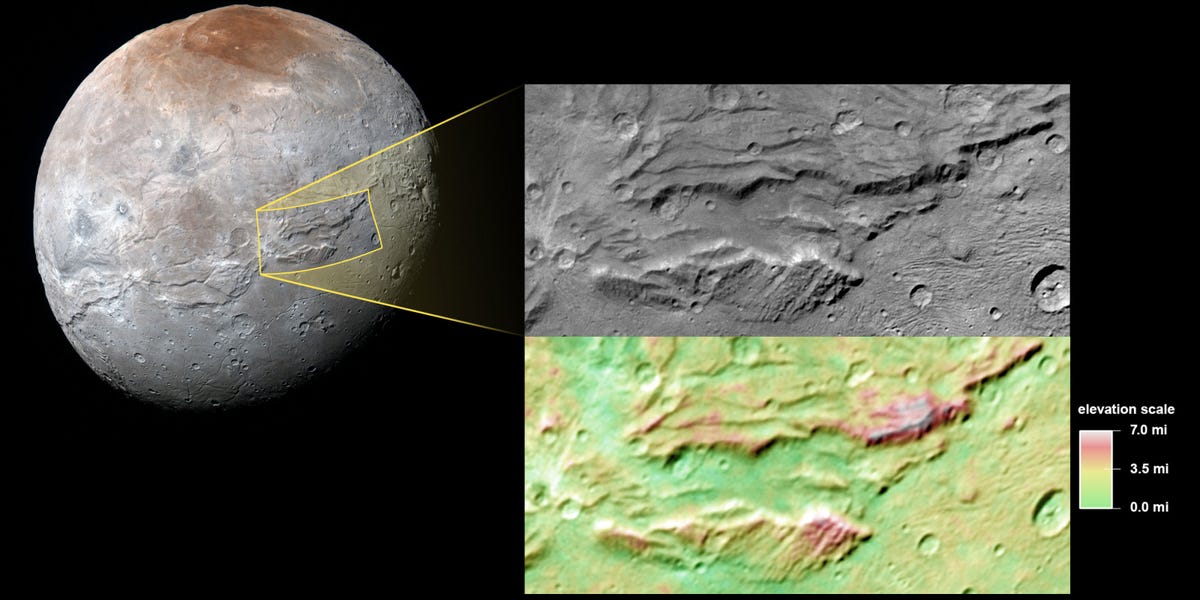

Pluto’s largest moon, Charon, looks like someone took a perfectly respectable icy world and tested it with an oversized cosmic can opener. Its surface is divided by cliffs, fractures, troughs, and canyons so enormous that Earth’s Grand Canyon would look like a drainage ditch by comparison.
The leading explanation is almost as dramatic as the landscape itself: Charon may once have hidden a liquid-water ocean beneath its frozen exterior. As that ocean gradually turned to ice, it expanded, stretched the moon’s crust, and helped tear the surface open on a global scale.
That does not mean Charon literally broke into pieces. Pluto’s moon is still very much present, circling its partner every 6.4 Earth days. Instead, its outer shell appears to have been pulled apart by internal geological stress, leaving behind some of the most spectacular tectonic scars in the solar system.
Meet Charon, Pluto’s Surprisingly Complicated Partner
Charon is the largest of Pluto’s five known moons, and calling it a moon almost understates the relationship. It is about 754 miles, or 1,214 kilometers, in diameterroughly half the width of Pluto. Because Charon is unusually large compared with the body it orbits, astronomers sometimes informally describe Pluto and Charon as a double dwarf-planet system.
The pair is also mutually tidally locked. One side of Charon always faces Pluto, while one side of Pluto always faces Charon. From the correct location on Pluto, Charon would appear to hang permanently in the same part of the sky, like an extremely committed porch light.
Before 2015, scientists knew Charon mainly as a blurry point of light. Many expected it to be an ancient, heavily cratered snowball that had spent billions of years doing approximately nothing. NASA’s New Horizons spacecraft ruined that tidy assumption during its historic flyby on July 14, 2015.
The images revealed mountains, landslides, smooth plains, colored polar terrain, enormous cliffs, and a vast system of fractures. Charon was not a boring ice ball. It was a geological crime scene, and the suspected culprit was hiding beneath the surface.
The Giant Canyons That Changed Charon’s Story
One of the most striking discoveries was a tectonic belt running across more than 1,000 miles, or 1,600 kilometers, of Charon’s observed face. Scientists believe the fracture system may continue around the moon’s unseen side, effectively forming an enormous scar across its middle.
Parts of the system are several miles deep. Argo Chasma, one of Charon’s most dramatic canyons, is estimated to extend about 430 miles and reach depths of approximately 5.5 miles. That makes it longer than Arizona’s Grand Canyon and more than five times deeper in places.
These are not simple impact craters produced by passing space rocks. Their long, connected shapes resemble extensional faultsstructures formed when a planet or moon’s crust is pulled apart. The terrain looks as though Charon’s exterior was stretched until huge blocks dropped downward between faults.
A Moon Divided Into Two Geological Personalities
The canyon belt also separates two very different regions. To the north lies Oz Terra, an older, rugged landscape covered with craters, ridges, mountains, and broken terrain. To the south lies Vulcan Planitia, a smoother plain that appears to have been resurfaced in Charon’s distant past.
Scientists have proposed that Vulcan Planitia was covered by cryovolcanic material. Cryovolcanism is the cold-world equivalent of volcanism, except the erupting substance may contain water, ammonia, ice crystals, or other volatile materials rather than molten rock.
In other words, Charon may once have had ice volcanoes. The phrase sounds like a dessert promotion, but the underlying physics is serious: pressurized liquids or slushy mixtures can rise through fractures and spread across a moon’s surface before freezing solid.
How a Hidden Ocean Could Rip an Icy Moon’s Surface
The ocean-freezing hypothesis begins with one of water’s most useful and destructive properties. Unlike most substances, water expands when it freezes. Liquid molecules settle into an open crystal structure, causing ordinary water ice to occupy roughly 9% more volume than the liquid from which it formed.
On Earth, this process cracks pavement, bursts poorly protected pipes, and turns forgotten freezer bottles into small domestic disasters. Inside Charon, the same basic process may have operated on a planetary scale.
Imagine a global or regional ocean trapped between a rocky interior and a thick outer shell of water ice. As Charon lost heat, ice would begin forming along the base of that shell. The growing layer would require more space, forcing the moon to expand outward.
Even a small increase in Charon’s radius could produce tremendous stress across its surface. The rigid crust would stretch until it fractured, creating faults, cliffs, and deep troughs. Some geological interpretations suggest Charon may have expanded outward by several kilometers during this process.
Freezing From the Inside Out
Charon’s exterior is bitterly cold, with surface temperatures generally hovering only a few dozen degrees above absolute zero. A buried ocean could nevertheless have remained liquid for a time because the outer ice shell would act as insulation.
Heat could have come from radioactive elements in Charon’s rocky component, energy left over from its formation, and early tidal interactions with Pluto. Ammonia mixed with the water may also have lowered the ocean’s freezing point, allowing liquid to survive longer than pure water would.
Eventually, however, Charon’s heat supply appears to have weakened. Pluto and Charon settled into their present circular, synchronized orbit relatively early, reducing the tidal flexing that might otherwise have generated continuing warmth. The ocean then froze progressively, changing the volume of the moon’s interior and loading its crust with stress.
Did the Ocean Really Break Charon Open?
The basic idea is convincing: a freezing ocean expands, and an expanding interior can fracture an icy shell. Yet the details are more complicated than the headline suggests.
Computer models published in 2023 examined whether stresses from a freezing ocean could create cracks extending all the way from Charon’s surface to the liquid below. The results suggested that such full-depth fractures would be difficult to produce if the ice shell was as thick as most thermal-evolution models predict.
Many models generate a buried ocean approximately 30 to 50 miles thick beneath more than 60 miles of ice. Under those conditions, freezing could still initiate surface fractures and help form the giant canyon system. However, the cracks would not necessarily penetrate the entire shell.
The Ice-Shell Problem
For a fracture to reach a pressurized ocean directly, the shell may have needed to be less than about 6 miles, or 10 kilometers, thick. That is dramatically thinner than common estimates of roughly 60 miles, or 100 kilometers, or more.
This creates a puzzle. If the smooth plains of Vulcan Planitia were produced by material erupting from the ocean, how did that material travel through such a thick barrier?
Several answers remain possible. Charon’s shell may temporarily have been thinner than current models indicate. Warm pockets or chemical impurities may have weakened certain regions. Cryovolcanic material may have originated within the ice shell rather than in the ocean itself. Alternatively, the plains may have formed through a geological process that scientists have not yet fully reconstructed.
The latest modeling therefore does not eliminate the ancient-ocean hypothesis. It strengthens the connection between freezing and Charon’s canyons while making direct ocean-fed cryovolcanism more difficult to explain.
Tides, Impacts, and Other Suspects in the Case
Ocean freezing may not have acted alone. Charon’s geological history probably involved several stages, each capable of adding new fractures or modifying older ones.
Early Tidal Flexing
Charon may once have followed a more eccentric, or oval-shaped, orbit around Pluto. Its distance from Pluto would then have changed during each orbit, causing the moon to flex under varying gravitational forces.
This repeated deformation could have created heat and produced tidal stress in the crust, somewhat like the forces affecting Jupiter’s moon Europa and Saturn’s moon Enceladus. However, comparisons between predicted tidal fractures and the structures observed by New Horizons have not produced a perfect match.
Researchers therefore suspect Charon’s orbit may have become circular before the ocean finished freezing. Early tides could have warmed the interior, while later expansion from ocean freezing produced much of the canyon system visible today.
Formation Violence
The Pluto-Charon system probably formed through a collision or close encounter involving large icy bodies during the solar system’s early history. Such an event could have supplied enormous amounts of heat, altered the objects’ rotation, and helped establish an initial underground ocean.
That formative event may also have influenced where later tectonic structures developed. Charon’s modern landscape could therefore preserve evidence from both its violent birth and the slow freezing of its interior.
Impacts and Regional Weaknesses
Large impacts may have damaged parts of the crust, creating weak zones where fractures could grow more easily. Variations in shell thickness, rock distribution, composition, and temperature might also explain why Charon’s canyons are concentrated in a broad belt instead of being distributed evenly across the surface.
What Charon Teaches Us About Ocean Worlds
Charon expands the definition of an ocean world. The term often brings to mind active moons such as Europa, Enceladus, Titan, or Ganymedeplaces that may still contain liquid water today. Charon represents another category: a possible former ocean world whose sea froze long ago but left a geological record behind.
This matters because frozen oceans can reveal how small bodies evolve. Their expansion creates tectonic features, while changes in orbital energy control how long liquid survives. By studying faults and plains from orbit, scientists can work backward to estimate the thickness of ancient ice shells and the timing of internal activity.
Charon also shows that size is not the only factor determining whether a world can experience complex geology. It is much smaller than Earth and receives little solar energy, yet interactions among water, rock, radioactive heat, orbital dynamics, and antifreeze chemicals may have produced an active interior.
The same processes could have affected numerous objects in the Kuiper Belt. Many distant worlds may be more than inert collections of frozen debris. Some could contain surviving oceans, while others may preserve scars from oceans that disappeared billions of years ago.
What Scientists Still Need to Learn
New Horizons transformed Charon from a dot into a world, but it provided only one fast encounter. The spacecraft passed through the Pluto system at high speed and could not enter orbit. It photographed one hemisphere in much greater detail than the other and carried no radar sounder or seismometer capable of looking directly beneath the crust.
A future Pluto-system orbiter could map Charon’s entire surface at higher resolution. Gravity measurements could reveal whether its interior is fully frozen or still contains a partially liquid layer. Radar might detect boundaries inside the ice, while improved spectroscopy could identify materials associated with ancient cryovolcanic eruptions.
Scientists would especially like to determine the true extent of Charon’s tectonic belt. If similarly large extensional features continue across the poorly observed hemisphere, they could support models requiring greater global expansion and a thicker ancient ocean.
Researchers also need a more precise timeline. Did cryovolcanic resurfacing occur before, during, or after the major canyon-forming episode? Did tidal heating create the first fractures? Did the freezing ocean enlarge them? On Charon, even the order in which geological events occurred can decide whether a model floats or sinks.
An Experiential Journey Across the Moon That Froze From Within
The following experience is an imaginative reconstruction based on Charon’s known terrain, not a claim of an actual human visit.
Imagine descending toward Charon in a small exploration vehicle. Pluto hangs above the horizon, huge enough to dominate the black sky yet distant enough to appear strangely silent. Because the two worlds are tidally locked, Pluto barely moves. It remains fixed overhead like a gray-brown monument, watching every step of the journey.
The first thing you notice on the surface is the absence of weather. There is no wind to whistle around your suit, no rain to soften the landscape, and no thick atmosphere to scatter sunlight into a blue sky. Shadows are sharp. The ground is composed largely of rigid water ice, which at Charon’s temperatures behaves less like a frozen lake and more like stone.
Your route begins in Oz Terra, where ancient craters overlap with ridges and broken mountains. The terrain feels old in a way that is difficult to reproduce on Earth. Here, a footprint would not be erased by a spring storm. A displaced stone might remain undisturbed for millions of years unless struck by another object from space.
As you approach the tectonic belt, the landscape stops feeling merely ancient and begins to look injured. The ground slopes toward a chasm whose opposite wall is barely visible. Earth’s Grand Canyon can be viewed from familiar overlooks, but Charon’s fractures would challenge ordinary human scale. A cliff several miles high is not simply scenery; it is a vertical world.
Standing near the edge, you would be looking at the frozen result of events that happened deep below. There was no single explosive moment when the moon cracked like an egg. Instead, the interior cooled over immense periods. Water crystallized. The expanding ice pushed outward. Stress accumulated quietly until the crust could no longer accommodate it.
The canyon beneath you is therefore not just an empty space. It is a measurement of Charon’s lost heat and vanished liquid. Its width reflects extension. Its depth records fault movement. Its direction may preserve clues about orbital forces that stopped operating billions of years before humans evolved.
Traveling south, the rough terrain gives way to the smoother surface of Vulcan Planitia. The change would feel like leaving shattered mountains and entering an immense frozen floodplain. If cryovolcanic material resurfaced this region, the plain may represent the remains of water-rich slurry that emerged from Charon’s interior and froze under the distant Sun.
The experience would also change how you think about oceans. On Earth, an ocean is open water, waves, storms, and shorelines. On Charon, an ocean may be something inferred from fracturesa missing layer remembered by the shape of the moon. Its final act was not to evaporate beneath sunlight but to freeze in darkness and expand against its prison.
Looking back toward the canyon belt, Charon would no longer resemble a dead satellite. It would resemble an archive. Every fault would be a sentence, every smooth plain a disputed chapter, and every crater a timestamp written in impact debris. The difficult part is that scientists have received only part of the book.
A future mission could return with better maps, subsurface radar, and gravity measurements. Until then, imagining this journey helps translate numerical models into a physical story: a small moon formed in violence, warmed enough to hide liquid water, and slowly transformed when that ocean froze from the inside out.
Conclusion: Charon Was Cracked, Not Destroyed
The phrase “an ocean ripped Charon apart” is intentionally dramatic, but it captures a real and powerful geological possibility. Charon’s ancient subsurface ocean may have frozen, expanded, and stretched the moon’s crust until enormous faults and canyons opened across its surface.
The evidence is compelling but not complete. Freezing can explain global expansion and the creation of deep extensional troughs. It is less clear whether those fractures penetrated a thick ice shell deeply enough to release ocean water and produce the smooth cryovolcanic plains seen by New Horizons.
That uncertainty makes Charon more interesting, not less. It reminds us that an apparently frozen moon can preserve evidence of oceans, tectonics, internal heating, and ancient geological upheaval. Pluto’s companion was never merely a background object. It was a changing world with an interior capable of reshaping its entire surface.