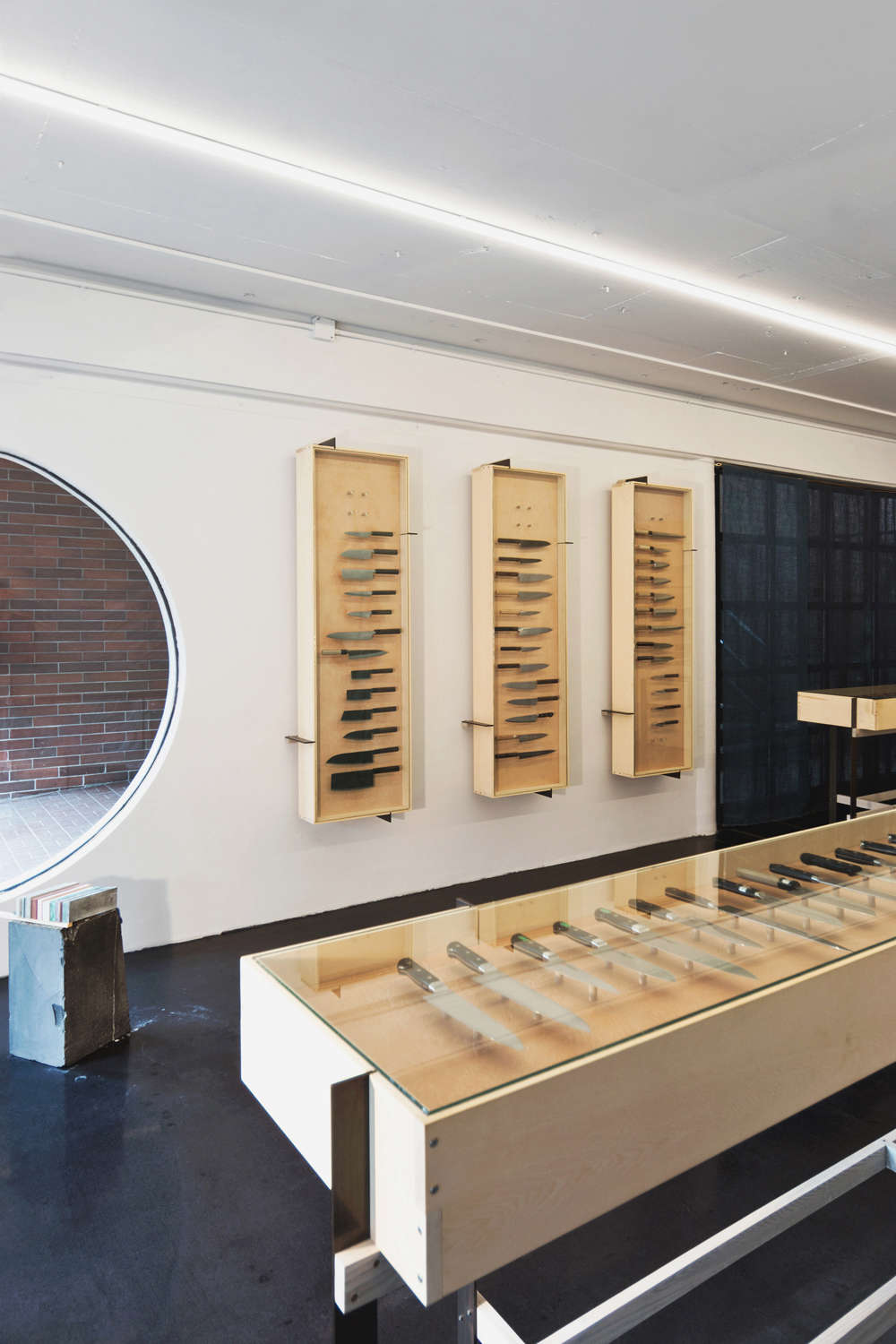

Some stores sell objects. Others quietly persuade you to reconsider the objects you already own. Ai & Om, an artisan knife shop in Vancouver, belongs to the second category. Its hand-forged Japanese knives are presented not as flashy kitchen trophies but as beautifully engineered toolseach blade given enough space to show its shape, texture, and unmistakable personality.
Located in Vancouver’s historic Chinatown, the shop was created by former chef Douglas Chang and designed by Scott & Scott Architects. Together, they transformed a modest storefront into a calm, gallery-like setting built from yellow cedar, ash, steel, leather, indigo-dyed jute, and an existing concrete floor. The result is appropriately sharp without becoming cold or theatrical.
It is a place where retail design, Japanese craftsmanship, and serious cooking meetprobably over a perfectly diced onion.
Ai & Om: A Knife Shop Built Around Love and Care
The name Ai & Om loosely combines ideas of “love” in Mandarin and “care” in Japanese. That philosophy applies not only to the knives but also to how they are selected, displayed, sharpened, and maintained.
Chang spent more than 13 years working in professional kitchens, including celebrated restaurants such as Eleven Madison Park in New York. During his time as a young chef, he learned to appreciate handcrafted knives and studied sharpening under a Japanese master. He later traveled to Japan, formed relationships with knife companies and blacksmiths, and began sourcing blades directly from family-run workshops.
The shop opened with a carefully edited collection rather than an intimidating wall of nearly identical steel. Its inventory has included respected makers and brands such as Konosuke, Akifusa, Nenohi, and Takeda, along with sharpening stones, cutting boards, axes, chisels, planes, and other precision tools.
This curatorial approach matters. Buying a Japanese kitchen knife is highly personal. Weight, blade profile, handle shape, steel composition, dominant hand, cutting motion, and maintenance habits all influence whether a knife feels wonderful or merely expensive.
Architecture That Lets the Knives Take Center Stage
Scott & Scott Architects approached the approximately 900-square-foot storefront with a restrained budget and a clear priority: concentrate resources on the elements customers would touch, examine, and use.
Earlier decorative additions were stripped away. The shell was painted white, while the existing concrete floor was ground and stained black. Instead of disguising the building beneath layers of retail decoration, the architects created a quiet background for the merchandise.
A Gallery, but Without the Whispering Guards
The knives are treated almost like artworks. Custom cases can function as floor displays or wall-mounted cabinets, allowing the layout to change as the collection evolves. Their construction combines pale yellow cedar boxes with gray, lye-washed ash frames, blackened steel, cutler bolts, and waxed leather mats.
Ash pegs and concealed magnetic mounts hold individual knives slightly above the leather. From a distance, the blades appear to float. Up close, hammer marks, layered steel patterns, polished edges, and dark kurouchi finishes become easy to study.
The cases also slide open to reveal storage for additional inventory. That dual role is one of the project’s smartest moves: the furniture is both elegant and hardworking. In other words, it behaves rather like a good chef’s knife.
Flexible Cedar Shelving
A wall of slatted yellow cedar provides adjustable shelving for whetstones, accessories, and tools. The long boards were sourced from northern Vancouver Island and left unfinished. This preserves the natural scent of the wood while allowing fingerprints, movement, and daily wear to gradually record the life of the shop.
Leaving a retail surface unfinished may sound risky to anyone who has ever met a spilled coffee. Here, however, aging is part of the design. The material is expected to develop character rather than remain trapped in showroom perfection.
A Material Conversation Between Vancouver and Japan
The interior does not attempt to reproduce a traditional Japanese shop. Instead, it builds a thoughtful connection between Japanese craft and materials from British Columbia.
Yellow cedar references the warmth, aroma, and visual quietness associated with hinoki, a Japanese cypress traditionally used in temples, shrines, baths, and fine woodworking. Locally sourced cedar gives that idea a distinctly Pacific Northwest expression.
The architects balanced the pale wood with a black concrete floor and deep blue panels made from inexpensive jute. They dyed the fabric indigo in their own studio, turning an ordinary commercial material into a rich, tactile surface. The blue screens soften windows and internal doors while giving the store a calm sense of enclosure.
Leather introduces another surface that improves with use. Steel provides strength. Cedar adds scent and warmth. Jute filters light. None of these materials needs to shout, which is fortunate because the knives already have points to make.
The Circular Window and the Theater of Sharpening
One of the store’s most memorable architectural details is a circular interior window. Through it, visitors and passersby can watch Chang sharpen blades. The opening turns maintenance into a visible part of the shopping experience rather than hiding it in a back room.
That decision reinforces the store’s central message: a knife is not complete when it leaves the display case. Its useful life depends on care, technique, and periodic restoration.
Sharpening with a whetstone removes a controlled amount of metal to recreate the edge. Honing is different; it maintains or realigns an existing edge but does not perform the same restorative work. Harder Japanese steels may hold a fine edge for longer, yet they can also be less forgiving of poor technique, twisting motions, bones, frozen food, or countertop cutting boardsthe culinary equivalent of driving a sports car over a staircase.
By placing sharpening in view, Ai & Om makes knowledge part of the product. Customers can also explore sharpening services, knife-skills instruction, and workshops rather than being sent home with a beautiful blade and a vague wish for good luck.
Understanding the Artisan Japanese Knives on Display
Gyuto: The Versatile All-Purpose Choice
A gyuto is the Japanese counterpart to a Western chef’s knife. Its pointed tip, relatively flat cutting section, and gentle curve make it useful for slicing meat, chopping vegetables, and performing precise tip work. For many cooks, a gyuto between roughly seven and nine inches is the most practical first purchase.
Santoku: Compact and Approachable
The santoku typically has a shorter blade and a less pronounced curve. It works well for cooks who prefer an up-and-down chopping motion or have limited counter space. Its name is commonly associated with three kitchen virtues: slicing, dicing, and chopping.
Nakiri: A Vegetable Specialist
With its rectangular profile and thin edge, a nakiri is designed for vegetables. The broad blade provides helpful knuckle clearance and makes it easy to transfer chopped ingredients. It resembles a tiny cleaver, but attacking bones with one is an excellent way to purchase two knives: the one you wanted and its newly detached corner.
Carbon Steel or Stainless Steel?
Carbon steel can take an extremely keen edge and is often straightforward to sharpen. It also reacts with moisture and acidic foods, developing a patina and potentially rusting if left wet. Stainless and stainless-clad blades generally require less vigilance, although no quality kitchen knife enjoys soaking in a sink beside a mysterious fork.
The correct choice depends on behavior, not prestige. A cook who enjoys maintenance may love reactive carbon steel. Someone who wants excellent performance with fewer chores may prefer stainless steel or a stainless-clad construction.
How to Choose a Knife Without Losing Your Head
The most expensive knife is not automatically the best knife for a particular cook. A sensible visit begins with honest questions about food, technique, and maintenance.
- Consider your regular ingredients: A vegetable-focused cook may value a nakiri, while an all-purpose gyuto suits a broader routine.
- Test the handle: Western handles, traditional Japanese wa handles, octagonal profiles, and rounded forms feel noticeably different.
- Check the balance: Some cooks prefer weight near the blade; others want a lighter, more neutral tool.
- Discuss steel care: Be realistic about immediate washing, careful drying, and periodic sharpening.
- Explain your cutting style: Rock chopping, push cutting, and straight chopping favor different blade profiles.
- Ask about handedness and bevels: Some edges are symmetrical, while others have an asymmetrical or single-bevel geometry.
A knowledgeable shop can translate these details into a manageable shortlist. That service is especially valuable when two knives look similar online but behave very differently on a cutting board.
Why This Vancouver Knife Shop Works as Retail Design
Ai & Om succeeds because its interior communicates the same qualities as its merchandise: precision, durability, economy, and respect for materials.
The architecture slows customers down. Instead of crowding dozens of products together, it gives each blade room to be understood. The magnetic displays reveal full profiles. Pale cases show dark steel clearly. Hidden storage reduces visual noise. Adjustable shelving allows the shop to evolve without demanding a new interior every season.
The design also supports conversation. Because the selection is curated and the space is calm, customers can focus on fit, purpose, and care. The store behaves less like a warehouse and more like a working studio where retail, education, and maintenance overlap.
For other specialty retailers, the lesson is useful: invest in the interaction between the customer and the product. A modest material can feel luxurious when it is carefully detailed. Flexible furniture can outperform permanent fixtures. Evidence of use can be beautiful. Most importantly, the design should explain why the object matters before a salesperson says a word.
A 500-Word Shopper’s Experience: From the Doorway to the Cutting Board
Picture the visit beginning on East Pender Street, where the storefront sits among the tea shops and traditional housewares businesses of Vancouver’s Chinatown. The neighborhood already understands the value of specialized goods, so a shop devoted to serious cutting tools feels less like an imported design concept and more like a natural continuation of the street.
Crossing the threshold, you notice the cedar before you catalog the merchandise. The scent is subtlemore workshop than perfume counter. Pale wood brightens the room, while the dark floor anchors it. Indigo panels soften the edges of the storefront and create a visual pause between the shop and the city outside.
Then the knives come into focus. They do not sit in crowded rows or blister packs. Each blade is suspended against leather, giving you a clean view of the cutting edge, spine, handle, and forged surface. One knife carries irregular hammer marks; another has a refined polish; a third preserves a dark blacksmith’s finish. Small differences that disappear in a standard product grid become obvious here.
A sensible shopper resists choosing the most dramatic blade immediately. Instead, you explain what you cook. Perhaps weeknight meals involve mountains of onions, herbs, cabbage, and chicken thighs. Maybe your current knife is thick, heavy, and about as enthusiastic as a Monday morning. The conversation shifts from decoration to use.
You handle a few options. A large gyuto may look impressive but feel unwieldy. A slightly shorter model could settle into the hand more naturally. An octagonal wooden handle offers a different grip from a full-tang Western handle. Balance becomes something you can feel rather than a sentence in a product description.
The staff may ask how you cut, whether you are right- or left-handed, and how much maintenance you will honestly perform. “Honestly” is the important word. Carbon steel is rewarding, but it expects to be washed and dried promptly. If your usual cleanup strategy involves leaving everything until tomorrow, stainless steel may preserve both the blade and the household peace.
Near the circular window, sharpening changes from an abstract service into a craft. The sound is quiet and rhythmic as the blade travels across the stone. Water gathers fine particles of steel, and repeated passes gradually restore the edge. Watching the process makes a whetstone seem less like mysterious equipment and more like a learnable kitchen skill.
Before leaving, you add a suitable cutting board or stone to the mental shopping list. A beautiful knife deserves a forgiving wooden or quality synthetic surface, not glass, granite, or ceramic. Those hard surfaces can dull an edge with startling efficiency, although they remain excellent if your secret ambition is to become a frequent sharpening customer.
The best part of the experience arrives later, at home. A ripe tomato yields without being crushed. An onion separates into clean, even slices. Herbs remain green rather than bruised into surrender. The knife does not cook dinner for you, sadly, but it removes friction from the work. That is the quiet pleasure Ai & Om celebrates: a well-made everyday tool, selected carefully and maintained with respect, can improve hundreds of ordinary meals.
Conclusion: Where Craft, Cooking, and Architecture Meet
Ai & Om is more than an artisan knife shop in Vancouver. It is a study in how architecture can clarify the value of handmade objects. Scott & Scott Architects used local cedar, adaptable displays, dark concrete, leather, steel, and indigo-dyed jute to create a space that feels warm, precise, and refreshingly free of retail clutter.
Douglas Chang’s culinary background gives the collection practical authority, while the shop’s sharpening services and educational approach remind visitors that ownership is only the beginning. A fine Japanese knife is not a museum piece. It should acquire marks, develop history, return to the sharpening stone, and prepare enough onions to make its owner look unusually emotional.
For design lovers, the store demonstrates the power of restraint. For cooks, it offers a more thoughtful way to select a daily tool. For Vancouver, it is a small but memorable meeting place between Japanese forging traditions and Pacific Northwest materials.
Research note
This original article synthesizes reporting and specialist guidance from 10 reputable publications and primary sources: Remodelista, Ai & Om, Yellowtrace, Wallpaper*, We Heart, MONTECRISTO, Scout Magazine, Serious Eats, Bon Appétit, and Food & Wine.
SEO Metadata