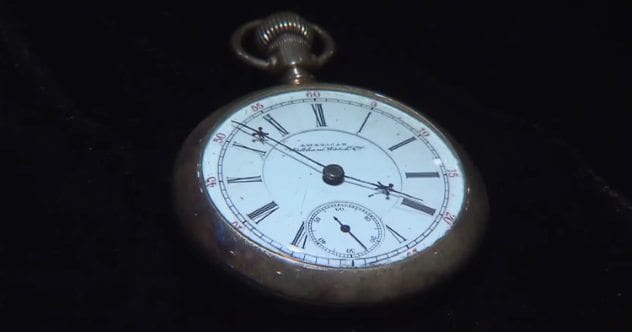

History does not always arrive with a marble monument and a neatly engraved date. Sometimes it arrives with cracked glass, corroded gears, and hands that refuse to move another minute. A clock normally promises continuity: breakfast at eight, the train at nine, lunch when the bell rings. When catastrophe interrupts that routine, a stopped timepiece can become an unnervingly intimate witness.
The ten frozen timepieces below survived earthquakes, shipwrecks, nuclear explosions, terrorist attacks, industrial failure, and one legendary railroad collision. Some recorded a disaster with remarkable accuracy. Others were a few minutes slow, stopped before the final moment, or acquired part of their meaning through later interpretation. That distinction matters. A broken clock is not automatically a perfect scientific instrument, but it can still preserve something official reports rarely capture: the instant an ordinary day became a before-and-after story.
Why Stopped Clocks Feel So Powerful
Mechanical evidence meets human memory
A frozen clock compresses a huge event into one small visual fact. Casualty totals, engineering failures, and seismic measurements explain scale, but a motionless minute hand makes the event personal. It suggests that someone had wound the watch, glanced at it, or expected to use it again. Then the world changed.
Still, these objects should be read carefully. A clock may have been running fast or slow before impact. Water can stop a watch gradually. Heat can erase hands while leaving shadows. Power loss may occur after an explosion rather than at the precise instant of it. The most responsible way to understand these artifacts is to appreciate both their emotional force and their limitations.
1. The Port Royal Pocket Watch: 11:43 A.M.
An underwater clock dated a sunken city
On June 7, 1692, an earthquake struck Port Royal, Jamaica, then one of the busiest ports in the Caribbean. Liquefaction caused sections of the town to slide into the harbor, while shaking and a tsunami destroyed buildings and killed thousands during the disaster and its aftermath.
Centuries later, underwater investigators recovered a Dutch-made pocket watch from the submerged ruins. X-ray examination revealed hands stopped at approximately 11:43 a.m., matching contemporary descriptions of the earthquake’s timing. Archaeologists had written records, but the watch offered a wonderfully compact confirmation. A fashionable object carried by one resident became a timestamp for an entire drowned town. Pirates may have loved treasure, but this battered little watch turned out to be Port Royal’s most useful piece of gold.
2. Casey Jones’s Pocket Watch: 3:52 A.M.
The railroad legend with a time on its face
Engineer John Luther “Casey” Jones was driving an Illinois Central passenger train near Vaughan, Mississippi, early on April 30, 1900, when he encountered freight cars obstructing the main line. His fireman jumped after Jones ordered him to save himself. Jones stayed at the controls, braking and sounding the whistle before impact.
Jones was the only person killed, and his effort to reduce speed helped prevent a much worse toll. The pocket watch associated with him is displayed with its hands fixed at 3:52 a.m., the reported time of the collision. Like many details surrounding famous folk heroes, the watch story has been polished by generations of retelling. Yet the crash time is historically established, and the artifact remains central to how visitors encounter Jones: not merely as a name in a ballad, but as a worker whose final minutes were measured in steel, steam, and seconds.
3. Malcolm Johnson’s Titanic Watch: 1:37 A.M.
A personal timeline from a ship that disappeared
Third-class passenger Malcolm Johnson was returning to the United States aboard RMS Titanic when the liner struck an iceberg shortly before midnight on April 14, 1912. Titanic sank at about 2:20 a.m. on April 15, killing roughly 1,500 passengers and crew members.
Johnson did not survive, but his corroded Omega pocket watch did. Its hands remain frozen at 1:37 a.m. The reading should not be treated as the exact sinking time; water, impact, or damage may have stopped the mechanism earlier. That uncertainty actually makes the watch more haunting. It does not mark the grand cinematic finale. It records one private point during the long emergency, when lifeboats were leaving and hundreds of people still hoped the ship might remain afloat. History often remembers 2:20. Johnson’s watch remembers the terrible waiting beforehand.
4. The Kobe Earthquake Alarm Clock: 5:46 A.M.
A bedroom object transformed into seismic evidence
At 5:46 a.m. on January 17, 1995, the Great Hanshin-Awaji Earthquake struck the Kobe region of Japan. Buildings collapsed, fires spread through densely developed neighborhoods, transportation links failed, and more than 6,000 people died.
Among the objects preserved by the disaster museum is an ordinary alarm clock crushed beneath a fallen chest of drawers. Its hands show 5:46, the moment the earthquake began. There is nothing luxurious or famous about it, and that is precisely why it works so well as a memorial. It belonged in the familiar geography of sleep: a bedroom, a dresser, a morning not yet started. The quake converted it from a household tool into a witness. It also reminds visitors that disasters rarely wait for a convenient hour, a completed cup of coffee, or even the courtesy of an alarm.
5. The Chernobyl Reactor Clock: 1:23:58 A.M.
Seconds preserved inside a radioactive ruin
During a late-night safety test on April 26, 1986, Reactor No. 4 at the Chernobyl Nuclear Power Plant suffered explosions and a fire. Radioactive material spread across wide areas, workers and emergency responders received dangerous exposures, and nearby communities were eventually evacuated.
Photographer Gerd Ludwig later documented a rusty wall clock deep inside the reactor building. It showed 1:23:58 a.m., the time associated with the explosions. Reaching it required protective clothing, radiation monitoring, and an extremely short visit. The resulting image is powerful because the object looks so bureaucratically normal. It could have hung in a factory corridor anywhere. Instead, it sits in one of the most contaminated industrial spaces on Earth, apparently preserving the final seconds before a routine test became a global synonym for nuclear disaster.
6. The Pentagon Firehouse Clock: 9:32 A.M.
A stopped clock that was already running slow
When American Airlines Flight 77 struck the Pentagon on September 11, 2001, the impact and resulting fire killed all 64 people aboard the aircraft and 125 people inside the building. A wall clock from the Pentagon helipad firehouse was knocked to the floor and stopped at 9:32 a.m.
The aircraft actually hit at approximately 9:37 a.m., meaning the clock had been several minutes slow. Far from making the artifact less meaningful, the mismatch offers an important lesson: frozen timepieces are witnesses, not infallible laboratory instruments. The clock records the mechanical condition of one object inside a violent event. Its bent frame and arrested hands connect museum visitors to the firefighters who worked nearby, while its incorrect reading warns historians not to confuse emotional authenticity with perfect precision.
7. The Hiroshima Pocket Watch: 8:15 A.M.
Heat left the time after destroying the hands
On August 6, 1945, the atomic bomb nicknamed Little Boy exploded over Hiroshima at approximately 8:15 a.m. The blast, heat, fires, and radiation devastated the city and caused tens of thousands of immediate and later deaths.
Survivor Shinji Mikamo later searched the ruins of his family home and found his father’s pocket watch. The glass and hands had been blown away, but heat had fused dark impressions onto the damaged face, preserving the hands’ positions at 8:15. The watch was eventually exhibited as a peace artifact, although it disappeared while on loan at United Nations headquarters in New York in 1989. Even absent, it continues to carry meaning. Its story is not only about a clock stopping; it is about a son finding the last physical link to a family and choosing to turn that object toward remembrance rather than revenge.
8. The Nagasaki Wristwatch: 11:02 A.M.
A city remembered by one immovable minute
Three days after Hiroshima, a second atomic bomb exploded over Nagasaki at 11:02 a.m. on August 9, 1945. The city’s hills altered the blast pattern, but enormous destruction, fire, radiation exposure, and loss of life followed.
A damaged wristwatch associated with the bombing remains fixed at 11:02 and became internationally recognized through photographer Shomei Tomatsu’s stark images. Unlike a wide aerial photograph of ruins, the watch reduces nuclear warfare to the scale of a human wrist. Someone once fastened it in the morning and expected it to measure an ordinary day. By 11:02, its practical purpose had ended, and its moral purpose had begun. The frozen dial now asks a question no watchmaker intended: what should humanity do with the knowledge that a single minute can permanently divide civilization?
9. The Aberfan Alarm Clock: 9:13 A.M.
Coal waste buried a school and stopped a village
On October 21, 1966, a saturated coal-waste tip collapsed above the Welsh village of Aberfan. The slide engulfed homes and Pantglas Junior School, killing 116 children and 28 adults.
A small alarm clock recovered from the debris stopped at 9:13 a.m. It still carries traces of the black slurry that swept through the community. The clock was preserved for decades by the family of a rescuer before entering the collection of St Fagans National Museum of History. Its emotional weight is difficult to overstate. An alarm clock is supposed to begin a school day, not memorialize its destruction. Displayed alongside other objects and survivor testimony, it helps keep the disaster centered on people rather than treating it as an abstract failure of industrial management.
10. Hilo’s Tsunami Clock: 1:04 A.M.
A public landmark left permanently out of service
On May 23, 1960, waves generated by the enormous Chilean earthquake crossed the Pacific and struck Hilo, Hawaii. Sixty-one people died in the Hilo area, and waterfront neighborhoods suffered severe destruction.
A green public clock in Waiakea stopped at 1:04 a.m. as the tsunami reached the bayfront. Rather than repair it and politely pretend normal service had resumed, the community preserved the hands at that time. The surrounding neighborhood was not rebuilt in the same form; much of the vulnerable land became open space and parkland. The clock therefore does more than remember victims. It stands beside a changed landscape and turns disaster memory into practical warning. Its message is blunt, useful, and refreshingly free of fine print: the ocean has done this before.
What These Frozen Timepieces Teach Us
Together, these clocks and watches reveal three kinds of truth. First, they can provide physical evidence, as at Port Royal or Kobe. Second, they can preserve a personal timeline, as with Malcolm Johnson’s Titanic watch. Third, they can become civic symbols, as Hilo’s deliberately unrepaired clock has done.
They also teach caution. The Pentagon clock was slow. Titanic watches stopped at different times. Some famous stories gained dramatic details through oral tradition. Responsible history does not weaken these artifacts by admitting uncertainty; it makes them more interesting. A clock can be mechanically imperfect and historically priceless at the same time.
The Experience of Standing Before a Clock That Will Never Move Again
Why museum encounters feel different from reading a date
Seeing a frozen timepiece in person can be unexpectedly unsettling. Photographs prepare visitors for twisted metal, shattered glass, and rust, but they do not fully communicate scale. A pocket watch may be smaller than the palm of a hand. An alarm clock may resemble one that sat beside a grandparent’s bed. The object does not announce itself with the grandeur of a monument. It simply waits behind glass, doing the one thing a clock is never supposed to do: nothing.
The first reaction is often to look at the hands. Visitors calculate the ordinary life that should have surrounded that hour. At 5:46 in Kobe, many people were asleep. At 9:13 in Aberfan, children had just begun their school day. At 1:04 in Hilo, families were awake because warnings and strange ocean behavior had already disturbed the night. At 8:15 in Hiroshima, people were commuting, working, preparing meals, and planning errands. The frozen time encourages the imagination to rebuild normality immediately before it was destroyed.
Then attention moves outward. The scratches, soot, bent casing, missing hands, or mineral corrosion become a second language. A pristine watch in a jewelry display invites admiration for craftsmanship. A disaster watch invites reconstruction. How did it fall? Was it being worn? Did water enter slowly? Who recovered it? Who decided not to repair it? Every mark becomes part of an unfinished investigation.
The experience can also produce discomfort about looking. These objects belonged to real people and communities, not to a horror-themed collection assembled for thrills. Good museums handle that tension by pairing artifacts with names, testimony, photographs, maps, and explanations of causes. The clock draws attention, but the surrounding interpretation returns that attention to human beings. Visitors leave understanding that the object is important because of the lives around it, not the other way around.
There is often a surprising practical effect as well. Hilo’s tsunami clock supports public awareness of evacuation and coastal risk. Kobe’s preserved household objects make earthquake preparedness feel immediate. Chernobyl’s reactor clock turns abstract discussions of systems failure into a specific chain of decisions unfolding before 1:23:58. The clocks do not merely say, “Something terrible happened.” They quietly add, “Learn why.”
Finally, frozen timepieces change the way people notice working clocks afterward. The ticking watch on a wrist, the microwave display in a kitchen, or the station clock above a platform can suddenly feel less invisible. Their movement represents routine, and routine represents safety. That may be the deepest experience these artifacts offer. They remind us that ordinary time is not boring. Ordinary time is the privilege of expecting the next minute to arrive much like the last one.
Conclusion
Frozen timepieces occupy a strange border between evidence and memorial. They can confirm an hour, complicate an official timeline, preserve a person’s last known minutes, or help a community decide what must never be forgotten. Their hands no longer move, yet their stories continue to travel across generations.
That is why a damaged watch can sometimes speak more clearly than a flawless monument. A monument is built after people know what happened. A stopped clock was there when nobody yet understood.
Note: This article synthesizes documented museum records, historical archives, and reputable reporting. Source links are intentionally omitted for clean web publication, and uncertain or approximate clock readings are identified in the text.