
History loves to play coy. Give it a king, a poet, or a reformer with a same-sex partner, and old records often start acting like a Victorian aunt clutching pearls behind a lace curtain. Suddenly lovers become “companions,” spouses become “friends,” and deeply intimate partnerships get filed away under wonderfully vague labels like close association. But if you read the letters, diaries, memoirs, and creative works closely, a fuller picture starts to emerge.
That fuller picture matters. Same-sex relationships from history are not modern inventions, trendy reinterpretations, or something that magically appeared once people got better lighting and better hashtags. They have always been part of human life. What changes is the language available to describe them, the danger involved in living them openly, and the kinds of evidence that survive. Some couples left behind passionate letters. Some encoded their feelings in poetry. Some built households together and let society call it whatever it liked, so long as no one kicked down the front door.
This list does not claim every relationship can be proven with a notarized certificate labeled Officially Romantic. History rarely works that way. Instead, these ten pairings show how same-sex love, devotion, desire, and domestic partnership have shaped politics, art, literature, and everyday life across centuries. Some were public scandals. Some were open secrets. Some were private worlds built in plain sight. All of them are fascinating.
Why Same-Sex Relationships in History Can Be Hard to Read Clearly
Before diving in, it helps to remember one big thing: modern identity labels do not always map neatly onto the past. A woman in the 19th century might live with another woman for decades, exchange deeply romantic letters, and never use the word “lesbian,” because that social identity did not function then the way it does now. A man in the ancient world might have relationships with both women and men without thinking of himself according to any modern orientation at all.
So the smartest way to write about queer history is with confidence where the evidence is strong and humility where the evidence is mixed. In other words: no panic, no erasure, and no bulldozing nuance with a modern label gun. With that in mind, here are ten intriguing same-sex relationships from history that still spark curiosity, scholarship, and more than a few raised eyebrows.
1. Alexander the Great and Hephaestion
Alexander the Great conquered an enormous empire, but his most enduring emotional bond may have been with Hephaestion, his lifelong companion and military confidant. The two were raised together in the Macedonian court, fought side by side, and were often compared to Achilles and Patroclus, the legendary pair from Greek tradition whose bond has long invited romantic interpretation.
Historians do not all use the same language for Alexander and Hephaestion. Some describe them as intimate friends; others argue the evidence strongly suggests they were lovers. What seems clear is the depth of Alexander’s grief when Hephaestion died in 324 BCE. Ancient accounts describe a level of mourning that was extravagant even by royal standards. Whether one calls it romance, devotion, or a relationship that overflowed the categories of its time, Hephaestion was not just another general. He was the person whose loss shook the conqueror most.
2. Hadrian and Antinous
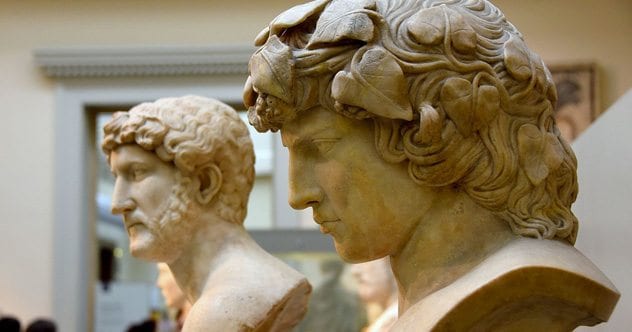
If you want a same-sex historical relationship with dramatic visuals, imperial power, and enough statues to fill a museum wing, Hadrian and Antinous are hard to beat. Antinous was the young beloved of the Roman emperor Hadrian, and after Antinous drowned in the Nile in AD 130, Hadrian responded not with quiet mourning but with monumental devotion. He deified Antinous, promoted his cult, and ensured his image spread across the empire.
That reaction tells us a lot. Emperors did not casually transform ordinary companions into divine icons. Antinous became one of the most recognizable faces of the Roman world after death, which says something profound about Hadrian’s attachment. Their relationship also shows that same-sex love in history could exist right at the center of power, not only in hidden rooms and coded letters. Even now, the surviving sculptures carry the strange mix of beauty and sorrow that made Antinous unforgettable in his own time.
3. Anne Lister and Ann Walker
Anne Lister is sometimes called “the first modern lesbian,” which may oversimplify things a bit, but it is easy to see why she inspires that description. A landowner, diarist, and relentless observer of the world, Lister documented her relationships with women in famously detailed journals, portions of them written in code. In 1834, she and Ann Walker exchanged rings, took communion together, and considered themselves married, even though the law certainly did not.
What makes Lister and Walker so compelling is how concrete their life together was. This was not merely longing from afar. They shared a home, finances, travel, and social headaches. Plenty of social headaches, in fact. Lister’s confidence and masculine style challenged the gender rules of her era, while Walker’s wealth and status made the union socially combustible. Yet they built a life anyway. Their relationship feels modern not because it was identical to present-day partnerships, but because it involved something eternally recognizable: two people deciding their commitment mattered more than society’s vocabulary for it.
4. Oscar Wilde and Lord Alfred Douglas
Some historical relationships changed literature. This one helped change the legal and cultural history of queer life in Britain. Oscar Wilde’s affair with Lord Alfred Douglas, known as Bosie, began in 1891 and quickly became intense, theatrical, and catastrophic. Which, to be fair, is a very Oscar Wilde sentence.
Douglas was younger, beautiful, aristocratic, and deeply entangled in the conflict that eventually led to Wilde’s downfall. When Bosie’s father, the Marquess of Queensberry, attacked Wilde over the relationship, Wilde made the disastrous decision to sue for libel. The move backfired spectacularly, exposing his sexual relationships with men and leading to criminal prosecution and imprisonment. Wilde and Douglas remain intriguing not because they had a tidy love story, but because their relationship laid bare the cruelty of a society eager to consume wit onstage while criminalizing the man who created it. Their romance was thrilling, destructive, and historically seismic.
5. Walt Whitman and Peter Doyle
Walt Whitman wrote about democracy, the body, comradeship, and love in language so expansive it could practically hug a continent. Yet some of his most moving expressions of affection were directed toward Peter Doyle, a former Confederate soldier and streetcar conductor whom Whitman met after the Civil War. Their bond unfolded through companionship, letters, walks, and emotional intimacy that later readers have found difficult to classify as merely friendly.
That difficulty is actually part of the point. Whitman lived in a world where same-sex intimacy was often described through the language of friendship and comradeship, which makes his connection with Doyle especially revealing. The tenderness in the letters is hard to miss. So is the sense that Doyle mattered deeply to Whitman’s emotional life. Their relationship illustrates how same-sex love in history was often forced into socially acceptable language, even when the feelings underneath it were anything but vague.
6. Jane Addams and Mary Rozet Smith
Jane Addams is usually introduced as a reformer, social worker, public intellectual, and founder of Hull House. All true. But the historical picture becomes richer when Mary Rozet Smith enters the frame. Addams and Smith shared a partnership that lasted more than three decades, and many scholars place it within the tradition of the “Boston marriage,” a term often used for long-term domestic unions between women.
What makes this relationship especially intriguing is how thoroughly love and work were intertwined. Addams and Smith were not just emotionally close; their shared life overlapped with one of the most important reform movements in American history. Hull House was a center of activism, social services, and intellectual exchange, and Smith was part of that world. Their relationship reminds us that queer history is not separate from political history. Sometimes it is right there in the engine room, helping build the modern world while history textbooks politely clear their throats and look elsewhere.
7. Amy Lowell and Ada Dwyer Russell
Amy Lowell had money, talent, opinions, and the kind of literary energy that could power a city block. She also had Ada Dwyer Russell, the actress who became the great love of her life. Their relationship shaped Lowell’s poetry in ways that are increasingly recognized today, especially in poems infused with longing, sensuality, and female desire that once slid past readers under the polite disguise of lyric beauty.
There is something deeply moving about the texture of their life together. Not just the grand emotions, but the everyday intimacy: shared walks, domestic closeness, steady companionship. Russell later edited Lowell’s posthumous collections, which says plenty about the depth of trust between them. In an era when open declaration carried real social risk, Lowell found ways to write desire into art without flattening it into safe abstraction. Her relationship with Russell proves that queer literary history is not a side note. Sometimes it is the secret voltage running through the whole poem.
8. Virginia Woolf and Vita Sackville-West
Few same-sex relationships from history have produced such a dazzling literary afterglow as Virginia Woolf’s affair with Vita Sackville-West. The two met in the 1920s, and their connection became romantic, intellectually charged, and creatively transformative. Vita was glamorous, socially bold, and aristocratic; Virginia was brilliant, searching, and intensely alert to the textures of consciousness. Together, they made quite the weather system.
Their affair did not last forever, but its influence did. Vita inspired Woolf’s Orlando, one of the most playful and radical novels of the 20th century, with its gender-bending protagonist and sly treatment of time, identity, and desire. Even after the romance cooled, the bond between the two women remained important. Their relationship fascinates not only because it was passionate, but because it became art. If many historical relationships survive as whispers, this one left behind a whole beautifully dressed novel striding across centuries.
9. Eleanor Roosevelt and Lorena Hickok
Eleanor Roosevelt and journalist Lorena Hickok occupy that especially interesting corner of history where “very close friendship” begins to sound like a sentence wearing a fake mustache. Their correspondence is extensive, emotionally vivid, and still debated in terms of labels. Some accounts once tried to wave the whole thing away as rumor; many historians now take the relationship’s romantic or erotic dimensions far more seriously.
Whatever label one prefers, Hickok was no minor figure in Eleanor’s life. The two women met during the 1932 campaign, exchanged thousands of letters, and influenced one another personally and professionally. Hickok even helped shape Eleanor’s relationship with the press, including the women-only White House press conferences that became a landmark in American political media history. What makes this relationship intriguing is not simply whether we can place it neatly in a category. It is that love, admiration, ambition, and public power were all tangled together. The emotional stakes were real, and so were the historical consequences.
10. Gertrude Stein and Alice B. Toklas
Gertrude Stein and Alice B. Toklas were partners in every sense except the one the law would not grant. They met in Paris in the early 20th century and built a life that combined domestic ritual, literary collaboration, hospitality, and mutual devotion. Toklas typed manuscripts, managed the household, steadied the social orbit, and became inseparable from Stein’s creative world. Stein, in turn, transformed their partnership into public myth with The Autobiography of Alice B. Toklas, a delightfully sly title for a book that is very much about Stein.
The two women lived together for decades, hosted artists and writers, and created one of the most famous intellectual salons of the century. Their relationship was not a secret exactly, but it was often filtered through euphemism. “Constant companion” was one favorite phrase, as though the entire 20th century had misplaced a more accurate dictionary. What makes Stein and Toklas so intriguing is how fully their love infused daily life: meals, manuscripts, visitors, dogs, habits, nicknames, and memory itself. Their partnership feels less like a footnote and more like an entire ecosystem.
What These Relationships Tell Us About the Experience of Queer Love in History
If there is one shared experience running through these relationships, it is the constant negotiation between feeling and visibility. Many of these people loved in worlds that did not offer them safe language, legal recognition, or social approval. So they improvised. They hid in plain sight. They encoded affection in art, in letters, in rituals, in shared homes, in travel, in private names, and in public arrangements that could be explained away just enough to pass inspection.
That improvisation was not the same in every century. Alexander and Hephaestion existed in a classical context with very different social assumptions from those confronting Wilde or Whitman. Hadrian could mourn Antinous with imperial spectacle in a way an ordinary Roman never could. Anne Lister could keep a coded diary because a diary could hold what society refused to hear aloud. Jane Addams and Mary Rozet Smith could live in a recognizable domestic partnership, but only under terms that kept the deepest truth partially veiled. Eleanor Roosevelt and Lorena Hickok moved inside a modern media age, where intimacy could still be hidden, but not without tension, and definitely not without paper trails.
Another recurring experience is the blending of love and work. Modern culture sometimes treats romance as a private subplot off to one side of “real achievement,” but history laughs at that idea. Quietly, elegantly, and with excellent cheekbones in several cases. These relationships shaped art, politics, reform, empire, and literature. Woolf’s affair with Vita helped produce Orlando. Stein and Toklas built an artistic household that influenced generations. Addams and Smith existed within a network of activism that changed American social thought. Hadrian’s grief reconfigured art and religion around Antinous. Love was not separate from public life; it helped make public life.
Then there is the experience of erasure. That may be the most familiar thread of all. Same-sex partners were often recast after the fact as “dear friends,” “companions,” “assistants,” or “housemates,” as if centuries of historians had been paid by the euphemism. Sometimes this happened because records were sparse. Sometimes it happened because institutions were uncomfortable saying the obvious. Sometimes it happened because the people themselves needed ambiguity to survive. That last point matters. Ambiguity can be a form of repression, but historically it was also sometimes a tool of protection.
And yet, despite secrecy, what survives is often astonishingly intimate. A coded diary entry. A grieving emperor’s statues. A poet’s love language. A household arrangement too emotionally specific to dismiss. A novel written for a lover. Thousands of letters that practically glow. These fragments do not merely prove that queer people existed in the past. They show that queer people loved, argued, collaborated, mourned, joked, traveled, built homes, and left marks on the world.
That is why these same-sex relationships from history remain so compelling. They are not fascinating only because they were forbidden, scandalous, or dramatic, though some certainly were. They matter because they reveal something universal inside something historically specific: people have always searched for ways to be seen by the person they love, even when the wider world refuses to look clearly. History may mumble, dodge, and euphemize. But these relationships still speak.
Final Thoughts
Looking back at same-sex relationships from history does more than satisfy curiosity. It expands the story of human intimacy itself. These couples and companions lived under wildly different rules, across wildly different eras, yet they faced recognizably human questions: Who sees me? Who stays with me? What do we call this thing that changes my life? Sometimes the answers were hidden in code. Sometimes they were carved in marble. Sometimes they were typed into manuscripts, folded into letters, or stretched across decades of partnership.
The real intrigue is not just that these relationships existed. It is that they mattered so much: to the people living them, to the art and politics that grew around them, and to us, still reading between the lines and finding whole worlds there. History may have tried to blur them at the edges, but the outlines remain remarkably bright.
SEO Tags