
Board games are older than Wi-Fi, older than pizza delivery, and definitely older than that one cousin who insists he “almost won” Monopoly after going bankrupt three hours ago. Across thousands of years, humans have gathered around boards, stones, dice, tiles, shells, seeds, pawns, and little plastic hotels to do something surprisingly serious: practice strategy, tell stories, teach values, build relationships, and occasionally accuse Grandma of cheating.
The most important board games in history are not just the best-selling or the most famous. They are games that changed how people played, thought, learned, competed, and connected. Some were buried in royal tombs. Some traveled across trade routes. Some taught religion, economics, language, mathematics, or negotiation. A few simply proved that families will argue passionately over cardboard if given the opportunity.
Below is a carefully chosen list of ten historically important board games, from ancient Egypt to the modern tabletop renaissance.
What Makes a Board Game Historically Important?
A board game becomes historically important when it does more than fill an evening. It may introduce a new style of play, influence culture, survive for centuries, travel across civilizations, or reshape the business of games. Chess changed strategic thinking. Go became connected with philosophy and elite education. Monopoly turned economic competition into a household ritual. Catan helped launch the modern designer board game boom.
In other words, importance is not measured only by sales. It is measured by staying power, cultural impact, design innovation, and the number of people who have stared at a board and whispered, “I have a plan,” seconds before disaster.
1. Senet: The Ancient Egyptian Game of Life, Death, and Lucky Throws
Why Senet matters
Senet is one of the oldest known board games, with evidence dating back thousands of years in ancient Egypt. It was played by pharaohs, nobles, and ordinary people, and it appeared in tomb paintings and burial goods. That alone makes it a heavyweight in board game history. When a game follows you into the afterlife, it is not just a hobby; it is practically spiritual luggage.
The game was played on a grid of thirty squares, usually arranged in three rows of ten. Players moved pieces according to throws of sticks or similar randomizers. Over time, Senet became more than a race game. It gained symbolic meaning connected with the soul’s journey after death. That blend of entertainment, ritual, and belief makes Senet one of the most culturally significant games ever created.
Senet also shows that board games were never “just for kids.” In ancient Egypt, games could reflect religion, social life, luck, status, and ideas about destiny. Modern players may complain about bad dice rolls; ancient players might have seen them as cosmic commentary.
2. The Royal Game of Ur: The Oldest Playable Classic
Why the Royal Game of Ur matters
The Royal Game of Ur comes from ancient Mesopotamia and is often described as one of the oldest playable board games in the world. Beautiful game boards discovered in the Royal Cemetery of Ur date to around 2600–2400 BCE. These boards were not rough doodles in the dirt; they were elegant objects made with materials such as wood, shell, and lapis lazuli. Ancient players clearly believed in gaming with style.
The game belongs to the family of race games, where players move pieces along a path and try to reach the end before their opponent. What makes the Royal Game of Ur especially important is that ancient rules were preserved on a cuneiform tablet, allowing modern scholars to reconstruct how it may have been played.
The Royal Game of Ur proves that competition, probability, and suspense were already part of organized play more than four thousand years ago. It also reminds us that the urge to say “one more game” may be older than written customer service complaints.
3. Go: The Elegant War of Empty Space
Why Go matters
Go, known as weiqi in China, baduk in Korea, and igo in Japan, is one of the most profound strategy games ever invented. Its rules are famously simple: two players place black and white stones on a grid, trying to surround territory. Yet from that simplicity comes almost bottomless complexity. Go is the kind of game that looks peaceful until you realize your entire corner has been quietly doomed for twenty minutes.
Historically, Go became associated with scholarship, discipline, military thinking, and refined culture in East Asia. In traditional Chinese culture, weiqi was counted among the cultivated arts of an educated person, alongside music, calligraphy, and painting. That status gives Go a rare place among board games: it was not only entertainment but also intellectual training and artistic expression.
Go’s influence continues today in mathematics, artificial intelligence, and cognitive science. The 2016 AlphaGo matches brought the ancient game into the global technology spotlight, proving that a board full of black and white stones could still humble modern machines, human champions, and anyone who thought tic-tac-toe was basically the same thing.
4. Mancala: The Seed-Sowing Game Family That Traveled the World
Why Mancala matters
Mancala is not one single game but a large family of “sowing” games played across Africa, the Middle East, Asia, the Caribbean, and parts of the Americas. Players move seeds, stones, shells, or beads through rows of pits, capturing pieces according to local rules. The equipment can be carved wood, a folding board, or simply holes scooped into the earth. Mancala is proof that great game design does not require batteries, plastic, or a 42-page rulebook.
Mancala games are historically important because they show how play travels with people. Versions spread through trade, migration, and cultural exchange. In many communities, mancala has served as a social game, a teaching tool, and a daily ritual. It develops counting, planning, memory, and pattern recognition, often through rules simple enough for children but deep enough for serious players.
The genius of mancala is its economy. A handful of seeds becomes a battlefield of timing, arithmetic, and foresight. It is one of humanity’s great reminders that the most durable games are often built from ordinary materials and extraordinary ideas.
5. Chess: The Global Language of Strategy
Why Chess matters
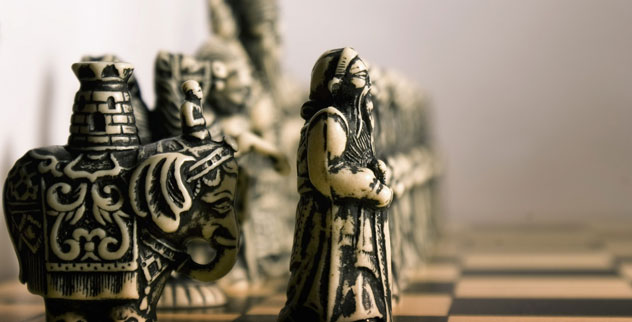
Chess may be the most famous strategy board game in the world. Its roots are commonly traced to early forms such as chaturanga in India, later spreading through Persia, the Islamic world, and Europe. Over centuries, the game evolved into the modern version with kings, queens, bishops, knights, rooks, and pawns. Somewhere along the way, humanity collectively decided that tiny wooden horses should jump in an L-shape, and somehow it worked.
Chess became a metaphor for war, politics, planning, sacrifice, and intelligence. It has been played in courts, cafés, schools, prisons, parks, tournaments, and online arenas where someone named “PawnDestroyer9000” can ruin your afternoon. Few games have influenced language so deeply. We speak of “checkmate,” “endgames,” “pawns,” and “strategic moves” far beyond the board.
Chess is historically important because it rewards foresight, calculation, creativity, and psychological pressure. It also democratizes mastery. A simple board and thirty-two pieces can host a beginner’s lesson, a casual lunch-break match, or a world championship studied by millions. That range is part of its power.
6. Backgammon: Luck, Skill, and the Ancient Drama of Dice
Why Backgammon matters
Backgammon belongs to the ancient family of tables games, combining race movement, blocking, hitting, probability, and risk management. Its ancestors reach far back into the ancient Near East and Mediterranean world, while the modern game became especially recognizable in Europe. It is one of the clearest examples of a board game that balances luck and skill without apologizing for either.
In backgammon, dice create uncertainty, but players decide how to manage it. Should you play safely? Attack? Build a blockade? Leave a blot exposed and pretend you meant to do that? The game teaches a lesson that feels extremely adult: you cannot control every roll, but you are responsible for what you do next.
Backgammon is historically important because it kept alive the race-game tradition while adding tactical depth and gambling tension. It has survived in clubs, homes, cafés, and digital apps because it offers quick drama. A game can shift in one roll, which is thrilling when it helps you and “statistically suspicious” when it helps your opponent.
7. Checkers: Simple Rules, Serious Strategy
Why Checkers matters
Checkers, also called draughts in many countries, is one of the most accessible strategy games in history. The rules are easy to learn: move diagonally, jump opponents, reach the far side, and crown a king. Yet the simplicity hides real depth. Checkers is the board game equivalent of a plain white T-shirt that somehow looks good in every century.
Its importance comes from durability and reach. Checkers can be played with wooden discs, bottle caps, stones, or anything flat enough to sit on a board. It requires little explanation, travels well, and works for children and adults. In the United States, it became a household staple, a schoolroom game, and a front-porch pastime.
Checkers also matters because it shows how a game can endure without ornament. It does not need elaborate artwork, fantasy lore, or miniature dragons. It offers pure movement, capture, position, and consequence. That clean design helped shape the idea of the abstract strategy game for generations.
8. Monopoly: The Capitalist Soap Opera in a Box
Why Monopoly matters
Monopoly is one of the most culturally recognizable board games ever published. The board, tokens, paper money, railroads, utilities, Chance cards, and tiny houses are embedded in popular memory. Even people who have not played in years remember the emotional journey: optimism, real estate ambition, bad luck, rent panic, and finally, someone flipping the board emotionally if not physically.
Monopoly’s history is also more complicated than the cheerful box suggests. The game is connected to Elizabeth “Lizzie” Magie’s earlier Landlord’s Game, patented in the early twentieth century to illustrate economic inequality and the dangers of land monopolies. Later, versions of the game spread through homemade boards and social circles before Parker Brothers turned Monopoly into a mass-market phenomenon in the 1930s.
Its importance lies in both design and irony. A game originally tied to critique became a celebrationor at least a dramatic reenactmentof accumulation, rent, and bankruptcy. Monopoly helped define the American family board game and proved that a game could become a shared cultural language. It also taught generations that landing on Boardwalk with a hotel is not a financial event; it is a personal tragedy.
9. Scrabble: The Word Game That Made Vocabulary Competitive
Why Scrabble matters
Scrabble turned spelling into sport. Invented by Alfred Mosher Butts during the Great Depression and later refined into the familiar board-and-tile format, Scrabble combined anagrams, crossword-style placement, probability, and point values based on letter frequency. It made language tactical. Suddenly, knowing a two-letter word could feel like discovering buried treasure.
Scrabble is historically important because it gave wordplay a durable competitive structure. It is educational without feeling like homework, strategic without requiring armies, and social without forcing players to pretend small talk is the main event. The game rewards vocabulary, spatial planning, risk calculation, and the ability to keep a straight face while playing “QI” for 31 points.
Its global success also shows how board games can adapt across languages. Different editions adjust letter distributions and values, making Scrabble not merely an English-language pastime but a flexible design concept. Few games have done more to make dictionaries feel dangerous.
10. Catan: The Game That Built the Modern Tabletop Boom
Why Catan matters
Catan, originally published as The Settlers of Catan in 1995 and designed by Klaus Teuber, changed the way many people thought about modern board games. It brought German-style or Eurogame design into wider international popularity, especially in the United States. Instead of player elimination, long downtime, and pure luck, Catan emphasized trading, resource management, variable setup, and constant player interaction.
Players collect brick, lumber, wool, grain, and ore to build roads, settlements, and cities on a modular island. The board changes from game to game, which means the same box can produce many different strategic puzzles. Catan also made negotiation central. It is the rare game where “Does anyone have sheep?” can sound like diplomacy, desperation, or a hostage situation.
Catan’s historical importance is its role as a gateway game. It introduced millions of players to the idea that board games could be modern, elegant, strategic, social, and replayable without lasting six hours or requiring a law degree to understand the rules. Many people who now enjoy hobby games began with Catan. In that sense, it did not just become a classic; it opened a door.
How These Games Changed the Way Humans Play
Looking at these ten board games together reveals a fascinating pattern. Early games often connected play with fate, ritual, travel, and status. Senet linked movement on a board with the journey beyond death. The Royal Game of Ur captured racing, luck, and competition in ancient Mesopotamia. Go and Chess turned conflict into abstract strategy. Mancala showed how counting and community could live inside simple materials.
Modern games expanded the role of board games in domestic and commercial culture. Monopoly brought economic drama to the family table. Scrabble made literacy competitive and fun. Catan helped move board gaming into a new era of designer-focused, replayable strategy games.
These games matter because they are mirrors. They reflect what societies value: wisdom, luck, property, language, trade, planning, fairness, competition, and social bonding. A board game may look small, but it can carry an entire worldview in its squares, pits, tiles, or hexes.
Experience Section: What Playing Historic Board Games Teaches Us Today
Playing the most important board games in history is a little like time travel, except cheaper, safer, and less likely to create a paradox involving your grandfather. When you sit down with chess, Go, mancala, backgammon, Scrabble, Monopoly, or Catan, you are not simply passing time. You are stepping into a long human tradition of learning through play.
One of the first experiences these games offer is patience. Modern entertainment often moves fast, but board games ask players to slow down and observe. In Chess, a careless move can haunt you five turns later. In Go, a quiet corner can become the center of the entire game. In Scrabble, the best play may require waiting for the right opening instead of dumping tiles at random like alphabet soup with ambition.
Another valuable experience is accepting uncertainty. Backgammon and the Royal Game of Ur remind players that luck is real. Dice do not care about your confidence. Cards do not respect your plan. Yet the best players learn to respond well to bad fortune. That lesson travels neatly into real life, where traffic, deadlines, weather, and printer jams also roll their own dice.
Historic board games also teach negotiation and social reading. Catan is a master class in this. A trade is never just a trade; it is a conversation about trust, timing, and whether the person asking for ore is about to build something suspiciously impressive. Monopoly teaches similar lessons, though with more rent-based trauma. Even a simple game of checkers can become psychological when one player starts smiling for no obvious reason.
For families, these games create shared memories. Many people remember who taught them chess, who always won Scrabble, who refused to trade in Catan, or who treated Monopoly money like a personal banking empire. The pieces become emotional anchors. A chipped checker, a worn Scrabble tile, or a folded Monopoly board can carry years of arguments, jokes, victories, and snacks.
For educators, historic board games remain powerful tools. Mancala teaches counting and forward planning. Chess teaches pattern recognition. Scrabble supports vocabulary. Go develops spatial thinking. Catan introduces resource management and negotiation. These lessons work because players are actively engaged. Nobody has to announce, “Congratulations, you are now learning probability.” The game sneaks the lesson in while everyone is busy trying to win.
For adults, board games offer something increasingly rare: focused, face-to-face attention. Phones can be set aside. Conversation flows naturally. Strategy gives people something to discuss beyond work, bills, and whether the group chat has become too chaotic. A board game creates a temporary world with clear rules, shared goals, and permission to be playful.
The best experience related to these historic board games is not always victory. Sometimes it is the comeback, the ridiculous mistake, the lucky roll, the brilliant word, the unexpected alliance, or the moment everyone laughs because the plan was terrible but memorable. That is why these games survived. They give structure to human connection. They make thinking visible. They turn ordinary tables into arenas, classrooms, theaters, and occasionally tiny courts of appeal.
In the end, playing these games teaches us that history is not only found in museums and textbooks. Sometimes it is sitting in a box on a shelf, waiting for someone to open it, shuffle the pieces, and say, “Who wants to play?”
Conclusion: The Board Is Small, the Legacy Is Huge
The ten most important board games in history show that play is one of humanity’s oldest and smartest habits. Senet and the Royal Game of Ur reveal ancient connections between games, fate, and ritual. Go, Chess, Mancala, Backgammon, and Checkers prove that strategic thinking can flourish with simple tools. Monopoly and Scrabble show how modern board games can shape culture, language, and family life. Catan demonstrates how one clever design can help revive an entire hobby.
Board games endure because they combine rules with imagination. They let us compete without actual conquest, gamble without necessarily losing the rent money, and learn without feeling trapped in a classroom. Most importantly, they bring people together around a shared space. The board may be cardboard, wood, cloth, stone, or pixels, but the real game has always been human connection.