
Editorial note: The word “hated” in this headline is used as a dramatic shorthand for documented Hoover-era hostility, surveillance, smear campaigns, deportation efforts, blacklisting, and counterintelligence operations. History cannot read a dead man’s mind, but the paper trail can certainly raise an eyebrow.
J. Edgar Hoover ran the FBI like a man guarding a dragon’s cave: suspicious of outsiders, jealous of his treasure, and convinced nearly everyone with a microphone, movement, passport, or inconvenient opinion was carrying matches. From 1924 until his death in 1972, Hoover turned the Bureau into one of the most powerful law-enforcement institutions in American history. He also helped create a culture in which dissent could be treated like disease, charisma like conspiracy, and civil rights like a national-security emergency.
The people on this list were not all alike. Some were civil rights leaders. Some were artists. Some were radicals, pacifists, antiwar activists, performers, or global intellectuals. A few were accused of Communist ties; others were guilty mainly of being too famous, too Black, too foreign, too independent, or too good at making Hoover’s worldview look like a locked filing cabinet with bad lighting.
What connects them is the documented attention of Hoover’s FBI or Hoover’s earlier Bureau of Investigation networks. Files were opened. Phones were tapped. Informants were planted. Passports were threatened. Gossip was weaponized. Reputations were squeezed until they cracked. In several cases, the Bureau’s actions did not merely observe history; they helped shape it.
Why Hoover Targeted Public Figures
Hoover’s favorite enemy was not simply a criminal. It was influence. He feared people who could build coalitions, inspire crowds, embarrass the government, question racism, oppose war, or make American democracy look less polished than its brochure. That is why many targets were not underground plotters but public figures: preachers, singers, scholars, athletes, actors, and organizers.
Under programs such as COINTELPRO, the FBI moved beyond ordinary investigation into disruption. The goal was often to “neutralize” movements by dividing allies, damaging reputations, planting suspicion, pressuring employers, leaking stories, and encouraging public distrust. In plain English: the Bureau did not just collect dirt. It sometimes brought its own shovel.
12 People J. Edgar Hoover Hated And Tried To Destroy
1. Emma Goldman: The Anarchist Hoover Helped Push Out
Emma Goldman was one of the most famous radicals in early twentieth-century America: an anarchist, labor advocate, birth-control supporter, antiwar speaker, and all-around nightmare for officials who preferred their citizens quiet and their women quieter. During the First Red Scare, a young Hoover helped organize intelligence on radicals through the Justice Department’s General Intelligence Division.
Goldman had already served prison time for opposing the draft during World War I. In 1919, she and hundreds of other immigrant radicals were deported aboard the Buford, nicknamed the “Red Ark.” To Hoover, Goldman represented a dangerous combination: ideas, eloquence, immigrant identity, and a stubborn refusal to apologize for any of it. Her deportation became an early example of how the government could use immigration law as a political broom.
2. Marcus Garvey: The Black Nationalist Hoover Wanted Deported
Marcus Garvey built the Universal Negro Improvement Association into a mass movement that encouraged Black pride, economic independence, and global solidarity. Hoover saw something else: a charismatic Black leader with international reach. That was enough to make alarms ring in Washington.
In 1919, Hoover wrote a memo noting that Garvey had not yet violated a federal law that would make deportation easy. Then came the key turn: Hoover suggested that Garvey might be pursued for fraud related to the Black Star Line. Garvey was later convicted of mail fraud, imprisoned, and deported to Jamaica in 1927. Whether one views the case as legally legitimate, politically motivated, or both, the result was unmistakable: Garvey’s American organization was weakened, and Hoover learned a lesson he would use for decadessometimes you do not need to defeat a movement’s ideas if you can remove its leader.
3. Paul Robeson: The Voice They Tried To Silence
Paul Robeson was a giant: singer, actor, athlete, lawyer, linguist, and activist. His voice could fill a concert hall, but his politics made powerful people reach for earplugs. Robeson criticized racism in the United States, defended workers, supported anti-colonial movements, and expressed sympathy for the Soviet Union. In Hoover’s America, that combination was treated like a five-alarm fire.
The FBI investigated Robeson, and the State Department revoked his passport in 1950, trapping him inside the United States and cutting him off from major income abroad. The damage was professional, financial, and personal. Robeson fought for years to regain travel rights, eventually winning after the Supreme Court made clear that political belief alone could not justify denying a citizen a passport. But by then, the campaign had already done what campaigns like this were designed to do: shrink his stage, isolate his voice, and make others afraid to stand near him.
4. W.E.B. Du Bois: The Scholar Hoover Could Not Ignore
W.E.B. Du Bois was one of America’s towering intellectuals: historian, sociologist, NAACP co-founder, editor, Pan-Africanist, and author of The Souls of Black Folk. He had criticized racism long before it became safe, profitable, or politely panel-discussed. Hoover’s Bureau kept files on Du Bois, and government pressure intensified during the Cold War.
Du Bois became involved in peace activism and anti-nuclear organizing, which made him a target in the age of McCarthyism. He was indicted under foreign-agent allegations connected to the Peace Information Center, though the case collapsed. His passport was also withheld for years. The message was obvious: a brilliant Black elder who criticized American hypocrisy on a global stage was not merely a scholar. To Hoover’s world, he was a reputational threat with footnotes.
5. Albert Einstein: The Genius With A Very Thick FBI File
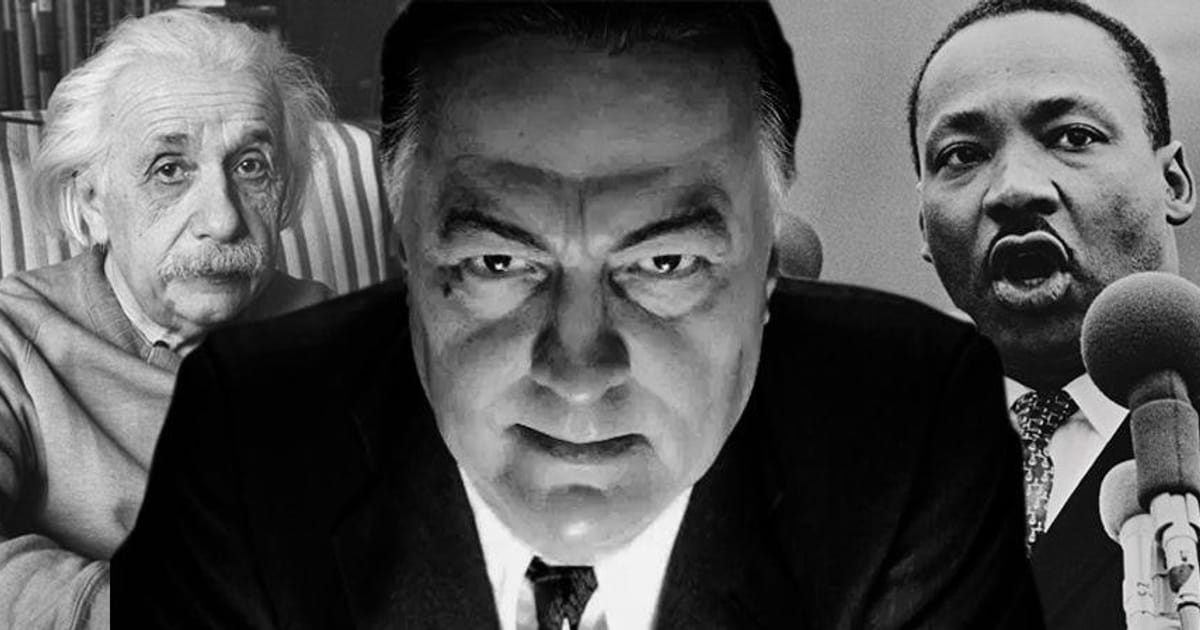
Albert Einstein is remembered for relativity, wild hair, and making physics look like wizardry with better math. Hoover’s FBI remembered something else: Einstein supported civil rights, opposed fascism, criticized racism, backed liberal and left-wing causes, and signed petitions that made the Bureau twitch.
The FBI compiled a large file on Einstein, treating his activism as suspicious and collecting information about his associations. Hoover viewed him not just as a scientist but as an influential public figure whose moral authority could legitimize causes the Bureau disliked. The absurdity is almost comic: one of the great minds of the modern world was watched as though his violin case contained subversion instead of, well, a violin.
6. Charlie Chaplin: The Little Tramp Hoover Wanted Out
Charlie Chaplin made audiences laugh, but Hoover was not known for his excellent sense of comedic timing. Chaplin’s films often sympathized with the poor and mocked authoritarianism. He never became a U.S. citizen, and in the heated politics of the Cold War, that made him vulnerable.
The FBI gathered a large file on Chaplin, including allegations of Communist sympathy and personal scandal. In 1952, while Chaplin was abroad promoting Limelight, the U.S. government revoked his reentry permit. He settled in Switzerland and remained effectively exiled for decades. Hoover did not need to prove Chaplin was plotting revolution. It was enough to paint him as foreign, immoral, and politically suspect. The Little Tramp had slipped on banana peels for laughs; Hoover’s America threw one under his career.
7. Martin Luther King Jr.: Hoover’s Most Infamous Target
Martin Luther King Jr. was perhaps Hoover’s most notorious target. The FBI began monitoring King during the Montgomery bus boycott and escalated its attention through the 1960s. Hoover believed King was influenced by Communists, despite the Bureau failing to prove Communist control over him. The more King criticized racism, poverty, the Vietnam War, and the FBI itself, the more Hoover’s hostility deepened.
The campaign against King included wiretaps, hotel-room bugs, media manipulation, and efforts to spread damaging personal information. The most infamous episode was the anonymous letter sent to King along with recordings, widely interpreted as an attempt to push him toward suicide before he received the Nobel Peace Prize. This was not routine policing. It was a government agency trying to break the reputation and spirit of a civil rights leader. King preached nonviolence; Hoover answered with paperwork, microphones, and poison ink.
8. Malcolm X: The Movement Builder Under Constant Watch
Malcolm X was sharp, disciplined, charismatic, and impossible to ignore. As a minister in the Nation of Islam and later founder of the Organization of Afro-American Unity, he challenged white supremacy with a directness that terrified many officials. The FBI kept extensive files on him and monitored his speeches, associates, travels, and organizational work.
It is important not to claim more than the evidence proves: the FBI’s full relationship to Malcolm X’s assassination remains debated, and documented surveillance does not equal proof of murder. Still, the Bureau’s attention was intense. Malcolm represented the kind of figure Hoover feared most: a leader who could turn anger into organization and local struggle into international human-rights language. If King was viewed as a dangerous moral conscience, Malcolm was viewed as a dangerous political accelerator.
9. Muhammad Ali: The Champion Who Refused To Step Forward
Muhammad Ali did not simply float like a butterfly and sting like a bee. He also made the establishment sweat like a man reading bad news under fluorescent lights. After joining the Nation of Islam and refusing induction into the U.S. military during the Vietnam War, Ali became a symbol of Black pride, religious conviction, and antiwar resistance.
FBI documents show that the Bureau kept tabs on Ali in the 1960s, especially because of his links to the Nation of Islam, which the FBI viewed as subversive. Ali lost his heavyweight title, faced conviction for draft refusal, and endured years away from boxing before the Supreme Court overturned his conviction. Hoover’s FBI was not the only force against him, but it belonged to the larger machinery of suspicion that treated Ali’s conscience as a threat. Ali’s real crime, in the eyes of many powerful men, was that he would not perform patriotism on command.
10. Jean Seberg: The Actress Smeared For Supporting The Panthers
Jean Seberg was a film star associated with European cinema and American glamour. Then she donated to groups including the Black Panther Party, and Hoover’s FBI saw an opportunity. Under COINTELPRO, the Bureau approved a plan to leak a false and humiliating story about her pregnancy to gossip columnists, hoping to embarrass her and “cheapen” her image.
The smear was grotesque because it was personal, gendered, and deliberately cruel. Seberg suffered a miscarriage and later struggled deeply with depression. She died by suicide in 1979. Historians and journalists still debate the full weight of the FBI campaign in her decline, but there is no doubt that the Bureau chose reputation sabotage as a weapon. The Seberg case is a reminder that Hoover’s targets were not only organization leaders. Sometimes the state came for a person because she wrote a check to the wrong cause.
11. Fred Hampton: The “Black Messiah” Hoover Feared
Fred Hampton was only 21 when he became chairman of the Illinois Black Panther Party, but he already had the political instincts of someone twice his age. He helped build the Rainbow Coalition, connecting Black activists, Puerto Rican organizers, and poor white groups around common struggles. That was exactly the kind of coalition Hoover feared.
COINTELPRO documents described the Bureau’s desire to prevent the rise of a unifying Black leader. Hampton fit the nightmare profile: young, funny, disciplined, persuasive, and able to make solidarity sound practical. The FBI had an informant, William O’Neal, inside Hampton’s circle. O’Neal provided information used before the police raid that killed Hampton and fellow Panther Mark Clark in December 1969. Some accounts state O’Neal drugged Hampton before the raid. The exact legal responsibility of Hoover personally remains contested, but the FBI’s role in targeting Hampton and the Panthers is central to the story. Hoover feared a “messiah”; the Bureau helped destroy a young organizer before his life fully began.
12. John Lennon: The Beatle Hoover Watched
John Lennon became a target because music, youth culture, and antiwar politics formed a combination Washington found annoying at best and dangerous at worst. By the early 1970s, Lennon and Yoko Ono were involved in peace activism, and the Nixon administration worried Lennon might help mobilize young voters against the war and against Nixon’s reelection.
The FBI assembled files on Lennon, and immigration authorities tried to deport him. Hoover corresponded about Lennon’s antiwar activities before Hoover’s death in 1972, and the pressure continued afterward. The government’s campaign dragged on for years before Lennon finally won permanent residency. The idea that a former Beatle with a piano and a protest slogan could frighten the national-security state sounds ridiculousuntil you remember that catchy songs can travel faster than memos.
The Pattern Behind Hoover’s Enemies List
Looking across these twelve lives, a pattern becomes clear. Hoover did not merely fear crime. He feared independent influence. Marcus Garvey built a Black international movement. Paul Robeson spoke to the world. Du Bois turned scholarship into a weapon against racism. Einstein gave radical causes the glow of genius. King turned morality into mass action. Malcolm X turned outrage into political identity. Hampton turned coalition into a real-world organizing strategy. Lennon and Ali reached millions who might never read a manifesto but would listen to a song, watch a fight, or repeat a sentence.
Hoover’s FBI often operated on the assumption that dissent was not a democratic function but a contamination. If a person criticized racism, war, capitalism, policing, or American foreign policy, the Bureau frequently asked who was “behind” them. The possibility that people might be angry because injustice was real did not fit neatly into Hoover’s filing system.
The destruction did not always look like prison. Sometimes it was exile. Sometimes it was a revoked passport. Sometimes it was a rumor, a headline, a whisper to an employer, a bug in a hotel room, or an informant who poisoned friendships from the inside. Hoover understood that reputation is a public figure’s oxygen. Cut it off, and the body of a movement begins to struggle.
Experiences And Lessons From This History
Reading about the people J. Edgar Hoover targeted is a strange experience because the stories feel both old and uncomfortably modern. You begin with dusty files, Cold War language, and black-and-white photographs. Then, somewhere around the third smear campaign and the fourth “security” excuse, the past stops feeling safely distant. It starts tapping on the window.
One experience that stands out is the shock of scale. A single FBI file can feel like a biography written by suspicion. Pages pile up: speeches clipped from newspapers, names of friends, travel plans, rumors, gossip, political meetings, donation records, personal relationships. The person becomes less a human being and more a folder. That is the first lesson: surveillance does not only gather information. It changes the way power sees people. A singer becomes a threat vector. A preacher becomes a target package. An actor becomes a propaganda risk. A boxer becomes an intelligence concern because he is too admired by the wrong audience.
The second experience is frustration. Many of Hoover’s targets were complicated people, and honest history should not turn them into greeting cards. Some praised governments or movements that deserved criticism. Some made personal mistakes. Some used rhetoric that alarmed many Americans. But the constitutional question is not whether every target was perfect. The question is whether the government should be allowed to punish lawful dissent by secretly wrecking lives. The answer should not require a law degree, a security clearance, or a magnifying glass.
The third experience is admiration. These people kept speaking under pressure that would have made most of us suddenly discover a lifelong passion for gardening and silence. Robeson fought for his passport. King kept organizing while being wiretapped. Ali gave up prime fighting years rather than violate his conscience. Seberg’s story is tragic, but her willingness to support unpopular causes shows moral courage in an industry where careers often depend on smiling at the right parties.
Finally, there is a writer’s lesson. Hoover’s victims remind us that public memory is a battlefield. The first story told about a person is not always the true one. Sometimes it is the story powerful people wanted printed. Sometimes the correction arrives decades late, in declassified files, congressional reports, or archives opened long after the damage is done. That is why revisiting these stories matters. It restores texture. It returns agency. It reminds readers that democracy is not protected by secrecy alone, and patriotism is not proven by obedience.
Hoover tried to make many of these people smaller. History, with a wicked sense of timing, made them impossible to ignore.
Conclusion
The story of J. Edgar Hoover’s targets is not just a parade of famous names and government files. It is a warning about what happens when law enforcement confuses criticism with treason and popularity with danger. Emma Goldman, Marcus Garvey, Paul Robeson, W.E.B. Du Bois, Albert Einstein, Charlie Chaplin, Martin Luther King Jr., Malcolm X, Muhammad Ali, Jean Seberg, Fred Hampton, and John Lennon all challenged powerful assumptions in different ways. Hoover’s response was often surveillance, disruption, pressure, or public humiliation.
Some survived with their reputations strengthened. Some were damaged beyond repair. Some died before the full truth of government action became public. But their stories remain because the files Hoover trusted to control memory eventually became evidence against his own methods. That is the irony Hoover probably would not have enjoyed: the paperwork meant to monitor dissent now helps prove why dissent was necessary.