
Hollywood monsters usually need makeup artists, computer effects, and a dramatic soundtrack to become frightening. Nature simply turns off the lights, adds several rows of teeth, and calls it evolution.
Across deep oceans, tropical forests, underground tunnels, and the unfortunate mouths of unsuspecting fish, real animals have developed adaptations that seem almost deliberately designed to disturb us. Some launch their jaws forward. Others replace body parts belonging to their hosts. A few transform living prey into obedient zombies, apparently because ordinary hunting was not theatrical enough.
These terrifying real-world monsters are not supernatural villains. Most have little interest in humans, and several are more vulnerable than dangerous. Nevertheless, their strange anatomy and gruesome survival strategies prove that nature can produce scarier creatures than any horror screenwriter working after midnight.
Deep-Sea Monsters That Make Swimming Pools Seem Safer
1. Goblin Shark: The Fish With a Spring-Loaded Face
The goblin shark already looks unsettling before it opens its mouth. It has a long, flattened snout, pinkish skin, and small eyes adapted to the darkness of deep water. Then the feeding begins. Its jaws shoot forward from its head to snatch fish, squid, and crustaceans. Sensory organs in its snout detect electrical fields produced by nearby prey, making it a living underwater motion detector with detachable-looking dentures.
2. Giant Squid: The Original Sea Monster
For centuries, stories of enormous tentacled beasts were dismissed as sailor exaggerations. Giant squid eventually proved that the sailors may simply have needed better cameras. The longest scientifically recorded specimens have approached 43 feet. Their two feeding tentacles seize prey using suckers lined with hard, toothed rings. Giant squid live in deep water and are rarely observed alive, which is probably why they maintain such excellent public relations.
3. Deep-Sea Anglerfish: The Smiling Lure of Doom
A female deep-sea anglerfish carries her own fishing equipment. A modified fin ray extends above her mouth and ends in a glowing lure that attracts curious prey through total darkness. What appears to be a convenient snack suddenly encounters a mouth filled with inward-pointing teeth. In some anglerfish species, the tiny male permanently attaches to the female and shares her bloodstream. Romance is complicated when one partner becomes an anatomical accessory.
4. Fangtooth Fish: Too Many Teeth for Its Own Mouth
The fangtooth is relatively small, but its teeth apparently missed that meeting. Its front fangs are so oversized that they fit into special pockets in the roof of its mouth, and the fish still cannot close its jaws completely. Those teeth help it grip slippery prey in a habitat where meals may be rare. The result resembles a bulldog, a piranha, and a medieval bear trap combined by an irresponsible laboratory.
5. Giant Isopod: The Armored Roach of the Abyss
Imagine a pill bug large enough to require its own dinner plate. Giant isopods are deep-sea crustaceans related to shrimp, crabs, and backyard roly-polies. Some grow between 11 and 20 inches long. They crawl across the seafloor searching for fish, squid, and other animals that have died and descended from above. Their segmented armor and numerous legs give them the appearance of prehistoric bugs patiently waiting for humanity to leave.
6. Bigfin Squid: The Puppet Hanging in the Darkness
Few creatures look more convincingly extraterrestrial than the bigfin squid. It has enormous fins and extraordinarily long arms and tentacles that bend at sharp, elbow-like angles before trailing beneath its body. Recorded individuals have exceeded 20 feet in total length, although most of that measurement consists of their threadlike appendages. Scientists are still learning how these elusive animals feed, which makes every deep-sea video feel like recovered footage from a missing spaceship.
7. Vampire Squid: A Monster With a Misleading Résumé
Its scientific name translates roughly to “vampire squid from hell,” and its arms are connected by a dark, cloak-like web. Surprisingly, it does not drink blood. The vampire squid extends sticky filaments to collect marine snow, including organic debris sinking from upper waters. When threatened, it can pull its web over its body and expose rows of harmless-looking but intimidating spines. It is less Dracula and more an extremely dramatic underwater custodian.
8. Hagfish: The Slime Factory That Ties Itself in Knots
Hagfish are jawless marine scavengers capable of releasing astonishing quantities of slime when threatened. The slime expands in seawater and can clog the gills of an attacking fish. Hagfish also tie their flexible bodies into knots, using the knot for leverage while feeding or wiping away mucus. Watching one consume a carcass is like observing an animated shoelace that has made several deeply questionable career decisions.
9. Sea Lamprey: The Living Suction Cup
The sea lamprey has a circular mouth filled with rings of rasping teeth. It attaches to fish, cuts into their tissue, and feeds on bodily fluids. Although native to Atlantic ecosystems, invasive sea lampreys became destructive predators in the Great Lakes. Their eel-like bodies and jawless mouths make them resemble props from a low-budget alien movieexcept these props swim, reproduce, and occasionally latch onto something alive.
10. Cookiecutter Shark: The Ocean’s Traveling Melon Baller
The cookiecutter shark is small enough to seem manageable, but its feeding method is pure nightmare material. It attaches to larger animals and removes a circular plug of flesh, leaving a crater-shaped wound. Whales, dolphins, large fish, and even great white sharks have carried its distinctive marks. Essentially, this compact predator approaches the biggest animals in the ocean, steals one mouthful, and disappears before anyone can file a complaint.
11. Frilled Shark: The Serpent With Three-Pronged Teeth
With its elongated body, six pairs of frilly gills, and mouth full of three-pronged teeth, the frilled shark looks like an ancient sea serpent that survived by avoiding all interior-design updates. It lives in deep water and is rarely encountered by people. Its curved teeth are suited to trapping slippery prey such as squid. Fortunately, this shark prefers the deep ocean, where it can continue looking prehistoric without alarming beachgoers.
Creepy Wildlife From Forests, Swamps, and Underground Lairs
12. Star-Nosed Mole: The Face Made of Fingers
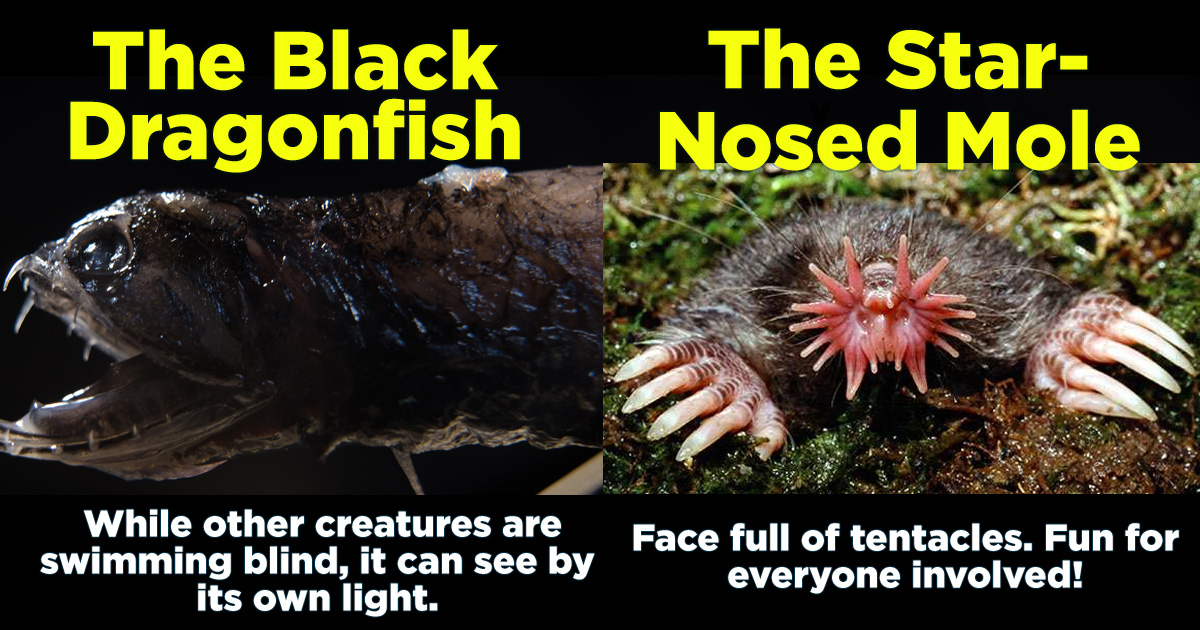
The star-nosed mole has 22 fleshy rays surrounding its nostrils. These structures form an extraordinarily sensitive touch organ, helping the nearly blind mammal locate food in wet soil and shallow water. It can identify and consume prey in a fraction of a second, earning recognition as one of the fastest-eating mammals. The mole is small and harmless, but its face looks as though a tiny pink sea creature has taken control of its head.
13. Aye-Aye: The Midnight Knocker
The aye-aye is a nocturnal lemur from Madagascar with enormous ears, continuously growing front teeth, and a thin, elongated middle finger. It taps on wood, listens for hollow spaces, gnaws through bark, and hooks insect larvae from inside. This specialized feeding technique is ingenious. Unfortunately for the aye-aye’s public image, it performs the entire routine while looking like a haunted squirrel that knows exactly where you hid the spare key.
14. Shoebill: The Bird That Looks Personally Offended
Shoebills inhabit freshwater swamps in tropical East Africa. Their enormous shoe-shaped bills help them capture fish and other aquatic prey, while their ability to stand motionless makes them look like statues positioned by a deeply troubled gardener. A shoebill may remain still for long periods before striking with sudden force. Its towering body, pale eyes, and severe expression create the impression that it remembers something embarrassing you did years ago.
15. Goliath Birdeater: The Dinner-Plate Tarantula
The Goliath birdeater is the world’s largest tarantula by mass, with a leg span reaching about 11 inches. Despite its name, it rarely eats birds, preferring insects and small vertebrates. When threatened, it can produce a loud hissing sound and release irritating hairs from its abdomen. Its venom is not considered deadly to humans, but that information may provide limited comfort when a spider approximately the width of a dinner plate starts hissing.
16. Coconut Crab: The Armored Tree Climber
The coconut crab is the largest land-dwelling arthropod on Earth. Adults can climb trees, manipulate heavy objects, and crack tough food with powerful claws. They are opportunistic omnivores and may investigate nearly anything edible. Because their bodies are armored and their legs can span several feet, encountering one at night can feel like discovering that a medieval siege engine has learned to climb palm trees.
17. Giant Centipede: Dozens of Legs and Two Venom Weapons
Large tropical centipedes can exceed 11 inches and prey on insects, frogs, lizards, rodents, and other small animals. The structures that inject venom are modified front legs called forcipules rather than true fangs. Their flattened bodies allow them to move through tight spaces with disturbing speed. A giant centipede does not need 100 legs to be frightening. Forty or so moving in coordinated waves will handle the assignment nicely.
Parasites With Storylines Too Disturbing for Hollywood
18. Tongue-Eating Louse: The Replacement Body Part
This parasitic crustacean enters a fish through the gills and attaches near the tongue. By interfering with the tongue’s blood supply, it causes the tissue to wither. The parasite then occupies the empty space and may function mechanically as a replacement. The fish can sometimes continue living with its unwanted mouth tenant. Of all possible roommate problems, “has replaced my tongue and refuses to leave” remains difficult to beat.
19. Emerald Cockroach Wasp: Nature’s Zombie Director
The emerald cockroach wasp does not simply overpower its prey. It delivers precisely placed stings that alter a cockroach’s behavior, reducing its motivation to escape. The wasp then guides the roach by an antenna into a burrow, lays an egg on it, and seals the entrance. After hatching, the larva feeds on the living host. This is not merely predation. It is kidnapping, neurological manipulation, and body horror presented as a normal reproductive cycle.
Why These Real-World Monsters Matter
Calling these animals monsters is entertaining, but their frightening features are practical adaptations rather than evidence of evil intent. Oversized teeth prevent rare meals from escaping. Slime discourages predators. Glowing lures save energy in food-poor waters. Strange fingers, noses, claws, and mouthparts allow animals to exploit resources unavailable to less specialized competitors.
Many creepy animals are also harmless to humans, ecologically valuable, or threatened by habitat loss and exploitation. Fear can attract attention, but understanding should follow. The deeper lesson is not that nature is malicious. It is that evolution has no obligation to make its solutions attractive to the human eye.
The Experience: Meeting Nature’s Horror Cast Without Becoming Lunch
Seeing one of these creatures in a photograph is entertaining. Encountering even a harmless version in person produces a different reaction. At an aquarium, visitors often approach a giant isopod expecting a mildly oversized roly-poly. Then they notice its armored plates, clustered legs, and pale reflective eyes. Someone usually whispers, “That thing is real?” The animal remains motionless, doing absolutely nothing, yet somehow wins the psychological confrontation.
Deep-sea expedition footage creates an even stronger sensation because the viewer shares the narrow field of vision provided by a remotely operated vehicle. Beyond the camera lights is complete darkness. A bigfin squid can drift into view without warning, its arms hanging beneath it like impossibly long wires. There is no chase and no dramatic attack. The uneasiness comes from scale, silence, and uncertainty. Scientists may react with excitement, while everyone watching from home quietly reconsiders the wisdom of exploring the ocean.
Wildlife encounters on land involve a more immediate calculation: How far away is that animal, and can it climb? A coconut crab beneath a palm tree may look slow until it begins moving confidently across roots or gripping bark. A shoebill standing in a swamp creates a different kind of tension. It remains so still that observers may wonder whether it is real. Then it turns its head and fixes them with a pale, unblinking stare. Nothing dangerous has happened, but the atmosphere has changed.
Smaller animals can create larger emotional reactions. A star-nosed mole displayed in a natural-history video is fascinating because its nasal rays move faster than the eye can easily follow. The same close-up shown unexpectedly on a large screen can empty a snack bowl with remarkable efficiency. Likewise, a Goliath birdeater behind secure glass is scientifically impressive until it raises its front legs or produces a defensive hiss. At that moment, the thickness of the glass becomes everyone’s favorite exhibit fact.
The parasite stories are often hardest to forget because they turn ordinary biological relationships into intimate invasions. A shark bite is frightening, but it is understandable: predator meets prey. A louse replacing a fish’s tongue or a wasp manipulating a cockroach feels more personal. These creatures interfere with movement, anatomy, and behaviorthe very qualities that make an animal seem in control of its own body.
Yet the most rewarding experience comes after the first wave of disgust fades. The monster becomes an adaptation. The alien shape becomes a solution to darkness, hunger, competition, or reproduction. Visitors begin asking how the animal evolved, what role it plays, and whether it is endangered. Curiosity replaces fear without eliminating wonder. That emotional journeyfrom “absolutely not” to “tell me more”may be the greatest trick these terrifying real-world monsters perform.
Editorial note: The word “monster” describes the appearance or behavior of these animals, not their ecological value or actual danger to people. Most avoid humans, and several deserve conservation rather than fear.