
Predicting the future is a dangerous hobby. It looks elegant when you are right, like wearing a tuxedo to a Nobel ceremony. But when you are wrong, history saves your quote, laminates it, and brings it out at parties for everyone to laugh at. The future has a wicked sense of humor, and it especially enjoys embarrassing confident people with impressive titles.
From “airplanes will never work” to “the internet will not matter,” many inaccurate future predictions were made by smart people using the best information available at the time. That is what makes them fascinating. These were not random guesses from someone yelling beside a streetlamp. They came from executives, scientists, journalists, inventors, investors, and technology leaders who had every reason to think they understood the road ahead.
So why were they so wrong? Usually, they underestimated human behavior. They judged new technology by its first awkward version. They assumed high prices would stay high, machines would remain clunky, and ordinary people would never want something unfamiliar. Then the future walked in wearing sneakers, carrying a smartphone, and ordered dinner online just to prove a point.
Why Future Predictions Go Wrong
Bad predictions often share the same ingredients: overconfidence, linear thinking, limited imagination, and a failure to notice that people do not simply adopt technology because it is logical. They adopt it because it becomes useful, cheap, fun, social, convenient, or impossible to avoid. A heavy brick phone becomes a pocket computer. A noisy computer room becomes a laptop. A “plywood box” becomes the center of home entertainment. A weird little online bookstore becomes a retail empire big enough to make shopping malls sweat into their pretzels.
Below are 26 inaccurate predictions about the future that aged like milk in a warm car. Some are funny. Some are humbling. A few are reminders that even experts should keep a spare slice of humble pie in the freezer.
26 Inaccurate Predictions About The Future
1. “Flying machines” would take millions of years
In 1903, a famous newspaper editorial suggested that a practical flying machine might take anywhere from one million to ten million years to develop. The timing was unfortunate. The Wright brothers achieved powered flight just weeks later at Kitty Hawk. That is not merely being wrong; that is being wrong with theatrical lighting.
2. Heavier-than-air flight was considered impossible
Before airplanes became routine, several respected thinkers doubted whether heavier-than-air machines could ever fly. The mistake was understandable when early contraptions looked like birdcages having a nervous breakdown. But once engineering caught up with ambition, aviation changed war, commerce, travel, tourism, shipping, and the size of airport coffee bills forever.
3. Rockets could not work in space
Rocket pioneer Robert Goddard was mocked for suggesting that rockets could function beyond Earth’s atmosphere. Critics argued that a rocket would have nothing to push against in a vacuum. Physics disagreed. Rockets work by ejecting mass, and Newton’s laws do not politely stop at the edge of the atmosphere. Apollo 11 later made the correction impossible to ignore.
4. The telephone was dismissed as impractical
Early reactions to the telephone included skepticism that it had serious commercial value. To be fair, the first telephone networks were limited, expensive, and not exactly pocket-friendly. But the basic ideatalking instantly across distanceturned out to be slightly more useful than sending a messenger boy through traffic with a note.
5. Radio was treated as a novelty with little business value
When radio was young, some observers struggled to imagine why anyone would pay for a message sent to no one in particular. The answer became broadcasting, music, news, sports, emergency alerts, talk shows, advertising, podcasts, and the mysterious ability of one catchy song to follow you into every grocery store in America.
6. The automobile was called a passing fad
At the beginning of the 20th century, some investors believed the horse would remain dominant and the automobile would fade as a novelty. Instead, cars reshaped cities, suburbs, manufacturing, oil markets, road systems, dating, drive-thru food, and the American talent for arguing about parking.
7. Television would lose its audience quickly
Film executive Darryl F. Zanuck is widely remembered for doubting that television would hold public interest, supposedly because people would grow tired of staring at a box every night. Several decades of sitcoms, news broadcasts, Super Bowls, streaming binges, and remote-control battles suggest people were quite willing to stare at the box. Some even bought bigger boxes.
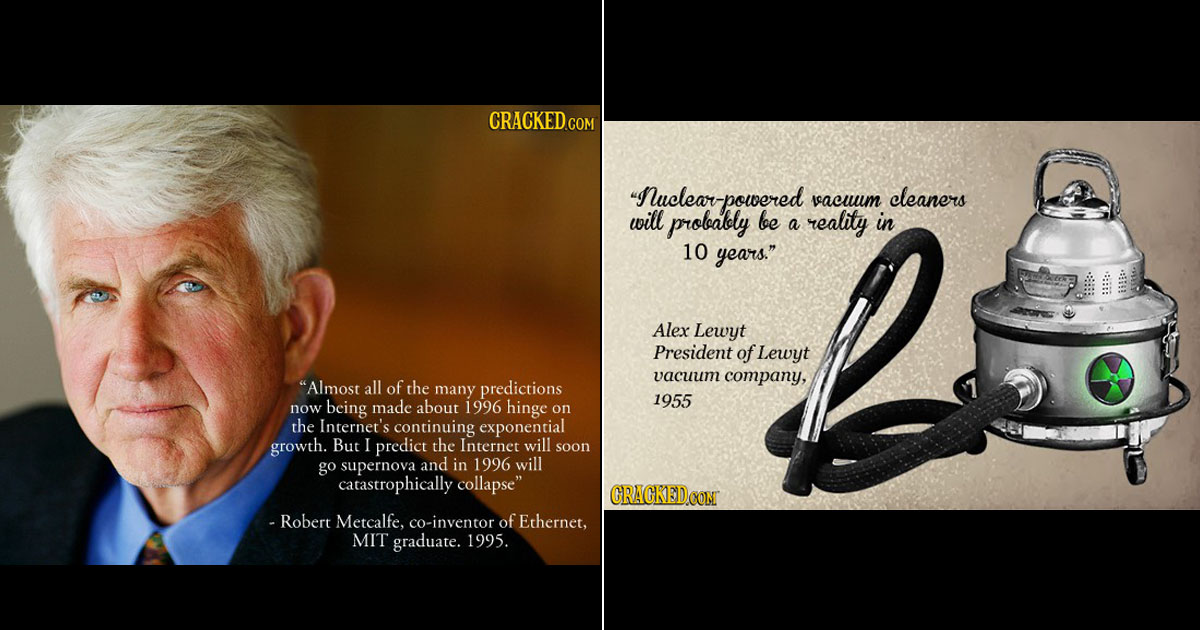
8. Nuclear-powered vacuum cleaners would arrive soon
In the atomic-age optimism of the 1950s, nuclear energy was expected to power almost everything. One famous prediction imagined nuclear-powered vacuum cleaners within a decade. Thankfully, this did not happen. Nobody needs to ask, “Did you dust under the sofa?” and hear, “Yes, but the living room now has a half-life.”
9. Communication satellites would not matter much
In the early 1960s, a U.S. communications official doubted that satellites would significantly improve domestic telephone, telegraph, television, or radio service. Then satellites became essential to global broadcasting, navigation, weather forecasting, military systems, disaster response, and the tiny miracle of getting lost while your GPS calmly says, “Recalculating.”
10. Future computers might weigh only 1.5 tons
In 1949, a technology forecast imagined that computers of the future might become dramatically smaller, possibly weighing “only” around 1.5 tons. That was an optimistic prediction at the time, not a joke. Today, a smartphone in your pocket has more practical computing power than many room-sized machines. It also takes better pictures of lunch.
11. The world market for computers would be tiny
The famous “world market for five computers” line is often attributed to IBM’s Thomas Watson, though historians debate the exact wording and source. Whether or not the quote is perfectly authentic, it captures a real mindset: early computers looked like specialized industrial equipment, not household tools. The personal computer revolution proved that demand expands when size, cost, software, and usability improve.
12. Data processing was just a fad
In the 1950s, some business observers doubted that data processing would last. That forecast now sounds adorable, like predicting that numbers are having a moment. Modern banking, healthcare, logistics, insurance, retail, government, science, and online advertising all run on data. We did not abandon data processing; we built civilization’s nervous system out of it.
13. Microchips seemed pointless
When microchips first appeared, not everyone understood what they were good for. That is reasonable: a tiny integrated circuit does not look dramatic. It does not puff smoke or play a trumpet. But microchips became the foundation of computers, smartphones, cars, medical devices, appliances, satellites, toys, and basically anything with a button smarter than a toaster lever.
14. Home computers would not be wanted
In 1977, Digital Equipment Corporation founder Ken Olsen said there was no reason for an individual to have a computer at home. His comment had context, but it still became a classic example of underestimating personal computing. Today, homes contain laptops, tablets, phones, game consoles, smart TVs, routers, voice assistants, and at least one printer that refuses to behave.
15. The paperless office would arrive quickly
The 1970s vision of the office of the future imagined digital systems making paper nearly obsolete. Instead, computers often made printing easier. Offices scanned documents, printed the scans, signed the printouts, scanned them again, and filed the originals in a cabinet labeled “Why Are We Like This?” The paperless office is more real than before, but paper remains stubbornly alive.
16. Robots would replace huge numbers of ordinary jobs by now
Future-focused books and magazines in the late 20th century often predicted that robots would soon take over broad categories of work, from cashiers to cleaners. Automation did change factories, warehouses, banking, retail, and customer service. But many jobs survived because real-world tasks are messy, social, unpredictable, and full of objects that refuse to sit neatly in a lab demo.
17. By now, we would have far more leisure time
Many futurists expected machines to shrink the workweek dramatically. Automation did increase productivity, but it did not automatically hand everyone a hammock and a lemonade. Instead, work changed shape. Email followed people home. Phones became portable offices. The future did give us powerful tools; it also gave us the 10:43 p.m. “quick question” from work.
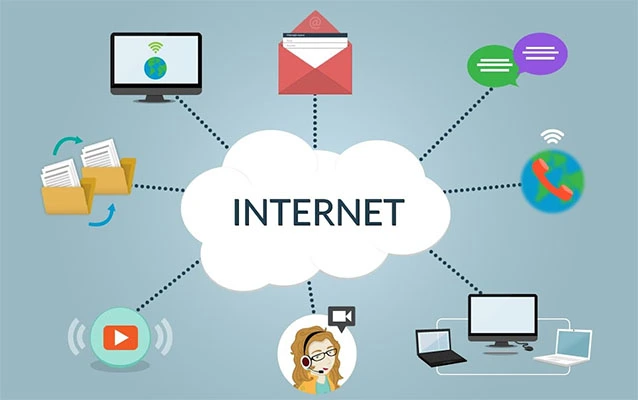
18. The internet would not change newspapers, shopping, or government
In 1995, astronomer and author Clifford Stoll argued that online databases would not replace newspapers, computer networks would not change government, and online shopping was overhyped. Some of his warnings about online junk and misinformation were sharp. But his doubts about commerce, media, and digital government were wildly off. The internet did not replace everything, but it definitely rearranged the furniture.
19. The internet’s economic impact would be no bigger than the fax machine
Economist Paul Krugman made a famous late-1990s prediction that the internet’s economic impact would look no greater than the fax machine’s. The comparison did not age well. The internet became a platform for search, advertising, cloud computing, streaming, social media, remote work, online marketplaces, digital payments, and entire companies that would make a fax machine feel like a Victorian teacup.
20. The internet would collapse under its own growth
Ethernet inventor Robert Metcalfe predicted in the 1990s that the internet would suffer a catastrophic collapse. Instead, the network grew, adapted, and became central to modern life. To his credit, Metcalfe later publicly ate his wordsliterally, by blending a printed copy of his column. That is accountability with fiber.
21. Spam would be solved in two years
In 2004, Bill Gates predicted that spam would be solved within two years. Email filters improved dramatically, but spam did not disappear. It evolved. Phishing, scam messages, botnets, spoofed senders, and suspicious “urgent invoice” emails continue to haunt inboxes like digital raccoons digging through the trash at 2 a.m.
22. Mobile phones would remain a small market
Early forecasts for mobile phones often underestimated demand. Some projections assumed high prices, weak batteries, poor coverage, and bulky handsets would keep the market tiny. Those assumptions were true for early devices, but they ignored improvement curves. As phones became cheaper, smaller, and more useful, the market exploded.
23. Smartphones would not gain serious market share
In 2007, Microsoft CEO Steve Ballmer laughed at the iPhone’s price and doubted it would gain significant market share. He was not crazy to question an expensive phone without a physical keyboard. But the iPhone helped redefine what a phone was. It turned the device into a camera, music player, browser, wallet, map, gaming console, and tiny glowing rectangle of distraction.
24. Online shopping would never rival the local mall
Skeptics once argued that customers needed salespeople, physical stores, and in-person browsing too much for online shopping to become dominant. Then convenience won. Search bars replaced directory maps. Customer reviews replaced the bored teenager in aisle six. One-click checkout replaced standing in line behind someone paying with 43 coins.
25. 3D television would become the next home-entertainment standard
After the success of 3D movies such as Avatar, many electronics companies expected 3D TV to become the future of home viewing. It did not. The glasses were annoying, content was limited, and many viewers decided that regular high-definition television was perfectly fine without making the couch feel like a theme-park ride.
26. Virtual reality would instantly replace normal computing
Virtual reality has made real progress in gaming, training, design, therapy, and simulation. But predictions that VR would quickly become the default way people work, socialize, and browse the web have repeatedly outrun adoption. Headsets can be impressive, but comfort, price, motion sickness, battery life, and social awkwardness still matter. The future may be immersive, but it has to stop fogging up people’s faces first.
What These Failed Predictions Teach Us
The funniest failed predictions about the future are not funny because the people behind them were foolish. Many were brilliant. Their errors reveal something deeper: the future is not just a bigger version of the present. It bends when costs fall, habits change, infrastructure appears, and culture decides that yesterday’s weird gadget is today’s normal life.
One common mistake is judging a technology too early. The first cars were noisy and unreliable. The first computers were enormous. The first mobile phones were expensive bricks. The early web was slow, ugly, and full of blinking text. If you judged any of these inventions only by version one, you might reasonably reject them. But version one is not destiny. It is the awkward baby picture.
Another mistake is focusing on the device instead of the ecosystem. A smartphone is not valuable only because it makes calls. It is valuable because it connects to app stores, payment networks, cameras, GPS, messaging platforms, maps, cloud storage, and social habits. Predictions fail when they evaluate a single object while ignoring the services and behaviors that may grow around it.
Finally, failed predictions remind us that people are wonderfully inconsistent. Consumers may reject a technology that experts love, then adopt a different technology nobody expected. They may say they value privacy, then share their sandwich location with an app. They may claim they hate screens, then watch six episodes of a show about competitive baking. Human behavior is the secret variable in every forecast.
Personal Experience: Why Wrong Predictions Feel So Familiar
Everyone has a small museum of bad predictions in their own life. Maybe you once said a certain app would never catch on, only to find yourself using it every day. Maybe you laughed at wireless earbuds and later spent 20 minutes searching for one under the couch. Maybe you swore you would never use voice commands, and now you ask a speaker to set timers because your hands are covered in flour and optimism.
That is what makes inaccurate future predictions so relatable. They are not only historical bloopers; they are a mirror. We all use the present as our measuring stick, even when the present is clearly under construction. When a new technology appears, it often looks inconvenient, expensive, unnecessary, or silly. The first reaction is usually, “Who needs that?” The future’s answer is often, “Apparently, everyone, but give it five years.”
Think about online shopping. Years ago, many people were uncomfortable entering a credit card number into a website. That caution made sense. The early internet felt like a strange digital alley with neon signs. Today, millions of people buy groceries, medicine, furniture, clothing, pet food, software, and birthday gifts online. Some households now receive so many packages that the porch looks like a cardboard-based art installation.
Or consider remote work. For years, many managers insisted that serious work had to happen in an office, preferably under fluorescent lights strong enough to interrogate a sandwich. Then video calls, cloud tools, shared documents, and changing expectations made remote and hybrid work ordinary for many professions. It did not eliminate offices, but it changed the assumption that productivity must sit in a cubicle wearing uncomfortable shoes.
The same pattern appears with entertainment. Streaming once seemed like a bonus feature, not the main event. People owned DVDs, subscribed to cable, and planned evenings around TV schedules. Now viewers expect movies, shows, music, and live events to appear instantly. Waiting for a specific broadcast time feels almost historical, like churning butter or asking for directions at a gas station.
My favorite lesson from failed predictions is that humility is practical. When we look at artificial intelligence, electric vehicles, robotics, gene editing, space travel, or future interfaces, the honest answer is rarely “This will definitely happen” or “This will never happen.” A better answer is: “Here is what would need to change for this to become normal.” Price must fall. Quality must improve. Regulations must adapt. People must find a reason to care. The boring middle steps matter more than the dramatic headline.
Bad predictions are entertaining, but they are also useful. They teach us to ask better questions. Instead of asking whether a new idea looks perfect now, ask whether it can improve quickly. Instead of asking whether people need it today, ask what behavior might change if it becomes cheap, easy, and socially accepted. Instead of laughing too loudly at the future, leave room for the possibility that the future is quietly taking notes.
So the next time someone declares that a technology has “no chance,” remember the airplane, the computer, the smartphone, the internet, and the television. History has a long memory and a mischievous grin. It loves nothing more than turning today’s confident dismissal into tomorrow’s opening paragraph.
Conclusion
The history of inaccurate future predictions proves that forecasting is not about sounding certain. It is about understanding uncertainty. The people who dismissed airplanes, rockets, television, computers, smartphones, satellites, and the internet were often reacting to real limitations. Their mistake was assuming those limitations would remain permanent.
Future predictions fail when they underestimate innovation, affordability, infrastructure, and human curiosity. They also fail when they ignore the messy emotional reasons people adopt technology: convenience, status, entertainment, connection, laziness, ambition, and the timeless desire to avoid standing in line.
The best lesson is simple: be skeptical, but not smug. The next world-changing idea may look ridiculous at first. It may be too expensive, too awkward, too niche, or too early. But if it solves a real problem and keeps improving, the joke may eventually be on the person who laughed first.
Note: This article was written for web publishing in clean body-only HTML, with source-link artifacts intentionally omitted while the content is based on real, historically reported examples.
SEO Tags