
Tension problems have a talent for making a perfectly friendly rope look suspicious. One moment, a cable is quietly holding a lamp; the next, it is pulling two blocks over a pulley while gravity, friction, and acceleration all argue about who is in charge.
The good news is that calculating tension in physics is not a matter of memorizing twenty unrelated equations. Most problems reduce to three situations: an object in equilibrium, a single object accelerating vertically, or several objects connected by a rope. Once you draw a clear free-body diagram and apply Newton’s laws with consistent signs, the rope usually confesses.
What Is Tension Force?
Tension is the pulling force transmitted through a stretched flexible connector such as a rope, string, cable, chain, or wire. The force acts along the connector and pulls away from the object at the point of contact. A flexible rope can pull, but it cannot provide a meaningful pushan observation summarized by the wonderfully practical phrase, “You cannot push a rope.”
In introductory physics, a rope is often treated as massless and inextensible, while pulleys are treated as massless and frictionless. Under those ideal assumptions, the magnitude of tension is the same throughout one continuous rope, even when a pulley changes the rope’s direction. Real systems can behave differently: a heavy rope, a pulley with rotational inertia, axle friction, or a slipping cable can produce different tensions in different segments.
The Essential Setup Before Using Any Formula
- Choose the object or system you are analyzing.
- Draw every external force acting on it.
- Choose positive coordinate directions.
- Resolve angled forces into components.
- Apply Newton’s second law:
ΣF = ma.
This routine matters more than clever algebra. A correct free-body diagram turns a tension problem into bookkeeping. An incorrect diagram turns it into interpretive dance.
Method 1: Calculate Tension in Static Equilibrium
Use the equilibrium method when an object is at rest or moving at constant velocity. In either case, acceleration is zero, so the net force is zero.
ΣF = 0One Vertical Rope Supporting a Mass
Suppose a mass m hangs motionless from one vertical rope. The forces on the mass are upward tension T and downward weight mg. Taking upward as positive gives:
T - mg = 0T = mgExample: A 20-kilogram stage light hangs at rest. Using g = 9.8 m/s²:
T = (20 kg)(9.8 m/s²) = 196 NThe rope tension is 196 newtons. This does not mean the rope “contains” 196 newtons like a bottle contains water; it means the rope transmits a 196-newton pull.
Two Identical Vertical Supports
If two identical vertical ropes share the load equally, their upward forces add:
2T - mg = 0T = mg / 2For the same 20-kilogram light, each vertical rope carries 98 newtons, assuming the load is centered and the supports are truly identical.
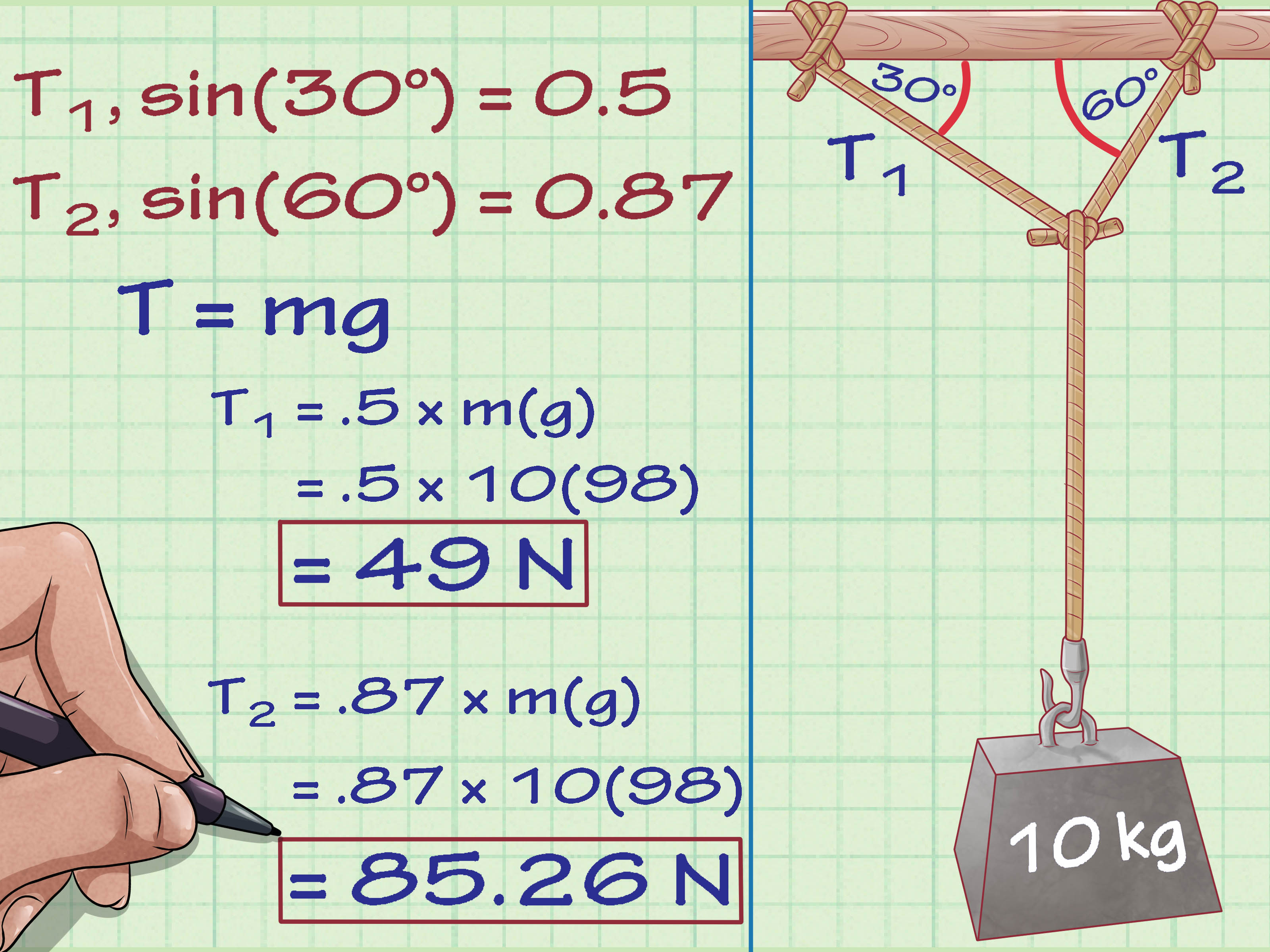
Two Angled Cables
Angled supports require components. If two identical cables make an angle θ above the horizontal, each cable contributes an upward component T sin(θ). The horizontal components cancel, while the vertical components support the weight:
2T sin(θ) = mgT = mg / [2 sin(θ)]For a 20-kilogram load supported by two cables at 30 degrees above horizontal:
T = 196 N / [2 sin(30°)] = 196 NEach angled cable carries 196 newtonstwice the load per cable compared with two vertical supports. As the cables become more horizontal, sin(θ) becomes smaller and the required tension rises sharply. That is why nearly horizontal clotheslines, tightropes, and utility wires can experience surprisingly large tension.
Method 2: Calculate Tension in an Accelerating Vertical System
When a mass accelerates upward or downward, tension generally does not equal weight. The correct equation comes from Newton’s second law, not from reflexively writing T = mg and hoping the acceleration does not notice.
Object Accelerating Upward
Take upward as positive. For a mass accelerating upward with magnitude a:
T - mg = maT = m(g + a)Example: A 10-kilogram load is lifted upward with an acceleration of 2.0 m/s²:
T = 10(9.8 + 2.0) = 118 NThe tension is greater than the 98-newton weight because the cable must both support the load and create an upward net force.
Object Accelerating Downward
If the same object accelerates downward with magnitude a, tension is smaller than weight:
mg - T = maT = m(g - a)For the 10-kilogram load accelerating downward at 2.0 m/s²:
T = 10(9.8 - 2.0) = 78 NIf the object is in free fall, a = g, so the ideal tension becomes zero. A negative answer would signal that the assumed taut-rope model has failed; an ordinary rope cannot push the mass downward.
Speed Is Not the Deciding Factor
A common mistake is to connect tension with speed rather than acceleration. An elevator moving upward at constant speed has zero acceleration, so cable tension balances the total weight. An elevator moving downward but slowing has an upward acceleration, so its cable tension is greater than its weight. Direction of motion and direction of acceleration are not always the same.
Method 3: Calculate Tension in Connected Masses and Pulley Systems
For two or more connected objects, draw a separate free-body diagram for each object. Ideal ropes constrain connected objects to related accelerations, and an ideal fixed pulley changes the direction of tension without changing its magnitude. The usual strategy is to write one Newton’s second law equation per object, solve for acceleration, and then substitute back to find tension.
Atwood Machine: Two Hanging Masses
Consider masses m1 and m2 connected over an ideal pulley, with m2 > m1. Mass 2 accelerates downward and mass 1 accelerates upward with the same magnitude a.
For m1: T - m1g = m1aFor m2: m2g - T = m2aAdding the equations eliminates tension:
a = [(m2 - m1)g] / (m1 + m2)Then substitute the acceleration into either mass equation:
T = m1(g + a) = m2(g - a)An equivalent shortcut for an ideal Atwood machine is:
T = [2m1m2g] / (m1 + m2)Example: Let m1 = 3.0 kg and m2 = 5.0 kg.
a = [(5 - 3)(9.8)] / (5 + 3) = 2.45 m/s²T = 3(9.8 + 2.45) = 36.75 NA useful check is that 36.75 newtons is greater than the lighter mass’s weight, 29.4 newtons, but less than the heavier mass’s weight, 49 newtons. That matches the directions of their accelerations.
Block on a Table Connected to a Hanging Mass
For a frictionless table, let m1 be the block on the table and m2 the hanging block:
T = m1am2g - T = m2aSolving gives:
a = m2g / (m1 + m2)T = m1m2g / (m1 + m2)If friction acts on the tabletop block, include it with the correct direction. For kinetic friction, fk = μkN, and on a level surface with no other vertical force components, N = m1g.
Inclines and Non-Ideal Pulleys
On an incline, align one axis with the slope. The component of gravity parallel to the incline is mg sin(θ), while the perpendicular component is mg cos(θ). Add tension, friction, and gravity components with signs based on your chosen positive direction.
Do not automatically assign one tension value to every rope segment in a real machine. If a pulley has mass and angular acceleration, the tensions on its two sides may differ because their difference creates the torque that spins the pulley. Introductory formulas work only when their ideal assumptions are stated and reasonable.
How to Check a Tension Calculation
- Check the units: Tension is a force, so the answer should be in newtons, not kilograms.
- Check the direction: Tension pulls along the rope and away from the object.
- Check limiting cases: If acceleration becomes zero, does the equation reduce to equilibrium?
- Check the magnitude: Upward acceleration requires
T > mg; downward acceleration requiresT < mg. - Check the assumptions: Is the rope massless? Is the pulley frictionless? Is the rope taut?
Common Mistakes When Calculating Tension
Assuming Tension Always Equals Weight
T = mg applies only when a single vertical tension balances weight and vertical acceleration is zero. It is not a universal tension formula.
Treating Centripetal Force as an Extra Force
In circular motion, centripetal force is the inward net force, not a new force added to tension, gravity, or the normal force. Sometimes tension supplies all the inward net force; sometimes it supplies only part of it.
Using the Wrong Trigonometric Component
Whether the vertical component is T sin(θ) or T cos(θ) depends on where the angle is measured. Sketch the triangle instead of trusting muscle memory.
Combining Objects Too Early
Treating connected masses as one system is excellent for finding acceleration because internal tension cancels. It is useless for finding that internal tension directly. After finding acceleration, isolate one object and solve for T.
Practical Experience: What Makes Tension Problems Easier
The biggest improvement in solving tension problems usually comes from changing the order of work. Beginners often search for a formula first, then try to force the diagram to cooperate. A more reliable habit is the reverse: draw the object, identify interactions, choose axes, and let the equation emerge. After a few problems, this feels slower for about five minutes and faster for the rest of your physics course.
One useful experience is to physically imitate the system. Hold a string attached to a small object and notice that the string pulls along its own length. Let the object hang still, lift it with increasing speed, and then lower it while slowing down. Even without a force sensor, your hand can feel that “moving upward” does not uniquely determine tension. The effort changes when acceleration changes. This small experiment helps separate velocity from acceleration more effectively than memorizing another rule.
Another practical lesson comes from angled supports. People often expect two ropes to divide a load neatly in half, but that only happens when both ropes are vertical. Stretch the supports outward and the vertical component of each tension shrinks. The rope must pull harder to provide the same upward support. A simple classroom demonstration with two spring scales and a hanging weight makes this visible: as the scales are pulled toward horizontal, both readings rise. The setup also explains why engineers allow cables to sag instead of making them perfectly flat.
Pulley problems teach a different habit: separate the system calculation from the object calculation. First, examine all connected masses together to find acceleration. Because tension is internal to the combined system, it often disappears from the summed equation. Then choose one massusually the one with the simplest forcesand use its free-body diagram to recover tension. This two-stage approach prevents pages of simultaneous algebra from becoming a small paper-based wildlife preserve.
Sign conventions are another source of experience-earned wisdom. There is no law requiring “up” or “right” to be positive. Choose directions that simplify the motion, but keep them consistent within each equation. A negative result for acceleration usually means the real motion is opposite your initial guess; it does not mean physics has filed a complaint. A negative tension, however, often indicates that a rope would go slack or that the assumed motion is impossible under the stated model.
Finally, compare every result with physical intuition. For a hanging mass accelerating downward, tension should be less than weight. For a mass accelerating upward, it should be greater. In an Atwood machine, tension should fall between the two weights. For nearly horizontal support cables, tension should become large. These checks catch sign mistakes, calculator slips, and missing force components before they become confidently boxed wrong answers.
The most valuable experience is not memorizing all possible arrangements. It is learning to rebuild the solution from Newton’s laws. Ropes, elevators, cranes, tow cables, pendulums, pulley machines, and suspension systems may look different, but the workflow remains remarkably stable: isolate, diagram, resolve, sum forces, solve, and check.
Conclusion
There are three dependable ways to calculate tension in physics: balance forces for equilibrium, apply ΣF = ma to an accelerating object, or write linked equations for connected masses and pulleys. The equations change with the setup, but the logic does not. Identify the object, draw a free-body diagram, choose axes, apply Newton’s second law, and test whether the result makes physical sense.
Once that process becomes automatic, tension stops being a mysterious force hidden inside a rope. It becomes what it has been all along: a pulling force with very good public relations.
Note: Numerical examples use g = 9.8 m/s² and idealized ropes and pulleys unless otherwise stated. Real engineering calculations may need rope mass, elasticity, safety factors, pulley inertia, bearing friction, and material strength.
SEO Metadata