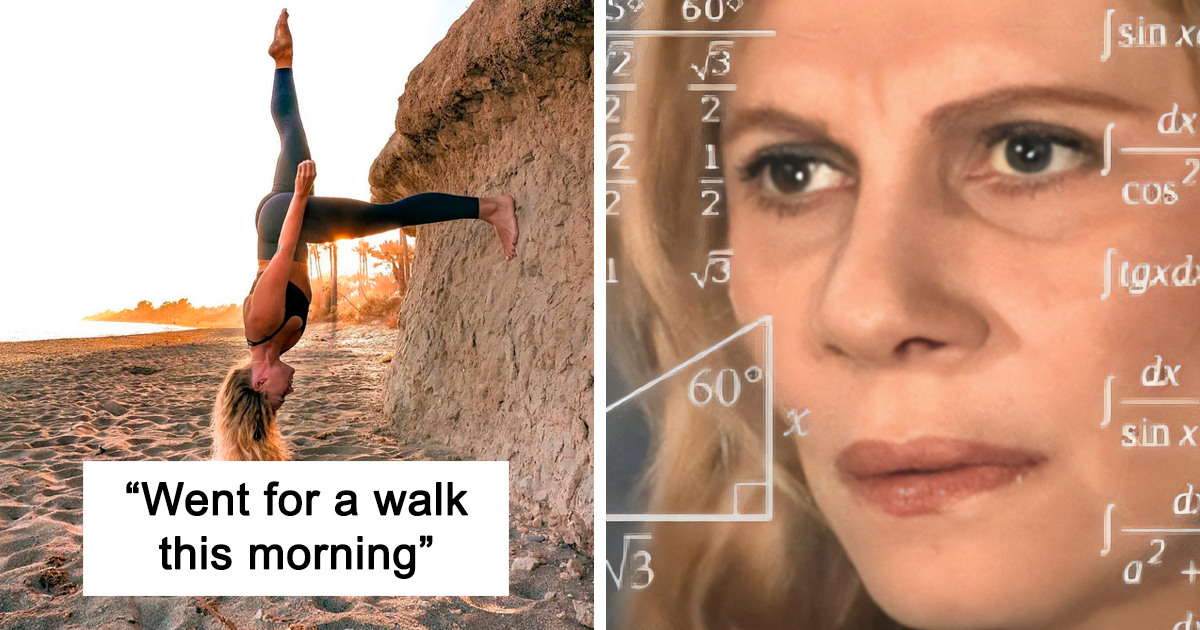

Gravity is usually the reliable adult in the room. It keeps coffee inside mugs, furniture on the floor, and overly confident humans from floating into the neighbor’s yard. Then a photograph appears showing a boulder balanced on a tiny point, a building hanging over open space, or a cat apparently sleeping on a vertical wall. Suddenly, gravity looks as though it has taken the afternoon off.
That delicious confusion is the specialty of the online “Confusing Gravity” community, where people share photographs that make everyday physics look suspicious. The images do not actually prove that Isaac Newton overlooked a loophole. Instead, they reveal how balance, hidden support, camera perspective, motion, and natural forces can create scenes that seem impossible at first glance.
Here are 40 memorable kinds of gravity-defying moments that make viewers stop scrolling, rotate their phones, squint at the screen, and quietly ask, “How is that still up there?”
Note: The descriptions below explore the types of photographs celebrated by the community and the most likely science behind them. Without seeing how every scene was arranged, some images may have more than one reasonable explanation.
Why Gravity-Defying Photos Fool Us So Easily
A photograph turns a three-dimensional world into a flat rectangle. Important clues can disappear: the horizon may be cropped out, a support may hide behind an object, or two items separated by several feet may appear to touch. Our visual system uses perspective, shading, size, overlap, and surrounding context to estimate depth. When those clues disagree, the brain often chooses the funniest possible interpretation.
Meanwhile, the objects in the scene remain obedient to physics. An object can stay balanced when its center of gravity remains above its base of support. It may look dramatically off-center because most of its mass is hidden, distributed unevenly, or counterbalanced outside the frame. For a stationary object, the forces and turning effects acting on it must balance.
Impossible Balancing Acts
-
1. A Tower of Stones Balanced on Pebbles
A stack of large rocks resting on contact points no wider than coins looks like a geological prank. Careful placement keeps each combined center of mass above the support below it.
-
2. A Chair Perched on Two Legs
A chair leaning backward without falling may have a heavy front section, a hidden brace, or just the right geometry. It appears reckless, but its weight is still supported.
-
3. A Bottle Balanced Sideways
A bottle hanging over a table’s edge can remain stable when liquid, utensils, or another concealed weight acts as a counterbalance. The bottle is not fearless; it is carefully negotiated.
-
4. A Ladder Standing at an Unreasonable Angle
Friction at the floor and a secure contact point near the top can prevent a ladder from sliding. The setup may be physically valid, although copying it remains an excellent way to meet a paramedic.
-
5. A Person Leaning Far Beyond Their Feet
Strategic footwear, a hidden platform, stiff clothing, or an unseen partner can make a person look impossibly tilted. Cropping removes the evidence while preserving the mystery.
Static friction is often the quiet hero in these scenes. It resists the beginning of sliding, allowing objects to remain on slopes or against surfaces until the applied force becomes too great.
Architecture That Appears to Float
-
6. A House Hanging Over a Cliff
Modern homes with dramatic overhangs can seem unsupported from one angle. In reality, reinforced beams transfer the load into a foundation or structural core farther inside the building.
-
7. A Balcony With Nothing Under It
Cantilevered balconies extend beyond their visible support. Their internal structure bends under load while anchored sections inside the building keep the entire assembly from rotating downward.
-
8. Stairs Floating Up a Wall
Floating staircases usually hide steel brackets or reinforced connections inside the wall. Remove visible railings and supports, and suddenly every step resembles a platform from a video game.
-
9. A Bridge Apparently Attached to One Side
Cantilever bridges and observation decks may project far beyond their supports. Engineers manage the resulting bending forces through strong materials, trusses, cables, and carefully placed structural mass.
-
10. A Twisted Tower With Misaligned Floors
Offset sections can make a high-rise look like loosely stacked blocks. Hidden cores, transfer systems, perimeter beams, and trusses redirect loads through the structure.
Nature’s Most Questionable Construction Projects
-
11. A Giant Boulder Resting on a Narrow Base
Erosion can remove softer material while leaving a harder rock balanced above it. The result resembles a monument designed by someone who had never heard of workplace safety.
-
12. A Natural Stone Arch
From the right angle, a rock arch can look too thin to support its own weight. Compression carries forces through the curved structure and into the rock on either side.
-
13. A Tree Growing Horizontally From a Cliff
Roots grip fractures and spread through soil while the trunk grows toward available light. The visible tree may extend outward, but much of its anchoring system remains hidden underground.
-
14. A Snow Shelf Curling Over Empty Space
Wind can build a snow cornice beyond a ridge, creating a smooth frozen wave. It may look solid from above while containing a dangerously unsupported overhang below.
-
15. A Cliff With an Enormous Overhanging Cap
Water, wind, and waves can erode lower material faster than the rock above. The top remains temporarily suspended until cracking and weight finally cause collapse.
Water and Ice Refusing to Behave Normally
-
16. A Droplet Hanging Beneath a Leaf
Surface tension allows water molecules to hold together while adhesion keeps the droplet attached to the leaf. Gravity pulls downward, but it does not always win immediately.
-
17. Water Suspended Across a Tiny Opening
A film of water can span a small hole or mesh. Surface tension and differences in air pressure may temporarily hold the water in place instead of letting it drain.
-
18. A Bubble Resting on Water Without Bursting
Thin films, surface tension, and gentle air movement can preserve a bubble long enough for a perfectly timed photograph. One fingerprint or breeze, however, ends the performance.
-
19. A Water Vortex That Looks Like a Solid Funnel
Rotating water forms a curved vortex as pressure, gravity, and circular motion interact. A fast camera can make the transparent funnel appear frozen in space.
-
20. An Iceberg Floating With Most of Its Mass Hidden
Buoyancy supports floating ice because it displaces water. The visible portion may look strangely small compared with the mass below the surface, turning the ocean into nature’s best concealment device.
Animals With Their Own Private Physics Department
-
21. A Mountain Goat Standing on a Tiny Ledge
Specialized hooves, excellent balance, and a low, controlled body position let climbing animals use footholds that humans would classify as decorative cracks.
-
22. A Cat Sleeping on the Edge of a Shelf
Cats can distribute their weight with alarming precision. What looks like most of the animal hanging over the edge may be balanced by a surprisingly heavy torso and strategically placed paws.
-
23. A Bird Frozen in Midair
A headwind can allow a bird to maintain nearly the same position relative to the ground. A fast shutter removes wing blur, making active flight resemble effortless suspension.
-
24. An Insect Walking on Water
Some insects spread their weight across water-repellent legs without breaking the surface. Surface tension behaves like a flexible membrane beneath themless a sidewalk and more a very nervous trampoline.
-
25. A Spiderweb Holding Rows of Heavy Droplets
Silk fibers carry tension while tiny droplets adhere to individual strands. Close-up photography enlarges the water, making the web appear to support a collection of glass marbles.
Tension travels through taut ropes, cables, fibers, and webs, allowing them to support weight by pulling along their length. Several angled strands can combine their forces to hold an object in equilibrium.
Perfectly Timed Photos That Pause a Fall
-
26. A Skateboarder Floating Above the Board
During a trick, rider and board may separate for only a fraction of a second. Captured at the highest point, both appear calmly parked in the air.
-
27. A Dancer Suspended Horizontally
Powerful movement, flexible posture, and split-second timing can create a pose that looks restful in a still photograph. The landing, conveniently, is not included.
-
28. A Tossed Object Apparently Hovering
At the top of its path, a thrown object briefly has almost no vertical speed. The photograph records position but hides motion, producing the illusion of levitation.
-
29. A Breaking Wave Turned Into a Wall
High shutter speeds preserve individual sheets and droplets of water. A chaotic moving wave becomes a sharp sculpture that exists for less time than it takes to say “splash.”
-
30. Snow Hanging Around a Moving Vehicle
A burst of powder can surround a skier, cyclist, or car. Freeze the scene at the right instant, and the snow looks like a solid tunnel suspended in midair.
Camera Angles That Put “Down” in the Wrong Place
-
31. A Photograph Rotated 90 Degrees
A person lying on pavement can become someone standing against a wall when the image is rotated. Remove the horizon, and the brain loses its most dependable orientation clue.
-
32. A Reflection Mistaken for Open Sky
Still water can mirror clouds and buildings so clearly that viewers confuse the reflection with the scene itself. Flip the photograph, and the world appears to hang beneath the sky.
-
33. A Missing Horizon That Hides a Steep Slope
A road, beach, or hillside may seem level when no reference line is visible. People and vehicles then appear to lean at impossible angles even though they are upright relative to the ground.
-
34. A Distant Object That Seems to Touch a Person
Forced perspective makes faraway buildings, aircraft, or landmarks appear small enough to hold. The objects align in the image while remaining widely separated in physical space.
-
35. A Shadow That Becomes a Separate Object
Strong light can produce a shadow that lines up with unrelated shapes. The brain combines them into a figure, floating platform, extra limb, or mysterious support that does not exist.
Hidden Forces and Clever Engineering
-
36. A Magnet Suspended Above a Surface
Magnetic forces can oppose weight strongly enough to produce levitation under controlled conditions. Specialized superconducting systems make the effect especially dramaticand wonderfully unfriendly to refrigerator-magnet comparisons.
-
37. An Object Stuck to Smooth Glass
Suction cups work when outside air pressure pushes them against a surface more strongly than the reduced pressure beneath them pushes outward. Gravity is present; atmospheric pressure is simply doing better.
-
38. A Sign Hanging From Nearly Invisible Cables
Thin wire can disappear against a bright sky or busy background. The supported object looks unattached even though tension in the cable carries its weight to an anchor.
-
39. A Spinning Wheel That Refuses to Fall
A rotating wheel or gyroscope can precess instead of immediately tipping. Its angular momentum changes the way it responds to torque, creating one of physics’ most convincing “Are you sure?” demonstrations.
-
40. An Art Installation With Invisible Support
Clear acrylic, monofilament, mirrors, counterweights, and carefully positioned frames can make sculptures float. The artist does not defeat gravity; the artist merely prevents gravity from receiving proper credit.
Electrical forces can also balance other forces in controlled demonstrations. Charged objects may attract or repel one another until they reach temporary equilibrium, creating another route to apparent levitation.
Gravity Never LeftIt Just Had Competition
The funniest part of these gravity-defying pictures is that the laws of physics are usually working perfectly. Gravity pulls downward, but it is joined by normal forces, friction, tension, pressure, buoyancy, magnetic attraction, structural resistance, and momentum. When those forces balance, an object can remain still in a position that looks deeply uncomfortable.
Even gravity itself is not absolutely identical everywhere. Earth’s mass distribution produces small variations in its gravitational field, although these differences are far too subtle to explain a chair balancing on one corner or a cat clinging to a curtain. NASA measures such variations from space to study moving water, ice loss, ocean circulation, and changes in Earth’s mass.
Most gallery images therefore belong to one of three categories: physically impressive, photographically deceptive, or cleverly staged. The very best manage all three at once.
What It Is Like to Hunt for Gravity-Defying Moments
Once you spend time studying confusing gravity photos, normal life becomes suspicious. You stop seeing an ordinary coffee cup near the edge of a desk and start seeing a potential optical illusion. A bicycle leaning against a dark fence deserves investigation. A reflection in a puddle becomes an alternate universe. Even a sock stuck halfway out of a laundry basket begins auditioning for the role of “object that has rejected Newtonian authority.”
The first habit you develop is searching for the missing support. Look behind the subject, examine the edges, and check whether a cable blends into the background. Bright skies hide thin wires beautifully. Dark furniture can conceal brackets. Transparent acrylic disappears when photographed straight on. In many cases, the trick becomes obvious after a few seconds. In others, the support remains invisible and you must accept that a garden ornament has defeated you intellectually.
The second habit is checking orientation. Find a horizon, hanging lamp, doorway, tree trunk, or other object that should normally be vertical. Rotating the photo often solves the mystery immediately. This is especially useful with images taken on stairs, steep hills, climbing walls, beaches, or reflective surfaces. The brain strongly prefers a familiar interpretation, so it may mentally “correct” a tilted environment and make every person inside it seem wrong.
Taking your own gravity-defying photo is surprisingly entertaining. Start with a safe, simple scene rather than balancing expensive electronics over a balcony. A rotated room photo works well: have someone lie on the floor beside furniture, frame the shot without a visible window or horizon, and rotate the final image. Forced perspective is another easy option. Place one person close to the camera and another far away, then align their hands so the nearer person appears to lift, push, or trap the distant one.
Timing adds a different challenge. Photograph someone jumping, tossing a lightweight object, or kicking through shallow water. Use a fast shutter speed or a phone’s burst mode, then choose the frame captured near the top of the movement. That is the moment when vertical motion briefly slows, making the subject look relaxed in midair. The final picture may suggest supernatural calm, while the neighboring frames reveal flailing arms and a facial expression normally associated with stepping on a toy brick.
Outdoor scenes offer even better opportunities because nature builds strange compositions without asking anyone to complete a risk assessment. Look for roots gripping rocks, snow curling from roofs, droplets hanging from leaves, birds flying into strong wind, or stones naturally stacked by erosion. Photograph from several heights and angles. Moving only a few inches can hide a support, merge distant objects, or remove the horizon entirely.
The safest rule is to create the illusion with perspective rather than danger. Do not climb unstable rock formations, stand beneath snow cornices, lean over unprotected edges, or imitate precarious stunts from an unexplained photograph. A convincing image should confuse viewers, not emergency-room staff.
After reviewing enough of these scenes, the experience becomes less about “beating gravity” and more about noticing how many forces shape the world. A droplet survives because molecules attract one another. A bridge projects over open space because engineers redirected its load. A stone remains upright because its center of mass sits over a tiny support. A photograph looks impossible because the camera removed exactly the clue your brain needed.
That is why confusing gravity pictures remain so satisfying. They provide a tiny mystery, a visual joke, and a physics lesson in the same frame. For a few seconds, the universe appears broken. Then the explanation arrivesand somehow the picture becomes even more impressive.