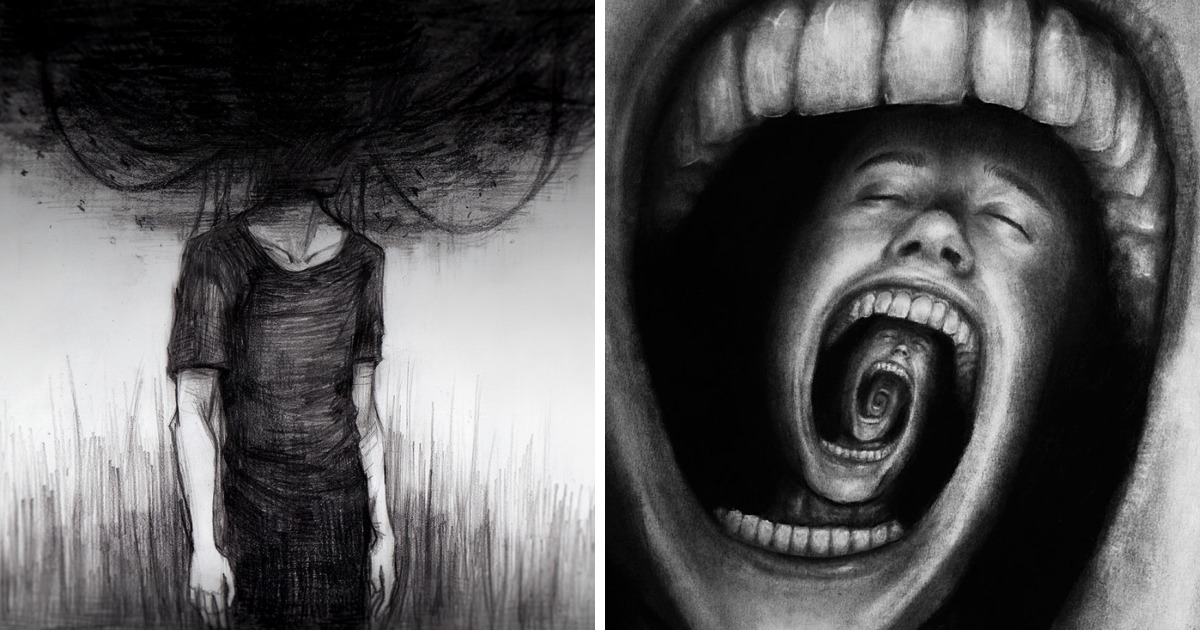

Depression is hard to photograph because it often wears ordinary clothes. It may answer emails, smile for a group picture, and say “I’m just tired” with impressive timing. Beneath that normal-looking surface, however, a person may feel trapped, hollow, hunted, exhausted, or disconnected from everyone nearby.
The collection 136 Artists Reveal the Dark Reality of Depression Through Drawings gives those invisible experiences a visible form. Its artists turn emotional pain into shadow creatures, flooded rooms, cracked bodies, sleepless nights, and smiling masks. The images do not offer one definition of depressionand that is their strength.
Why These Depression Drawings Hit So Hard
The original gallery gathers 136 visual interpretations, including works titled “Brain Sick,” “Mind Devour,” “Monster Inside the Head,” “Drowning in Depression,” “Again Insomnia,” and “My Depression Looks Like This.” Many contributors describe firsthand mental health struggles; others use illustration to help viewers understand experiences that resist ordinary language.
Clinical language identifies symptoms. Art shows what they can feel like at 3:17 a.m., when the ceiling seems judgmental and the brain has opened twenty-seven tabs, all playing the same terrible thought. Depression can affect mood, thinking, sleep, appetite, work, and daily functioning, and it may involve genetic, biological, environmental, and psychological factors.
The Visual Language of Depression
Monsters and Shadows
One of the collection’s most recognizable symbols is the monster: a looming figure, a creature behind the subject, or a dark shape inside the head. In “Monster Inside the Head,” suffering is not safely outside the person; it has moved in and rearranged the furniture.
The metaphor works because depressive thoughts may feel both personal and alien. Once given a body on paper, the invisible pressure becomes something the artist can observe, frame, challenge, or simply survive.
Masks and the Performance of Being Fine
Several drawings feature smiling masks or divided faces. “My Depression Looks Like This” depicts someone selecting a cheerful expression while the private self remains hidden. The idea resonates because a person can keep working, parenting, joking, or posting happy photos while struggling intensely.
The mask also reveals a social habit: “How are you?” is often treated as a greeting, not an investigative podcast. Saying “fine” can feel safer than explaining a complicated truth to people already glancing toward the exit.
Drowning and Losing Control
Water appears repeatedly in depression art. A face sinks beneath dark waves; a body reaches upward; a room fills while the world outside continues normally. “Drowning in Depression” communicates heaviness, panic, and the sense that enormous effort produces almost no movement.
From the outside, a person may appear still. Internally, they may be using every available ounce of energy to function. Survival can look surprisingly uneventful.
Cages, Closed Rooms, and Distorted Reality
Other artists portray confinement. Faces appear behind bars, bodies curl into tiny spaces, and colorful worlds remain visible but unreachable. “Trapped” and “Depression Distorts Reality” use barriers and contrast to show how illness can shrink a person’s behavioral world.
A shower becomes a project. A phone call becomes a cliff. The door may be unlocked, but depression supplies its own bars.
Insomnia and Mental Noise
“Again Insomnia” captures a mind that will not settle when the body desperately needs rest. Sleep disturbance can mean trouble falling asleep, waking too early, or sleeping far more than usual.
Artists visualize this with tangled lines, distorted clocks, and figures surrounded by thoughts. Depression is not always quiet. Sometimes the internal committee schedules an emergency meeting about every awkward moment since middle school.
Depression Is More Than Sadness
The strongest works reject the cartoon version of depression: one tear, one rain cloud, one dramatic sigh near a window. Clinical depression may involve emptiness, irritability, restlessness, slowed movement, poor concentration, physical aches, appetite changes, loss of interest, and profound fatigue. Symptoms must be persistent and disruptive before a clinician diagnoses a depressive disorder.
That wider range explains the artists’ different visual languages. A fragmented portrait may suggest poor concentration; a faceless figure may evoke lost identity; a colorless world may communicate anhedonia, or reduced pleasure.
Still, a dark drawing is not a diagnostic test. Artists can explore fictional or symbolic themes without having a mental health condition. The images invite conversation; they do not issue medical verdicts.
Why Art Can Express What Words Cannot
Art can create distance between a person and an overwhelming feeling. Instead of saying, “I am hopeless,” someone can draw hopelessness as a room, creature, knot, or landscape. The emotion becomes visible and discussable without being forced into a neat sentence.
Formal art therapy is a clinical practice combining art-making, psychological theory, and a therapeutic relationship with a credentialed professional. It is not the same as doodling alone, attending craft night, or coloring during televisionpleasant though those activities may be.
Systematic reviews suggest that structured art-based interventions may reduce depressive symptoms in some groups, although methods and study quality vary. Art therapy is best viewed as professional care or complementary support, not a universal cure delivered by a heroic box of colored pencils.
How the Collection Builds Empathy
A collection of 136 interpretations prevents one artist from speaking for every depressed person. One image shows suffocation; another shows numbness. Some are chaotic and violent, while others are nearly empty. Bright colors can be as unsettling as black ink.
For viewers without depression, the images make symptoms emotionally legible. For those who recognize themselves, the gallery can reduce isolation: someone else has drawn the mask, creature, room, or weight they thought existed only inside them.
Research reviews have also linked arts engagement with communication, empathy, inclusion, and improved attitudes toward people experiencing mental health challenges.
How to Respond When a Drawing Feels Familiar
If an image feels painfully accurate, pause before scrolling onward. Recognition may be worth taking seriously when low mood, loss of interest, sleep disruption, hopelessness, guilt, or impaired functioning has lasted for weeks.
For the Person Who Sees Themselves
Tell someone you trust and consider contacting a primary care provider or licensed mental health professional. Depression is treatable, commonly through psychotherapy, medication, or both, with additional options for severe or treatment-resistant illness.
Creative work can support reflection, but it does not need to be good. A journal page may contain three words. A collage may look like a recycling bin lost an argument. Expression matters more than polish.
For Friends and Family
Listen without arguing with the person’s feelings. Offer specific helpmaking an appointment, providing transportation, bringing food, or sitting togetherinstead of the vague “Let me know if you need anything.” Avoid “cheer up” and “others have it worse.” Depression is not corrected by motivational confetti. Patience, regular contact, and encouragement toward qualified care are more useful.
Experiences Behind Depression Art: What Making and Viewing It Can Feel Like
The gallery’s power comes from experience rather than technical perfection. Some images are polished digital pieces; others are raw sketches. A few feel carefully planned, while others seem created because the image had to leave the artist’s head immediately.
Finally Finding the Right Image
A person may spend months saying they feel “off” because ordinary vocabulary seems too small. Then they see a figure curled inside a giant head and think, That is it. I live inside the problem, and the problem lives inside me.
Recognition can hurt, yet it may also provide language. The person can show the artwork to a partner, parent, friend, or therapist and say, “This is closer than anything I have been able to explain.” One detaila shadow, a sealed mouth, a body unable to reach the color around itcan become a bridge from private sensation to shared understanding.
Making Art on a Low-Energy Day
Creating while depressed may look nothing like the romantic image of an inspired artist working through the night. Choosing a pencil can feel like a major decision. The page may stay blank. The same line may be drawn repeatedly because repetition is manageable.
Even a small mark, however, can restore a sense of agency. Depression often insists that nothing matters. Making an image creates evidence of action: this line was not here, and now it is. That is not a cure, but it is a choiceand choice can feel precious when life seems predetermined.
Sometimes the result is disturbing. Sometimes it is funny in a bleak, “my brain has certainly chosen chaos today” way. Humor can coexist with suffering without dismissing it.
Feeling Seenand Then Overwhelmed
Viewing many dark images can be validating and exhausting. A person may feel understood at first and drained later. Certain works may trigger painful memories or urges to withdraw. It is healthy to stop, close the page, move to a brighter room, contact someone supportive, or return another day.
Online galleries encourage endless scrolling, but the thumb can keep moving long after the nervous system has submitted a formal complaint. Art about mental illness deserves attentive viewing, not emotional endurance testing.
Sharing the Drawing
Posting depression art can create connection, but it also invites misunderstanding. Viewers may offer support, romanticize the pain, or assume the picture reveals everything about its creator. Artists deserve boundaries. A work can be personal without becoming public property.
At its best, sharing transforms isolation into recognition. One person makes an image in a lonely room; another finds it years later and feels less strange. The artwork cannot carry the full burden of recovery, but it can open a doorto conversation, professional help, or simply a little more air.
Conclusion: The Darkness Is Real, but It Is Not the Whole Story
136 Artists Reveal the Dark Reality of Depression Through Drawings refuses to make depression tidy. Its monsters, masks, cages, fractured identities, and drowning bodies communicate experiences that often remain hidden.
Yet the collection should not be read as proof that suffering is permanent. Depression can be severe and disabling, but effective treatments and support exist. Art may describe the darkness, create distance from it, and begin a conversation. The drawing is evidence of painbut also evidence that someone found a way to make a mark from inside it.