
Note: This article discusses the legal, permitted preparation of a historic vessel for use as an artificial reef. It is not a guide to unauthorized ship sinking, maritime sabotage, or any unsafe activity. In other words: do not try this at home, unless your home is a county reef program with federal permits, marine engineers, environmental contractors, tugboats, divers, and a truly alarming amount of paperwork.
America’s Fastest Ocean Liner Gets One Last Assignment
The phrase “how to sink a ship” sounds like the beginning of a pirate confession, but in the case of the SS United States, it is really the story of engineering, environmental cleanup, maritime history, tourism planning, and one very large retirement project. After decades of sitting at a Philadelphia pier, America’s most famous ocean liner is being prepared for a final journey to the Gulf of Mexico, where she is expected to become the world’s largest artificial reef off Florida’s Emerald Coast.
This is not a random burial at sea. The SS United States is no ordinary ship. Delivered in 1952, she was the largest passenger vessel ever built in the United States, measuring about 990 feet long. On her maiden voyage, she broke the transatlantic speed record, earning a legendary place in maritime history. Built with input from the U.S. Navy, she was fast, fire-resistant, and designed so she could be converted into a troop carrier if needed. She was luxury with a military backup plan, which is basically the most 1950s thing imaginable.
But time is undefeated, even against aluminum superstructures and patriotic funnels. The ship retired from service in 1969, spent years changing hands, and eventually became a familiar landmark on the Philadelphia waterfront. Preservation groups dreamed of restoring her as a hotel, museum, entertainment venue, or floating cultural destination. Those ideas were bold, beautiful, and expensive enough to make accountants stare silently into the middle distance.
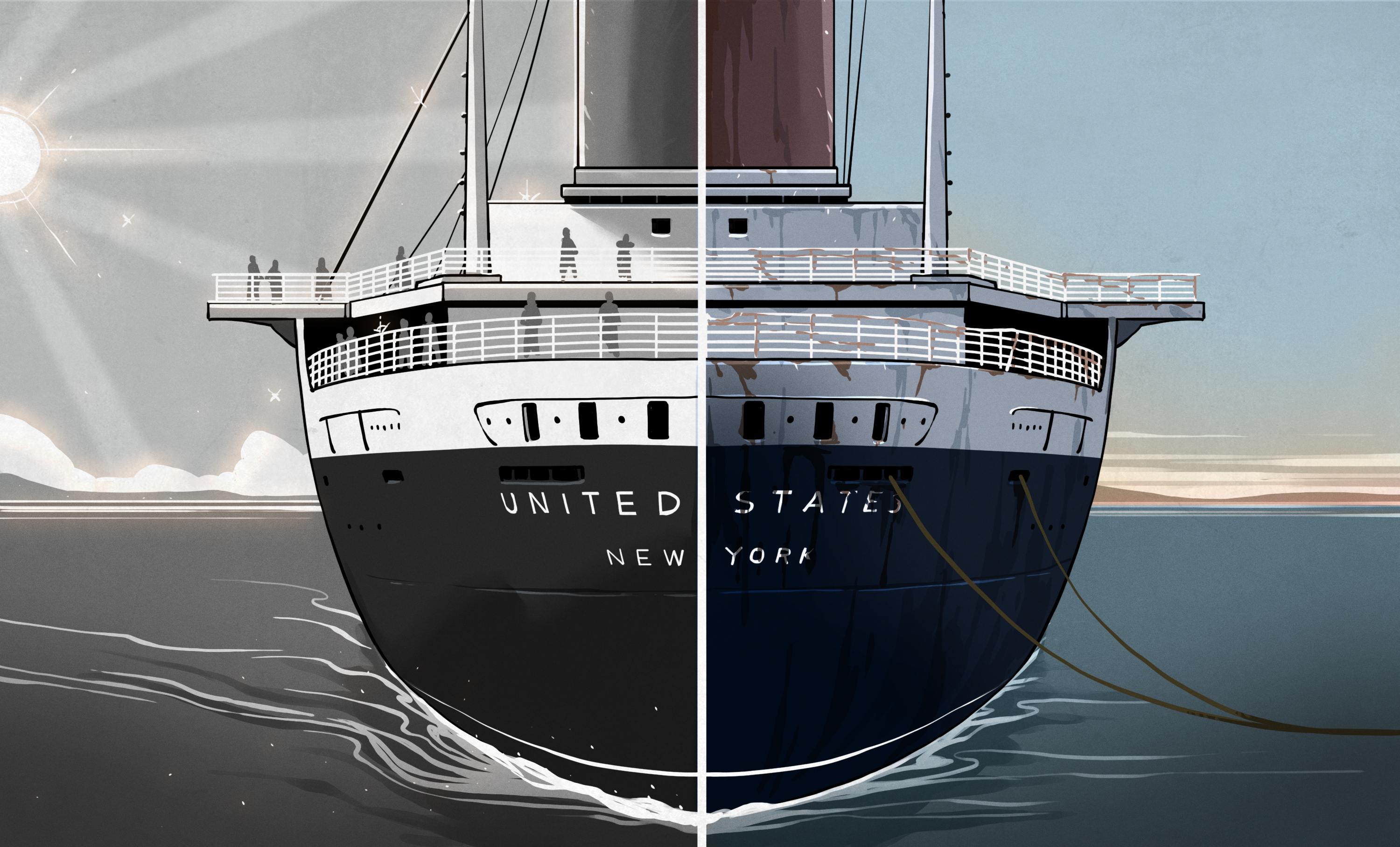
Now the plan is different: preserve her legacy above water through a museum and below water through a massive artificial reef. Preparing the SS United States for that transformation means cleaning, cutting, documenting, stabilizing, towing, permitting, and finally deploying the vessel in a controlled operation. It is a long goodbye, but it is also a new beginning.
Why Sink the SS United States at All?
The central question is emotional as much as practical: why sink an American icon? The answer depends on whom you ask. Preservationists see a masterpiece of naval architecture that deserved a fully restored future. Okaloosa County and reef supporters see a vessel that had few realistic options left and could now become a world-class dive site, marine habitat, and museum anchor in every sense except the literal one.
The SS United States had been stripped over the decades. Her engines were no longer operational. Much of the glamorous interior had already disappeared. Restoring her to passenger service or converting her into a stationary attraction would have required enormous investment, a permanent waterfront location, structural rehabilitation, code compliance, and long-term operating money. That is a lot of “ifs” before breakfast.
Artificial reefing offers a different kind of preservation. Instead of disappearing into scrap, the ship can remain recognizable, purposeful, and visited. Divers may one day descend along her enormous hull. Anglers may find fish gathering around her structure. A land-based museum in Destin-Fort Walton Beach is expected to tell the ship’s story using artifacts, exhibits, and preserved iconic components, including her famous funnels.
In that sense, the SS United States is not simply being sunk. She is being reassigned. The ship that once crossed the Atlantic faster than any passenger liner before her is being turned into a destination for marine life, divers, historians, and anyone who thinks a 990-foot ocean liner makes a pretty dramatic fish condo.
The Final Journey Begins in Philadelphia
For nearly 30 years, the SS United States sat along the Delaware River in South Philadelphia. To locals, she was impossible to miss: massive, silent, faded, and still somehow proud. After legal and financial disputes over her berth, the ship’s future became urgent. Okaloosa County, Florida, reached an agreement to acquire the vessel with the goal of converting it into an artificial reef and supporting a museum project.
Moving a ship of this size after decades at rest is not like pulling a car out of long-term airport parking. Before the first major tow, teams had to consider hull condition, weather, bridge clearances, tide windows, tug arrangements, navigation plans, and Coast Guard safety requirements. The ship could not move under her own power, so tugboats had to do the hard work.
In February 2025, the SS United States left Philadelphia and began the slow tow to Mobile, Alabama. The journey covered more than 1,000 nautical miles and marked the first major chapter of her transformation. Crowds watched as the great liner slipped away from the city that had hosted her long after her working life ended. It was part maritime operation, part public farewell, and part reminder that ships, unlike most celebrities, do not age quietly.
Why Mobile, Alabama Matters
Mobile was not chosen because the ship needed a vacation with better seafood, although that would be understandable. The Alabama port provides industrial capacity, maritime contractors, and access to facilities needed for large-scale vessel preparation. Before an old ship can become an artificial reef, it must be cleaned and modified so it does not become an underwater pollution problem.
For the SS United States, the Mobile phase has included environmental remediation, removal of materials that should not enter the Gulf, and preparation of the structure for its underwater life. Officials have described this process as necessary to ensure an environmentally safe deployment. By spring 2026, required remediation had been reported as complete, with the project waiting on final approvals from federal agencies before a deployment date could be set.
Step One: Clean the Ship Before the Sea Gets It
Artificial reefing begins with a simple rule: the ocean is not a landfill wearing a blue hat. Before a vessel is intentionally sunk, hazardous and unsuitable materials must be removed. Federal best management practices for vessel reefing emphasize environmental preparation so ships placed underwater support habitat rather than contaminate it.
For a historic liner, cleanup can include removing or addressing fuels, oils, loose debris, wiring, plastics, glass, chemicals, contaminated materials, and other components that could create environmental risk. Older vessels can also contain substances that modern regulations treat very seriously, including asbestos-containing materials, lead-based coatings, and residues from machinery spaces.
That work is slow because it has to be. Contractors must identify materials, remove them safely, document the process, and satisfy regulators that the vessel meets required standards. The SS United States is not a weekend project with a rented dumpster. She is a former transatlantic liner larger than many city blocks, and every deck, compartment, and structural feature requires review.
Step Two: Save the Pieces That Tell the Story
One of the most important parts of preparing the SS United States is deciding what should not go down with the ship. Her famous red, white, and blue funnels are among the most recognizable features ever placed on an ocean liner. They were designed to suggest motion even when the ship was standing still, which is either brilliant industrial design or the maritime equivalent of wearing running shoes to the grocery store.
The funnels and other selected components have been reserved for the future SS United States Museum and Visitor Experience. That matters because reefing alone cannot tell the full story. A diver may feel the scale of the ship underwater, but a museum can explain why she mattered: her Cold War-era design, her record-breaking maiden voyage, her mid-century interiors, her celebrity passengers, and her role as a symbol of American ambition.
Artifacts, photographs, digital exhibits, simulations, and preserved structural pieces can help visitors understand the ship before she became a reef. The underwater site and the museum are best understood as two halves of the same preservation plan. One protects the silhouette in the sea; the other protects the memory on land.
Step Three: Prepare the Ship for Divers and Marine Life
A reefed ship must be more than clean. It must be suitable for the environment and reasonably accessible for its intended future users. That means planners look at how the vessel will rest on the bottom, how water will move through it, how marine life may colonize it, and how divers might safely experience it under professional guidance.
For dive access, large openings may be planned so divers are not tempted into dangerous, tight, unplanned penetrations. Sharp hazards, loose materials, and unstable components may be removed or secured. Air pockets, entanglement risks, and confusing interior paths are all concerns in artificial reef preparation. A shipwreck can be beautiful, but beauty is less charming when it comes with a surprise maze and rusty tripwires.
Because the SS United States is so large, her future reef profile is expected to offer experiences for multiple levels of divers. Plans have described a site with the bottom around 180 feet deep and upper portions much shallower, making parts of the structure more accessible while still offering challenges for advanced and technical divers.
Step Four: Permits, Approvals, and the Paperwork Ocean
Before the SS United States can be deployed, the project must satisfy regulatory requirements. Agencies such as the U.S. Army Corps of Engineers and the Environmental Protection Agency are involved because placing a massive vessel on the seafloor affects navigation, water quality, marine habitat, and public use.
This is the part of the story where the romance of maritime history meets the thrilling world of forms, reviews, environmental documentation, and official signoffs. It may not look dramatic on television, but it is essential. The goal is to ensure the ship is clean enough, the site is suitable, and the deployment plan meets legal and environmental standards.
As of the latest public updates available in mid-2026, the SS United States had completed environmental remediation and was awaiting final approvals before a specific sinking date could be set. That means the final journey is close, but not simply a matter of choosing a calm Tuesday and pushing a big red button labeled “reef.”
Where Will the SS United States Be Sunk?
The planned reef site is off Northwest Florida, near Destin-Fort Walton Beach and within reach of the Pensacola region. Public reporting has described the selected area as roughly 22 nautical miles southwest of Destin and about 32 nautical miles southeast of Pensacola, with the vessel expected to sit at a depth of about 180 feet.
Location matters. Artificial reefs must be placed where they will not obstruct shipping, damage sensitive natural habitat, or create unreasonable hazards. They also need to be accessible enough to support diving, fishing, and tourism. The SS United States is expected to join an already active artificial reef network in the Gulf, adding a landmark of unusual size and historic importance.
For Northwest Florida, the project is not just about nostalgia. It is also an economic development strategy. Dive shops, charter boats, hotels, restaurants, museums, and local attractions may benefit from visitors drawn by the chance to see America’s flagship underwater. Fish get habitat; divers get bragging rights; tourism marketers get a phrase they can put on billboards without exaggerating: world’s largest artificial reef.
What Happens When a Ship Becomes an Artificial Reef?
Once a properly prepared vessel rests on the seafloor, marine life begins to claim it. Algae, barnacles, corals, sponges, and other organisms attach to surfaces. Small fish use openings and shadows for shelter. Larger fish arrive to hunt, feed, and patrol. Over time, the ship becomes less like an object placed in the ocean and more like a new neighborhood with very salty zoning laws.
Artificial reefs can increase local habitat complexity, especially in areas where the seafloor is otherwise sandy or flat. A ship the size of the SS United States creates vertical relief, shade, current breaks, ledges, and surfaces for colonization. That structure can attract species such as snapper, grouper, amberjack, mackerel, and other Gulf fish.
Still, artificial reefs are not magic. They must be planned and monitored responsibly. A poorly prepared vessel can create pollution or safety issues. A well-prepared one can become a long-term habitat and recreation site. The difference lies in preparation, regulation, and management. That is why the cleanup and approval process matters as much as the dramatic final deployment.
The Emotional Debate: Preservation or Reefing?
Not everyone celebrates the plan. For many maritime enthusiasts, the SS United States should have remained above water. They argue that the ship is a one-of-a-kind engineering achievement and an irreplaceable piece of national history. Their frustration is understandable. Sinking a historic ship can feel final, even when the goal is preservation by transformation.
Supporters of the reef plan counter that the realistic alternative was not a fully restored ocean liner gleaming at a major waterfront. The alternative may have been scrapping. After decades of failed redevelopment efforts, legal pressure, rising costs, and no permanent berth, reefing became a practical way to give the ship a future.
Both sides share one belief: the SS United States matters. The disagreement is over what kind of survival is possible. The museum plan helps bridge that gap by preserving key artifacts and storytelling elements on land while allowing the ship’s hull to serve a new public purpose underwater.
Lessons From the SS United States Project
The final journey of the SS United States offers several lessons for historic preservation. First, saving a large ship requires more than affection. It needs money, location, maintenance, political support, engineering studies, and a business model. Ships are not statues. They rust, leak, require dockage, and quietly generate bills with the enthusiasm of a printer jam generating error messages.
Second, preservation can take more than one form. A museum, digital archive, artifact collection, artificial reef, documentary, and public education program can all preserve different parts of a vessel’s meaning. Not every historic object can remain intact forever, but its story can be carried forward with care.
Third, environmental responsibility is non-negotiable. The romance of sinking a legendary liner only works if the ship is cleaned, approved, and deployed responsibly. The Gulf does not need nostalgia-flavored pollution. It needs habitat, science, and accountability.
Experiences Related to the SS United States’ Final Journey
For anyone who has ever stood beside a great old ship, the SS United States story feels personal even from a distance. Large vessels have a strange emotional power. They are machines, yes, but they also feel like places. They carry memories in their decks, silhouettes, paint lines, stairwells, dining rooms, engine spaces, and names. When a ship like the SS United States reaches the end of one life and the beginning of another, people do not respond as if a pile of metal is being moved. They respond as if a national landmark has exhaled.
Imagine watching her leave Philadelphia after so many years. For some, she was the backdrop to commutes, errands, waterfront walks, and childhood questions from the back seat: “What is that big ship?” For others, she represented family history. A parent, grandparent, sailor, engineer, immigrant, celebrity, or service member may have crossed paths with her. Even people who never stepped aboard could feel attached to the idea of her: fast, sleek, American-built, and stubbornly still there.
The final tow to Mobile had the feel of a public procession. Tugboats replaced engines that once made ocean-liner history. The ship moved slowly where she had once been famous for speed. That contrast is hard to miss. The liner that crossed the Atlantic in record time had to make her final coastal journey carefully, patiently, and under tow. It was not glamorous in the old sense, but it was dignified in a different way.
There is also a unique experience waiting for future divers. Descending toward a ship of that scale will not feel like visiting a small wreck. It will feel like approaching an underwater building, a steel-and-aluminum landscape. The bow, decks, railings, openings, and enormous hull will create a sense of scale that photographs cannot fully deliver. Divers may not see the polished liner of 1952, but they will see the bones of an engineering legend surrounded by Gulf water and marine life.
For non-divers, the museum experience may become just as meaningful. Standing near a preserved funnel, looking at historic images, listening to passenger stories, and learning how the vessel was designed can make the ship real again. The best museums do not simply display objects; they restore context. They explain why something mattered and why people fought over its future.
The SS United States’ final journey is bittersweet because it asks the public to accept an imperfect ending. But many historic preservation stories are imperfect. Buildings are relocated. Artifacts are conserved outside their original setting. Ships become museums, hotels, reefs, or memories. What matters is whether the transition is handled with honesty and respect.
In the end, preparing the SS United States for her final journey is not really about how to sink a ship. It is about how to let a ship keep serving after her first purpose has vanished. She once carried passengers across the Atlantic. Soon, if approvals are completed and the deployment proceeds, she may carry coral, fish, divers, stories, and a new generation of curiosity. That is not the same as sailing, but it is not oblivion either. For a ship that has already outrun history once, becoming a reef may be one last unexpected record.
Conclusion
The SS United States is heading toward one of the most unusual second acts in maritime history. Preparing her for the Gulf is a careful process involving environmental cleanup, artifact preservation, structural modification, regulatory review, and public storytelling. The result may be a massive artificial reef that supports marine life, attracts divers and anglers, strengthens tourism, and keeps the memory of America’s flagship alive in a new form.
Some will always wish she had been restored above water. That feeling is valid. But after decades of uncertainty, the reef plan offers a future that is visible, visitable, and meaningful. The SS United States may no longer race across the Atlantic, but her final journey could still make waves.