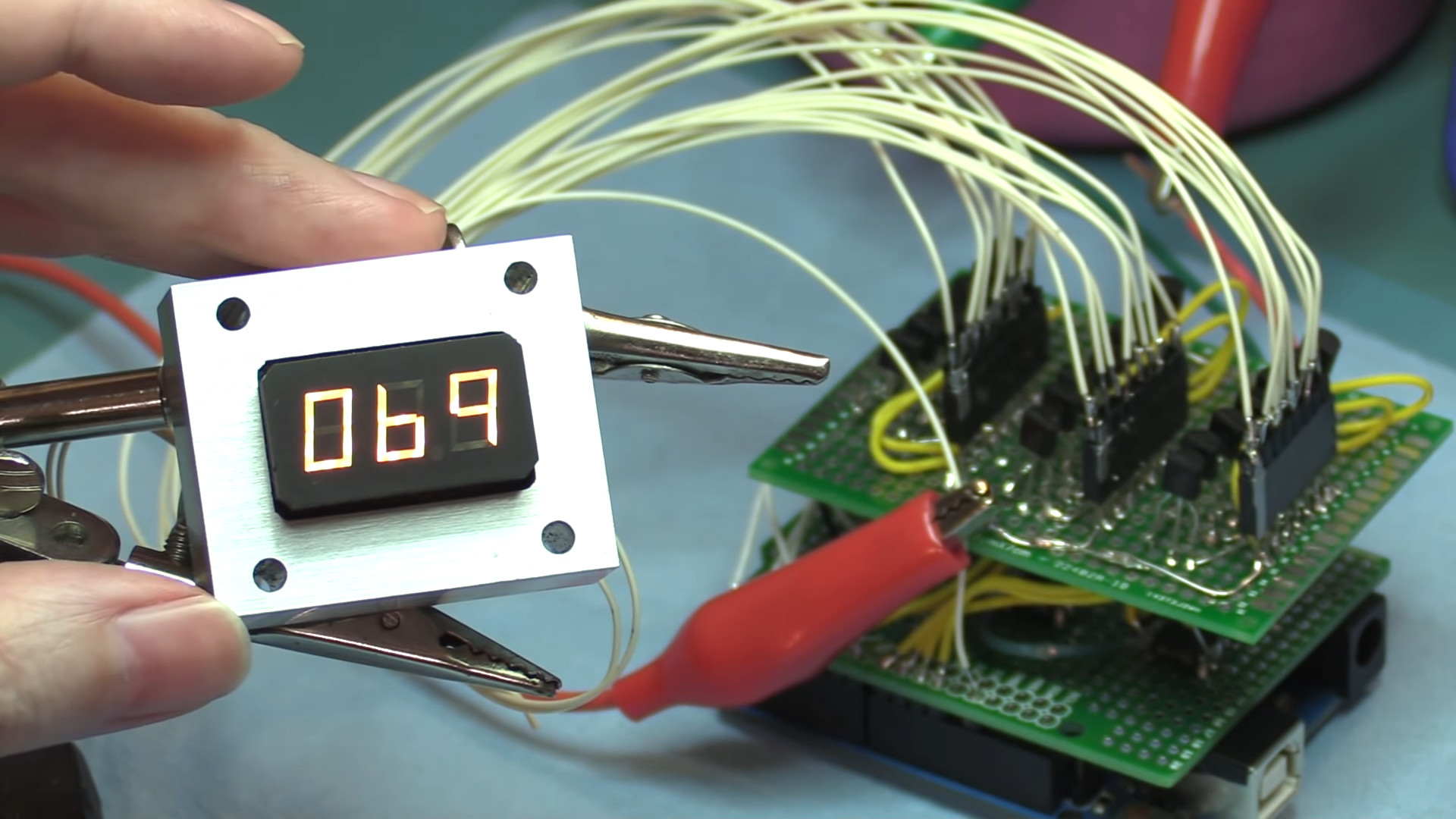

Some electronic displays deliver information. Others deliver information while looking as though they belong in a secret laboratory where engineers wear narrow ties and every machine has a reassuringly heavy power switch. Incandescent 7-segment displays belong firmly in the second category.
Often called Numitron displays, these wonderfully odd devices form numbers with tiny glowing filaments rather than LEDs, liquid crystals, phosphor-coated anodes, or neon-filled numeral shapes. Each segment is essentially a miniature light bulb squeezed into a glass package and assigned one simple job: become part of a number when electricity arrives.
The technology was commercially practical for only a relatively brief period, yet it remains irresistible to collectors, electronics enthusiasts, clock builders, and anyone who believes a digital number should have a little warmth and drama.
What Is an Incandescent 7-Segment Display?
A conventional 7-segment display uses seven bar-shaped elements arranged like a squared-off figure eight. The segments are normally identified as A through G. By energizing different combinations, the display can show the digits zero through nine, along with a limited collection of letters and symbols.
Modern versions usually use LEDs or LCD segments. An incandescent version replaces those elements with fine tungsten coils. Apply the correct voltage to one coil and electrical resistance heats it until it glows. Activate several coils at once and a recognizable numeral appears.
Tiny Light Bulbs Doing Mathematics
The principle is almost comically direct. There is no phosphor, ionized gas, semiconductor junction, or complicated optical projection system. A filament gets hot, the filament glows, and the glowing lines assemble themselves into a digit. It is the same broad idea as an incandescent lamp, except the lamp has been persuaded to display “4.7” instead of illuminating a hallway.
Many classic devices placed the filament structure inside an evacuated glass envelope. The supporting plate was often dark so that unlit segments nearly disappeared behind the illuminated character. Some models added a decimal point, while related designs offered plus and minus symbols or additional segments for limited alphabetic characters.
From Early Segmented Numbers to the RCA Numitron
Segmented numerical displays existed long before the familiar red LED clock. Patents and industrial signaling systems experimented with illuminated segment patterns during the early twentieth century. The concept was attractive because seven controllable elements could represent every decimal digit without requiring ten separate numeral shapes.
RCA brought the best-known incandescent version to the commercial electronics market around 1969 and 1970 under the Numitron name. The company promoted it for equipment such as calculators, cash registers, gasoline pumps, automobile dashboards, measuring instruments, and other machines that needed bright numerical readouts.
RCA’s DR2000-series devices produced characters approximately 0.6 inch tall, while the smaller DR2100 series offered roughly 0.4-inch numerals. Typical published operating figures were about 4.5 volts and 24 milliamps per illuminated segment. That low-voltage requirement was a major selling point during an era when competing display technologies could demand far more complicated power supplies.
Numitron Versus Minitron
“Numitron” is often used casually for almost any incandescent segmented display, although it began as an RCA trademark. Other manufacturers produced similar filament displays, and some compact versions became known as Minitrons. These frequently appeared in rectangular, circuit-board-friendly packages rather than traditional round glass tubes.
The packaging changed, but the magic trick remained the same: delicate glowing wires turned electrical data into warm, sharply defined numbers.
Why Incandescent 7-Segment Displays Look So Good
The Warm Glow Has Real Texture
An LED segment switches on with crisp efficiency. An incandescent segment seems to wake up. Its brightness rises as the filament heats and falls as it cools, giving transitions a subtle softness. The effect is brief, but the eye notices it. Rapidly changing digits can appear to breathe rather than blink.
The emitted light also has a broad, warm spectrum. Instead of the intensely saturated red, green, or blue associated with many LEDs, the filament produces an amber-white glow that feels closer to firelight. Colored filters can turn it red, orange, green, or another shade while preserving the soft character of the source.
You Can See the Mechanism
A glowing filament display does not hide how it works. Look closely and you can see the coiled wires, support pins, ceramic plate, glass envelope, and tiny welds. It is a complete electromechanical sculpture masquerading as a digital component.
That visibility matters. A modern display module can be technically superior while offering very little visual mystery. An incandescent display exposes its construction and invites inspection. It reminds the viewer that a number is being physically created by heated metal.
Unlit Segments Stay in the Background
Well-designed filament displays use dark substrates and carefully positioned coils to produce excellent contrast. When a segment is off, it can become nearly invisible. When it is on, the line appears to float in front of a black background.
This makes the digits look cleaner than one might expect from such an old technology. The planar construction also avoids the visual overlap found in stacked-numeral displays, where multiple complete number shapes sit behind one another.
They Operate at Friendly Voltages
Nixie tubes are beautiful, but they generally require a high-voltage supply. Vacuum fluorescent displays need filament and grid or anode drive arrangements. Many incandescent 7-segment displays operate from approximately five volts, making them much easier to combine with low-voltage digital circuitry.
“Easier” does not mean “connect directly to a microcontroller and hope for the best.” The current requirement is much higher than that of a typical indicator LED. However, a suitable transistor, MOSFET, Darlington array, or power shift register can handle the load without requiring an exotic supply.
The Engineering Quirks Behind the Glow
Current Consumption Adds Up Quickly
A classic Numitron segment operating at 24 milliamps may not sound demanding. Now illuminate all seven segments to display an eight. The digit requires about 168 milliamps. Four static digits showing “8888” can approach 672 milliamps before decimal points, indicator lamps, control electronics, and conversion losses enter the calculation.
That is perfectly manageable, but it is not USB-powered-clock territory unless the power system is designed properly. A regulated supply with adequate current capacity, local bypass capacitors, suitable conductors, and correctly rated switching devices is essential.
Cold Filaments Behave Differently
Tungsten has a lower resistance when cold than when glowing. The initial current can therefore be higher than the steady operating current. In a tiny display this surge is brief, but it is another reason to avoid driving the segments directly from logic pins.
Conservative voltage also matters. A small increase can produce a dramatic rise in brightness while shortening filament life. Running a rare display slightly below its maximum rating often gives an attractive glow and reduces thermal stress.
Multiplexing Is Possible, but Not Effortless
LED displays are commonly multiplexed. The controller rapidly activates one digit at a time, relying on persistence of vision to make all digits appear continuously illuminated. Incandescent displays can also be scanned, and period documentation described multiplexed arrangements.
The trouble is that a filament responds thermally. At a low duty cycle it may not reach full brightness, while compensating with aggressive voltage pulses can stress an irreplaceable component. Static drive is electrically untidy because it requires more switching channels, but it often produces the most stable brightness and the gentlest operating conditions.
For a small clock, the sensible compromise is usually a power shift register or a chain of low-side drivers that gives each segment a steady current path without consuming dozens of microcontroller pins.
How to Drive a Numitron With Modern Electronics
Begin With the Exact Data Sheet
Do not assume that every filament display uses the same pinout, voltage, current, or common connection. Identify the manufacturer and part number whenever possible. A DR2110, an IV-9, and a rectangular Minitron may all display the same digits while requiring different wiring.
For an unknown device, use a multimeter and a current-limited bench supply. Start at a very low voltage and map the segments carefully. Never begin by applying five volts randomly to old pins. That is less “reverse engineering” and more “tiny glass funeral.”
Use Proper Switching Hardware
Logic-level N-channel MOSFETs are excellent low-side switches when the display has a common positive connection. Bipolar transistor arrays can also work, although their voltage drop must be considered. Power shift registers such as the TPIC6B595 are popular in modern builds because they combine serial control with outputs capable of sinking substantially more current than ordinary logic chips.
A classic BCD-to-7-segment decoder may be useful when the project only needs decimal digits. A microcontroller offers greater flexibility because it can generate unusual patterns, perform brightness control, animate transitions, and display the occasional questionable letter that seven segments can almostbut not quiterepresent.
Design for Power-On Safety
Microcontroller pins can float or enter unpredictable states during startup. Add pull-up or pull-down resistors so the segment drivers remain off until the firmware is ready. A master output-enable line is even better. It prevents the display from flashing random segments every time the device resets.
Place decoupling capacitors near the driver circuitry and provide bulk capacitance near the display bank. Several filaments switching simultaneously can produce abrupt changes in current that cause voltage dips, resets, or visible brightness variations.
Use Dimming Conservatively
Pulse-width modulation can adjust brightness, and the filament’s thermal inertia naturally smooths rapid pulses. Still, the peak voltage should remain within a safe range. Incandescent segments are not high-power LEDs waiting to be overdriven at heroic pulse currents.
For valuable tubes, modest voltage reduction is often the simplest dimming method. It changes both brightness and color temperature, producing an especially warm glow at lower levels.
Where Incandescent Displays Lose to Modern Technology
No one should mistake nostalgia for efficiency. Incandescent segments consume more power than LEDs, release more heat, require heavier driver circuitry, and can be damaged by shock or vibration. They are no longer mass-produced in the way ordinary LED modules are, so failed components may be difficult or expensive to replace.
Brightness matching can also become a challenge. New-old-stock displays from different manufacturing batches may not have identical filament geometry. Used devices can show uneven segments, darkened glass, bent supports, weak seals, or partially damaged filaments.
They are also limited communicators. Seven bars handle numbers beautifully but treat the alphabet like an awkward family reunion. A few letters look respectable, several require imagination, and others should not be attempted without adult supervision.
Yet these weaknesses contribute to their appeal. An incandescent display demands planning, rewards careful construction, and gives a project a physical presence that a generic module rarely matches.
Great Projects for Incandescent 7-Segment Displays
A digital clock is the obvious choice because slowly changing numbers emphasize the graceful filament transitions. Add a real-time clock module, a temperature sensor, and automatic nighttime dimming for a practical desk display.
Other possibilities include a frequency counter, bench power-supply readout, audio level indicator, countdown timer, retro thermostat, dice machine, radio dial, elevator-style floor indicator, or a deliberately overengineered kitchen timer.
A single tube can become a minimalist clock that cycles through the hours and minutes one digit at a time. It can also serve as a status indicator, displaying operating modes, error codes, or the number of minutes since someone last asked why the project uses obsolete technology.
Buying and Preserving Vintage Filament Displays
Collectors should look for clear part numbers, intact evacuation seals, straight leads, consistent internal supports, and photographs showing every segment illuminated. A white or chalky getter deposit inside a vacuum device may indicate that air has entered the envelope.
Matched lots are preferable for multi-digit projects. Even when the electrical specifications agree, displays from different sources may vary in color, segment shape, height, or brightness. Purchase at least one spare when possible because replacing a failed digit years later may require redesigning the entire front panel.
Handle the leads gently and avoid bending them repeatedly at the glass seal. Use sockets when suitable ones are available. A smoked acrylic window or neutral-density filter can improve contrast, hide unlit structures, and protect the glass from wandering fingers.
Most importantly, resist the temptation to run the tubes at maximum brightness simply because they can survive it. A softly glowing display usually looks better, runs cooler, and has a much greater chance of entertaining future generations of hardware enthusiasts.
Why These Displays Still Matter
Incandescent 7-segment displays occupy a fascinating intersection between the age of vacuum tubes and the age of integrated digital electronics. Their information is unmistakably digital, but the process of creating it is beautifully analog. Temperature rises, resistance changes, metal glows, and light fades gradually after the current stops.
They remind us that efficiency is not the only measure of good design. Sometimes a component earns affection because it reveals its operation, responds visibly to physics, and turns an ordinary number into a small performance.
LEDs are practical. LCDs are efficient. Nixies are theatrical. Incandescent 7-segment displays somehow manage to be practical, inefficient, theatrical, and charming at the same time. That is why they are awesome.
A Builder’s Experience With Incandescent Digits
The following account combines experiences commonly reported by makers who restore and build projects around filament displays.
The first surprise usually arrives before the display produces any light. A Numitron looks simple in a photograph, but under a magnifying lens it becomes a miniature construction project. Each segment is a carefully formed coil suspended between tiny supports. The decimal point may use crossed filaments. The dark plate contains openings and mounting details that are almost invisible until the glass catches the light.
Mapping an undocumented tube encourages patience immediately. A current-limited supply is set low, two leads are selected, and nothing happens. Another combination produces nothing. Then one filament begins to glow so faintly that it could be mistaken for a reflection. The voltage rises slightly and a perfect amber line appears. It is difficult not to grin. One segment has turned a box of unidentified old parts into a functioning display.
The second surprise is the current meter. Lighting one segment seems harmless. Lighting enough segments to form an eight causes the reading to climb with impressive confidence. Add three more digits and the modest clock project begins demanding a power supply that looks as though it could recharge a small motorcycle. This is normally the moment when the builder stops thinking of Numitrons as unusual LEDs and starts treating them as banks of tiny lamps.
Driver-board testing brings another distinctive pleasure. With LEDs, a test pattern snaps instantly from 0 to 1 to 2. Filament segments overlap slightly as they heat and cool. At slow transition speeds, the effect is subtle. During a rapid count, however, the numerals develop glowing trails that make the display look alive. An ordinary incrementing loop suddenly resembles instrumentation from a 1970s spacecraft.
Front-panel experiments can consume an entire evening. Clear acrylic preserves maximum brightness but exposes every support wire. Smoked acrylic hides the inactive structure and makes illuminated segments appear to float. Amber material deepens the warmth. A dark red filter creates an unexpectedly convincing vintage calculator appearance. Moving the filter only a few millimeters from the tube changes reflections and viewing angle, so cardboard prototypes become surprisingly useful.
Photography presents its own challenge. Automatic camera settings often exaggerate the glow and erase the filament detail. Lower exposure reveals the coils, but then the surrounding project disappears into darkness. The best images usually come from balancing soft ambient light with reduced display brightness rather than simply turning every segment up to its maximum rating.
After several hours of operation, the enclosure feels slightly warm. That warmth is not usually dangerous in a properly designed project, but it changes the way the hardware is perceived. The clock is no longer a silent slab of electronics. It has an operating temperature, a faint visual rhythm, and a sense that something physical is happening behind the glass.
The most satisfying moment comes when the project is finally placed on a desk. Visitors recognize the digits immediately but often cannot identify the technology. They may guess LEDs, Nixies, or “some kind of old tube.” Explaining that every line is a separate incandescent filament usually causes them to lean closer.
That reaction captures the real value of these displays. They make familiar information unfamiliar again. A time such as 12:47 is completely ordinary, yet presenting it with seven glowing wires per digit turns it into something worth examining. The display performs its basic job while quietly teaching a lesson about resistance, heat, light, materials, and the inventive detours electronics took before modern modules became cheap and universal.