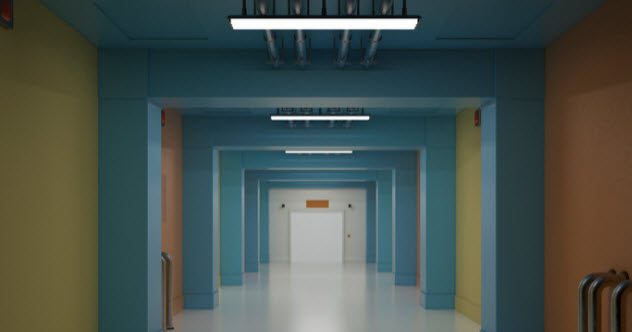

Some government buildings advertise themselves with marble steps, flags, and helpful signs explaining where visitors should stand. Others hide inside mountains, beneath luxury hotels, or under patches of prairie so ordinary that even the cows appear uninterested.
America’s underground facilities were largely products of World War II and the Cold War. Military planners feared that a surprise attack could destroy Washington, interrupt communications, eliminate command centers, or prevent the government from functioning. Their solution was a network of hardened shelters, relocation centers, missile-control posts, and subterranean command complexes.
Not every facility on this list remains secret. Several have been declassified, converted into museums, or acknowledged through official budgets and historical records. Others remain active, which means many details are appropriately unavailable. The ranking therefore focuses on publicly documented history rather than rumors involving alien refrigerators, underground monorails, or mysterious cafeteria meatloaf.
Here are 10 of the most fascinating secret United States government bunkers, including continuity-of-government facilities, nuclear command centers, and Cold War sites hidden in plain sight.
10. Titan Missile Site 571-7, Arizona
A nuclear fortress beneath the desert
South of Tucson, Arizona, a seemingly modest military compound conceals one of the most impressive surviving underground missile complexes in the country. Titan Missile Site 571-7 was one of 54 Titan II installations placed on alert across the United States during the Cold War.
Its underground sections included a launch-control center, connecting cableways, blast locks, equipment rooms, and an enormous missile silo. Crews worked behind heavy doors and shock-isolated structures while monitoring a Titan II intercontinental ballistic missile capable of being launched from inside its silo.
The site was deactivated as part of the Titan II retirement program and preserved instead of demolished. It is now the Titan Missile Museum and the only remaining Titan II complex open to visitors. The missile is permanently disabled, but the control room, communications equipment, suspended floors, and thick concrete surroundings make the threat of nuclear war feel disturbingly immediate. It is less like entering a traditional museum and more like walking onto the set of a thriller in which nobody is permitted to improvise.
9. Nike Missile Site SF-88, California
San Francisco’s underground last line of defense
During the Cold War, the United States Army surrounded major cities, industrial regions, and military installations with Nike missile batteries. Approximately 300 sites were constructed nationwide, but most disappeared after the program ended.
SF-88, hidden in the Marin Headlands north of San Francisco, is the best-preserved example. The installation protected the Bay Area from formations of hostile bombers. Its missiles were stored horizontally in underground magazines and raised to the surface on elevators when required.
The site operated from 1955 until 1974. Soldiers remained on alert around the clock, maintaining missiles that could be prepared for launch within minutes. That routine involved long stretches of inspection, training, and waiting, punctuated by the knowledge that a real launch order would probably mean the beginning of a much larger catastrophe.
Today, the National Park Service preserves SF-88 with help from veterans and volunteers. Its restored equipment reveals how military infrastructure could sit remarkably close to neighborhoods and scenic parkland without most residents understanding what was beneath the concrete.
8. Delta-01 Launch Control Facility, South Dakota
The bunker that commanded 10 Minuteman missiles
Across the Great Plains, Cold War missile installations were deliberately designed to look forgettable. A fenced compound beside a rural road might appear to contain little more than utility buildings. Thirty-one feet below Delta-01, however, two Air Force missileers once sat inside a hardened Launch Control Center capable of commanding 10 Minuteman missiles.
The underground room was reached by a small elevator and protected by a massive blast door. Its equipment monitored missile status, communications, security alarms, and emergency messages. Launch procedures required cooperation between crew members, reducing the chance that one person could make a civilization-altering decision after having a particularly bad morning.
Delta-01 maintained active alert status from 1963 until 1993. It is now part of Minuteman Missile National Historic Site, where limited ranger-led tours introduce visitors to the confined environment in which crews completed long shifts beneath the prairie.
The facility demonstrates that a bunker did not need to resemble a mountain fortress. Sometimes the most consequential room in hundreds of square miles was a compact capsule buried below an ordinary ranching landscape.
7. Manzano Base, New Mexico
A hardened home for America’s early nuclear arsenal
The foothills southeast of Albuquerque once contained one of the most sensitive weapons-storage complexes in the United States. Construction in the Manzano Mountains began in the late 1940s as the military developed secure facilities for storing, maintaining, and supporting nuclear weapons.
Natural terrain added protection, while hardened structures and underground storage areas helped separate critical materials from the outside world. The site became Manzano Base in 1952 and operated alongside nearby Sandia Base and Kirtland Air Force Base during the rapid expansion of America’s nuclear weapons program.
Unlike a command bunker, Manzano’s primary historical role involved weapons storage and technical support. That distinction hardly made it less secret. Nuclear components, security procedures, and storage arrangements were among the most closely guarded subjects of the era.
Manzano Base was later absorbed into Kirtland Air Force Base. Public military histories confirm its importance, although many operational details remain outside the public record. It represents the industrial side of underground defense: less glamorous than a presidential shelter, but absolutely central to the machinery of nuclear deterrence.
6. Mount Pony Federal Reserve Bunker, Virginia
Because even the apocalypse apparently needs cash
Mount Pony near Culpeper, Virginia, housed one of the Cold War’s strangest contingency plans. Dedicated in 1969, the Federal Reserve’s Communications and Records Center was a radiation-hardened bunker designed to support financial communications and help the banking system survive a national disaster.
The facility contained the Culpeper Switch, an important component of the Federal Reserve’s electronic communications network. It also stored billions of dollars in currency. The theory was practical: if war or another catastrophe disrupted banking and destroyed large quantities of money, reserve cash could help restart economic activity.
Picture it: cities are damaged, communications are struggling, and somewhere inside a Virginia mountain, pallets of carefully wrapped banknotes are waiting for business hours to resume.
The federal government decommissioned the facility in 1993. Congress later authorized its transformation into the Library of Congress Packard Campus for Audio-Visual Conservation. Instead of guarding emergency currency, the former bunker now protects films, television programs, radio broadcasts, and sound recordings. It may be history’s most impressive career changefrom safeguarding dollars to safeguarding Dolly Parton.
5. The Greenbrier Congressional Bunker, West Virginia
A secret shelter beneath a luxury resort
The bunker beneath The Greenbrier resort is one of the most ingenious examples of Cold War concealment. In 1958, Congress arranged for the construction of an emergency relocation center beneath a new hotel wing in White Sulphur Springs, West Virginia.
Codenamed Project Greek Island, the shelter was intended to house members of the House and Senate after a national emergency. Its facilities included dormitory space, meeting rooms, communications areas, medical capabilities, kitchens, and chambers where Congress could theoretically continue legislative business.
Hotel construction provided an excellent cover. Conference rooms and public spaces helped explain the heavy equipment, excavation, and unusual architectural additions. For approximately three decades, a small maintenance staff kept the bunker ready while resort guests played golf, attended banquets, and remained blissfully unaware that the legislative branch had reserved accommodations downstairs.
The Washington Post revealed the bunker’s existence in 1992, ending its operational role. It is now open for guided tours. Visitors can see enormous blast doors and spaces designed for lawmakers who might have been forced to debate national survival while sleeping in bunk beds. Bipartisanship would presumably have arrived shortly after everyone discovered the shower schedule.
4. Presidential Emergency Operations Center, Washington, D.C.
The White House bunker brought into public view on 9/11
Beneath the White House complex is a secure emergency facility known as the Presidential Emergency Operations Center, or PEOC. It serves as a protected communications and coordination space for the president, vice president, and senior officials during severe threats.
The public knows relatively little about its construction, dimensions, or present capabilities. That is unsurprising. Publishing a detailed visitor’s guide would rather defeat the purpose of having a secure presidential bunker.
The PEOC became widely known after the terrorist attacks of September 11, 2001. Vice President Dick Cheney, national security officials, Secret Service personnel, and senior White House staff gathered there as the attacks unfolded. President George W. Bush later met with the National Security Council inside the facility.
Official photographs from that day revealed an environment that looked more like a compact crisis conference room than a Hollywood super-bunker. Its true value was not decorative drama but protected communications, reliable information, and a place where national leaders could work while the security situation remained uncertain.
3. Mount Weather Emergency Operations Center, Virginia
The executive branch’s continuity stronghold
Mount Weather occupies a rugged area in Virginia’s Blue Ridge region west of Washington, D.C. The site began as a weather research location before being expanded during the Cold War into a major emergency and continuity facility.
Its public mission is connected to the Federal Emergency Management Agency and national continuity programs. FEMA describes Mount Weather as providing redundant infrastructure, communications, logistics, buildings, and personnel capable of supporting vital government functions under a wide range of conditions.
The site has long been associated with plans to relocate executive branch personnel if Washington becomes unsafe or unusable. It has also supported disaster-response coordination, training, classified activities, and continuity exercises.
Older accounts often describe a vast subterranean settlement complete with nearly everything required to sustain government operations. Some popular descriptions mix documented facts with decades of rumor. What can be stated confidently is that Mount Weather remains an important federal continuity facility and that many current details are not publicly disclosed.
In other words, it is not an abandoned movie set waiting for adventurous explorers. It is an active government installation, and the “No Trespassing” signs are not whimsical regional decorations.
2. Raven Rock Mountain Complex, Pennsylvania
The underground alternate Pentagon
Raven Rock Mountain Complex sits near the Pennsylvania-Maryland border and is frequently called Site R. Developed during the early Cold War, it was created as a hardened alternate command location for the Department of Defense if the Pentagon could no longer operate.
The installation’s exact internal configuration remains largely classified, but its broad mission is officially acknowledged. Department of Defense budget documents describe Raven Rock as a secure strategic battle-command platform that supports continuity of operations and essential defense functions.
That makes it more than a shelter. It is intended to preserve decision-making, communications, coordination, and military command during an extreme emergency. The complex continues to receive operational support and infrastructure investment, confirming that its role did not end with the collapse of the Soviet Union.
Raven Rock has inspired countless stories about underground cities, endless tunnels, and secret transportation systems. Public evidence supports the existence of a major hardened complex, but not every dramatic online claim. The known mission is already remarkable enough: maintain national defense command when normal headquarters are unavailable. Adding a subterranean shopping mall would merely complicate the expense reports.
1. Cheyenne Mountain Complex, Colorado
America’s most iconic mountain bunker
No list of secret United States government bunkers would be complete without Cheyenne Mountain. Built near Colorado Springs, the facility was conceived during the Cold War as a hardened command center capable of supporting warning and defense operations during a nuclear attack.
Construction required removing hundreds of thousands of tons of granite. Inside the mountain, 15 buildings were placed on giant springs to help isolate them from shock. Massive blast doors, reservoirs, generators, communications systems, and protected working areas made the complex a symbol of hardened military engineering.
Cheyenne Mountain became operational as the NORAD Combat Operations Center in 1966. Its missions included aerospace warning, air defense, and warning of missile attacks against North America. Most routine NORAD and U.S. Northern Command operations later shifted to nearby Peterson Space Force Base, but Cheyenne Mountain remains an alternate joint operations center and training location.
It earns the top ranking because it combines engineering, military importance, cultural fame, and a genuinely mountain-sized commitment to backup planning. Public tours are not currently available, so anyone hoping to stroll through the blast doors with a camera and a granola bar will need to revise the itinerary.
Why the United States Built So Many Underground Facilities
These bunkers were created for different missions, but they shared a central assumption: a future attack might be so sudden and destructive that normal government offices, communication networks, and military bases would stop functioning.
Continuity planners therefore distributed leadership, records, equipment, communications systems, and weapons-control responsibilities across multiple hardened locations. Redundancy mattered. A single indestructible headquarters was impossible, but a network of alternate facilities could make complete paralysis less likely.
Technology has changed the threat landscape. Cyberattacks, terrorism, biological emergencies, electromagnetic disruption, natural disasters, and attacks on infrastructure now influence continuity planning alongside nuclear weapons. The old bunkers nevertheless remain physical reminders of a problem every government must address: how do institutions continue operating when the usual rooms, networks, and personnel are suddenly unavailable?
Experiencing America’s Secret Bunker History
What visiting a declassified bunker feels like
Visiting a preserved government bunker is different from touring a normal historic building. In a mansion, battlefield museum, or state capitol, the architecture is often intended to impress. A bunker is designed to survive. Its beauty, when it has any, is accidental.
The experience usually begins with compression. Corridors are narrow, ceilings feel low, and thick doors divide one section from another. Exposed pipes, cable trays, ventilation ducts, alarms, and mechanical equipment compete for space. Even when a guide explains that the facility has been inactive for decades, the rooms retain a sense of unfinished business.
At the Titan Missile Museum, visitors descend into a world of suspended floors, heavy doors, warning lights, and control consoles. The simulated launch procedure can be unsettling because the equipment is not a movie prop. Real crews once trained to perform those steps, knowing they might receive an authenticated order that could not be reversed after launch.
Delta-01 creates a different feeling. Its location beneath quiet South Dakota prairie emphasizes how successfully the missile network blended into everyday America. Aboveground, there is sky, grass, wind, and passing traffic. Underground, there is a compact control room connected to weapons that once represented extraordinary destructive power. The contrast is more powerful than any dramatic soundtrack.
The Greenbrier bunker offers perhaps the strangest visitor experience because its concealment was woven into a luxury resort. One moment, guests are surrounded by colorful décor and polished hospitality; the next, they are looking at blast doors and institutional dormitories intended for Congress. The transition makes Project Greek Island’s secrecy easier to understand. The bunker did not hide in an empty wilderness. It hid behind normal activity.
The sounds, objects, and details visitors remember
People often expect bunkers to feel enormous. Some do, but individual working spaces can be surprisingly cramped. What leaves a lasting impression is usually the weight of everything: doors that look as though they could stop a locomotive, thick concrete walls, steel hardware, and machinery engineered with little concern for elegance.
Silence also plays a role. When ventilation equipment is turned off, underground rooms can feel disconnected from weather and time. There are no windows showing whether it is morning, evening, sunny, or snowing. That isolation helps visitors appreciate the psychological challenge faced by missile crews and emergency staff who spent long shifts belowground.
Small human details prevent the sites from becoming abstract monuments. Kitchens, bunks, coffee equipment, handwritten labels, office chairs, telephones, and maintenance checklists reveal that these facilities depended on ordinary workers. A bunker may be made of reinforced concrete, but its mission still relies on someone replacing filters, testing radios, preparing meals, and remaining awake at 3:17 a.m.
How to approach bunker tourism responsibly
The safest and most rewarding experiences are at officially operated museums and authorized historical sites. The Titan Missile Museum, Delta-01, SF-88, and The Greenbrier provide structured access without trespassing, damaging artifacts, or interfering with active installations.
Visitors should resist treating the subject as nothing more than doomsday entertainment. These facilities represent fear, deterrence, public spending, technological achievement, and the possibility of mass destruction. The best tours balance fascination with uncomfortable questions: Who would have been protected? Who would have been left outside? Could leaders communicate effectively? Would preserved institutions still be legitimate after a national catastrophe?
A good bunker visit does not leave people cheering for the apocalypse. It leaves them grateful that most of these rooms were never used for their ultimate purposeand slightly more appreciative of sunlight, windows, and doors that can be opened without hydraulic assistance.
Conclusion
America’s government bunkers reveal a hidden layer of national history. Cheyenne Mountain and Raven Rock protected military command. Mount Weather and the White House PEOC supported continuity and crisis management. The Greenbrier prepared to shelter Congress, while Mount Pony attempted to protect the financial system. Missile facilities placed small crews underground with responsibilities almost too large to imagine.
Some of these locations are now museums. Others remain active and appropriately secretive. Together, they show how the United States prepared for scenarios in which familiar institutions might have to disappear belowground to survive.
Their walls were built from concrete and steel, but their real purpose was continuity: preserving authority, communication, and decision-making when everything aboveground had gone terribly wrong. Fortunately, the most interesting bunker experience available today usually ends at a gift shop rather than with an emergency broadcast.
Note: This article uses only publicly documented, officially acknowledged, declassified, or museum-preserved information. Exact access procedures, security arrangements, technical vulnerabilities, and undisclosed operational details concerning active facilities have intentionally been excluded.
SEO Metadata