This Photographer Brings Awareness To Diversity Through Portrait Photography (40 New Pics)

Some photographers chase sunsets. Some chase perfectly folded napkins on restaurant tables. Brock Elbank chases something far more interesting: the human face in all its glorious, unpredictable, “no two people are built from the same blueprint” beauty. His portrait photography has become a visual celebration of diversity, individuality, and the features many people were once taught to hide.
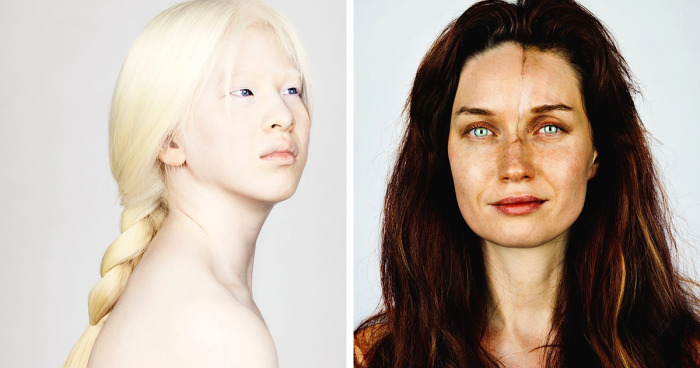
In the series that inspired the title “This Photographer Brings Awareness To Diversity Through Portrait Photography (40 New Pics)”, Elbank continues a body of work that turns freckles, vitiligo, scars, beards, birthmarks, congenital melanocytic nevi, and other visible differences into powerful portraits of presence. These are not “before and after” images. They are not makeover stories. They are not pity portraits dressed up in dramatic lighting. They are direct, dignified, beautifully composed images that say: look closer, but look with respect.
And that is the quiet genius of Elbank’s work. He doesn’t ask viewers to “accept” diversity as if it were a homework assignment due Friday. He makes diversity impossible to ignore because it is right there, centered, lit with care, and staring back with confidence. The result is portrait photography that feels both intimate and public, personal and universal, artistic and deeply human.
Who Is Brock Elbank?
Brock Elbank is a London-based British portrait photographer known for photographing people whose appearances challenge narrow beauty standards. His work has included celebrated portrait series focused on beards, freckles, vitiligo, scars, congenital melanocytic nevi, and broader studies of humankind. Instead of smoothing out differences, Elbank leans into them. In a world where filters can turn every face into the same shiny plastic spoon, his camera does the opposite: it returns texture, personality, and story.
Elbank’s portrait style is often clean, controlled, and strikingly simple. The background rarely competes with the subject. The lighting is deliberate. The face, skin, posture, and expression carry the image. This restraint matters. When the frame is uncluttered, the viewer cannot escape into distractions. There is no busy wallpaper to examine, no random chair to judge, no suspicious houseplant demanding its own Instagram account. There is simply a person, fully present.
Why Diversity in Portrait Photography Matters
Portraiture has always been more than a record of what someone looks like. A portrait can communicate identity, mood, cultural background, dignity, vulnerability, strength, humor, and belonging. It can also reveal how society chooses to see people. For centuries, portraits often centered the powerful, wealthy, famous, or socially approved. Modern portrait photography has widened that frame, making room for people whose stories were ignored, stereotyped, or treated as side notes.
Diversity in portrait photography matters because images help shape what people consider normal, beautiful, professional, worthy, and memorable. When magazines, ads, museums, and social feeds show only one type of face or body, the message is not subtle. It whispers, and sometimes shouts, that everyone else is an exception. Elbank’s work pushes back against that visual laziness. His portraits say that the so-called exception may actually be the most interesting part of the room.
This is especially important for visible differences. Freckles, vitiligo, scars, facial hair, skin conditions, and birthmarks can become emotional territory for the people who live with them. Some people are teased. Some are stared at. Some are asked invasive questions by strangers who apparently missed the class called “Basic Manners 101.” By photographing these features with elegance and confidence, Elbank helps shift the conversation from “What happened to you?” to “Who are you?”
The Power Behind the “40 New Pics” Format
A collection of 40 portraits does something a single viral image cannot. One portrait can be moving, but a gallery creates rhythm. As viewers scroll through face after face, difference stops feeling rare. The eye adjusts. The mind relaxes. The viewer begins to notice patterns and contrasts: soft expressions, bold stares, delicate skin details, strong silhouettes, quiet smiles, playful confidence, and the calm authority of people who have decided they no longer need to apologize for being seen.
That repetition is powerful. The first portrait may surprise the viewer. The tenth may invite admiration. By the thirtieth, the viewer is no longer treating difference as spectacle. They are reading the portraits as a community of individuals. That is how awareness grows: not through one dramatic lecture, but through repeated, respectful exposure to real people.
Freckles: From “Flaw” to Fingerprint
One of Elbank’s best-known projects is his work with freckled subjects. Freckles are often treated strangely in popular culture. On children, they may be called cute. On adults, they may be edited away, covered with makeup, or treated as something to “correct.” Elbank’s portraits reject that idea completely. In his work, freckles are not noise on the skin; they are visual music.
The beauty of the freckle portraits comes from their specificity. Freckles gather differently on every face. They cluster, scatter, fade, darken, and create patterns that feel almost astronomical. One person’s face may look dusted with cinnamon. Another’s may resemble a night sky. The comparison sounds poetic, but it is also technically accurate: the camera records details that many people have been trained to overlook.
By photographing freckled people from different countries, ethnic backgrounds, ages, and personal histories, Elbank shows that freckles are not a single “look.” They are part of the enormous variety of human appearance. In that sense, the series becomes more than a study of skin. It becomes a study of how individuality repeats itself without ever duplicating itself.
Vitiligo and the Courage to Be Visible
Elbank’s vitiligo portraits carry a different emotional charge. Vitiligo, a condition that causes areas of skin to lose pigment, is highly visible and often misunderstood. People with vitiligo may deal with curiosity, judgment, misinformation, or unwanted attention. In many communities, skin differences can carry social pressure that is difficult to explain to someone who has never experienced it.
In Elbank’s portraits, vitiligo is not hidden, softened, or treated as a problem. The graphic contrast of the skin becomes part of the composition. The subjects look elegant, strong, thoughtful, funny, calm, fierce, or tender depending on the person, not the condition. That distinction is essential. The portraits do not reduce people to vitiligo. They show people with vitiligo as complex human beings who happen to have visually remarkable skin.
This is where portrait photography can become a form of public education. A viewer may arrive with limited understanding and leave with a changed visual vocabulary. Instead of seeing vitiligo as something unfamiliar or uncomfortable, they may begin to see pattern, confidence, and humanity. Awareness starts when the image slows people down long enough to replace assumption with attention.
Scars, Beards, Birthmarks, and the Wider Story of Human Difference
Elbank’s larger body of work also includes portraits of people with scars, beards, and congenital melanocytic nevi. Each theme opens a different conversation. Scars may point to survival, injury, surgery, accident, illness, or personal transformation. Beards can carry cultural, religious, stylistic, gender, and identity meanings. Birthmarks and skin conditions can shape how people are perceived from childhood onward.
What unites these projects is Elbank’s refusal to treat difference as a gimmick. The portraits are not circus posters. They are not “look how unusual this person is” clickbait dressed in studio lighting. They are carefully made images in which the subject’s visible traits become part of a larger story about dignity, confidence, and the right to occupy space.
That may sound serious, and it is. But the portraits are also full of life. Some subjects look like they could command a boardroom. Others look like they know a joke you haven’t earned yet. Some appear serene, others intense. The variety keeps the work from becoming a single-message campaign. It is not saying, “Everyone with visible differences feels the same.” It is saying, “Everyone has a story, and you should stop assuming you already know it.”
The Minimalist Style That Makes the Message Stronger
Elbank’s portrait photography often uses a minimalist visual language: close framing, strong lighting, controlled backgrounds, and careful attention to the subject’s face and body language. This approach gives the images a timeless quality. They do not feel trapped in a passing trend, which is helpful because trends move fast. One week the internet loves soft beige minimalism; the next week everyone wants neon mushrooms and chrome furniture. Portraits built on human presence last longer.
The simplicity also creates equality across the series. Whether the subject is heavily freckled, has vitiligo, wears a magnificent beard, or carries visible scars, the treatment remains respectful and consistent. No one is presented as a “special case.” The style tells viewers: every subject deserves the same level of attention, craft, and seriousness.
How Portrait Photography Builds Awareness Without Preaching
Awareness campaigns sometimes suffer from a common problem: they sound like vegetables. You know they are good for you, but the presentation can be a little steamed and joyless. Elbank’s work avoids that trap because it leads with beauty, curiosity, and craft. The viewer is pulled in by the image before they begin thinking about the social message.
That order matters. If people feel lectured, they may resist. If they feel invited to look closely, they may open up. Portrait photography can create that invitation. It asks viewers to pause, observe, and recognize the person in front of them. In the best cases, it changes not only what people see, but how they see.
The awareness here is not abstract. It is connected to everyday behavior. Maybe someone stops commenting on a stranger’s skin. Maybe a parent becomes more careful about how they talk about appearance around a child. Maybe a person with visible differences sees a portrait and feels less alone. Maybe an art director realizes that beauty casting does not need to look like a photocopy of a photocopy. These small shifts matter because culture is built from repeated habits.
Representation, Beauty Standards, and the Internet
The internet has made images more powerful and more chaotic. On one hand, social media can flatten beauty standards into a narrow set of edited features: poreless skin, symmetrical faces, identical poses, and lighting so smooth everyone looks like they were rendered by a luxury candle. On the other hand, the same platforms allow photographers, artists, advocates, and everyday people to share images that challenge those standards.
Elbank’s portraits belong to the second category. They use the reach of digital media to spread a more expansive idea of beauty. Instead of asking people to fit the frame, the work expands the frame to fit more people. That is a very different kind of visual culture. It is also a healthier one.
Beauty standards do not disappear overnight. They are stubborn little gremlins. But photography can weaken them by offering alternatives that feel strong, stylish, and emotionally convincing. A single image may not change the world, but a sustained body of work can change what thousands of people become used to seeing.
What Other Photographers Can Learn From Brock Elbank
Elbank’s work offers useful lessons for portrait photographers at every level. First, the subject is not a prop. A good portrait begins before the shutter clicks, with trust, conversation, and respect. Many of Elbank’s subjects are not professional models, which means the photographer’s ability to create comfort is part of the craft.
Second, consistency can be powerful. By using a recognizable portrait style across different subjects and themes, Elbank creates a visual archive. The images speak to one another. A viewer can move from freckles to vitiligo to scars and understand that the central subject is not a single condition or feature. The central subject is human variation.
Third, technical excellence supports emotional impact. Lighting, lens choice, color grading, framing, and print quality are not separate from the message. If the goal is to honor the subject, the craft must be strong enough to carry that honor. A careless portrait can accidentally reinforce the very stereotypes it hopes to challenge.
Why These Portraits Stay With Viewers
The most memorable portraits usually have a sense of encounter. They feel less like looking at an image and more like meeting someone. Elbank’s portraits often create that effect because the subjects are not swallowed by concept. The theme is clear, but the person remains central.
That balance is difficult. Too much concept, and the subject becomes an illustration. Too little structure, and the series loses focus. Elbank finds the middle ground by giving each person a clean, powerful visual stage while allowing their individuality to do the real work.
This is why the “40 new pics” idea is so effective for readers and viewers. The gallery format invites browsing, but the portraits reward attention. You can scroll quickly and still feel the impact. Or you can slow down and notice the subtle differences: the angle of a chin, the calm of a gaze, the way skin catches light, the confidence in a shoulder, the almost invisible smile that changes the entire mood.
Experiences Related to Diversity Portrait Photography
Spending time with diversity-focused portrait photography can change the way people experience images in everyday life. At first, many viewers notice the most visible feature: freckles, vitiligo, scars, birthmarks, hair, or another striking detail. That is natural. The eye is drawn to contrast and pattern. But after a few minutes, something more interesting happens. The visible difference stops being the only subject. Viewers begin to notice expression, attitude, styling, posture, and personality.
This shift is one of the most valuable experiences portrait photography can offer. It teaches the viewer to move from reaction to recognition. Reaction says, “That looks different.” Recognition says, “This is a person with a full life, not a visual category.” The difference between those two responses may seem small, but socially, it is enormous.
For people who have visible differences themselves, seeing this type of portrait work can feel surprisingly emotional. Many people grow up learning which parts of themselves should be hidden in photos. They angle their face away from the camera, cover skin with makeup, avoid sleeveless shirts, crop images carefully, or volunteer to be the person taking the picture so they do not have to be in it. Then they encounter portraits like Elbank’s and see someone with a similar feature photographed with confidence and artistic seriousness. That moment can be quietly powerful.
For photographers, the experience is equally instructive. Diversity portrait photography demands more than finding an interesting face. It requires ethical attention. The photographer must ask: Am I honoring this person or using their difference as decoration? Have I listened to their story? Have I created a comfortable environment? Does the final image give them dignity, agency, and complexity? These questions matter because the camera can either challenge stereotypes or repeat them with better lighting.
Viewers also learn that confidence is not always loud. Some of the strongest portraits are quiet. A direct gaze, relaxed shoulders, or neutral expression can communicate more than a dramatic pose. In a culture addicted to exaggerated reactions, there is something refreshing about a portrait that simply allows a person to exist without explaining themselves.
The broader experience is one of visual re-education. After seeing enough portraits that celebrate human variation, the viewer may begin to question why mainstream beauty imagery has often been so repetitive. Why were so many faces edited toward the same ideal? Why were scars hidden? Why were skin conditions treated as flaws? Why did “professional” so often mean polished into sameness? Diversity portrait photography does not answer every question, but it makes the old answers feel inadequate.
That is the lasting value of projects like this. They make room. Room for people to be seen. Room for photographers to work with more care. Room for audiences to grow beyond quick judgment. Room for beauty to become less narrow, less nervous, and far more interesting. And honestly, beauty could use the extra room. It has been squeezed into a tiny cultural apartment for far too long.
Conclusion: Portraits That Turn Difference Into Presence
“This Photographer Brings Awareness To Diversity Through Portrait Photography (40 New Pics)” is more than a catchy title. It describes a body of work that understands the social power of being seen well. Brock Elbank’s portraits do not ask viewers to look past difference. They ask viewers to look at difference with intelligence, respect, and wonder.
In doing so, the photographs challenge tired beauty standards and offer something richer: a visual celebration of human variety. Freckles become fingerprints. Vitiligo becomes pattern. Scars become history. Beards become character. Birthmarks become presence. And the face, that endlessly readable human landscape, becomes a place where identity is not corrected but honored.
At its best, portrait photography does not simply show us what people look like. It shows us what we have failed to notice. Elbank’s work reminds us that diversity is not a trend, a checkbox, or a polite slogan for conference banners. It is the ordinary truth of being human. The camera just helps us see it more clearly.
SEO Tags