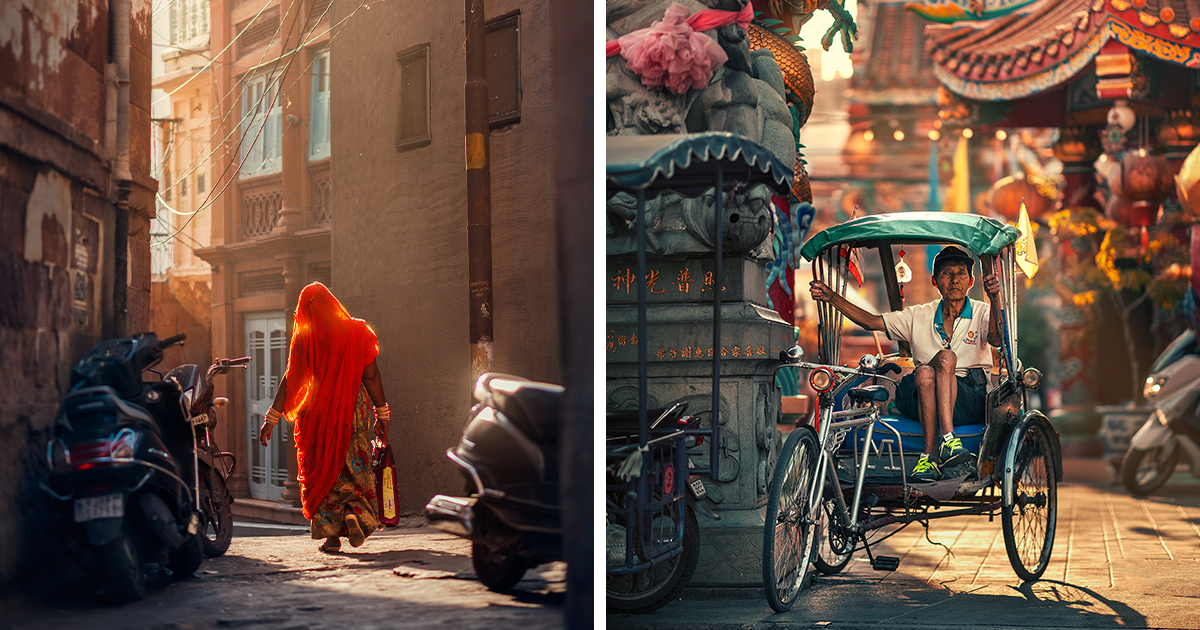

There is a moment near sunrise and sunset when ordinary light seems to develop a personality. Sidewalks glow, hair catches fire without anyone needifully expensive movie. Photographers call it the golden hour, although the exact duration depends on location, season, weather, and how cooperative the sun feels that day.
For me, golden hour photography is not simply about making everything orange. It is about watching people become part of the light. A face turns toward the sun. A child runs through tall grass. Two friends laugh at something nobody else will ever understand. A stranger becomes a silhouette for half a second and then disappears into the evening.
This collection of 18 captivating pictures of people in the golden hour is built around those small human moments. Some images depend on expression. Others are about movement, shadows, outlines, or the relationship between a person and the space around them. Together, they show why natural light portrait photography can be technically simple yet emotionally complicatedin the best possible way.
Why Golden Hour Is So Powerful for People Photography
When the sun sits low near the horizon, its light travels through more of the atmosphere before reaching us. More of the shorter blue wavelengths are scattered, helping the remaining direct light appear warmer, with stronger yellow, orange, and red tones. For photographers, the result can be softer-looking, more directional light than the hard overhead illumination common around midday.
That low angle is wonderfully useful for golden hour portraits. It can create long shadows, glowing edges around hair, warm skin tones, dramatic silhouettes, and a sense of depth. Instead of simply illuminating a person, the light can become part of the composition.
Of course, golden hour does not automatically produce a masterpiece. The camera can still miss focus. Highlights can still disappear into a white blob. A beautiful sunset can still be photobombed by a trash can with tremendous confidence. Good light helps, but observation remains the real skill.
18 Captivating Golden Hour Pictures and the Stories They Suggest
1. The Quiet Walker
The first picture shows a solitary figure walking along a path as the sun drops behind the trees. The person is small within the frame, which is exactly the point. Instead of demanding attention with a close-up, the photograph lets the surrounding light tell half the story. The long shadow stretching toward the camera adds direction and a subtle sense of movement.
This is one of my favorite approaches to people photography: showing enough of the environment to let viewers imagine where the subject has been and where they might be going.
2. A Face Turned Toward the Last Light
In the second portrait, the subject turns slightly toward the remaining sunlight rather than looking directly into the camera. That small decision changes everything. The pose feels less like an official portrait and more like a private moment that happened to be photographed.
Side lighting creates gentle dimension across the face, while the background falls into softer tones. The image reminds me that expressions do not need to be dramatic. Sometimes a thoughtful look can hold more attention than the largest smile in the world.
3. Hair Lit Like a Halo
Backlighting is one of the classic pleasures of sunset portrait photography. In this picture, the subject stands with the sun behind them, allowing the light to catch individual strands of hair. The result is a bright rim around the head and shoulders.
The challenge with backlighting is keeping enough detail in the face. Exposing carefully for the subject, using a reflector, or adding a subtle amount of fill light can help. The goal is not to flatten the scene, but to keep the person from becoming an accidental witness-protection silhouette.
4. The Child Who Would Not Stand Still
Some portraits improve the moment you stop trying to make them portraits. This photograph captures a child running instead of posing. The low sun stretches the shadow across the ground, while the warm light turns the movement into something almost cinematic.
A faster shutter speed is useful when photographing active subjects because golden hour light becomes dimmer as the sun falls. The technical challenge is worth it. Genuine motion often produces gestures and expressions that no carefully arranged pose can reproduce.
5. Two Friends Between Jokes
The fifth image is not the big laugh. It is the second afterwardthe moment when two friends are trying to recover. Their shoulders are still lifted, their expressions have not completely settled, and neither seems especially interested in the camera.
This is why I prefer giving people something to do instead of repeatedly asking them to smile. Conversation creates movement. Movement creates changing expressions. Somewhere between the polished poses, real personality tends to sneak into the frame.
6. The Golden Window
Here, sunlight passes through a narrow opening between buildings and lands directly on the subject. The surrounding area is already falling into shade, making the illuminated face and clothing stand out naturally.
Golden hour is often described as soft, but it can also create strong directional light. Looking for these temporary patches of brightness adds variety to outdoor portrait photography. A wall, doorway, row of trees, or city street can shape sunlight almost like equipment in a studio.
7. The Cyclist at the Edge of the Day
A cyclist pauses with one foot on the ground as the evening light cuts across the scene. The bicycle is important because it gives the subject context without requiring a long explanation. This is not merely a portrait of a person. It is a portrait of a person within an activity.
I like photographs that preserve clues: tools, clothing, gestures, and surroundings. These details give viewers something to explore after the initial visual impact of the golden light has done its job.
8. A Couple Walking Away
Not every compelling portrait needs visible faces. In this photograph, two people walk away from the camera, their figures surrounded by warm light. Their body language becomes the subject: the distance between them, the angle of their shoulders, and the rhythm of their steps.
Photographing people from behind can create privacy and universality at the same time. Viewers are free to imagine a relationship and a story. Sometimes showing less gives the photograph more room to breathe.
9. The Street Musician in Amber Light
The ninth picture combines a human subject with layers of city life. A musician stands in warm evening light while buildings and pedestrians recede into the background. Instead of eliminating every distraction, the composition uses them to create atmosphere.
For environmental portraits, I often want enough depth of field to preserve some sense of place. A completely blurred background can be beautiful, but sometimes the location deserves a speaking role rather than being reduced to anonymous bokeh.
10. Hands, Not Faces
This close photograph focuses on a pair of hands illuminated by low sunlight. Faces usually dominate portrait photography, so deliberately excluding them changes the way we read the image. Texture, gesture, age, jewelry, and the way someone holds an object can reveal an extraordinary amount.
Golden light is especially effective for details because side lighting emphasizes texture. Wrinkles, fabric, dust, and small imperfections become visual information rather than things that need to be erased.
11. The Wind Arrives at Exactly the Right Time
Wind is either a creative assistant or a tiny weather-based villain. In this case, it helped. The subject’s clothing and hair move across the frame while the warm background remains calm, giving the photograph energy.
I have learned not to fight every unpredictable element. A perfectly controlled portrait can look beautiful, but a little disorder often makes an image feel alive. The trick is taking enough frames to catch the instant when chaos becomes composition.
12. The Unplanned Reflection
A reflective window adds a second layer to this portrait. The subject appears clearly, but the surrounding sky and city are also visible across the glass. The golden tones connect the real figure and the reflected environment.
Reflections can turn an ordinary location into a more complex scene without digital effects. Windows, water, polished metal, and even phone screens can become compositional tools. The important part is moving around. A difference of a few inches can completely change what appears in the reflection.
13. The Almost-Silhouette
This photograph keeps just enough detail in the subject to avoid becoming a pure silhouette. The face is dark but readable, while the sky remains bright and colorful. I like that middle ground between full portrait exposure and total shadow.
Scenes with a bright sky and darker subject can challenge a camera’s dynamic range. Careful exposure matters, especially when important highlights are close to clipping. Shooting in RAW can also provide greater flexibility when balancing shadows and highlights later.
14. A Profile Against the Sky
A clean profile can be remarkably powerful during the final minutes before sunset. The outline of the forehead, nose, lips, and chin becomes a simple graphic shape against the sky.
This picture works because the background is uncluttered. A silhouette needs separation. A tree growing visually out of someone’s head is distracting in a normal portrait and achieves no sudden artistic promotion simply because the sun is setting.
15. The Family That Stopped Posing
The strongest frame from this family sequence arrived after the formal photograph was supposedly finished. Everyone relaxed. One person looked away, another started laughing, and the carefully arranged formation broke apart.
That transition produced the picture I would keep. Group portraits often improve when people are allowed to interact instead of being managed like furniture. Technical perfection matters, but connection is usually what makes viewers stay with an image.
16. The Runner in a Cloud of Dust
In the sixteenth photograph, movement lifts dust into the low sunlight. The particles become visible because they are strongly backlit, turning an ordinary path into something far more atmospheric.
Golden hour can reveal elements that are almost invisible under flatter light: mist, dust, breath, spray, smoke, and fine hairs. Paying attention to what the light passes throughnot just what it lands oncan create unexpectedly dramatic images.
17. The Final Ray Through the Trees
This portrait was made when the sun was almost gone. A narrow ray slipped between branches and illuminated one side of the subject. The rest of the scene had already become cooler and darker.
The contrast between warm and cool areas gives the photograph its emotional tension. It also demonstrates why photographers should keep working as the light changes. Golden hour is not one fixed look. It evolves minute by minute, and the final moments may look completely different from the beginning.
18. After the Gold Begins to Fade
The last picture in the series sits on the border between golden hour and the cooler light that follows sunset. The subject is still visible against a softly colored sky, but the intense warmth has started to disappear.
I like ending the collection here because photography is often about transitions rather than perfect moments. The light changes, the mood changes, and the photographer has to change with it. Sometimes the best final image appears when the event you planned to photograph is technically already over.
What These Golden Hour Portraits Taught Me
The biggest lesson from working with natural light is that planning and spontaneity are not enemies. I can scout a location, check the sunset time, study where the sun will appear, prepare camera settings, and still leave room for something unexpected.
I also pay close attention to backgrounds. During a golden hour portrait photography session, it is easy to become hypnotized by glowing light and forget that a bright sign, parked car, or random pole is performing an unwanted supporting role. Taking one step left or right can often improve a photograph more than changing lenses.
For portraits, I generally prioritize sharp eyes when the face is important, a shutter speed fast enough for the subject’s movement, and an aperture that supports the story. A wide aperture can isolate a person beautifully, while a smaller aperture may be better when the environment matters. There is no single magic setting because the available light, focal length, subject movement, and creative intention all change.
Editing also requires restraint. Golden hour already brings warmth. Adding too much saturation, temperature, or orange color can make natural skin look radioactive. My preference is to protect the mood that existed at the scene rather than forcing every slider to prove it showed up for work.
My Experience Photographing People in the Golden Hour
Working on golden hour portraits has changed the way I think about time. In normal life, an hour feels generous. During a photo session, the useful light can seem to disappear while I am still deciding whether a background contains one distracting branch too many. The sun has no interest in my creative crisis. It keeps moving.
That pressure taught me to arrive early. I like to walk through a location before the best light appears and identify several possible backgrounds. I look at which direction the sun will come from, where deep shade forms, and how quickly I can move between setups. This preparation is not glamorous. Nobody makes dramatic movies about a photographer quietly checking where a parking lot ends. Yet it creates the freedom to be more spontaneous later.
I have also become more patient with the people in front of the camera. Many people feel uncomfortable when someone points a lens at them. Telling them to “act natural” usually produces the exact opposite result. Suddenly, they forget what humans normally do with their hands.
Conversation works better. Walking works better. Giving someone a simple actionturning toward the light, adjusting a jacket, looking at another person, or moving through the scenecreates natural transitions. I often find that the photograph I love happens between the poses I originally planned.
Another lesson is that golden hour rewards attention more than expensive equipment. A sophisticated camera can provide excellent autofocus, dynamic range, and low-light performance, but it cannot notice the tiny moment when a subject’s expression changes. It cannot decide that the wind has suddenly improved the scene. It cannot realize that the reflected light from a pale wall is creating a better portrait ten feet away.
I have missed photographs too. Sometimes I spent too long adjusting settings. Sometimes I became obsessed with one composition while better possibilities unfolded behind me. Sometimes clouds arrived and erased the dramatic sunset I had imagined. Those sessions were useful because they forced me to stop treating golden hour like a guaranteed special effect.
Clouds can soften the light. Haze can change the color. Buildings can block the sun earlier than expected. A location that looks perfect online may be crowded when I arrive. Real photography includes adaptation, and that uncertainty is part of what keeps the process interesting.
My favorite experience, though, is watching people forget about the camera. There is often a moment during a session when the performance disappears. A person becomes absorbed in conversation, a child starts exploring, friends begin teasing one another, or someone simply pauses to look at the sky. Those moments feel different through the viewfinder. The photograph stops being about a pose and starts being about presence.
Golden light helps because it gives the scene a visual language of its own: warmth, softness, lengthening shadows, and the unmistakable feeling that the day is changing. But the light is only the setting. The human moment remains the subject.
After photographing people this way, I have become less interested in making every image flawless. A little flare can work. Motion can work. Deep shadows can work. A photograph does not always need to explain everything. In fact, leaving a little mystery is often what makes an image memorable.
That may be the most important experience behind these 18 pictures. I began by chasing beautiful light. I ended up paying more attention to people.
Conclusion: The Best Light Is Only the Beginning
Golden hour deserves its reputation, but beautiful color alone does not create a meaningful portrait. The most captivating images come from combining light with timing, observation, composition, and genuine human behavior.
These 18 pictures represent different ways of seeing people during a brief daily transformation: walking, laughing, moving, waiting, connecting, and sometimes simply standing still while the world changes color around them. Some photographs are close and personal. Others let the subject become a small part of a larger landscape. Together, they remind me that golden hour photography is most powerful when the glow supports the story instead of becoming the entire story.
The sun will set again tomorrow. The light may be similar, but the people, gestures, weather, expressions, and accidents will not. That is why I keep returning with a camera.
Note: The photographic scenarios in this feature are presented as an original first-person editorial narrative, while the technical discussion reflects established principles of natural-light portrait photography and the science of low-angle sunlight.