
A good knife sharpener can transform a frustrating kitchen blade into a precise cutting tool, rescue a neglected pocket knife, or put a useful edge back on workshop scissors. The difficult part is choosing among electric belt systems, guided sharpening kits, whetstones, pull-through sharpeners, honing rods, and portable field toolsall of which promise edges sharp enough to frighten a tomato.
Bob Vila’s tested knife sharpener roundup covered an unusually broad range of products rather than naming one universal winner. That approach makes sense because the best knife sharpener for a home cook is not necessarily the best choice for a collector, camper, gardener, or DIY enthusiast. This guide examines those tested picks, explains their strengths and limitations, and adds practical buying advice based on newer product testing and blade-care guidance.
Quick Verdict: Which Knife Sharpener Is Best?
For versatility, Bob Vila selected the Work Sharp Power Knife & Tool Sharpener as the best overall electric model. Its flexible abrasive belts, variable-speed operation, and adjustable angle guide make it useful for kitchen knives, outdoor blades, scissors, and certain tools.
The Wicked Edge Pro-Pack I was the top manual system for people who want highly repeatable bevels and polished edges. It is powerful, precise, and impressively substantial, although its price and footprint make it better suited to serious enthusiasts than occasional users.
For an inexpensive kitchen solution, the KitchenIQ Edge Grip 2-Stage Sharpener remains one of the easiest options to understand. It cannot match a premium guided system, but it can quickly improve an ordinary chef’s knife without requiring a seminar in blade geometry.
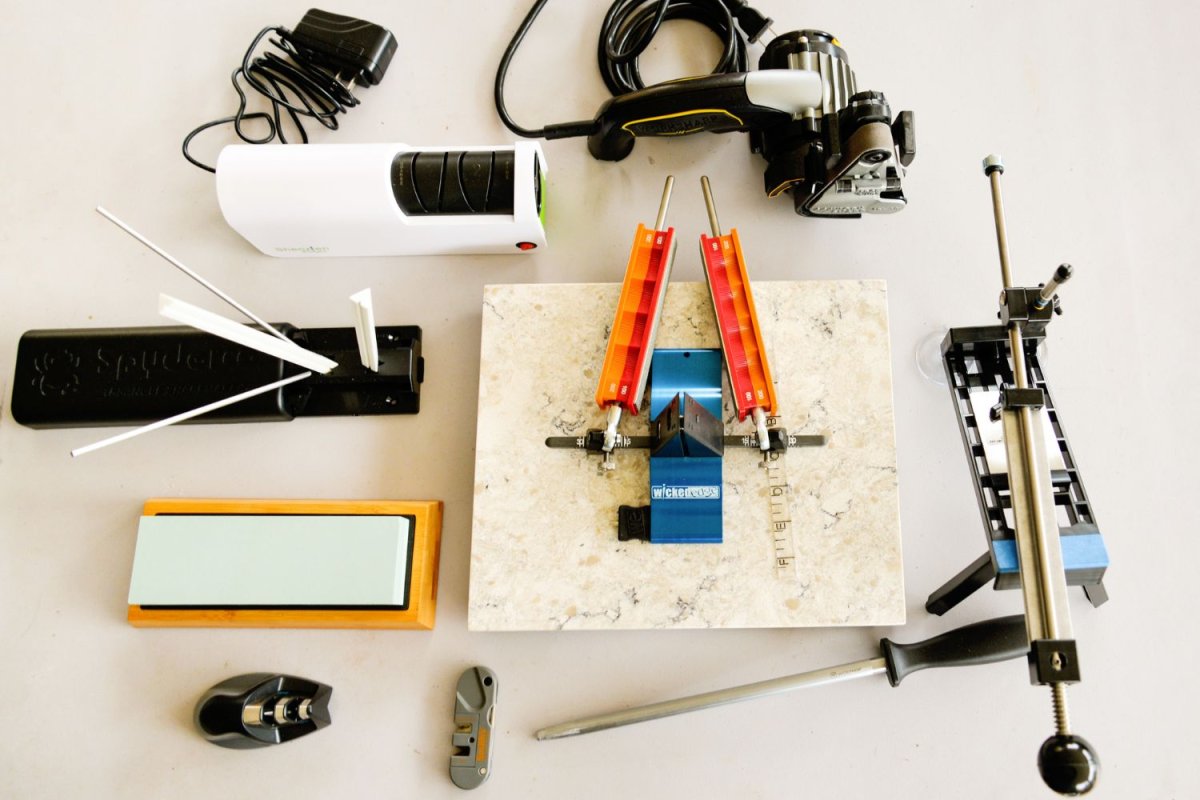
Bob Vila’s Tested Knife Sharpener Picks at a Glance
- Best overall electric: Work Sharp Power Knife & Tool Sharpener
- Best overall manual: Wicked Edge Pro-Pack I
- Best value: KitchenIQ Edge Grip 2-Stage Sharpener
- Best portable system: Edge Pro Apex 4
- Best sharpening stone set: KnifePlanet Premium Stone Set
- Best honing steel: Wüsthof 10-Inch Honing Steel
- Best for ceramic knives: Shenzhen Knives Electric Diamond Sharpener
- Best for pocket knives: Smith’s Pocket Pal
- Also worth considering: Spyderco Tri-Angle Sharpmaker
Sharpening vs. Honing: Know What Your Knife Needs
Sharpening and honing are related, but they do different jobs. Sharpening removes a small amount of blade material to create a fresh cutting edge. Honing primarily straightens or refines an edge that has rolled slightly out of alignment during normal use.
A knife that still cuts but feels less precise may only need a few controlled passes on a honing rod. A blade that crushes tomatoes, slides across onion skin, or demands unreasonable force probably needs actual sharpening. Honing a genuinely dull blade is like combing a bald tire: admirable effort, limited effect.
Why Grit Matters
Coarse abrasives remove material quickly and are useful for repairing chips, restoring badly worn edges, or changing a bevel. Medium grits establish the working edge, while fine stones and polishing compounds smooth scratches and refine the apex.
A multistage system usually starts aggressively and finishes gently. Skipping directly to a fine polishing stage will not efficiently repair serious damage. Conversely, repeatedly using a coarse stage for routine touch-ups removes more steel than necessary.
Why Sharpening Angle Matters
A lower angle generally produces a keen, precise edge, while a wider angle creates a more durable edge for hard use. Many kitchen knives fall somewhere around 15 to 20 degrees per side, while rugged outdoor and utility blades may use wider bevels.
The safest approach is to follow the knife manufacturer’s recommendation or preserve the existing bevel. An adjustable sharpener offers flexibility, but a fixed-angle system may be easier for beginners because it removes one more opportunity for creative disaster.
Best Overall Electric: Work Sharp Power Knife & Tool Sharpener
The Work Sharp stands apart from typical countertop electric sharpeners. Instead of hiding abrasive wheels inside narrow slots, it uses replaceable flexible belts and an angle guide. The design resembles a miniature belt grinder built specifically for controlled blade maintenance.
Its adjustable sharpening range and variable-speed motor allow users to slow down for kitchen knives or work more aggressively on thicker blades and tools. The belt can conform slightly to the edge, helping create a durable convex profile rather than a sharply defined flat bevel.
The biggest advantage is versatility. One machine can sharpen chef’s knives, hunting knives, scissors, and numerous workshop or garden tools. The downside is that powered belts can remove steel quickly. Beginners should use light pressure, select a moderate speed, and avoid lingering near the tip.
Metal dust is another consideration. This is better treated as a workshop sharpener than a device to operate beside an uncovered bowl of salad. Work Sharp has also introduced updated generations with refined speed controls and angle adjustments, so buyers should compare the current model with the version included in the original Bob Vila test.
Best Overall Manual: Wicked Edge Pro-Pack I
The Wicked Edge Pro-Pack I is less of a casual kitchen accessory and more of a sharpening workstation. The knife is clamped securely while diamond stones travel along guide rods at controlled angles. Once the settings are recorded, users can reproduce nearly identical results during future sharpening sessions.
The supplied abrasives progress from coarse diamond stones for establishing a bevel to fine stones and leather strops for polishing. This allows the system to repair neglected edges and then refine them to a highly finished surface.
Consistency is its greatest strength. Freehand sharpening depends heavily on muscle memory, while the Wicked Edge mechanically controls the angle. Collectors can document the position and settings for each knife, reducing guesswork the next time the blade needs maintenance.
There are trade-offs. The system is expensive, takes time to assemble, and occupies considerably more space than a pull-through sharpener. It is overkill for someone who sharpens one inexpensive chef’s knife twice a year. For knife enthusiasts seeking repeatable, polished bevels, however, it provides a level of control that ordinary handheld sharpeners cannot approach.
Best Budget Pick: KitchenIQ Edge Grip 2-Stage Sharpener
The KitchenIQ Edge Grip proves that a useful knife sharpener does not need to resemble laboratory equipment. It has two slots: a coarse carbide stage for restoring a dull straight edge and a fine ceramic stage for smoothing and maintaining it.
Its clever edge-grip design allows the unit to sit at the edge of a counter. This creates clearance for the knife and keeps the user’s knuckles from knocking against the work surface. The handle also keeps the supporting hand behind a protective guard.
During Bob Vila’s evaluation, the sharpener improved moderately dull paring and chef’s knives with a small number of passes. It was less successful against deep damage, which is expected from a compact, fixed-angle tool.
This model is best for practical kitchen knives rather than expensive specialty blades. The preset geometry will not suit every bevel, and repeated use of the coarse carbide stage can remove more metal than necessary. Use the ceramic slot for maintenance and reserve the carbide slot for blades that are truly dull.
Best Portable System: Edge Pro Apex 4
The Edge Pro Apex 4 offers much of the control of a guided bench system in a package that can be disassembled and carried. Its adjustable platform supports the knife while a stone mounted on a pivoting rod moves across the edge at a selected angle.
The Apex 4 kit includes multiple grits for repairing, sharpening, and polishing. It can accommodate a wide variety of blade shapes without permanently clamping the knife, which makes repositioning long blades relatively easy.
Its portability does not mean instant mastery. Users still need to keep the blade stable, move the stone evenly, and reposition the knife without changing the effective angle. A few practice sessions on an inexpensive blade are sensible before placing a cherished Japanese chef’s knife on the platform.
For travelers, mobile sharpening professionals, hunters, and cooks who want guided precision without installing a permanent station, the Apex 4 offers an attractive balance of control and packability.
Best Whetstone Set: KnifePlanet Premium Sharpening Stones
The KnifePlanet set combines four useful grit levels: 400, 1,000, 3,000, and 8,000. The coarse stone can address damage and establish an edge, the 1,000-grit surface handles general sharpening, and the finer stones refine and polish.
The kit also includes a bamboo base, nonslip supports, an angle guide, and a flattening stone. That last accessory is important because water stones can develop low spots after repeated use. A dished stone makes consistent sharpening difficult, even when the user’s technique is otherwise excellent.
Whetstones provide more control than most pull-through sharpeners and allow users to match unusual blade angles. They also require patience. Maintaining the angle through the curved tip is usually the hardest skill for beginners.
For cooks willing to practice, a versatile stone set can maintain everything from everyday stainless-steel knives to finer carbon-steel blades. It is also one of the most satisfying methods. Few kitchen chores make a person feel more mysteriously competent than producing a clean edge with water, stone, and deliberate movement.
Best Honing Steel: Wüsthof 10-Inch Honing Steel
The Wüsthof honing steel is designed for regular edge maintenance rather than major repair. Its 10-inch rod provides enough working length for most kitchen knives, while the textured steel helps realign and lightly refine the edge.
A honing steel is most useful when employed before the knife becomes seriously dull. Several controlled strokes on each side can restore cleaner slicing performance and delay the need for abrasive sharpening.
Always keep the rod stable, maintain a consistent angle, and move the blade away from the supporting hand. Speed is unnecessary. Professional cooks may perform rapid theatrical strokes, but home users receive no bonus points for adding danger and sound effects.
Best for Ceramic Knives: Shenzhen Electric Diamond Sharpener
Ceramic blades are extremely hard and hold an edge well, but that hardness also makes them brittle. Ordinary steel honing rods and many conventional sharpeners are unsuitable. Diamond abrasives are generally required because they are hard enough to work on ceramic material.
The Shenzhen electric sharpener uses diamond grinding wheels and separate stages intended to repair and refine ceramic blades. Bob Vila’s testers used it to remove small chips and restore a functional edge.
Users must proceed carefully. Aggressive pressure can worsen chipping, and a ceramic knife with major fractures may be better handled by a professional or replaced. This machine is a specialized purchase rather than the best universal sharpener for a mixed collection.
Best for Pocket Knives: Smith’s Pocket Pal
Smith’s Pocket Pal is a tiny field-maintenance tool with carbide and ceramic pull-through slots plus a tapered diamond rod for serrations. It weighs very little and can be clipped to a pack or stored in a pocket, tackle box, vehicle, or camping kit.
The carbide slot can restore a quick working edge, while the ceramic stage refines it. The folding rod is useful for individual serrations, gut hooks, and other shapes that cannot pass through a standard V-shaped slot.
Its fixed angle limits precision, and it is not intended to rebuild a completely rounded or badly damaged edge. Think of it as roadside assistance for a knife, not a full engine rebuild. For maintaining working blades during camping, fishing, hunting, or daily carry, its portability is difficult to beat.
Also Consider: Spyderco Tri-Angle Sharpmaker
The Spyderco Sharpmaker uses triangular ceramic rods placed vertically in a base at preset angles. The user holds the knife upright and draws it down each rod, which is often easier than trying to maintain a freehand angle over a horizontal stone.
The triangular surfaces can sharpen plain edges, serrations, scissors, and pointed tools. Coarse and fine rods support basic edge restoration and finishing, while optional stones expand the system’s capabilities.
It is compact, relatively clean, and approachable for beginners. Its main limitation appears when a blade needs extensive reprofiling. The standard ceramic rods work efficiently for maintenance, but serious repair may require coarser optional abrasives or another sharpening method.
How to Choose the Best Knife Sharpener
Choose an Electric Sharpener for Speed
Electric sharpeners are convenient for busy households, large knife collections, and users who value repeatable results. Look for multiple stages, controlled guides, and adjustable angles. Use them only when necessary because powered abrasives can remove material rapidly.
Choose a Guided System for Precision
Clamp-and-rod or supported-platform sharpeners are ideal for enthusiasts who want consistent bevels. They require more setup than electric or pull-through models, but they provide excellent control over angle and grit progression.
Choose Whetstones for Maximum Flexibility
Whetstones let users sharpen nearly any straight-edged knife at almost any practical angle. They are especially useful for Japanese knives, carbon-steel blades, and owners who enjoy developing a hands-on skill.
Choose a Pull-Through Sharpener for Simplicity
A pull-through model suits ordinary kitchen knives and occasional users. Select one with a stable base, protective hand guard, and separate coarse and fine stages. Avoid using aggressive carbide slots after every cooking session.
Choose a Portable Sharpener for Outdoor Use
Compact carbide, ceramic, and diamond tools are useful for maintaining working edges away from home. They prioritize convenience over perfect geometry but can keep a pocket knife functional until a more complete sharpening session is possible.
How to Test a Knife After Sharpening
A dramatic arm-hair test is not necessary. Safer household checks provide more useful information:
- Paper test: The knife should enter printer paper cleanly without tearing or snagging.
- Tomato test: A sharp blade should break the skin without crushing the tomato.
- Onion test: The knife should start a cut without sliding across the dry outer layer.
- Carrot test: A properly sharpened edge should cut with controlled pressure rather than wedging violently.
- Visual test: Bright reflections along the apex can reveal flat or damaged sections that have not been fully sharpened.
Clean the blade thoroughly after sharpening to remove metal particles and abrasive residue. Hand-wash it, dry it immediately, and store it where the edge will not collide with other utensils.
Common Knife-Sharpening Mistakes
- Using excessive downward pressure instead of letting the abrasive do the work
- Changing the sharpening angle between strokes
- Failing to sharpen the heel and curved tip evenly
- Using a coarse stage for minor maintenance
- Sharpening only one side of a double-bevel knife
- Moving too quickly with a powered belt or grinding wheel
- Attempting to sharpen ceramic or serrated knives with unsuitable equipment
- Ignoring stone flattening, belt wear, or abrasive buildup
- Testing the edge with a thumb or fingertip
Practical Experience: What Using Different Knife Sharpeners Is Really Like
The first lesson most people learn is that the sharpener they will actually use is often more valuable than the technically superior system left in a cabinet. A premium guided kit can produce a spectacular edge, but it provides no benefit when assembly feels like preparing a satellite launch. A compact ceramic sharpener used responsibly every few weeks may deliver better long-term results for a busy home cook.
Manual pull-through sharpeners create the fastest transformation. A tired chef’s knife that skids across a tomato can become noticeably more effective after several light passes. The immediate result feels miraculous, which tempts users to repeat the coarse stage far too often. That enthusiasm should be resisted. The coarse slot is a repair tool, not a morning exercise routine for the knife.
Whetstone sharpening feels awkward during the first few sessions. Beginners often sharpen the heel effectively but lift the handle too much near the tip, creating an uneven bevel. Another common problem is changing the angle unconsciously on every stroke. Marking the existing bevel with a permanent marker provides useful feedback: if the ink disappears only near the shoulder or apex, the angle needs adjustment.
After the technique begins to make sense, whetstones become surprisingly efficient. The process develops a rhythm, and the sound changes as the edge makes more consistent contact. A 1,000-grit stone can handle most routine sharpening, while a finer stone improves smoothness and slicing performance. Extremely high grits are enjoyable for enthusiasts, but the difference may be less noticeable when the knife spends its life chopping carrots on a plastic board.
Guided systems produce a different experience. Setup takes longer, but uncertainty drops dramatically once the blade is secured and the angle is selected. They are particularly satisfying when restoring an old knife with an uneven bevel. Progressing through the stones reveals the scratches becoming finer until the edge takes on a polished appearance. The danger here is perfectionism: a person can spend 45 minutes chasing a mirror finish on a utility knife destined to open cardboard boxes.
Powered belt sharpeners are the most impressive and the least forgiving. They can repair a damaged outdoor blade quickly, but the tip can round over if the user stops or twists while pulling it through the guide. Light pressure and continuous movement matter. Practicing with an inexpensive knife before sharpening a valuable blade is not cowardice; it is cheaper education.
Honing rods deliver subtler results. The knife may not look different, yet it often slices more cleanly after the edge is realigned. Slow, controlled strokes are easier to repeat than the rapid movements demonstrated by television chefs. Resting the tip of the rod on a stable cutting board can make the process safer and help maintain the angle.
Maintenance habits ultimately determine how long the new edge lasts. Glass and stone cutting boards dull knives quickly, while wood and quality plastic are gentler. Tossing knives into a crowded drawer damages edges and creates an unpleasant surprise for the next person searching for a spoon. Hand-washing and drying also protect the blade from corrosion, impacts, and dishwasher abuse.
The most practical setup for many households is a combination: a honing rod for regular maintenance, an easy guided or manual sharpener for periodic restoration, and professional service for serious chips or expensive specialty knives. This approach keeps everyday blades useful without removing unnecessary metal or turning dinner preparation into an advanced metallurgy course.
Final Thoughts
Bob Vila’s tested picks demonstrate why there is no single best knife sharpener for every user. The Work Sharp excels when speed and versatility matter. The Wicked Edge offers exceptional repeatability for enthusiasts. The Edge Pro combines precision with portability, while the KnifePlanet stones reward users who want hands-on control. KitchenIQ and Smith’s provide affordable solutions for routine kitchen and field maintenance.
Before buying, consider the knives you own, their edge angles, how badly they are worn, and how much technique you are willing to learn. A well-matched sharpener makes cutting easier, improves control, and extends the useful life of a blade. Choose poorly, and you may simply convert one dull knife into a smaller dull knife.
Editorial note: Bob Vila’s referenced roundup was updated in December 2022. Product availability, package contents, pricing, and model generations may change, so confirm current specifications before purchasing.
SEO Metadata