30 Ideas and “Tips” About Cooking That Irk People Something Fierce, as Shared in This Online Group

Cooking advice has a strange ability to outlive evidence, ruined dinners, and several generations of scorched garlic. A questionable tip gets repeated by a relative, printed in a cookbook, squeezed into a 30-second video, and suddenly everyone is pouring oil into pasta water as if performing an ancient Italian blessing.
An online cooking discussion invited people to share the myths, shortcuts, and recipe instructions that make them reach for the nearest oven mitt in frustration. Some complaints were matters of taste. Others exposed misleading recipe times, muddled culinary terminology, or food-safety practices that deserve to be retired immediately.
Below are 30 cooking ideas and “tips” that irritate experienced home cooks, along with the practical truth hiding beneath each one.
Why Bad Cooking Tips Refuse to Leave the Kitchen
Most cooking myths survive because they sound logical. Searing creates a crust, so surely that crust must trap moisture. Oil feels slippery, so surely it must stop pasta from sticking. Cold water starts colder, so perhaps it somehow gets motivated and boils faster.
Other myths survive because recipes compete for attention. “Weeknight dinner in 25 minutes” is more clickable than “Dinner in 25 minutes, plus 20 minutes of chopping, 15 minutes of preheating, and an emotional support snack.” The original online discussion became popular largely because readers recognized these little deceptions immediately.
The goal is not to establish one joyless set of kitchen commandments. Good cooking depends on ingredients, equipment, culture, and personal preference. However, understanding what actually happens in a pan makes it easier to decide which rules deserve respect and which belong in the garbage disposal.
30 Cooking Myths and Tips That Make People Fiercely Annoyed
-
1. “This Entire Dinner Takes 20 Minutes”
Many recipes count only active cooking time while quietly ignoring washing, chopping, preheating, measuring, marinating, and searching the refrigerator for the parsley you definitely bought. A realistic recipe should distinguish preparation time, cooking time, and inactive waiting time. Otherwise, a supposed 20-minute meal becomes a 55-minute trust exercise.
-
2. “Caramelize the Onions for 5 to 10 Minutes”
In five minutes, onions can soften, sweat, or develop a few brown edges. Deeply caramelized onions generally require much more patience. True caramelization involves gradually driving off moisture and developing concentrated sweetness and color. Turning up the heat may produce burned edges, but burned is not French for caramelized.
-
3. “Always Add the Garlic First”
Minced garlic cooks quickly and can become bitter when burned. In many dishes, onions, carrots, celery, or other sturdy aromatics should get a head start. Garlic can then join the party during the final minute or two. Adding it first is not always wrong, but doing so over high heat requires careful timing and attention.
-
4. “Searing Meat Seals In the Juices”
A browned surface is delicious, but it is not waterproof. Searing develops complex roasted flavors through browning reactions; it does not create a magical moisture force field. Juiciness depends more heavily on the cut, internal temperature, cooking method, and whether the meat was cooked into expensive shoe leather.
-
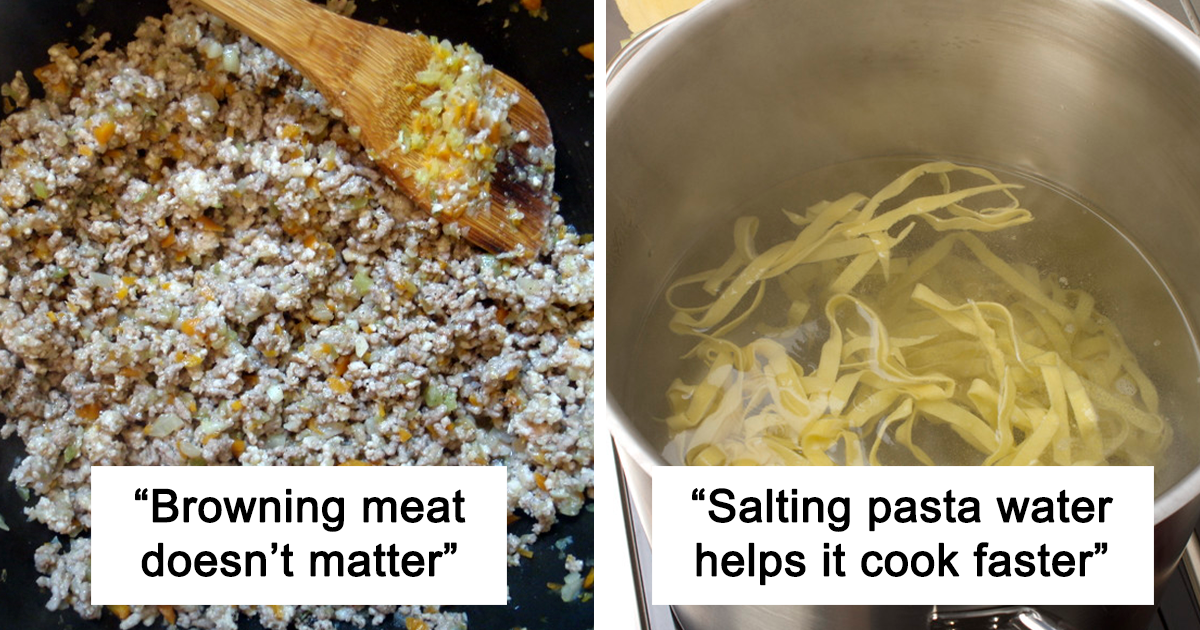
5. “Browning Meat Does Not Matter in Stew”
Browning may not be mandatory when time is short, but saying it makes no difference is equally misleading. A properly browned surface contributes roasted flavors, while the browned bits left in the pot can enrich the cooking liquid after deglazing. The stew will still exist without this step; it simply may have less depth.
-
6. “Salt Makes Pasta Water Boil Much Faster”
The normal amount of salt used in a home kitchen does not provide a meaningful speed boost. Salt belongs in pasta water primarily because it seasons the noodles as they cook. Add it for flavor, not because you expect the pot to break a land-speed record.
-
7. “Pour Oil Into Pasta Water to Prevent Sticking”
Oil mostly floats on top of the water instead of surrounding the submerged noodles. The practical way to prevent sticking is to stir the pasta, especially during its first few minutes. Oil that eventually coats drained pasta may also make it harder for sauce to cling properly. Save the good olive oil for the finished dish.
-
8. “Cold Water Boils Faster Than Hot Water”
Under ordinary kitchen conditions, hotter water has less heating to do before it reaches the boiling point. Cold water may be preferred for other practical reasons, but it does not receive a secret acceleration bonus. To speed things up, use an appropriate burner, choose a properly sized pot, and put a lid on it.
-
9. “Only Cook With Wine You Would Happily Drink”
You should avoid badly flavored or heavily salted products sold as cooking wine. However, a sauce does not require a collector’s bottle. An affordable, clean-tasting wine is usually enough. The sensible rule is to avoid wine you find actively unpleasant, not to sacrifice the bottle reserved for your anniversary dinner.
-
10. “All the Alcohol Cooks Off Immediately”
Alcohol reduction depends on cooking time, temperature, pan shape, and the method used. A quick flambé or brief simmer does not necessarily remove everything. This matters when preparing food for someone who avoids alcohol for medical, religious, recovery, or personal reasons. “It probably disappeared” is not a reliable measurement.
-
11. “Wash Raw Chicken Before Cooking It”
Rinsing raw poultry can splash contaminated droplets onto sinks, counters, utensils, and nearby food. Proper cooking, not faucet water, destroys harmful microorganisms. The USDA advises against washing raw meat and poultry because it can increase cross-contamination around the kitchen.
-
12. “You Can Always Judge Doneness by Color”
Color is an unreliable food-safety instrument. Meat can appear brown before reaching a safe internal temperature, while safely cooked meat can retain some pinkness. A food thermometer provides better information than slicing everything open and staring at it like a culinary fortune teller.
-
13. “Thaw Meat on the Counter All Day”
The center may remain frozen while the outer surface warms into a temperature range where bacteria can multiply rapidly. Safer methods include thawing in the refrigerator, using cold water with proper handling, or using a microwave when the food will be cooked immediately afterward.
-
14. “Food Is Fine at Room Temperature Until It Smells Bad”
Dangerous bacteria do not always announce themselves with a suspicious odor or dramatic green glow. Perishable food should generally not remain at room temperature for more than two hours, or one hour in temperatures above 90 degrees Fahrenheit. Smelling leftovers is not a substitute for safe storage.
-
15. “Chemicals in Food Are Automatically Bad”
Everything from water to table salt consists of chemicals. The useful questions are which substance is present, how much is present, and what credible research says about it. Treating the word “chemical” as a synonym for “poison” may sound health-conscious, but it does not provide meaningful information.
-
16. “MSG Is an Uniquely Sinister Ingredient”
Monosodium glutamate supplies sodium and glutamate, the latter of which also occurs naturally in foods such as tomatoes, mushrooms, and aged cheese. Some individuals may choose to limit it, just as they limit other sources of sodium, but fear-based claims often ignore both dosage and established food science.
-
17. “Organic Automatically Means More Nutritious and Tastier”
Organic labeling describes particular agricultural and production standards. It does not guarantee that every organic tomato will be sweeter, every organic cookie will be nutritious, or every organic potato will possess superior moral character. Variety, freshness, growing conditions, handling, and preparation also influence flavor and quality.
-
18. “Olive Oil Is the Only Oil Worth Using”
Olive oil is versatile, flavorful, and suitable for many cooking methods. It is not automatically the ideal choice for every dish. Sometimes a neutral oil better preserves other flavors, while certain high-temperature techniques benefit from refined oils with higher smoke points. Cost and taste matter too.
-
19. “Adding Oil Raises Butter’s Smoke Point”
Mixing oil with butter may affect flavor, texture, and how the fat behaves in a pan, but it does not prevent butter’s milk solids from browning and eventually burning. The mixture still contains the same heat-sensitive components. Clarified butter is a more useful choice when a buttery flavor and higher-temperature cooking are both desired.
-
20. “One Tiny Clove of Garlic Is Plenty for a Giant Pot”
This complaint is partly comedic and partly practical. Garlic intensity varies by freshness, variety, preparation, and cooking time. One raw grated clove can dominate a dressing, while one long-cooked clove may disappear into a gallon of soup. Measurements should reflect the technique instead of treating every clove as a standardized garlic capsule.
-
21. “Season Only at the End”
Final seasoning is important, but building flavor in stages often produces better results. Salt can help draw moisture from vegetables, penetrate meat, and season starches internally. Spices may bloom in fat, while acids and delicate herbs are often best adjusted near the end. Timing matters as much as quantity.
-
22. “Do Not Taste Anything Until It Is Finished”
Tasting throughout the process helps reveal whether a dish needs salt, acidity, sweetness, dilution, or more cooking. Naturally, raw meat, raw egg mixtures, and unsafe ingredients should not be sampled. For sauces, soups, stews, and cooked components, however, tasting is one of the cook’s most valuable diagnostic tools.
-
23. “An Instant Pot Recipe Takes Only Six Minutes”
Six minutes may describe the time spent cooking at pressure. It may exclude the time required to heat the contents, build pressure, and release pressure afterward. A six-minute pressure cycle can still become a 30-minute process. That is not a failure of the appliance; it is a failure of honest timekeeping.
-
24. “This Is a One-Pot Meal”
Some one-pot recipes require a cutting board, colander, blender, sheet pan, three prep bowls, and a temporary holding plate. Technically, perhaps only one pot touched the stove. Spiritually, the sink knows the truth. A genuinely convenient recipe should consider total cleanup, not merely cookware semantics.
-
25. “Frozen and Canned Ingredients Are Cheating”
Frozen vegetables, canned beans, jarred tomatoes, and other prepared ingredients can save time, reduce waste, and produce excellent meals. They are tools, not confessions of failure. The better question is whether the ingredient works for the dish. Nobody receives a medal for soaking chickpeas while exhausted on a Tuesday.
-
26. “There Is Only One Authentic Version of This Dish”
Traditional methods deserve respect, especially when discussing a cuisine outside one’s own culture. Yet many celebrated dishes already have regional, family, seasonal, and historical variations. Authenticity can provide valuable context, but it becomes irritating when used as a weapon against every adaptation, substitution, or creative interpretation.
-
27. “Every Grandmother Is an Extraordinary Cook”
Some grandmothers preserved extraordinary culinary knowledge. Others boiled vegetables until they could be consumed through a straw. Nostalgia can make food feel special, but age and family status do not automatically grant perfect technique. Recipes should be judged by their results, not merely by the number of generations attached to them.
-
28. “This Viral Kitchen Hack Changes Everything”
Content-farm videos often prioritize surprise over reliability. Some hacks waste ingredients; others use materials in ways they were never designed to be heated, cut, or consumed. Before trying a spectacular shortcut, ask whether it comes from a credible cook, whether the steps make physical sense, and whether safety information is missing.
-
29. “Press Down on Burgers and Steaks to Make Them Cook Faster”
Repeatedly crushing meat with a spatula can force flavorful liquid onto the grill or into the pan. A deliberate smash burger is different because it is pressed firmly at the beginning to maximize surface contact and browning. Pressing an already cooking patty again and again merely gives dinner an unwanted juice-removal program.
-
30. “Crowding the Pan Is Fine if the Heat Is High Enough”
A crowded pan traps moisture and lowers the effective cooking temperature. Instead of browning, food may steam in its own released liquid. Working in batches can feel slower, but it often finishes faster than waiting for an overfilled skillet to evaporate a shallow indoor lake.
Which Cooking Rules Actually Deserve to Survive?
The most useful cooking rules explain cause and effect. Drying food encourages browning because surface moisture must evaporate before strong browning develops. Stirring pasta early helps prevent starchy surfaces from bonding together. A thermometer measures internal temperature more accurately than visual guesswork.
Good advice also leaves room for context. Garlic can go into a pan early when the heat is low and sufficient moisture is present. Olive oil can be used for many high-temperature applications, although another oil may be cheaper or more neutral. Meat does not always need to rest for the same amount of time, and not every pot of onions must become dark mahogany.
The warning sign is absolute language without explanation: always, never, instantly, foolproof, life-changing, or authentic in exactly one way. Cooking is full of variables. An instruction that refuses to acknowledge any of them is often selling confidence rather than teaching technique.
A Home Cook’s Experience: When Popular Tips Meet an Ordinary Kitchen
The following is a composite of common experiences reported by home cooks rather than a claim of one person’s literal kitchen diary.
The first lesson usually arrives with onions. A recipe promises that a full skillet will become deeply caramelized in eight minutes. At minute eight, the onions are pale, wet, and only beginning to soften. The cook raises the heat, hoping enthusiasm can replace chemistry. Two minutes later, a few edges are black while the rest remain crunchy. Dinner continues, but trust has left the building.
Pasta provides the next experiment. Oil is poured into the boiling water because that is what someone’s uncle, television chef, or decorative kitchen sign once recommended. The oil floats on the surface like a tiny Mediterranean weather system. The noodles still stick until they are stirred. Later, the sauce slides from them with impressive efficiency. The following week, the cook skips the oil, stirs early, saves a cup of starchy water, and produces a noticeably more cohesive sauce.
Then comes garlic. Adding it before the onions feels correct because so many recipe videos begin with a dramatic handful of minced garlic hitting hot oil. Unfortunately, the cook is still opening cans and measuring spices while the garlic turns from fragrant to brown to bitter. On the second attempt, the onions cook first and the garlic goes in shortly before the liquid. Suddenly, the kitchen smells inviting instead of vaguely electrical.
Pressure cooking creates a different kind of disappointment. The recipe headline advertises an eight-minute dinner. The appliance takes more than ten minutes to build pressure, cooks for eight, and then needs additional release time. The food is good, but it arrives nowhere near the advertised schedule. The useful discovery is not that pressure cookers are bad. It is that recipe timing should be read like a rental agreement: inspect what has been excluded.
Food-safety myths are less amusing. A cook may have grown up watching raw chicken being rinsed in the sink and assume the practice is necessary. Learning that droplets can spread contamination across nearby surfaces changes the routine immediately. The chicken goes directly from its package to the preparation area, hands and tools are washed carefully, and a thermometer determines when cooking is complete.
The biggest improvement, however, often comes from tasting. Instead of following measurements with ceremonial obedience, the cook samples the soup after the vegetables soften, again after the stock reduces, and once more before serving. A small amount of salt wakes up the vegetables. A splash of acid balances the richness. Fresh herbs added at the end supply an aroma that 40 minutes of simmering would have erased.
Eventually, cooking becomes less about collecting commandments and more about noticing results. The cook learns the sound of moisture leaving a crowded pan, the smell of garlic approaching danger, and the visual difference between softened onions and truly caramelized ones. Recipes remain useful, but they become maps rather than legally binding contracts.
That may be the most valuable answer to irritating cooking advice: test it, understand it, and keep only what makes the food safer, tastier, or easier to prepare. Everything else can join the oil floating uselessly on top of the pasta pot.
Conclusion
Cooking myths are rarely destroyed by one correction because they are attached to habits, family memories, viral videos, and confident people holding wooden spoons. Still, better technique begins with asking why an instruction works.
Caramelized onions need honest timing. Searing builds flavor rather than sealing in liquid. Pasta needs stirring more than an oil slick. Raw chicken needs careful handling, not a shower. Most importantly, good cooks taste, observe, adapt, and use reliable measurements when safety is involved.
The kitchen does not require perfect obedience. It rewards attention. Learn the principle behind a rule, adjust it to the ingredients in front of you, and remain suspicious of anyone promising restaurant-quality French onion soup in seven minutes.