
If you have ever looked at an old roof inspection and seen the phrase stapled shingles, you probably had the same reaction most homeowners do: “That sounds… not ideal.” And honestly, that reaction is not wrong. A roof is supposed to stand up to rain, wind, sun, flying leaves, and the occasional branch that believes in chaos. So when people hear that the shingles were attached with staples instead of roofing nails, the next thought is usually, “Did someone try to build my roof with office supplies?”
Here is the real answer: shingle staples are not automatically catastrophic, but on a modern asphalt shingle roof, they are usually a bad bet. They are outdated, less forgiving during installation, often discouraged or barred by manufacturer instructions, and usually not the fastener a roofer should be using on a new shingle roof today. In other words, staples are not always a roof’s villain origin story, but they are very often the red flag that makes roofers, inspectors, and insurance adjusters lean in a little closer.
That does not mean every stapled roof is doomed. Some older roofs installed with staples have lasted for years. But if you are asking whether staples are a smart choice for a new roof, or whether they can contribute to problems on an older one, the practical answer is yes: they can absolutely be bad for your roof.
The Honest Answer: Why Staples Usually Lose the Argument
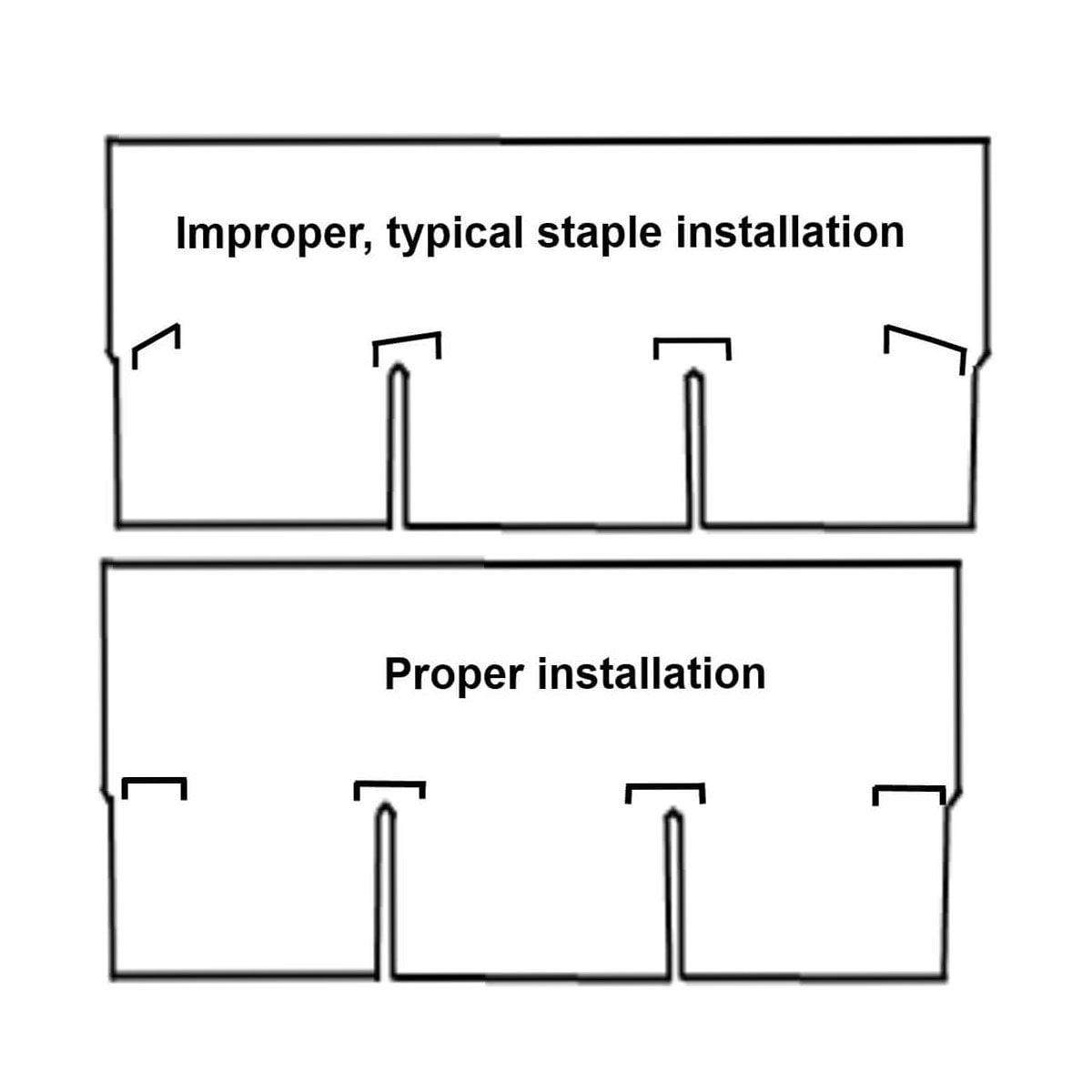
The biggest problem with shingle staples is not that they are magically weak. It is that they are much less forgiving than roofing nails. A proper roofing nail has a round head that spreads holding pressure over a predictable area. A staple uses a narrow crown and two legs, which means placement, angle, depth, and orientation matter a whole lot. If the staple is slightly crooked, overdriven, underdriven, or turned the wrong way, it can reduce holding power or damage the shingle mat instead of securing it cleanly.
That is why modern roofing guidance keeps circling back to one theme: use nails, place them correctly, and follow the shingle manufacturer’s nailing zone. Roofing is one of those trades where the difference between “fine” and “future leak” can be about half an inch and one rushed compressor setting.
Staples also have a reputation problem because they were often used for speed. A crew with staple guns could move fast. Very fast. Too fast, sometimes. And a roof is not the place where speed alone deserves a trophy. When the fastener choice already has a smaller margin for error, rapid installation can make bad placement even more likely.
Why Modern Roof Systems Are Built Around Nails
If you read current asphalt shingle installation instructions from major manufacturers, you will notice a pattern immediately: nails, nails, and more nails. The details vary by product, roof slope, and wind zone, but the language is consistent. Manufacturers talk about nail gauge, nail head diameter, nail length, nail placement, nail line, nail penetration, and the number of nails per shingle. That is not a coincidence. Modern fiberglass asphalt shingles, warranty language, wind testing, and code expectations are built around nail fastening.
For a standard shingle installation, four nails per shingle is a common baseline. In higher-wind or steep-slope conditions, six nails is often required. Some systems go even further with starter strips, hand sealing, special underlayment, and strict placement rules at eaves and rakes. None of this means a nail is perfect on its own. It means the whole roof system is designed around the assumption that nails will be used correctly.
That matters because roof performance is not just about whether a fastener holds on a calm Tuesday. It is about whether the shingle stays put when wind gets under the tabs, when sealant has not fully activated yet, when the roof faces a strong storm edge, or when the eaves take the first beating from a weather event. On those days, the details stop being technical trivia and start becoming very expensive.
So Are Staples Ever Acceptable?
This is where the conversation gets more nuanced. If you dig through older building handouts or local reroof documents, you may still find references to “approved staples.” That is not a myth. Some local guidance has historically allowed staples if they met size requirements and if the shingle manufacturer approved them. That is why homeowners sometimes get mixed messages when they search online or compare inspection reports from different years.
But “sometimes historically permitted” is not the same thing as “smart for a new roof in 2026.” Those older or local exceptions do not change the bigger industry direction. The mainstream standard today is nails for asphalt shingles. Even where staples are not categorically banned in a local handout, the practical question becomes: does the specific manufacturer allow them on the exact shingle product being installed, and will that choice preserve wind coverage and warranty expectations? In many cases, the safest answer is to avoid the fight and use nails.
There is also an important distinction homeowners often miss: staples may still appear in roofing work, but not necessarily as the fastener for the shingles themselves. Some underlayments allow temporary or same-day staple fastening, while shingle fastening rules remain nail-based. So seeing the word “staples” in a roofing instruction document does not mean staples are acceptable for the finished asphalt shingle attachment. That is a classic roof-language trap.
When Staples Cause Real Problems
Stapled shingles tend to become a bigger concern under a few predictable conditions.
Wind Exposure
High wind is where a mediocre fastening job gets exposed fast. If shingles were stapled with poor placement, weak penetration, or inconsistent orientation, wind uplift can start lifting tabs and working the shingles loose. Once one section fails, the surrounding shingles are more vulnerable. Roof damage loves company.
Incorrect Installation
A stapled roof installed perfectly is one thing. A stapled roof installed by a rushed crew on a hot afternoon with an overpowered gun is another. Crooked fasteners, overdriven crowns, shallow penetration, and bad placement near the exposure line can all reduce performance. And unlike a nail head, a staple has less margin for installer sloppiness.
Modern Fiberglass Shingles
Modern fiberglass shingles can be durable, but they also demand proper fastening. Manufacturers care a lot about nail placement because the fastener has to catch the right zone and, in many laminated products, secure multiple layers the right way. That precision is another reason nail-based instructions dominate current guidance.
Storm Claims and Resale
Even if a stapled roof is not currently leaking, it can still become an issue during resale or after a storm. Home inspectors often flag stapled shingles as an older or less desirable fastening method. Insurance adjusters and roofing contractors may also look more closely at a stapled roof after wind damage because improper fastening can complicate the conversation about causation, repairability, and remaining service life.
Important Reality Check: Nails Can Fail Too
It would be too easy to say, “Staples bad, nails good,” and call it a day. Roofing is annoying enough to refuse that level of simplicity. A badly nailed roof can also fail. High nailing, low nailing, crooked nailing, overdriven nails, underdriven nails, and missed nailing zones can all lead to blow-offs, sealing failures, raised tabs, buckling, and shortened roof life.
So the real comparison is not staples versus perfect nails. It is staples with a smaller tolerance for error versus nails in a system designed for nails. That is why nails remain the better answer. They are more compatible with current shingle design, modern code language, high-wind detailing, and warranty expectations. They are not idiot-proof, but they are more forgiving than staples when the crew, weather, or compressor pressure is not having its best day.
What Homeowners Should Do If Their Roof Was Stapled
If your existing roof was installed with staples, do not panic and start shopping for tarps at midnight. First, look at performance, age, and condition.
- If the roof is older and still performing well, the immediate issue may be monitoring rather than emergency replacement.
- If you have recurring blow-offs, lifted tabs, loose shingles, or visible fastening problems, stapling may be part of the reason.
- If you are getting reroof quotes, ask every contractor what fastener method they plan to use, how many nails per shingle they will install, and what they do for high-wind areas, starter strips, and nail placement control.
- If you live in a storm-prone region, a reroof is a great time to upgrade the whole system: deck repairs, better underlayment, proper flashing, starter strips, and the correct nailing pattern.
- If you are buying or selling a house, a stapled roof is worth a closer inspection, not automatic panic. The goal is to understand whether the roof is merely older in method or actively failing in performance.
A good roofer should be able to explain all of this in plain English. If the explanation sounds like interpretive dance set to warranty jargon, keep interviewing.
What Roofers and Inspectors Usually Mean When They Call Staples “Bad”
Most professionals are not saying that every single staple instantly ruins a roof. They are saying something more practical: a stapled asphalt shingle roof is usually less desirable because it is harder to trust, harder to defend, and less aligned with current best practice.
That matters because roofing is a long game. A roof is expected to perform for decades, not just until the contractor’s truck reaches the next stop sign. The best roofing decisions reduce uncertainty. Nails do that better than staples in the modern asphalt shingle world.
So if your question is whether shingle staples are bad for your roof, the most honest homeowner-friendly answer is this: they are not always an emergency, but they are usually a step down from what you want. On a new roof, they are generally the wrong choice. On an old roof, they are a reason to inspect carefully, especially if wind damage, warranty questions, or resale concerns are on the table.
Real-World Experiences Homeowners and Roofers Commonly See
One of the most common real-world experiences with stapled roofs shows up after a wind event that was not even especially dramatic. A homeowner may say, “It was not a huge storm, just a rough night,” and then discover a few shingles missing near the eaves or rake edge the next morning. When a roofer investigates, the story is often not that the whole roof was terrible. It is that the fastening method and placement left less margin for stress in the most exposed areas. Starter courses, edge detailing, and fastening count matter a lot there, and a stapled installation can be less forgiving when the wind starts testing the roof one tab at a time.
Another frequent experience happens during a home inspection. The roof may look mostly normal from the yard, but the inspector notes stapled shingles, inconsistent fastening, or older installation practices. Suddenly the conversation shifts from “the roof seems okay” to “the roof may need closer evaluation.” That does not always kill a deal, but it can change negotiations fast. Buyers hear the word staples and imagine the roof is hanging on by craft supplies and optimism. Sellers then have to explain that the roof is not necessarily failing today, while the buyer is already mentally pricing a future reroof.
Roofers also talk about the difference between stapled roofs that age quietly and stapled roofs that become high-maintenance. Some older stapled roofs do survive for years without obvious leaks. But when problems do show up, they often appear as small repeat annoyances rather than one dramatic collapse. A shingle corner lifts. A couple of tabs crease. One section near a valley looks tired before the rest. After a repair, another small area acts up the following season. Homeowners describe this as “death by a thousand roof cuts,” which is not an official roofing term, but it should be.
Then there is the contractor experience during reroofing. Crews tearing off older stapled roofs often see how inconsistent the fastening was from one slope to another. Some staples look fine. Others are crooked, shallow, or overdriven. Some are aligned well, others clearly are not. That inconsistency is exactly why modern roof systems favor nails and strict nailing zones. A good roof should not depend on whether the installer happened to be in a patient mood on the south slope and a hurry on the west one.
Homeowners in coastal or high-wind regions often report the clearest lesson of all: once they reroof with the correct nail pattern, upgraded starter strips, better underlayment, and proper edge flashing, the roof simply behaves better. Fewer callbacks. Fewer blown tabs. More confidence during storm season. That does not make nails glamorous, but roofing is one of those categories where boring is beautiful. If nobody is talking about your roof during the next storm, that usually means it is doing its job perfectly.
Final Verdict
Shingle staples are not always a disaster, but they are usually not what you want on an asphalt shingle roof. In the current roofing world, nails are the standard because codes, manufacturers, wind testing, and high-performance installation methods are built around them. Staples can still show up in older roofs or in limited local language, but that does not make them the best choice. It just means roofing has a long memory and homeowners sometimes inherit yesterday’s decisions.
If your roof is stapled and holding up, keep an eye on it and have it inspected if you notice wind damage, lifted tabs, or age-related wear. If you are putting on a new roof, do yourself a favor and insist on the correct nail-based installation for your specific shingle product and wind zone. Your future self, your insurance paperwork, and your sleep during storm season will all appreciate the upgrade.